01. The Problem: Dedicated Platform Teams vs. Coaching Existing Managers
Engineering organizations at scale constantly face the imperative to improve developer efficiency, standardize operations, and accelerate product delivery. The goal is often to reduce cognitive load on product teams, ensuring they can focus on business logic rather than complex infrastructure. This challenge often boils down to a strategic decision: centralize expertise in dedicated platform teams or distribute ownership and knowledge through existing management structures. Building dedicated platform teams, for instance, focuses on centralizing expertise to create robust, reusable infrastructure and tooling. These teams might develop internal developer portals, standardize CI/CD pipelines using GitLab or AWS CodePipeline, or manage Kubernetes clusters with consistent deployments. The intent is to abstract away infrastructure complexity, allowing product engineers to focus purely on core feature development. The immediate benefit is specialization and scale. A well-designed internal platform can significantly reduce duplicated effort across dozens or hundreds of product teams, potentially saving thousands of engineering hours annually on tasks like provisioning environments or setting up monitoring with Datadog. However, the cost is substantial. A small platform team of six senior engineers, with an average total compensation of $300,000 each, represents an annual investment of $1.8 million in salaries alone, before considering tooling, infrastructure, and overhead. While platform teams promise consistency, they can inadvertently become a bottleneck if not agile enough. Feature requests can backlog, and the platform team's roadmap might diverge from critical product team needs. There's also the risk of "over-engineering" or building solutions that are too generic, losing crucial context from the consuming product teams. Alternatively, organizations can invest in coaching and empowering existing engineering managers (EMs) to drive efficiency improvements within their own teams. This approach decentralizes the responsibility for best practices, promoting a culture where each team optimizes its development lifecycle, perhaps adopting a specific CI/CD pipeline template or implementing better observability patterns using OpenTelemetry. This strategy offers a lower initial capital outlay compared to hiring an entirely new platform organization. Training programs for EMs, even comprehensive ones spanning several weeks, typically cost a fraction of the annual salaries for a dedicated team. For example, a specialized leadership training program might cost $5,000-$15,000 per manager, a small investment compared to multi-million dollar team budgets. EMs also bring invaluable team-specific context, ensuring solutions are directly relevant to their team's unique challenges. However, this distributed model inherently struggles with consistency and scale. If not carefully coordinated, it can lead to fragmented practices, where Team A uses tool X and Team B prefers tool Y for the same problem. This fragmentation increases operational complexity for incident response, knowledge sharing, and talent mobility. Furthermore, EMs often have limited time and deep technical bandwidth for complex infrastructure challenges beyond their core product responsibilities, potentially leading to "reinventing the wheel" across different teams or suboptimal local optimizations. Both approaches aim to enhance engineering velocity and reduce technical debt, but their economic models, implementation complexities, and inherent trade-offs are distinct. The core problem for leadership is determining which investment yields the greatest return for specific organizational needs, considering factors like current organizational maturity, budget constraints, and the desired level of standardization versus team autonomy.02. Key Cost Factors: Salaries, Overhead, and ROI
The financial implications of dedicated platform teams versus coaching existing managers are stark. Dedicated platform teams require significant upfront investment in salaries, infrastructure, and tooling, while coaching existing managers leverages existing resources but demands time and expertise to scale.
Salaries and Headcount
Dedicated platform teams typically require 5-10 full-time engineers (FTEs) to build and maintain a modern platform, including DevOps, SRE, and platform engineering roles. At $150K-$200K per FTE annually, this translates to $750K-$2M in annual salaries alone. These teams often need additional roles like security specialists or compliance officers, further increasing costs. In contrast, coaching existing managers requires no additional headcount, though it may involve hiring a platform engineering consultant or external trainer for $100K-$200K per engagement.
Overhead costs also differ. Dedicated teams need dedicated office space, cloud infrastructure (e.g., AWS, GCP), and tooling (e.g., Kubernetes, Terraform). A mid-sized platform might cost $50K-$100K annually in cloud spend, plus $20K-$50K for third-party tools like Datadog or New Relic. Coaching efforts, by contrast, have minimal overhead—existing teams use their current tools and infrastructure.
ROI and Time to Value
The ROI of dedicated teams is often tied to long-term efficiency gains. For example, a platform team might reduce deployment times by 70% and cut incident response by 50%, saving $500K-$1M annually in engineering productivity. However, these benefits take 12-18 months to materialize, requiring patience from leadership. Coaching efforts, while slower to scale, can deliver immediate wins. A manager trained in platform engineering might reduce cloud waste by 30% in the first quarter, saving $100K-$200K.
Dedicated teams also face higher risk. If the platform doesn’t meet adoption targets, the team may be repurposed or disbanded, wasting the initial investment. Coaching efforts, while less predictable, are incremental and can be adjusted based on feedback. For instance, if a manager struggles to adopt Kubernetes, the coaching can focus on incremental steps rather than a full rewrite.
Tradeoffs and Scaling
Dedicated teams scale better for large organizations with complex needs. A 10,000-engineer company can justify a $2M platform team if it delivers measurable ROI. Smaller teams (100-500 engineers) may find coaching more cost-effective, as the incremental improvements compound over time. For example, a 100-engineer team might save $50K annually by optimizing CI/CD pipelines, which compounds to $500K over five years.
Coaching also has limitations. Without dedicated resources, platform improvements may stall. For instance, a team might adopt Kubernetes but lack the expertise to optimize it, leading to inefficiencies. Dedicated teams, while expensive, ensure continuous investment in the platform. For example, AWS’s internal platform teams invest 20% of their time in R&D, ensuring the platform evolves with industry trends.
In summary, dedicated teams offer faster, more predictable ROI but require significant upfront investment. Coaching is leaner but slower to scale. The right choice depends on organizational size, maturity, and risk tolerance. A 500-engineer team might start with coaching and transition to a dedicated team as needs grow. A 5,000-engineer team should prioritize the dedicated team upfront to avoid technical debt.
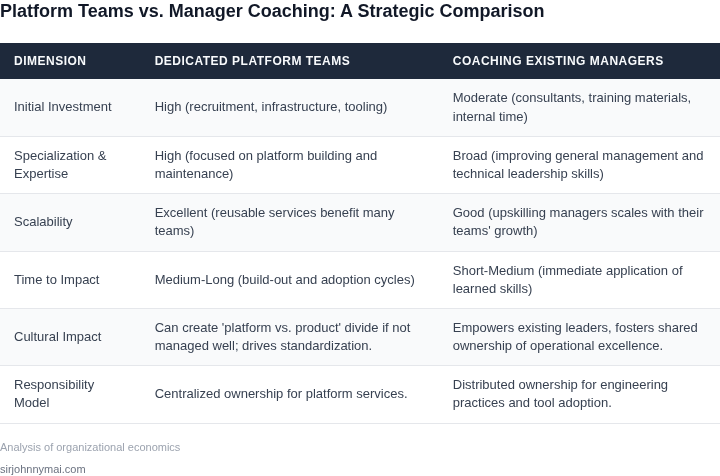
03. Worked Example: Cost Comparison for a $10M Engineering Org
Let's consider a hypothetical mid-sized engineering organization operating with a $10 million annual budget dedicated to engineering salaries and core infrastructure. Based on average fully-loaded costs for senior engineers (including benefits, overhead, and tooling allocation) at around $300,000 per engineer, this budget supports approximately 33 engineers across 3-4 teams.
The $10M covers the salaries of these 33 engineers, their direct managers, and essential baseline tooling like version control (GitHub Enterprise), basic CI/CD runners, and initial cloud spend on AWS or Azure. Our analysis will focus on the incremental investment required for either a dedicated platform team or a comprehensive coaching program, evaluating the direct financial outlay beyond this baseline.
Alternative A: Building a Dedicated Platform Team
To establish a foundational platform, I would propose a lean team of three: one Staff Software Engineer, specializing in distributed systems and infrastructure architecture, and two Senior Software Engineers focused on implementation and operational excellence. This composition provides the necessary strategic leadership and hands-on execution power to build shared services.
- Staff Software Engineer: $400,000 (fully loaded annual salary)
- Senior Software Engineer (x2): $350,000 each = $700,000 (fully loaded annual salaries)
- Platform Tooling & Infrastructure Investment: The platform team will likely introduce or consolidate enterprise-grade tools like a centralized observability stack (e.g., enhanced Datadog plan, Splunk Cloud), advanced Kubernetes orchestration, or a bespoke internal developer platform. I estimate an additional $200,000 per year for licenses, managed services, and compute for these shared platform components.
The strategic intent here is to centralize crucial capabilities, reducing redundant work across product teams and enhancing overall operational robustness. This includes creating self-service APIs for infrastructure provisioning, standardizing deployment pipelines using tools like Spinnaker, or managing a service mesh with Istio.
Total Annual Cost for Dedicated Platform Team: $400,000 + $700,000 + $200,000 = $1,300,000
Alternative B: Coaching Existing Managers
Opting for a coaching approach means investing in leadership development for the existing 3-4 engineering managers. This program would focus on equipping them with the knowledge and skills to drive platform-thinking within their own teams, optimize tooling, manage technical debt, and foster cross-team collaboration for shared concerns.
- External Executive Coaching Program: For four managers, a robust 12-month program involving individual sessions, workshops on platform best practices, and access to learning resources. I would budget approximately $25,000 per manager annually. This covers specialized guidance on topics like identifying infrastructure inefficiencies, advocating for shared standards, and facilitating team-level adoption of best practices.
- Incremental Tooling & Infrastructure Investment: Under this model, there is no direct additional investment in new centralized platform tooling, as the primary focus is on empowering existing teams to make better decisions with their current resources. While managers might identify opportunities for optimizing existing cloud spend on AWS or consolidating licenses, there isn't a new, large-scale platform budget component. The existing baseline tooling cost continues.
This approach relies on distributed ownership and incremental improvements rather than a centralized build-out. Managers learn to leverage existing solutions like AWS CloudFormation or Terraform templates more effectively and promote internal knowledge sharing on topics like incident response (using PagerDuty) or performance monitoring.
Total Annual Cost for Coaching Existing Managers: $25,000 × 4 managers = $100,000
Cost Comparison Summary
| Cost Factor | Dedicated Platform Team | Coaching Existing Managers |
|---|---|---|
| Salaries (Platform Engineers) | $1,100,000 | — |
| Coaching Program Fees | — | $100,000 |
| Incremental Platform Tooling/Infra | $200,000 | — |
| Total Annual Incremental Cost | $1,300,000 | $100,000 |
The upfront financial investment differs by an order of magnitude, clearly illustrating the resource commitment each alternative demands. A dedicated platform team represents a substantial capital expenditure, effectively an 13% increase on our existing $10M engineering budget for direct platform-related costs alone. Conversely, a comprehensive coaching program is a far leaner investment, representing just 1% of the engineering budget.
This cost differential highlights a critical tradeoff: immediate, concentrated effort versus diffused, gradual improvement. The next step is to evaluate the return on investment (ROI) over time, considering factors like developer productivity gains, operational stability, and time-to-market acceleration, which are often harder to quantify but ultimately determine the value of each approach. The initial higher spend for a platform team often targets faster, more uniform adoption of best practices and a quicker path to achieving economies of scale in infrastructure, which is a key driver for that investment.
04. Decision Framework: When to Build vs. Coach
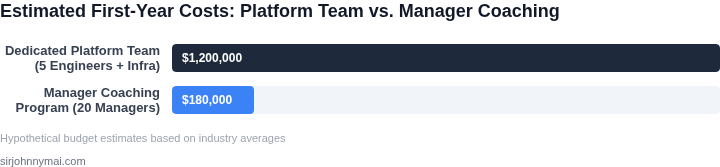
After analyzing the cost factors and reviewing the $10M engineering organization example, it's clear there's no single "best" approach for platform strategy. The optimal path depends heavily on an organization's specific context, strategic priorities, and current capabilities. I've developed a decision framework to help engineering leaders systematically evaluate their options, moving beyond reactive decisions to a more strategic choice. This framework considers three primary approaches to delivering platform capabilities. We evaluate a Dedicated Platform Team, leveraging Coached Existing Managers to embed platform ownership within feature teams, and leveraging a highly managed external service like AWS App Runner as a strategic alternative to reduce internal build/coach needs for specific use cases. The latter option, while not always a direct substitute for a full platform, represents a valid consideration for rapid deployment and reduced operational burden. The table below outlines key criteria, providing insights into when each approach excels and where its limitations lie. Use this to guide your discussions and align on the most suitable strategy for your engineering organization's growth phase and technical roadmap.| Evaluation Criteria | Dedicated Platform Team | Coached Existing Managers | AWS App Runner |
|---|---|---|---|
| Organizational Scale & Complexity | Ideal for large, complex organizations with many teams, requiring consistent infrastructure patterns and shared services like Kubernetes or internal data platforms. Centralizes expertise to manage enterprise-grade challenges. | Best for smaller to medium-sized organizations or during early growth phases where teams are fewer and platform needs are less divergent. Distributes knowledge effectively across a manageable number of managers. | Excellent for specific, well-defined applications or microservices needing rapid deployment, scaling, and minimal operational overhead. Suitable for organizations adopting serverless-first strategies or microservices architectures without heavy customization needs. |
| Customization & Control Needs | Offers maximum control and customization for bespoke platform features, proprietary tooling, or deep integration with specific security and compliance requirements. Allows for specialized optimizations not available off-the-shelf. | Provides moderate flexibility; teams can customize within established guardrails or open-source toolsets like Prometheus for monitoring. Customization is often ad-hoc and distributed, potentially leading to fragmentation without strong governance. | Limited customization; highly opinionated platform designed for common web application and API patterns. Control is abstracted away, trading deep configuration for ease of use and reduced management burden. Best for standard containerized applications. |
| Speed to Value / Time-to-Market | Initial setup is slower due to team hiring and platform build-out (as discussed in Section 03), but accelerates feature team delivery significantly long-term by providing robust, self-service infrastructure. | Quicker initial ramp-up as it leverages existing personnel, but platform maturity evolves slower due to distributed effort. Feature teams might experience slower delivery due to balancing platform ownership with product responsibilities. | Extremely fast time-to-market for supported workloads; applications can be deployed within minutes from source code or container images. Focuses solely on application deployment and scaling, abstracting infrastructure concerns entirely. |
| Operational Overhead & Maintenance | High initial and ongoing operational overhead due to managing complex systems like cloud infrastructure (AWS, Azure) and tools like Datadog for observability. Requires dedicated SRE/operations talent. | Distributed overhead across feature teams, which can dilute focus from product development. Requires significant investment in training and tooling for managers to effectively guide their teams on operational best practices. | Minimal operational overhead for the organization; AWS manages infrastructure, patching, and scaling. Reduces the need for dedicated operations teams for specific workloads, shifting maintenance responsibility to the cloud provider. |
| Talent & Skill Availability | Requires highly specialized platform engineers, SREs, and architects, which are often expensive and difficult to hire. This can be a significant bottleneck if talent markets are tight. | Leverages existing management talent, but requires a strong investment in upskilling managers in platform principles, observability, and infrastructure-as-code (e.g., Terraform). Managerial bandwidth is a concern. | Reduces demand for specialized infrastructure talent, as much of the operational complexity is managed. Developers can deploy directly without deep infrastructure knowledge, though understanding App Runner's capabilities is key. |
| Recommendation | For organizations with critical need for deep customization, high scale, and a long-term strategic investment in differentiating platform capabilities. Requires significant budget and patience. | For smaller organizations, those testing new initiatives, or where budget constraints limit dedicated team formation. Prioritizes distributed ownership and internal skill growth, but requires robust training programs and governance. | For specific application types (web, API) prioritizing rapid deployment, cost efficiency, and minimal operational overhead. Excellent for new projects, internal tools, or certain microservices where a managed, opinionated service suffices. |
05. Action Step: Assess Your Org’s Readiness
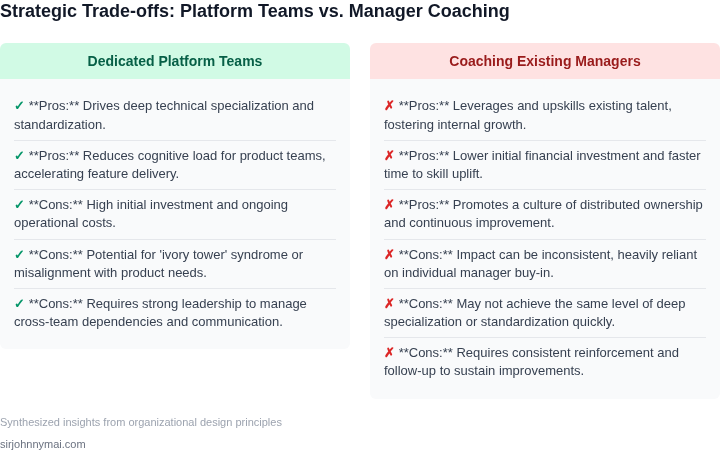
Having explored the economic drivers, cost factors, and decision framework in previous sections, the critical next step is assessing your organization's specific readiness. Building a dedicated platform team is a strategic investment that requires careful evaluation beyond just financial modeling. This checklist provides a practical lens to gauge your current state against the established benefits.
I’ve structured this assessment to focus on key areas that directly influence a platform team's potential impact and success. Each point identifies an opportunity or a prerequisite for moving forward effectively:
-
Operational Burden on Feature Teams
Quantify the percentage of feature team effort dedicated to undifferentiated operational tasks, such as managing cloud infrastructure or configuring observability tools like Datadog. High percentages indicate a significant opportunity cost, directly impacting our feature delivery velocity as detailed in Section 02.
-
Technical Debt & Architectural Inconsistency
Evaluate the prevalence of 'snowflake' deployments and divergent architectural patterns across our service portfolio. Inconsistent approaches complicate security audits, increase cognitive load, and contradict the standardization benefits outlined in Section 04.
-
Tooling Fragmentation & Redundancy
Audit our engineering toolchain for redundant capabilities. If multiple teams are independently implementing similar solutions, like custom deployment scripts or separate alert routing systems, we incur unnecessary complexity and potential licensing inefficiencies.
-
Developer Experience (DX) & Productivity Friction
Gather both qualitative feedback and quantitative metrics on our developer experience, including onboarding time, deployment frequency, and MTTR. Persistent pain points or declining metrics suggest underlying platform inefficiencies, impacting ROI as discussed in Section 03.
-
Security & Compliance Overhead
Assess the manual effort required by individual feature teams to meet evolving security benchmarks and compliance mandates. If teams are repeatedly implementing similar security controls or performing manual compliance checks, a centralized platform can embed these as automated guardrails.
-
Executive Sponsorship & Budget Commitment
Confirm a clear executive sponsor and a committed multi-year budget. A platform initiative is a substantial, strategic investment. Without sustained leadership backing and resource allocation, even the most promising team will struggle to achieve long-term impact.
-
Platform Engineering Talent Availability
Evaluate our current capacity and market competitiveness for attracting and retaining specialized platform engineering talent. This includes SREs, infrastructure engineers proficient in AWS or Azure, and developer experience specialists. Our ability to staff a high-performing team is paramount.
To initiate this assessment, pull the last six months of engineering time tracking data from tools like Jira or Azure DevOps. Quantify the percentage of engineer-hours dedicated to non-feature work, specifically categorizing tasks related to infrastructure setup, tooling maintenance, or operational troubleshooting. Schedule a subsequent 30-minute review with your senior engineering managers to discuss these quantitative findings and gather their qualitative observations on developer friction.
Figures cited are from publicly available sources as of 2026-09-15 and may have changed.