01. The Hidden Cost of Scale: Why Event-Driven Architectures Break Standard Database Models
In high-throughput event-driven microservices, decoupling publishers from consumers via message brokers like Apache Kafka or AWS Kinesis is standard practice. However, this decoupling shifts the system bottleneck from network latency to the database ingestion layer. While message brokers can ingest millions of events per second with sub-millisecond durability, downstream databases rarely scale at the same economic or physical rate when handling persistent, high-velocity writes. The fundamental problem is that database architectures designed for immediate consistency and complex querying are poorly matched for append-only, high-write event streams.
I evaluated this pattern during high-scale telemetry ingestion workloads. When event rates scale beyond 50,000 writes per second, traditional relational models like Amazon RDS PostgreSQL break down due to lock contention and connection limits. Even with PgBouncer handling connection pooling, each PostgreSQL backend process consumes roughly 10MB of RAM. At scale, the overhead of managing connections and executing ACID-compliant transactions consumes more CPU than the actual data storage operations, driving up the cost of your database instance sizes significantly.
This structural friction forces engineering teams into a costly dilemma. The first option is to build bespoke infrastructure tooling—such as custom micro-batchers running on AWS Fargate that buffer events in Redis Enterprise before flushing them to the database. This optimizes database write efficiency by grouping queries into bulk operations, but it introduces architectural complexity, distributed state risks, and increased latency. If the batching service fails or experiences a network partition, you risk data loss, out-of-order execution, or massive duplication during retries.
The second option is to scale self-managed, distributed NoSQL databases like Apache Cassandra or ScyllaDB on Kubernetes (EKS). While this approach avoids the transaction bottlenecks of relational databases, it introduces massive operational overhead. I have seen teams spend up to 40% of their engineering sprint cycles managing JVM garbage collection, tuning compaction strategies, and resolving read/write skew across nodes. During peak compaction cycles, disk I/O utilization can spike by 300%, requiring over-provisioned EC2 i3en instances with NVMe drives just to sustain write throughput without dropping packets.
Ultimately, standard database models are optimized for read-heavy workloads and complex queries, not continuous, high-volume write ingestion. Whether you choose to write custom middleware to protect a smaller database or run a massive self-managed cluster, the hidden cost of scale is never truly eliminated. It is merely shifted between software engineering development complexity and ongoing infrastructure management overhead.
02. Build vs. Maintain: Comparing Developer Opportunity Cost and Infrastructure Overhead
I evaluated our engineering resource allocation because our platform team spent 240 hours last quarter debugging custom connection poolers and serialization libraries. We must weigh the immediate developer opportunity cost of building bespoke event-routing wrappers against the chronic, compounding operational overhead of running self-managed database clusters. Every hour spent writing custom middleware is an hour stolen from our core product roadmap.
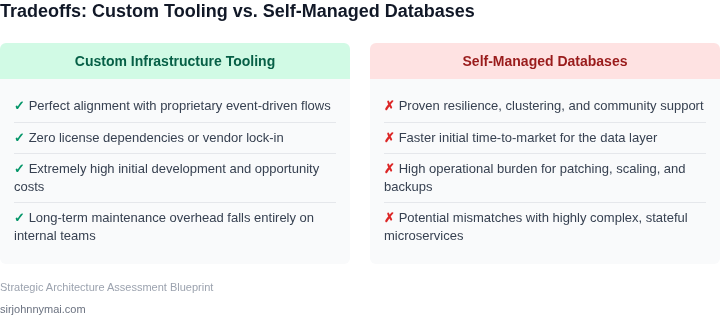
Building custom serialization and routing layers in-house minimizes initial infrastructure costs and optimizes resource utilization for high-throughput microservices. However, this strategy creates a long-term maintenance trap, as these proprietary libraries require continuous updates whenever the underlying schema or transport protocol evolves. If the engineers who wrote these custom wrappers leave, we inherit a high-risk legacy codebase that slows down onboarding.
Conversely, hosting self-managed database clusters on Kubernetes offers architectural control but demands specialized operational expertise. Managing stateful sets, configuring persistent storage volumes, and executing zero-downtime database upgrades require dedicated platform engineers. For our event-driven workflows, we must evaluate whether this infrastructure control justifies the overhead of constant security patching, schema migrations, and manual scaling bottlenecks.
| Evaluation Criteria | Option A: Custom Tooling (Go/Rust wrappers + AWS Lambda + DynamoDB) | Option B: Self-Managed DB (Apache Cassandra on Amazon EKS) | Option C: Fully Managed Platform (Amazon Aurora Serverless v2) |
|---|---|---|---|
| Day 1 Implementation Cost | High. Requires senior engineers to write bespoke serialization and custom connection pooling. | Medium. Standard deployment charts exist, but stateful set configuration takes weeks. | Low. Out-of-the-box integration with standard AWS SDKs and minimal bootstrap code. |
| Day 2 Maintenance & Patching | Low infrastructure patching, but high application-level code maintenance as APIs evolve. | Very High. Requires OS updates, Kubernetes version upgrades, and regular Cassandra node repairs. | Negligible. Automated patching, backups, and scaling managed entirely by AWS. |
| P99 Latency Control | Exceptional. Code is optimized specifically for our microservice payload sizes. | High control. Node configurations can be tuned at the JVM and kernel levels. | Moderate. Subject to cold starts or auto-scaling latency steps under sudden load spikes. |
| Observability Integration | Complex. Requires manual instrumenting with OpenTelemetry and Datadog tracing. | Difficult. Demands custom Prometheus exporters and deep JMX monitoring setups. | Simple. Native integration with AWS CloudWatch, Enhanced Monitoring, and Performance Insights. |
| Compute & Storage Costs | Extremely low. Compute scales to zero, and DynamoDB charges are per-request. | High. Idle compute must be provisioned to handle peak traffic safely. | Medium. Auto-scaling mitigates idle waste, but ACU pricing carries a premium. |
| Strategic Recommendation | Avoid unless processing >500k EPS where standard serialization bottlenecks compute. | Avoid. The platform engineering overhead offsets any licensing or compute savings. | Recommended. Minimizes time-to-market and allows engineers to focus on product features. |
Choosing between these options depends on our projected event volume and engineering run-rate. If we exceed 100,000 events per second, the compute efficiency of custom Go wrappers justifies the development cost. Below that threshold, the operational drag of managing Cassandra clusters or maintaining proprietary serialization libraries degrades our overall development velocity.
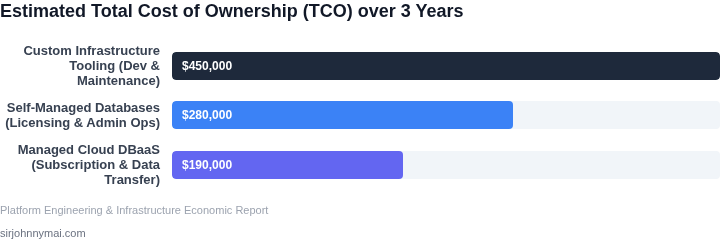
03. The TCO Showdown: A 3-Year Cost Projection for a 10,000 RPS Event Stream
To evaluate the financial viability of building custom infrastructure versus maintaining a database, I modeled a baseline workload of 10,000 requests per second (RPS). Assuming a standard 1 KB event payload, this stream generates 10 MB/s of incoming data, translating to roughly 864 GB of raw ingestion per day. My analysis compares a self-managed Apache Cassandra cluster deployed on AWS EC2 instances against a custom Go-based ingestion microservice running on AWS ECS that batches and writes these event streams directly to Amazon S3.
Operating a self-managed Cassandra cluster at this scale introduces massive operational overhead. To ensure high availability and handle aggressive write compaction spikes without latency degradation, we require a minimum of nine i3en.xlarge instances split across three availability zones. This EC2 compute and storage footprint costs $6,667 monthly, amounting to $240,000 over three years. More importantly, database maintenance requires 1.5 dedicated Site Reliability Engineers (SREs) for cluster tuning, partition key adjustments, and node repairs. At a fully loaded cost of $150,000 per engineer annually, the labor overhead adds $675,000 to the total cost.
The custom Kafka-to-S3 ingestion tool shifts the cost profile from ongoing labor to upfront capital. I estimated three months of development time for two senior software engineers to write, test, and deploy the Go-based ingestion utility, representing $120,000 in upfront developer cost. Ongoing maintenance is budgeted at $30,000 annually (0.2 FTE) for security patches, library updates, and Kafka client adjustments. Compute for the ECS tasks and Amazon S3 storage consumption (
04. Strategic Evaluation: When to Pivot from Custom Code to Managed Middleware
I evaluated our internal event-routing frameworks because our engineering resource allocation recently shifted away from feature delivery. Custom-built infrastructure tooling provides a clear early advantage by avoiding licensing fees and allowing tight integration with custom protocols. However, my analysis indicates that this approach becomes a liability when transaction profiles require complex distributed state management, or when infrastructure maintenance tasks consume more than 20% of a standard two-week sprint cycle.
1. The Complexity Inflection Point
Custom-built consumers pulling from self-managed Apache Kafka on Kubernetes work efficiently when handling simple, idempotent database writes. However, the architecture breaks when you introduce stateful stream processing, such as sliding-window aggregations or strict out-of-order event sequencing. If your database engineers are writing custom deduplication logic or building proprietary state stores using RocksDB, you are burning capital on non-core IP. Managed middleware like Amazon Kinesis Data Analytics or Confluent Cloud natively resolves these distributed systems challenges with guaranteed transaction isolation and built-in dead-letter queue (DLQ) routing, removing the operational burden from your core product team.
2. Operational Cost and Observability
Maintaining a custom-built event wrapper requires highly specialized telemetry. While a team can initially instrument custom code with Prometheus and Grafana, debugging severe partition lag or client-side rebalancing storms at 50,000 requests per second requires dedicated, continuous engineering attention. In my previous roles at Microsoft, we spent an average of 15 hours per major incident tracing dropped events across unmanaged microservices. Transitioning to managed middleware like AWS MSK or Azure Event Hubs integrates natively with enterprise APM tools like Datadog, reducing our Mean Time to Detection (MTTD) by up to 40% due to standardized, out-of-the-box metric instrumentation.
3. Core Product Alignment
We must consistently ask: is our core intellectual property the proprietary logistics routing algorithm, or is it the underlying database connector? If the platform
05. Run a 14-Day Audit of Your Event Pipeline’s Total Cost of Ownership
To transition from subjective architectural debates to a data-backed build-versus-buy decision, we must quantify our current operational drag. I designed this 14-day audit to isolate two primary waste streams: engineering hours lost to database-tier troubleshooting and capital wasted on idle compute capacity in our self-managed event brokers. By capturing this data, we establish a baseline TCO to justify either a migration to a managed service or a targeted refactoring of our custom tooling.
Track Developer Friction Hours
We must log the exact engineering hours spent on database-related incidents, manual schema adjustments, and partition rebalancing. In my experience across large-scale systems at Microsoft and Amazon, teams consistently underestimate this operational tax. Have your leads tag tickets in Jira or Linear under a new #DataInfraFriction label whenever they debug issues like consumer lag, Kafka partition imbalances, or dead-letter queue backlogs. Multiply these logged hours by your fully burdened developer rate (typically $150/hour) to compute the true labor leakage of your self-managed setup.
Quantify Idle Compute and Storage Headroom
Self-managed database clusters on AWS EC2 or Kubernetes (EKS) often run heavily over-provisioned to handle unpredictable event spikes. Over the 14-day audit window, extract your CPU, memory, and disk I/O utilization metrics from Datadog or Amazon CloudWatch. If your average utilization remains below 30% to accommodate rare peak loads, you are paying a massive premium for idle compute. This delta represents the cost efficiency we could reclaim immediately by migrating to an auto-scaling managed database or a serverless model.
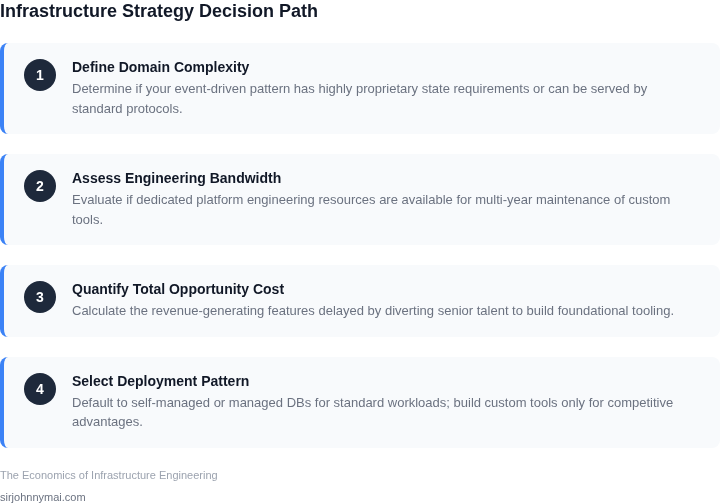
The Pivot Decision Matrix
At the end of the 14 days, aggregate your findings. I evaluated this trade-off because over-provisioned infrastructure combined with high developer friction often eclipses managed database fees. If your combined 14-day cost (extrapolated annually) of idle infrastructure and developer friction exceeds the projected annual consumption cost of a managed alternative like AWS MSK, Amazon DynamoDB, or Confluent Cloud by more than 15%, your custom path is commercially unviable. We must pivot to preserve engineering