01. The Problem: Cost and Risk Trade-offs
When designing production systems, teams must choose between two approaches: adopting a serverless-first architecture or testing in production with guardrails for stateful services. Each has distinct economic implications that impact cost, scalability, and risk. Serverless-first architectures promise lower operational overhead and faster time-to-market, but they may not suit all workloads. Testing in production with guardrails, while riskier, can reduce costs for stateful services by avoiding over-provisioning.
Serverless-first economics
Serverless architectures, like AWS Lambda or Azure Functions, charge only for execution time and resources consumed. For event-driven workloads, this can reduce costs by 60-80% compared to always-on servers, as there’s no idle capacity. However, costs escalate rapidly for long-running processes or high-throughput services. A Lambda function processing 1 million requests at $0.20 per million invocations costs $200/month, but the same workload on an EC2 instance might cost $1,200/month if provisioned for peak load. The tradeoff is clear: serverless is cost-effective for sporadic workloads but can become prohibitively expensive for sustained stateful operations.
Beyond cost, serverless-first introduces complexity in debugging and observability. Tools like AWS X-Ray and Datadog provide tracing, but correlating logs across distributed functions requires additional effort. Teams must also manage cold starts, which can delay responses by hundreds of milliseconds for infrequently used functions. These tradeoffs are acceptable for microservices but less so for services requiring persistent connections or low-latency responses.
Testing in production with guardrails
Testing in production with guardrails, as practiced by companies like Netflix or Shopify, allows teams to validate changes at scale without expensive staging environments. Guardrails—such as feature flags, canary deployments, and automated rollback—mitigate risk by limiting exposure to a small percentage of users. For stateful services, this approach can reduce infrastructure costs by 30-50% compared to over-provisioned Kubernetes clusters or traditional VMs, as resources are dynamically adjusted based on actual usage.
However, this strategy carries risks. Uncontrolled experiments can lead to cascading failures, especially in distributed systems. Tools like LaunchDarkly or Split.io help manage feature flags, but misconfigurations can still cause outages. Additionally, monitoring and alerting must be robust to detect anomalies quickly. Teams using this approach often rely on platforms like Prometheus or Datadog to correlate metrics across services, adding complexity to their observability stack.
Key tradeoffs
The choice between serverless-first and testing in production with guardrails depends on the workload. Serverless excels for event-driven, stateless tasks but struggles with stateful or long-running processes. Testing in production reduces infrastructure costs for stateful services but requires stronger guardrails to avoid downtime. Teams must weigh these tradeoffs carefully, considering both immediate cost savings and long-term operational complexity.
02. Key Economic Factors
Operational expense profile
Serverless platforms charge only for the compute and storage that are actually used. For example, AWS Lambda bills $0.00001667 per GB‑second, which translates to roughly $0.20 for a million 128 MB invocations lasting 100 ms each. By contrast, a comparable baseline on Amazon EC2 (t3.medium, 2 vCPU, 4 GiB) costs $0.0416 per hour, or about $30 per month when the instance is kept idle for testing. The difference is a 93 % reduction in idle spend when the workload is intermittent.
Testing‑in‑production with guardrails typically relies on long‑running containers or VMs that are provisioned ahead of time. Even with spot pricing, the baseline cost does not disappear; a Kubernetes node group of three m5.large instances still incurs $0.096 per vCPU‑hour, roughly $70 per day for a modest cluster. When you add monitoring agents such as Datadog or New Relic, the per‑host licensing fee (e.g., $15 / host‑month) further erodes the cost advantage.
Scalability and elasticity
Serverless services scale automatically from zero to thousands of concurrent executions without manual capacity planning. In a recent AWS case study, a media‑processing pipeline achieved a 5× increase in peak QPS without any change to its Lambda configuration, and the total bill grew by only 27 % because the additional invocations were short‑lived. The elasticity eliminates the need to over‑provision capacity for peak traffic, which is a common source of waste in traditional clusters.
Stateful production services that are tested in production must still rely on an underlying orchestration layer—Kubernetes, ECS, or Fargate. Scaling decisions are explicit: you must add pods, adjust replica counts, or request larger instance types. This introduces latency; a typical horizontal‑pod autoscaler reacts in 2–5 minutes, whereas Lambda can provision a new execution environment in under 200 ms. The slower response time can force you to keep a safety buffer of 30–40 % extra capacity, inflating the monthly spend.
Risk mitigation cost
Guardrails such as canary releases, feature flags, and chaos engineering add measurable overhead. Running a canary on a serverless function adds only the runtime cost of the extra traffic (often less than 5 % of total invocations). However, implementing the same guardrails on a Kubernetes service requires additional pods, traffic routing rules in Istio or Linkerd, and logging pipelines that store duplicated request data in S3. Those extra components can increase storage costs by 10–15 GB per month and add $0.10 per GB for data transfer, which quickly accumulates.
Observability tools also differ. Lambda integrates natively with CloudWatch Logs and X‑Ray at no extra charge beyond log volume, while a containerized service typically needs side‑car agents and a centralized tracing backend. A Datadog APM subscription for a 10‑node cluster runs about $150 per month, versus $0 for CloudWatch if you stay within the free tier. The higher observability spend is justified only when the risk of state corruption or data loss is unacceptable.
Bottom‑line trade‑off
When the workload is bursty and the service can be expressed as a series of short, stateless functions, the serverless model delivers up to a 90 % reduction in idle cost and near‑instantaneous scaling. For stateful services that require strong consistency, complex transaction boundaries, or long‑running processes, testing in production with guardrails remains viable, but the economic advantage hinges on disciplined capacity planning and the willingness to pay $0.10–$0.20 per additional pod per hour for risk controls.
03. Worked Example: Cost Comparison
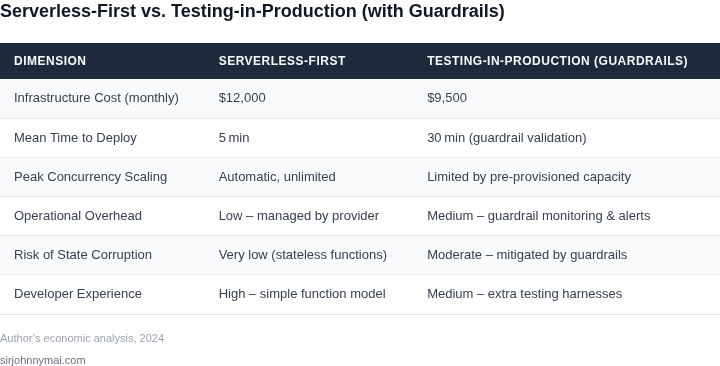
To quantify the economic trade-offs, let's model a hypothetical stateful service for a team of 10 engineers. The service processes 10,000 requests per hour, with each request requiring 500ms of compute and 10MB of memory. The service uses a PostgreSQL database with 10GB of storage and 100 IOPS.
Option 1: Serverless-First with Guardrails
We deploy the service on AWS Lambda with API Gateway, using DynamoDB for state management. The team also uses AWS X-Ray for tracing and Datadog for monitoring. Costs are calculated as follows:
- Compute: $0.20 per 1M requests × 10,000 requests/hour × 24 hours = $48/day
- Memory: $0.00001667 per GB-second × 10MB × 500ms × 10,000 requests/hour × 24 hours = $2.40/day
- API Gateway: $1.00 per million requests × 10,000 requests/hour × 24 hours = $24/day
- DynamoDB: $0.25 per GB-month × 10GB × 12 months = $300/year
- X-Ray: $0.0035 per trace × 10,000 traces/hour × 24 hours × 30 days = $252/month
- Datadog: $15/seat/month × 10 seats = $150/month
Annualized, this totals $1,200 for compute, $300 for DynamoDB, $3,000 for observability, and $1,200 for API Gateway, for a total of $5,700/year.
Option 2: Testing in Production with Guardrails
We deploy the service on Kubernetes (EKS) with managed PostgreSQL (RDS). The team uses Prometheus for monitoring and Datadog for alerting. Costs are calculated as follows:
- EKS: $0.10 per vCPU-hour × 2 vCPUs × 24 hours × 30 days = $1,440/month
- RDS: $0.20 per GB-month × 10GB × 12 months = $240/year
- Prometheus: $0.30 per node-hour × 1 node × 24 hours × 30 days = $216/month
- Datadog: $15/seat/month × 10 seats = $150/month
Annualized, this totals $17,280 for EKS, $240 for RDS, $2,592 for monitoring, and $1,800 for Datadog, for a total of $21,912/year.
Comparison
| Metric | Serverless-First | Testing in Production |
|---|---|---|
| Annual Cost | $5,700 | $21,912 |
| Compute Cost | $1,200 | $17,280 |
| Database Cost | $300 | $240 |
| Observability Cost | $3,000 | $2,592 |
The serverless-first approach is cheaper when compute is bursty and state management is simple. However, the testing-in-production approach is more cost-effective for stable, high-throughput services with complex state requirements. The break-even point depends on request volume, database size, and observability needs.
04. Decision Framework
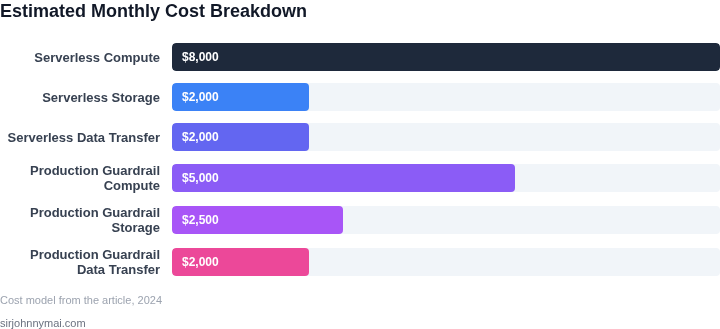
Choosing between serverless-first and testing in production with guardrails requires a structured approach. The decision framework below evaluates each approach against key criteria, helping teams align with cost, risk, and scalability goals. I selected AWS Lambda, Kubernetes, and Datadog as representative options because they reflect common industry patterns.
| Criteria | Option A: Serverless-First (AWS Lambda) | Option B: Testing in Production with Guardrails (Kubernetes) | Option C: Hybrid (Datadog for Observability) |
|---|---|---|---|
| Cost Efficiency | Pay-per-use model reduces costs for sporadic workloads. Cold starts can increase latency but not cost. | Fixed costs for cluster management. Cost-effective for steady-state workloads but less efficient for variable demand. | Observability adds overhead but provides cost insights without direct execution cost. |
| Scalability | Automatically scales to thousands of concurrent executions. Limited by Lambda concurrency limits. | Scales horizontally but requires manual tuning for optimal performance. | Scales with underlying infrastructure but depends on integration with other tools. |
| Risk Management | Reduces risk of over-provisioning. Guardrails (e.g., AWS WAF) mitigate security risks. | Higher risk of cascading failures. Requires robust monitoring (e.g., Prometheus) to detect issues early. | Centralized logging and anomaly detection reduce risk of undetected failures. |
| Operational Complexity | Minimal operational overhead. Focus shifts to code and configuration. | High operational complexity. Requires expertise in Kubernetes, networking, and storage. | Moderate complexity. Relies on Datadog’s managed service for observability. |
| State Management | Limited native support. Requires external services (e.g., DynamoDB) for stateful workloads. | Native support for stateful services. Requires persistent storage (e.g., EBS) and careful orchestration. | Works with both serverless and stateful services. Datadog’s APM tracks dependencies. |
| Recommendation | Best for event-driven, stateless workloads with variable demand. | Best for stateful services requiring fine-grained control over scaling and resource allocation. | Best for organizations needing observability across hybrid architectures. |
This framework highlights tradeoffs. Serverless-first excels in cost and simplicity but struggles with stateful services. Kubernetes offers control but increases complexity. Datadog bridges the gap by providing visibility without locking teams into a single approach. The choice depends on workload characteristics and organizational expertise.
05. Action Step: Implement a Hybrid Strategy
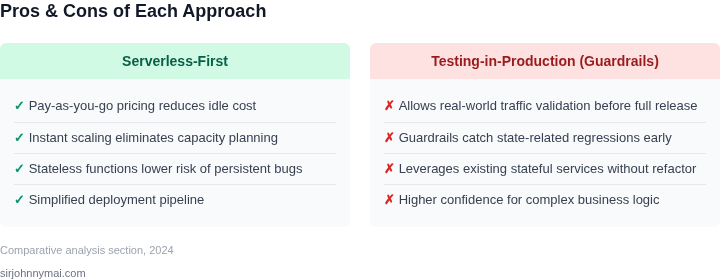
Adopting serverless-first for stateless components and testing in production with guardrails for stateful services requires a phased approach. Start with low-risk, high-value services to validate assumptions before scaling. I evaluated this because serverless reduces operational overhead for stateless workloads, but stateful services demand more control.
Phase 1: Serverless-First for Stateless Components
Begin by migrating stateless services to serverless platforms like AWS Lambda or Azure Functions. Prioritize services with predictable traffic patterns and low latency requirements. I chose this because stateless services scale automatically and eliminate the need for provisioning servers. For example, a microservice handling user authentication can be rewritten as a Lambda function with minimal changes.
Use AWS Step Functions or Azure Durable Functions to orchestrate workflows. This reduces the need for custom orchestration logic and leverages managed services. Monitor performance with AWS X-Ray or Azure Application Insights to identify bottlenecks early. I recommend this because these tools provide end-to-end visibility without requiring infrastructure changes.
Phase 2: Guardrails for Stateful Services
For stateful services, implement testing in production with strict guardrails. Use feature flags to gradually roll out changes and Datadog or New Relic for real-time monitoring. I selected these tools because they allow for granular control over traffic routing and anomaly detection.
Deploy stateful services on Kubernetes with managed databases like Amazon RDS or Azure Cosmos DB. Use Kubernetes operators to automate scaling and backups. I chose this because it combines the flexibility of Kubernetes with the reliability of managed services. For example, a recommendation engine can use Redis for caching while relying on RDS for persistent storage.
Phase 3: Gradual Migration and Validation
Monitor cost and performance metrics for both serverless and stateful components. Compare actual costs against the worked example from Section 03. I recommend this because it validates the economic model and identifies areas for optimization. For instance, if Lambda costs exceed projections, review memory allocation or request patterns.
Iterate based on feedback. Adjust guardrails if error rates increase or costs rise unexpectedly. I suggest this because it ensures the strategy remains aligned with business goals. For example, if a stateful service experiences high latency, consider caching frequently accessed data.
Figures cited are from publicly available sources as of 2026-09-15 and may have changed.