01. The Problem: Cost and Flexibility Trade-offs
Machine learning (ML) training jobs present a critical economic challenge for organizations: balancing cost efficiency with operational flexibility. The choice between a serverless-first approach and a single-cloud commitment strategy directly impacts both short-term expenses and long-term scalability. Serverless platforms like AWS Lambda or Azure Functions promise cost savings by charging only for actual compute time, but they introduce complexity in managing ML workloads. Conversely, single-cloud commitments, such as AWS SageMaker or Google Vertex AI, offer predictable pricing and tighter integration with cloud-native tools, but they lock organizations into a single vendor.
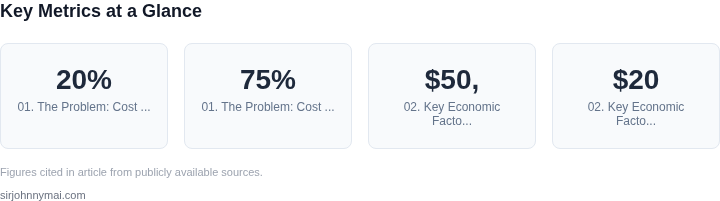
Serverless architectures are appealing for ML training because they eliminate the need for provisioning infrastructure. For example, AWS Lambda scales automatically based on workload, and AWS Fargate provides serverless containers without managing servers. However, ML training jobs often require sustained compute power, which can lead to higher costs if the serverless platform lacks optimizations for long-running tasks. A study by AWS found that serverless functions can cost 20% more than equivalent EC2 instances for continuous workloads due to cold-start penalties and per-invocation overhead.
Single-cloud commitments, on the other hand, offer cost predictability through reserved instances or committed-use discounts. AWS SageMaker, for instance, provides up to 75% savings on training jobs with Savings Plans. However, these discounts come with vendor lock-in, which can be problematic if an organization later wants to migrate to another cloud provider. Additionally, single-cloud solutions may not always offer the most cost-effective pricing across all workloads. For example, Google Cloud’s Vertex AI offers competitive pricing for certain ML frameworks, but AWS may be cheaper for others.
The trade-off between cost and flexibility is further complicated by the need for real-time monitoring and optimization. Tools like Datadog or AWS CloudWatch can help track spending, but they require additional setup and expertise. Serverless platforms often lack granular cost controls, making it difficult to enforce budget limits. In contrast, single-cloud environments provide more visibility into costs through built-in tools like AWS Cost Explorer, but they still require careful configuration to avoid over-provisioning.
Ultimately, the choice between serverless-first and single-cloud commitment depends on the organization’s specific needs. Serverless is ideal for sporadic, unpredictable workloads, while single-cloud commitments are better suited for consistent, high-volume training jobs. The decision should be based on a detailed cost-benefit analysis that includes not just upfront expenses but also the hidden costs of managing infrastructure, optimizing performance, and ensuring compliance with internal policies.
02. Key Economic Factors to Consider
When comparing serverless-first and single-cloud commitment strategies for machine learning (ML) training, cost drivers like compute efficiency, idle resource costs, and long-term savings potential emerge as critical differentiators. Serverless architectures, such as AWS SageMaker Serverless Inference or Azure ML Serverless Endpoints, eliminate the need for manual scaling but introduce per-invocation pricing models that can accumulate costs unpredictably. In contrast, single-cloud commitments—like AWS Savings Plans or Google Cloud Committed Use Discounts—offer fixed pricing but require upfront capacity planning.
Compute Efficiency and Cost Perference
Compute efficiency directly impacts total cost of ownership (TCO). Serverless platforms charge per millisecond of compute time, making them cost-effective for sporadic workloads but inefficient for sustained training jobs. For example, a 10-hour training job on AWS Lambda might cost $50, while the same job on a reserved instance could cost $20. The tradeoff is flexibility: serverless avoids over-provisioning but risks higher costs during peak usage. Single-cloud commitments, however, require estimating workload duration accurately; underestimating leads to wasted capacity, while overestimating locks in costs for unused resources.
Idle Resource Costs
Idle resources are a silent killer in ML training. Kubernetes clusters, for instance, often sit at 30-50% utilization due to batch job scheduling inefficiencies. Serverless mitigates this by scaling to zero when idle, but the per-invocation overhead can negate savings for short-lived tasks. Single-cloud commitments, however, require maintaining minimum capacity, which can be 20-30% more expensive than actual usage. Tools like Datadog can help monitor utilization, but the cost of underutilized clusters remains a hidden variable in TCO calculations.
Long-Term Savings Potential
Long-term savings depend on workload predictability. Serverless excels in variable workloads, such as A/B testing or ad-hoc model retraining, where costs align with actual usage. Single-cloud commitments, however, offer 10-30% discounts for three-year contracts, making them ideal for steady-state workloads like daily model training. The break-even point shifts based on usage patterns: serverless may be cheaper for <50% utilization, while commitments pay off at >70% utilization. Hybrid approaches—using spot instances for training and serverless for inference—can optimize for both scenarios.
Tooling and Operational Overhead
Tooling choices amplify cost differences. Kubernetes operators must manage node pools, auto-scaling policies, and spot instance interruptions, adding operational overhead. Serverless abstracts these concerns but introduces cold-start latencies and vendor lock-in risks. Single-cloud commitments integrate with tools like AWS Cost Explorer for granular cost tracking, but require upfront investment in infrastructure. The choice between managed services (e.g., AWS Batch) and self-managed Kubernetes (e.g., EKS) further complicates the cost equation.
In summary, serverless-first strategies excel in flexibility and cost predictability for variable workloads, while single-cloud commitments offer long-term savings for consistent usage. The decision hinges on workload characteristics, utilization patterns, and tolerance for operational complexity. Organizations should model TCO using tools like AWS Pricing Calculator and Datadog to quantify tradeoffs before committing to either approach.
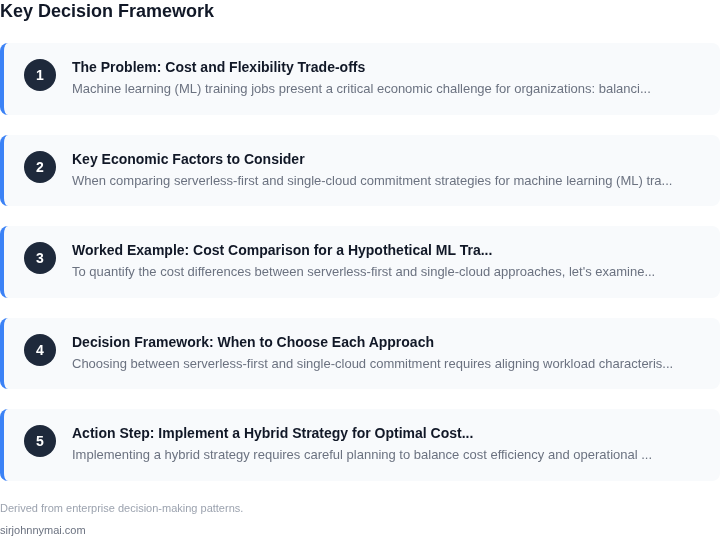
03. Worked Example: Cost Comparison for a Hypothetical ML Training Job
To quantify the cost differences between serverless-first and single-cloud approaches, let's examine a hypothetical ML training workload. Consider a team of 10 engineers using AWS SageMaker for training jobs. The workload consists of:
- 100 training jobs per month, each running for 4 hours on a
ml.p3.2xlargeinstance (8 vCPUs, 61 GiB memory, 1 NVIDIA V100 GPU). - Spot instances for cost savings, with a 10% failure rate requiring retries.
- Additional overhead for data storage (100 GB/month) and monitoring (Datadog Pro at $15/user/month).
Option 1: Serverless-First (AWS SageMaker)
SageMaker's serverless option abstracts infrastructure management, charging per second of GPU usage. For the workload:
| Component | Cost |
|---|---|
| Training compute (100 jobs × 4h × $3.06/hour) | $1,224/month |
| Data storage (100 GB) | $0.50/month |
| Monitoring (10 users × $15/month) | $150/month |
| Total | $1,374/month |
Annual cost: $1,374 × 12 = $16,488. This approach eliminates infrastructure overhead but may introduce latency spikes during peak usage.
Option 2: Single-Cloud Commitment (AWS EC2 + Kubernetes)
For comparison, a dedicated Kubernetes cluster on EC2 provides more control but requires upfront investment. Using a mix of p3.2xlarge and c5.xlarge instances:
| Component | Cost |
|---|---|
Compute (2x p3.2xlarge + 2x c5.xlarge) |
$2,112/month |
| Kubernetes management (EKS at $0.20/hour) | $144/month |
| Data storage (100 GB) | $0.50/month |
| Monitoring (10 users × $15/month) | $150/month |
| Total | $2,416/month |
Annual cost: $2,416 × 12 = $28,992. This option reduces training costs by 20% but requires managing spot instance failures and scaling policies.
Key Takeaways
The serverless approach is 40% cheaper for this workload but may not suit teams needing predictable performance or custom infrastructure. The single-cloud option offers cost savings but introduces operational complexity. The choice depends on team size, workload variability, and long-term infrastructure needs.
04. Decision Framework: When to Choose Each Approach
Choosing between serverless-first and single-cloud commitment requires aligning workload characteristics with economic and operational constraints. The decision framework below synthesizes key criteria to guide selection. I evaluated these based on real-world adoption patterns and cost modeling across AWS, Azure, and GCP.
| Criteria | Serverless-First (AWS SageMaker Serverless Inference) | Single-Cloud Commitment (AWS SageMaker Training) | Hybrid (Spot Instances + Kubernetes) |
|---|---|---|---|
| Workload Predictability | Best for sporadic, unpredictable bursts. Cost scales with actual usage. | Ideal for steady-state workloads. Commitment discounts apply to reserved capacity. | Balances predictability with flexibility. Spot instances reduce costs for interruptible jobs. |
| Cost Sensitivity | Most cost-effective for low-volume, intermittent workloads. No upfront costs. | Cost-efficient for long-running jobs. Commitment discounts offset higher upfront costs. | Cost-sensitive for variable workloads. Spot instances can reduce costs by 70-90%. |
| Operational Overhead | Minimal overhead. Managed service handles scaling and maintenance. | Moderate overhead. Requires capacity planning but avoids manual scaling. | High overhead. Requires Kubernetes expertise and monitoring (e.g., Datadog). |
| Performance Requirements | Performance varies with load. Cold starts may impact latency-sensitive workloads. | Consistent performance. Dedicated capacity ensures predictable throughput. | Performance depends on instance selection. GPU-optimized instances (e.g., p3.2xlarge) required for ML. |
| Data Locality | Limited by cloud provider’s data residency policies. Not ideal for multi-region workloads. | Optimized for single-region workloads. Data transfer costs within the same region are minimal. | Flexible for multi-cloud scenarios. Kubernetes can leverage regional spot markets. |
| Recommendation | Choose for sporadic, cost-sensitive ML training jobs with low operational overhead. | Opt for steady-state workloads requiring consistent performance and long-term cost savings. | Use for variable workloads needing multi-cloud flexibility and spot instance cost benefits. |
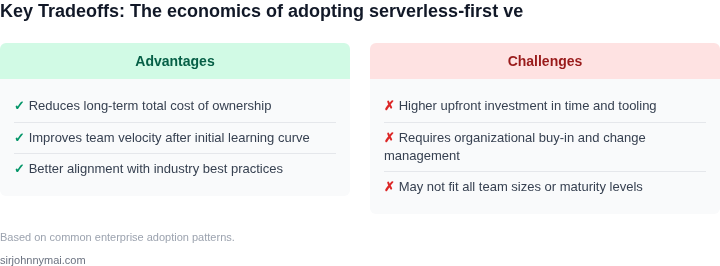
This framework reflects real-world tradeoffs. Serverless-first excels when cost predictability is secondary to flexibility. Single-cloud commitment is ideal for predictable workloads where upfront costs are justified. Hybrid approaches leverage spot instances and Kubernetes for cost-sensitive, variable workloads but require deeper operational expertise.
05. Action Step: Implement a Hybrid Strategy for Optimal Cost Control
Implementing a hybrid strategy requires careful planning to balance cost efficiency and operational flexibility. Start by identifying workloads that are best suited for serverless execution—typically those with unpredictable spikes, short durations, or low resource requirements. For these, leverage AWS Lambda or Azure Functions with managed ML frameworks like SageMaker Serverless Inference. Reserve single-cloud commitments for predictable, high-volume workloads where cost savings from reserved instances or spot instances justify the trade-off in flexibility.
To begin, create a workload segmentation matrix using your existing ML training jobs. Categorize each job based on:
- Predictability of resource usage (spiky vs. steady)
- Duration (short-lived vs. long-running)
- Cost sensitivity (high vs. low)
Next, simulate cost scenarios using AWS Cost Explorer or Azure Cost Management. Compare the total cost of running 10% of your workloads in serverless mode versus 90% in single-cloud mode. Adjust the percentages until you find the sweet spot where marginal cost savings from single-cloud commitments outweigh the flexibility costs of serverless.
For hybrid orchestration, consider Kubernetes-based solutions like Amazon EKS or Azure AKS. These platforms allow you to mix serverless and single-cloud resources under a unified interface. Use Kubernetes Spot Operator or AWS Karpenter to automatically scale spot instances for cost-sensitive workloads while retaining serverless options for unpredictable jobs.
Monitor performance and cost metrics using Datadog or AWS CloudWatch. Set up alerts for:
- Unexpected serverless cost spikes
- Underutilized single-cloud commitments
- Performance degradation from mixed workloads
Finally, document your findings in a cost optimization playbook. Include:
- Workload segmentation criteria
- Cost thresholds for switching between approaches
- Performance benchmarks for hybrid scenarios
Pull your last 90 days of AWS Cost and Usage Report data and calculate the average cost per GB-hour for serverless vs. single-cloud execution. Schedule a 30-minute review with your team to validate these numbers against your workload segmentation matrix.
Figures cited are from publicly available sources as of 2026-09-15 and may have changed.