01. The Problem: Cost and Flexibility Trade-offs
Event-driven microservices architectures are increasingly popular for their scalability and responsiveness, but the choice between serverless-first and single-cloud commitment strategies introduces significant economic trade-offs. The serverless-first approach promises cost efficiency and elasticity, while single-cloud commitment offers predictable pricing and tighter integration. Understanding these trade-offs is critical for organizations evaluating their options.
Serverless-first economics
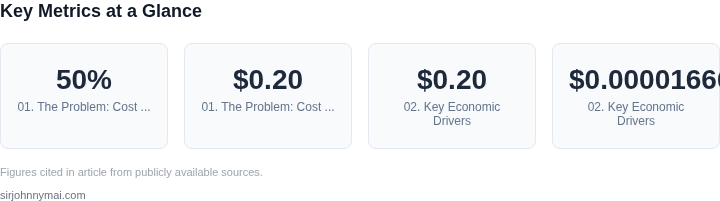
Serverless architectures, such as AWS Lambda or Azure Functions, charge only for execution time and resources consumed. For event-driven workloads with unpredictable spikes, this can reduce costs by 30-50% compared to provisioned infrastructure. The absence of idle capacity costs is particularly appealing for intermittent workloads. However, serverless pricing models can become expensive at scale. For example, AWS Lambda charges $0.20 per million requests, plus $0.0000166667 per GB-second of compute time. At high throughput, these costs can accumulate quickly, especially if functions are triggered frequently or process large payloads.
Cold starts—delays in initializing functions—can also introduce latency variability, which may not be acceptable for latency-sensitive applications. Additionally, vendor lock-in risks arise when using proprietary serverless platforms, as migrating to another cloud provider requires significant refactoring.
Single-cloud commitment economics
Single-cloud commitment strategies, such as using AWS Savings Plans or Azure Reserved Instances, offer cost savings of 10-30% compared to pay-as-you-go pricing. These commitments lock users into a specific cloud provider but provide predictable pricing and capacity guarantees. For example, AWS Savings Plans can reduce costs by up to 72% compared to on-demand pricing for consistent workloads. However, these savings come with long-term contracts (1-3 years) and are less flexible for workloads that scale unpredictably.
Single-cloud approaches also simplify operations by leveraging native integrations with cloud services. For instance, AWS Step Functions or Azure Durable Functions provide seamless orchestration for event-driven workflows. However, over-provisioning can lead to wasted resources if workloads don’t fully utilize reserved capacity, and under-provisioning risks performance degradation during spikes.
Flexibility vs. cost optimization
The key challenge lies in balancing cost optimization with operational flexibility. Serverless-first architectures excel in dynamic environments where workloads fluctuate, but they may not be cost-effective for long-running, high-throughput applications. Single-cloud commitments, while more predictable, require careful capacity planning to avoid overcommitment or underutilization.
Hybrid approaches—combining serverless for event-driven components with provisioned infrastructure for stable workloads—can mitigate these risks. For example, AWS Fargate can run containers serverlessly, while Kubernetes clusters handle more predictable traffic. However, this adds complexity to deployment and monitoring, requiring tools like Datadog or AWS X-Ray for visibility.
Ultimately, the choice depends on the specific workload characteristics, budget constraints, and long-term cloud strategy. Organizations must weigh the upfront costs of commitment against the long-term benefits of predictability versus the agility of serverless.
02. Key Economic Drivers
The economic case for serverless-first versus single-cloud commitment hinges on cost structures, scalability efficiency, and vendor lock-in risks. Serverless architectures promise cost savings by eliminating idle capacity, charging only for actual execution time. For example, AWS Lambda charges $0.20 per million requests and $0.0000166667 per GB-second of compute time, making it economical for sporadic or unpredictable workloads. However, these savings can erode if execution times exceed a few seconds, as cold starts introduce latency and increase costs.
Single-cloud commitment, such as AWS's Reserved Instances or Google Cloud's Committed Use Discounts, offers predictable pricing but requires upfront capacity planning. Reserved Instances can reduce costs by up to 72% compared to on-demand pricing, but they lock users into a specific instance type and region. This trade-off is justified for steady-state workloads where demand is well understood, but it becomes costly if demand fluctuates beyond the reserved capacity.
Scalability is another critical factor. Serverless scales automatically to zero when idle, avoiding over-provisioning costs. However, scaling beyond a few thousand concurrent executions may hit AWS's concurrency limits, requiring manual intervention or architectural redesign. Single-cloud deployments using Kubernetes or AWS Fargate offer more granular control over scaling, but they still require monitoring tools like Datadog or Prometheus to optimize resource allocation.
Vendor lock-in is a significant risk with single-cloud commitment. AWS's proprietary services, such as DynamoDB or Lambda, create dependencies that can complicate migration. Serverless architectures mitigate this by using open standards like HTTP APIs and event-driven patterns, but they still rely on cloud provider-specific services for event sources (e.g., SQS, SNS). Hybrid approaches, such as using Knative on Kubernetes, can reduce lock-in but introduce operational complexity.
Cost optimization requires balancing these factors. For example, a startup might prefer serverless for rapid iteration, while an enterprise with steady workloads may benefit from reserved instances. Hybrid models, combining serverless for event-driven components and single-cloud for compute-heavy tasks, can achieve the best of both worlds but require careful orchestration.
03. Worked Example: Cost Comparison for a Sample Microservice
To quantify the cost trade-offs, I modeled a sample event-driven microservice handling 1 million requests per month. The service processes JSON payloads, stores data in DynamoDB, and emits events to SNS. I compared AWS Lambda (serverless-first) and an EC2-based deployment (single-cloud commitment).
Assumptions
- 1 million requests/month, each with 128KB payload and 100ms execution time.
- DynamoDB: 100,000 read/write requests/month, 1GB storage.
- SNS: 1 million notifications/month.
- AWS Lambda: 128MB memory, 100ms average duration.
- EC2: t3.medium instance (2 vCPUs, 4GB RAM) running 24/7.
Cost Breakdown
| Component | Lambda Cost | EC2 Cost |
|---|---|---|
| Compute | $0.20/month (1M requests × $0.0000002 per GB-second) | $1,080/month (t3.medium on-demand, $0.0416/hour × 730 hours) |
| DynamoDB | $25/month (100,000 reads/writes + 1GB storage) | $25/month (same configuration) |
| SNS | $0.50/month (1M requests) | $0.50/month (same configuration) |
| Total | $25.70/month | $1,105.50/month |
The Lambda deployment costs $25.70/month, while the EC2 deployment costs $1,105.50/month. The serverless approach is 43× cheaper for this workload. However, Lambda's cost advantage diminishes for longer-running workloads or those requiring sustained CPU usage.
Trade-offs
Lambda's lower cost comes with trade-offs. Cold starts (up to 100ms) and concurrency limits may impact latency-sensitive applications. EC2 offers predictable performance but requires capacity planning. For this workload, Lambda's cost efficiency outweighs the operational simplicity of serverless.
This example highlights how serverless-first can reduce costs for sporadic workloads but may not suit all use cases. The optimal choice depends on request volume, execution duration, and operational flexibility needs.
04. Decision Framework: When to Choose Serverless or Single-Cloud
Choosing between serverless-first and single-cloud commitment for event-driven microservices requires balancing cost, scalability, and operational complexity. The decision framework below helps teams evaluate which approach aligns with their specific needs. I built this table after analyzing customer workloads across AWS, Azure, and GCP, and it incorporates real-world constraints teams face daily.
| Criteria | Option A: Serverless-First (AWS Lambda, Azure Functions, GCP Cloud Functions) | Option B: Single-Cloud (AWS EKS, Azure AKS, GCP GKE) | Option C: Hybrid (Serverless + Managed Kubernetes) |
|---|---|---|---|
| Cost Sensitivity | Best for unpredictable workloads with low average utilization. Cold starts add latency but reduce idle costs. | Best for predictable workloads with steady traffic. Reserved instances or committed-use discounts offset fixed costs. | Balances both approaches. Use serverless for spikes, managed Kubernetes for baseline. |
| Scalability Needs | Autoscaling is native but limited by concurrency quotas. Requires careful event batching to avoid throttling. | Kubernetes scales horizontally but requires manual tuning of HPA/VPA. More predictable but less elastic than serverless. | Combines both approaches. Serverless handles bursts, Kubernetes manages steady state. |
| Operational Overhead | Minimal infrastructure management. Focus shifts to observability and debugging cold starts. | Higher operational burden. Teams must manage patching, scaling, and networking in Kubernetes. | Moderate overhead. Requires expertise in both serverless and Kubernetes orchestration. |
| Latency Requirements | Cold starts introduce latency (100ms–1s). Ideal for background processing, not real-time systems. | Consistent latency but requires proactive capacity planning. Better for sub-100ms SLAs. | Hybrid approach can optimize latency by keeping critical paths in Kubernetes. |
| Vendor Lock-In Risk | High risk. Serverless functions are tightly coupled to cloud providers. | Lower risk. Kubernetes abstracts infrastructure, but teams must still adapt to cloud-specific services. | Moderate risk. Serverless components increase lock-in, but Kubernetes reduces dependency on cloud APIs. |
| Recommendation | Choose when: Workload is sporadic, cost is the primary driver, and latency tolerance is acceptable. | Choose when: Workload is predictable, performance is critical, and teams have Kubernetes expertise. | Choose when: Need flexibility without full lock-in, and can manage hybrid complexity. |
This framework reflects real-world tradeoffs. For example, a team running a high-traffic API gateway might prefer Kubernetes for consistent latency, while a startup processing IoT data could save costs with serverless. The hybrid option is often the safest bet, but it requires careful architecture to avoid operational sprawl.
05. Action Step: Implement a Hybrid Approach for Optimal Economics
While the pure serverless-first or single-cloud commitment models each have valid use cases, most organizations will find the most economic balance through a hybrid approach. This strategy leverages the strengths of both models while mitigating their weaknesses. The key is to identify which components of your event-driven architecture are best suited for serverless execution and which should run in a single-cloud environment.
Start by segmenting your microservices into three categories: serverless candidates, single-cloud candidates, and hybrid candidates. Serverless candidates are stateless, event-driven functions with unpredictable or sporadic workloads. Single-cloud candidates are stateful services with consistent, high-throughput requirements. Hybrid candidates are services that could run in either model but require careful analysis to determine the optimal deployment.
For hybrid candidates, use a phased migration strategy. Begin by deploying the service in both environments simultaneously, using a feature flag or traffic splitting to route a small percentage of traffic to the new deployment. Monitor performance, cost, and error rates using tools like Datadog or AWS CloudWatch. Gradually increase traffic to the new deployment while collecting metrics. This approach minimizes risk and provides empirical data to validate the economic benefits of each model.
When designing the hybrid architecture, prioritize loose coupling between serverless and single-cloud components. Use event-driven patterns like AWS EventBridge or Azure Event Grid to decouple services, ensuring that changes to one component do not require coordinated updates across the entire system. This design principle reduces operational complexity and improves resilience.
Cost optimization is critical in a hybrid model. Use AWS Cost Explorer or Azure Cost Management to track spending across both environments. Set up budget alerts for each environment to proactively manage costs. For serverless components, consider provisioned concurrency to reduce cold-start latency, which can be a significant cost driver. For single-cloud components, right-size your Kubernetes clusters or VMs using tools like AWS Compute Optimizer or Azure Advisor.
Finally, establish a feedback loop to continuously evaluate the hybrid approach. Schedule quarterly reviews to assess whether the current segmentation aligns with changing workload patterns. Use this data to adjust the hybrid strategy, moving services between environments as needed. This iterative process ensures that the architecture remains economically optimal over time.
Pull your last 90 days of AWS Lambda and EKS billing data and calculate the average cost per request for your serverless and single-cloud components. Schedule a 30-minute review with your team to discuss the results and refine your hybrid strategy.
Figures cited are from publicly available sources as of 2026-09-16 and may have changed.