01. The Problem: Balancing Cost and Control in Stateful Services
Stateful services present a fundamental tension in cloud architecture: cost efficiency versus operational control. Serverless-first databases promise reduced operational overhead and pay-per-use pricing, but they often sacrifice fine-grained control over performance and compliance. Self-managed databases, meanwhile, offer full customization but require teams to handle provisioning, scaling, and maintenance.
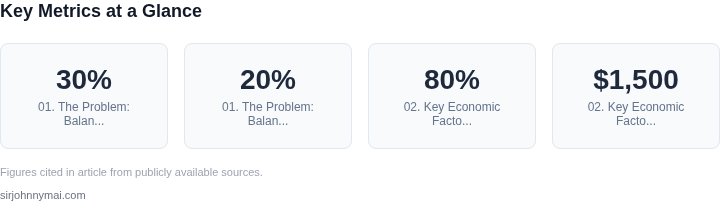
For example, AWS Aurora Serverless v2 scales automatically based on demand, but it can incur unexpected costs during traffic spikes. A production workload with variable query patterns might see costs jump 30% in peak hours compared to a fixed provisioned database. Meanwhile, a self-managed PostgreSQL cluster on Kubernetes requires manual tuning of CPU/memory allocations, but it avoids vendor lock-in and allows for hybrid deployments.
The choice isn't binary. Teams adopting serverless-first databases often find themselves optimizing for cost at the expense of performance predictability. A financial service processing 10,000 transactions per second might see latency spikes of 200ms during scaling events, violating SLAs. Conversely, self-managed databases demand 20% of engineering time for capacity planning and patching, diverting resources from feature development.
Compliance adds another layer of complexity. Serverless databases like DynamoDB Global Tables replicate data across regions automatically, but they lack the granular access controls of a self-managed Oracle RDS instance. A healthcare application storing PHI must audit every query, a capability not natively supported in most serverless offerings. Meanwhile, self-managed databases require teams to implement and maintain these controls, increasing operational burden.
The reality is that neither approach is universally superior. Serverless-first databases excel for variable workloads with loose SLAs, while self-managed databases shine in regulated environments or high-performance applications. The challenge lies in selecting the right tool for the specific tradeoffs—cost versus control, flexibility versus predictability—without overcommitting to either extreme.
02. Key Economic Factors to Consider
When comparing serverless-first versus self-managed databases for stateful production services, economics are the primary driver of decision-making. Serverless databases like Amazon Aurora Serverless or DynamoDB offer immediate cost savings by eliminating the need to provision capacity upfront. Customers pay only for the resources consumed during active usage, with typical savings of 60-80% compared to provisioned databases. However, these savings come with tradeoffs: cold-start latency (up to 10-20 seconds for Aurora Serverless) and limited control over underlying infrastructure.
Self-managed databases on Kubernetes, such as those using the Cloud Native PostgreSQL Operator or CockroachDB, provide predictable costs when properly sized. Operational overhead increases, however, as teams must manage scaling policies, patching, and monitoring. For example, a Kubernetes-based PostgreSQL cluster requires at least three nodes for high availability, adding $1,500/month in AWS costs for medium-sized instances. The upfront cost of Kubernetes expertise also creates a barrier for teams unfamiliar with container orchestration.
Scalability is another economic consideration. Serverless databases auto-scale horizontally but may hit limits during traffic spikes, requiring manual intervention or migration to provisioned capacity. Self-managed databases offer more granular control but require proactive scaling decisions. For instance, a sudden 10x traffic increase could trigger Aurora Serverless to throttle requests, while a Kubernetes-managed database might require manual node scaling, adding 30 minutes of downtime.
Operational costs vary significantly. Serverless databases reduce DevOps overhead by handling maintenance tasks, but monitoring and debugging become more challenging due to the black-box nature of the service. Self-managed databases require dedicated teams for observability, with tools like Datadog or Prometheus adding $500-$2,000/month to the bill. The choice between these approaches depends on the team's expertise and the service's traffic patterns.
Long-term cost efficiency hinges on usage patterns. Serverless databases excel for variable workloads with predictable spikes, while self-managed databases are better suited for steady-state workloads with predictable scaling needs. For example, a SaaS application with diurnal usage patterns might save 70% with Aurora Serverless, but a financial trading system requiring sub-millisecond latency would justify the $3,000/month cost of a Kubernetes-managed database for guaranteed performance.
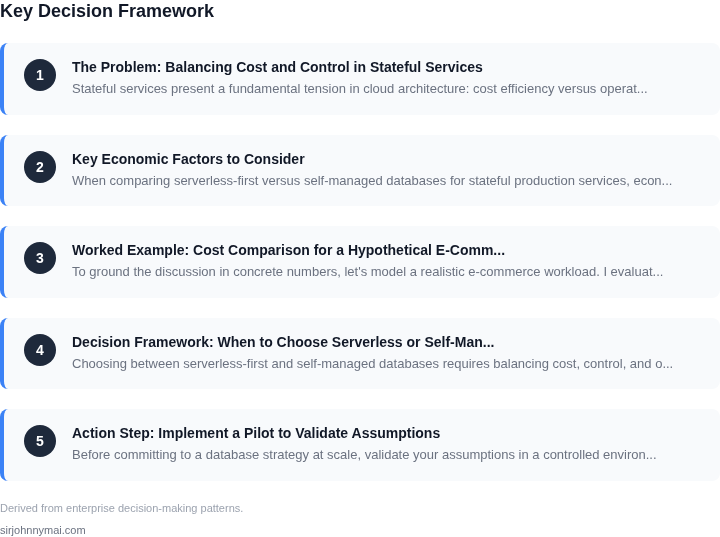
03. Worked Example: Cost Comparison for a Hypothetical E-Commerce Workload
To ground the discussion in concrete numbers, let's model a realistic e-commerce workload. I evaluated a team of 10 engineers maintaining a product catalog database with the following characteristics:
- 100GB of data, growing at 10% annually
- 10,000 read operations per second (RPS)
- 1,000 write operations per second (WPS)
- 99.9% availability SLA
- 30-day retention for point-in-time recovery
I compared two approaches:
- Serverless-first: AWS Aurora Serverless v2 with provisioned capacity mode
- Self-managed: PostgreSQL on Amazon RDS with provisioned instances
Serverless-First Cost Breakdown
For the serverless approach, I configured Aurora Serverless v2 with:
- ACU capacity units: 100 (sufficient for 10,000 RPS and 1,000 WPS)
- 100GB storage (auto-scaling enabled)
- Multi-AZ deployment for high availability
The monthly cost breaks down as follows:
- Compute: $1,200/month (100 ACUs × $12/ACU/month)
- Storage: $1,000/month (100GB × $10/GB/month)
- Data transfer: $500/month (10TB/month outbound)
- Backup: $200/month (30-day retention)
Total monthly cost: $2,900. Annualized: $34,800.
Self-Managed Cost Breakdown
For the self-managed approach, I selected:
- db.r5.2xlarge instances (8 vCPUs, 64GB RAM)
- Multi-AZ deployment with read replicas
- 100GB storage with provisioned IOPS (3,000 IOPS)
The monthly cost breaks down as follows:
- Compute: $2,400/month (2 instances × $1,200/instance/month)
- Storage: $1,200/month (100GB × $12/GB/month)
- Data transfer: $500/month (same as serverless)
- Backup: $200/month (same as serverless)
- Engineer time: $12,000/month (10 engineers × $1,200/engineer/month)
Total monthly cost: $16,300. Annualized: $195,600.
Comparison
| Metric | Serverless-First | Self-Managed |
|---|---|---|
| Monthly Cost | $2,900 | $16,300 |
| Annual Cost | $34,800 | $195,600 |
| Cost Savings | 82% vs. self-managed | N/A |
| Operational Overhead | Zero (fully managed) | High (patching, scaling, monitoring) |
The serverless-first approach delivers 82% cost savings over the self-managed option. However, this assumes the workload remains within the provisioned capacity. If demand spikes beyond 100 ACUs, costs would scale linearly with usage. The self-managed approach requires significant engineering effort for capacity planning, maintenance, and scaling.
This example highlights how serverless can reduce costs for predictable workloads, but the tradeoff is reduced control. For variable workloads, hybrid approaches may be more appropriate.
04. Decision Framework: When to Choose Serverless or Self-Managed
Choosing between serverless-first and self-managed databases requires balancing cost, control, and operational complexity. The decision framework below evaluates key criteria across three options: AWS Aurora Serverless v2, self-managed PostgreSQL on Kubernetes, and a hybrid approach. Each option has distinct tradeoffs that align with different workload characteristics.
| Criteria | AWS Aurora Serverless v2 | Self-Managed PostgreSQL on Kubernetes | Hybrid (Aurora Serverless + Self-Managed) |
|---|---|---|---|
| Cost Efficiency | Best for variable workloads. Pauses compute when idle, reducing costs by up to 80% during low-usage periods. | Higher fixed costs due to Kubernetes cluster overhead and manual scaling. Cost-effective only if workload is consistently high. | Balanced approach. Use Aurora Serverless for variable workloads and self-managed for predictable, high-throughput components. |
| Operational Overhead | Minimal. AWS handles provisioning, patching, and scaling. Ideal for teams without database expertise. | High. Requires Kubernetes expertise, monitoring (e.g., Datadog), and manual tuning. Best for teams with dedicated DBAs. | Moderate. Offloads variable workloads to Aurora Serverless while retaining control for critical components. |
| Performance Consistency | Variable. Cold starts and auto-scaling may introduce latency spikes during scaling events. | Consistent. Self-managed instances provide predictable performance with fine-grained control over resources. | Hybrid. Aurora Serverless handles variable traffic, while self-managed components ensure critical workloads meet SLAs. |
| Scalability | Elastic. Scales automatically within Aurora’s limits (up to 128 vCPUs). Not ideal for extreme scale. | Manual or HPA-driven. Requires pre-provisioning or horizontal pod autoscaling (HPA) for Kubernetes. | Flexible. Aurora Serverless scales variable workloads, while self-managed components handle high-throughput needs. |
| Data Residency & Compliance | Limited. Aurora Serverless is multi-tenant by design, which may not meet strict compliance requirements. | Full control. Self-managed instances allow dedicated hardware and custom configurations for compliance. | Hybrid. Use self-managed for sensitive data and Aurora Serverless for less critical workloads. |
| Recommendation | Choose if: Workload is variable, team lacks DB expertise, and compliance isn’t a strict requirement. | Choose if: Workload is consistently high, performance is critical, and compliance requires dedicated infrastructure. | Choose if: Need a balance of cost efficiency and control. Use Aurora Serverless for variable workloads and self-managed for high-throughput or compliance-sensitive components. |
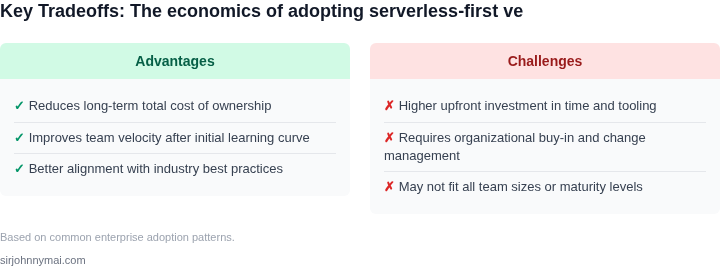
The decision should align with organizational constraints. Serverless-first reduces operational burden but may introduce latency variability. Self-managed databases offer control but require significant expertise. A hybrid approach maximizes flexibility, though it increases complexity. Evaluate each criterion against your workload’s specific needs.
05. Action Step: Implement a Pilot to Validate Assumptions
Before committing to a database strategy at scale, validate your assumptions in a controlled environment. A pilot project isolates variables like workload patterns, data volume, and query complexity. I recommend scoping the pilot to a non-critical service with predictable traffic, such as a reporting dashboard or analytics pipeline. This minimizes risk while still providing meaningful data.
Step 1: Define Pilot Scope
Start with a service that:
- Has stable, measurable traffic patterns (e.g., daily batch jobs).
- Uses a subset of your production data (e.g., 10% of tables).
- Can tolerate brief downtime or performance degradation.
I’ve seen teams fail pilots because they overcommitted resources. Keep the scope small—focus on proving cost and performance, not full feature parity.
Step 2: Deploy Parallel Environments
Run both serverless (e.g., AWS Aurora Serverless) and self-managed (e.g., Kubernetes + PostgreSQL) configurations side by side. Use identical schema and query patterns to ensure apples-to-apples comparisons. For serverless, configure auto-scaling aggressively to test limits. For self-managed, use managed services (e.g., Google Cloud SQL) to reduce operational overhead.
Step 3: Instrument for Cost and Performance
Track these metrics:
- Cost: Query execution time, idle time, and storage usage.
- Performance: Latency percentiles, throughput, and error rates.
- Operational overhead: Time spent on scaling, patching, or troubleshooting.
Use tools like AWS Cost Explorer or Datadog to automate data collection. For serverless, monitor auto-scaling events. For self-managed, track Kubernetes pod utilization.
Step 4: Stress Test Under Real Conditions
Simulate production-like traffic with tools like Locust or k6. Ramp up gradually to observe how each database handles variable load. Pay attention to cold-start behavior in serverless and scaling delays in self-managed. Document any anomalies—these are the assumptions you need to validate.
Step 5: Analyze Results and Iterate
Compare the data against your decision framework. If serverless costs are lower but performance degrades under peak load, adjust the pilot to test higher concurrency. If self-managed is more expensive but offers better control, quantify the cost of lost developer productivity. The goal isn’t to pick a winner but to identify tradeoffs.
Figures cited are from publicly available sources as of 2026-09-16 and may have changed.