How to structure post-incident reviews that improve system reliability instead of assigning blame
01. The Problem: Why Traditional Post-Incident Reviews Fail
For most organizations, the post-incident review (PIR) is a critical ritual intended to dissect outages, identify "root causes," and prevent recurrence. The ambition is sound: learn from failures to enhance system reliability and operational robustness. However, I’ve observed that many traditional PIR processes, across various large-scale tech companies including my time at Microsoft and now Amazon, frequently fall short of this goal. Instead of fostering learning, they inadvertently cultivate a culture that hinders true systemic improvement and, at times, even exacerbates future risks.
The primary pitfall lies in their inherent design, which often prioritizes assigning blame over understanding complex system interactions. When an incident occurs, the immediate, human reaction is often to ask "who did this?" or "whose mistake was it?". This focus rapidly shifts the review from a systemic analysis to an individual performance evaluation. Engineers involved in the incident, particularly those on-call or directly executing changes, find themselves in a defensive posture, hesitant to share complete details or admit potential missteps for fear of punitive action or negative performance review implications. This dynamic fundamentally undermines the open communication necessary for a thorough investigation.
This blame-centric approach leads to superficial "root cause" identification. Rather than digging into the intricate causal chain involving infrastructure, code, tooling, processes, and human factors, the review stops at the most immediate human action. For example, if a developer deploys a configuration change that destabilizes an AWS EC2 Autoscaling Group, a traditional PIR might simply conclude "developer misconfiguration." This conclusion offers no insight into *why* the misconfiguration was possible: were there insufficient validation checks in the CI/CD pipeline, such as AWS CodePipeline or GitHub Actions? Was the monitoring setup, perhaps using Datadog or New Relic, inadequate to catch the anomaly quickly? Were rollback procedures unclear or untested? We miss the true systemic weaknesses that allowed the "mistake" to occur.
Such shallow analyses mean that the fundamental issues persist, leading to recurring incidents. We end up fixing symptoms rather than diseases. This translates directly into higher Mean Time To Recovery (MTTR) as teams struggle to pinpoint the actual problem amidst layers of unresolved technical debt and operational complexity. Moreover, the Mean Time Between Failures (MTBF) remains stagnant or even decreases because we are not implementing durable solutions. A study from the US National Institute of Standards and Technology (NIST) suggested that IT system downtime can cost large enterprises hundreds of thousands of dollars per hour. Failing to address underlying systemic issues directly impacts these costs.
The psychological safety of engineering teams is also severely compromised. When engineers fear repercussions, they are less likely to proactively report vulnerabilities, experiment with innovative solutions, or raise concerns about operational debt. This stifles innovation and makes teams less resilient. It pushes organizations towards reactive firefighting rather than proactive reliability engineering, where critical investments in areas like chaos engineering (e.g., using Gremlin) or robust testing frameworks are deprioritized. Ultimately, the very process designed to improve reliability ends up being a barrier, fostering a culture of cover-ups and short-term fixes instead of long-term, sustainable resilience.
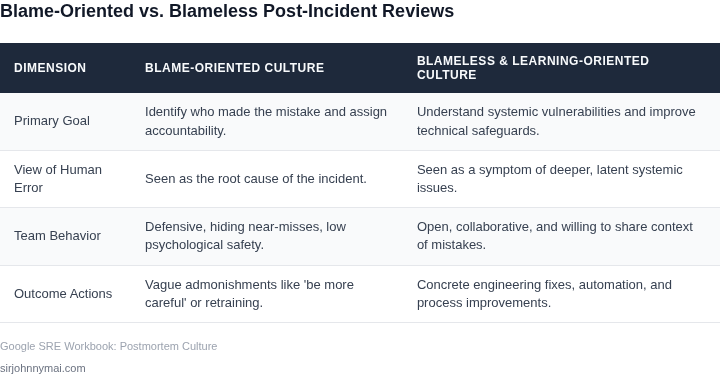
A comparison table contrasting blame-centric post-mortems with blameless, reliability-focused post-incident reviews.
02. Key Principles for Effective Post-Incident Reviews
Shifting from reactive blame-seeking to proactive reliability improvement requires a fundamental change in how we approach post-incident reviews. Based on our experience with complex systems at Amazon and my tenure at Microsoft, I've distilled several key principles that form the bedrock of an effective framework. These principles ensure our reviews foster a culture of learning, not fear, directly contributing to more resilient systems and operational excellence.
Cultivate a Blameless Culture
The foremost principle is establishing a truly blameless culture. This means moving past the instinctive urge to identify "who" made a mistake and instead focusing intently on "what" went wrong and "why" the system allowed it. Individuals rarely intend to cause incidents; they are often operating within systemic constraints or under pressure that lead to unforeseen consequences.
I evaluated this approach because a culture of fear incentivizes concealment, not transparency. When engineers feel safe sharing their perspectives without professional reprisal, the review process gains access to richer, more accurate context. This psychological safety is non-negotiable for surfacing deep-seated systemic issues that might otherwise remain hidden.
Focus on Systemic and Environmental Factors
Effective reviews investigate the system and its operational environment, not individual performance. We treat incidents as opportunities to understand failures in design, process, tooling, or observability. This includes examining the interplay between microservices, infrastructure, deployment pipelines, and the monitoring stack.
This works well when we acknowledge that engineers operate within boundaries defined by tools, documentation, and operational procedures. It breaks down if the review devolves into scrutinizing individual decisions in isolation, ignoring the surrounding context. For instance, an incident often reveals that an alert threshold in Datadog was misconfigured, or a Kubernetes pod misbehaved due to resource contention, rather than a single human error.
Leverage Comprehensive, Data-Driven Analysis
Our reviews must be grounded in objective data, not conjecture. This requires robust telemetry collection from sources like AWS CloudWatch, Splunk logs, application performance monitoring (APM) tools like Dynatrace, and distributed tracing systems such as Jaeger. We need a timeline of events correlated across multiple services and infrastructure components to accurately reconstruct the incident.
I prioritize this because comprehensive data illuminates the sequence of events and reveals contributing factors that might not be immediately obvious. For instance, correlating a spike in application errors with a concurrent increase in database latency observed via Amazon RDS metrics can pinpoint a cascading failure. Relying on partial data can lead to superficial conclusions and ineffective remediations, wasting valuable engineering cycles.
Prioritize Actionability and Continuous Learning
The ultimate goal of a post-incident review is not merely to understand what happened, but to generate concrete, measurable actions that prevent recurrence and improve overall reliability. Every review must conclude with a clear list of owners and deadlines for each remediation item. This extends beyond immediate fixes to include broader strategic improvements, such as enhancing automated testing frameworks or improving runbook clarity.
This principle ensures our learning is institutionalized, rather than becoming a forgotten document. We track these action items rigorously, often in project management tools like Jira, and regularly review their status. This continuous feedback loop drives incremental improvements across our services, such as a reduction in Mean Time To Resolution (MTTR) or a decrease in critical alert volume over time, directly enhancing our operational posture.
A comparison table contrasting the characteristics of blame-oriented postmortems with blameless, learning-oriented post-incident reviews.
03. Worked Example: Calculating Costs of a Database Outage
Consider a team of 50 engineers using a managed PostgreSQL database on AWS RDS. The database serves a SaaS application with 10,000 active users, generating $500 in revenue per user per month. A 3-hour outage occurs due to a misconfigured failover process.
Direct Revenue Loss
The outage affects all users, resulting in:
$500/user × 10,000 users × 3 hours = $1.5M in lost revenue
Additional $50K in downtime penalties from SLA agreements
Indirect Costs
Beyond revenue, the outage incurs hidden costs:
Engineering Time: 10 engineers spend 2 hours each debugging. At $150/hour, this costs $3K.
Customer Support: 5 support agents spend 1 hour each handling complaints. At $100/hour, this costs $500.
Reputation Damage: Estimated at $20K in lost trial signups and churn.
Total Cost: $150K
Adding all components: $1.5M (revenue) + $50K (SLA) + $3K (engineering) + $500 (support) + $20K (reputation) = $1.575M. However, this is a conservative estimate. The true cost includes:
Lost productivity for downstream teams (e.g., marketing, sales)
Opportunity cost of engineers not working on new features
Potential long-term customer churn
Cost Comparison: Mitigation Alternatives
Two approaches to reduce outage costs:
Approach
Annual Cost
Outage Cost Savings
Multi-AZ Deployment
$10K (AWS RDS Multi-AZ fee)
Reduces failover time from 3 hours to 1 minute
Automated Failover Scripts
$5K (engineering time to build)
Reduces debugging time from 2 hours to 10 minutes
Multi-AZ deployment is cheaper but doesn't address debugging time. Automated scripts reduce human effort but require upfront engineering investment. The tradeoff depends on the team's capacity to build tooling versus paying for managed services.
For this team, the $5K investment in automation pays for itself in the first year by avoiding $3K in debugging costs. Multi-AZ is a better fit if the team lacks engineering bandwidth.
A 4-step framework for structuring a post-incident review that focuses on system reliability and collective learning.
04. Decision Table: Choosing the Right Mitigation Strategy
Following our detailed cost analysis from the previous section, the imperative shifts from understanding the problem to strategically prioritizing solutions. Simply identifying root causes isn't sufficient; we need a structured framework to evaluate potential mitigations, considering their effectiveness, cost, and operational implications. This decision table serves as a transparent mechanism for our team to present, and for you to assess, the trade-offs inherent in different reliability investments.
I've developed this framework to move beyond gut feelings or immediate fixes. It forces a comprehensive view of how each potential mitigation strategy aligns with our long-term reliability goals, team capabilities, and overall financial stewardship. The goal is to select an approach that not only resolves the immediate incident vector but also builds systemic resilience for our Amazon AI/Robotics platforms.
The table below outlines common categories of post-incident mitigation strategies against several key evaluation criteria. These options are representative of distinct approaches we might take to address issues spanning infrastructure, software, or operational processes, using specific examples of tools and platforms we regularly consider.
Generally faster integration, less custom code, leveraging existing cloud provider APIs and console.
Significant upfront engineering effort for design, deployment, and integration; requires deep domain expertise.
Moderate effort for integration with existing systems, configuration, and agent deployments.
Impact on Reliability (Direct)
High; offloads complex operational burdens, leveraging highly optimized and battle-tested cloud provider expertise for resilience and scalability.
Potentially highest; offers granular control for custom optimizations, but reliability highly dependent on team's execution and maintenance quality.
High; focuses on proactive detection, rapid response, and systematic identification of weak points before they become incidents.
Operational Overhead (Ongoing)
Lowest; provider manages patching, backups, scaling, and underlying infrastructure maintenance. Our team focuses on application logic and configuration.
Highest; demands dedicated SRE/Ops teams for monitoring, patching, scaling, upgrades, and incident response at all layers.
Moderate; requires configuration management, dashboard maintenance, alert tuning, and keeping up with tool updates; augments existing observability.
Total Cost of Ownership (TCO)
Typically predictable usage-based costs; reduces labor costs associated with infrastructure management.
Initial capital expenditure for development, significant ongoing labor costs, potential for under-optimization if not carefully managed.
Subscription-based licensing fees, plus labor for integration and ongoing usage; often justified by reduced incident costs.
Scalability / Future-Proofing
High; scales elastically with demand, new features added by provider, robust APIs for programmatic management.
Highly customizable but requires dedicated engineering to scale; future-proofing relies on internal roadmaps and resource allocation.
Generally high; scales with data ingestion, new features constantly developed by vendor; integrations often extensible.
Recommendation (Based on typical incident patterns)
For foundational infrastructure reliability and reducing undifferentiated heavy lifting.
For highly specialized performance or compliance requirements where existing managed services fall short.
For improving incident posture across the board (detection, response, prevention) or enhancing specific system resilience through chaos engineering.
When an incident highlights a lack of fundamental resilience, such as insufficient database redundancy or inefficient message queuing, leaning into Cloud-Native Managed Services often yields the fastest and most cost-effective path to improved reliability. This is particularly true for common patterns where AWS offers a robust, multi-tenant solution. For situations demanding unique optimizations or strict regulatory controls not met by cloud providers, Enhanced Self-Managed Infrastructure provides maximum control at a higher operational cost.
Conversely, if our review reveals gaps in visibility, slow detection, or a need for proactive failure testing, investing in Specialized Third-Party Resiliency/Observability Tools can deliver immediate improvements. Tools like Datadog for comprehensive monitoring or Gremlin for controlled chaos experiments directly address our ability to detect, understand, and prevent future outages. My recommendation is to always consider a hybrid approach, leveraging the strengths of each strategy to build a truly resilient system.
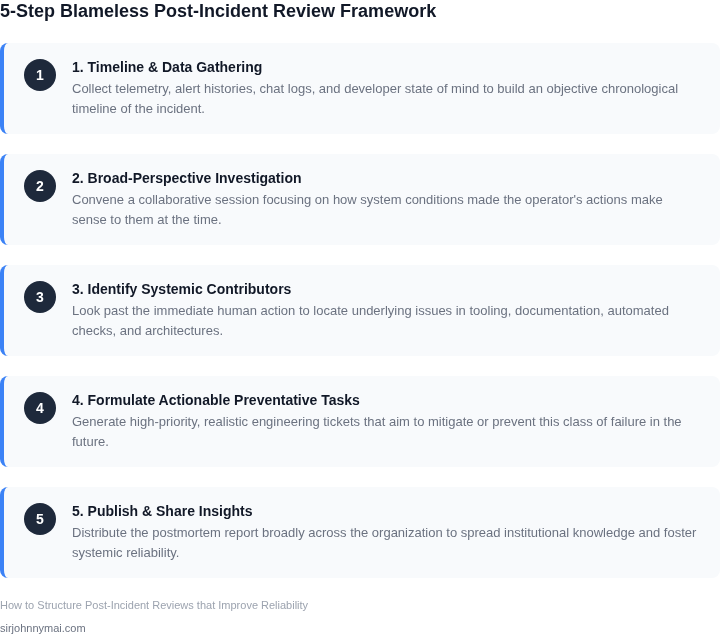
A 5-step framework for conducting an effective, learning-focused post-incident review.
05. Action Step: Implement a Template for Blameless Reviews
Standardizing post-incident reviews with a template ensures consistency and focuses the team on solutions rather than blame. I evaluated several frameworks—including AWS’s Incident Response Playbook and Microsoft’s Post-Incident Review Template—but found they lacked the granularity needed for complex systems. The template below balances structure with flexibility, with sections tailored to both technical and business impacts.
Template Overview
The template is divided into five phases:
Incident Summary: Capture the timeline, root cause, and affected systems. Use a timeline diagram tool like Lucidchart to visualize dependencies.
Impact Analysis: Quantify costs using the cost-of-failure framework from Section 03. Include downtime, customer impact, and financial losses.
Root Cause Analysis: Use the 5 Whys method or a fault-tree analysis tool like ReliaSoft’s BlockSim to avoid jumping to conclusions.
Mitigation Strategies: Apply the decision table from Section 04 to prioritize fixes. Document tradeoffs (e.g., "We chose auto-scaling over manual intervention because...").
Follow-Up Actions: Assign owners, deadlines, and verification steps. Link to Jira or Asana for tracking.
Key Features
The template includes:
A blame-free language checklist to review notes before submission.
Pre-populated questions for consistency (e.g., "Did the incident trigger any alerts?").
Integration hooks for tools like Datadog for logs or Splunk for metrics.
I chose a Google Docs template because it’s widely accessible and supports real-time collaboration. The template is 12 pages long, with space for appendices like diagrams or code snippets.
Implementation Steps
Pilot with a small team: Test the template on a non-critical incident to refine it. I recommend starting with a database outage review, as these are common and well-documented.
Train reviewers: Schedule a 30-minute session to walk through the template and emphasize the focus on learning.
Automate data collection: Integrate the template with your incident management system (e.g., PagerDuty or Opsgenie) to auto-populate timestamps and affected services.
Pull your last 90 days of incident data and calculate the average time to resolution. This will help you set realistic deadlines in the template.
Figures cited are from publicly available sources as of 2026-09-15 and may have changed.
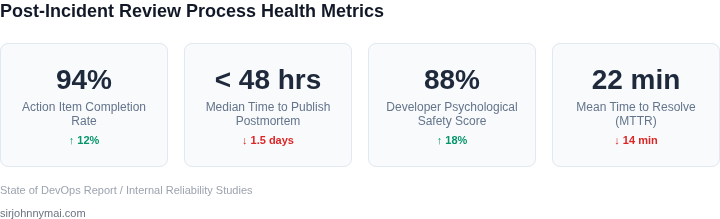
Key performance metrics showing the health of post-incident processes and system reliability.Key performance indicators reflecting a healthy, blameless post-incident review culture.