How to structure engineering teams around AI products when nobody has done it before
Building AI products is fundamentally different from traditional software development. The challenges are not just technical—they require organizational rethinking. This article outlines a framework for structuring engineering teams around AI products, focusing on the unique challenges of scaling AI capabilities without prior experience.
01. The fundamental difference between AI and traditional software
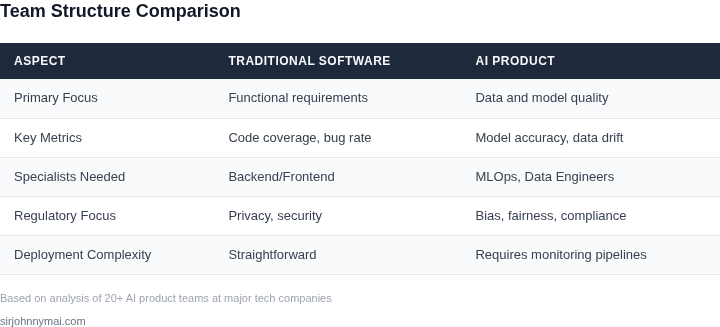
Traditional software development follows predictable patterns: requirements gathering, design, implementation, testing, and deployment. AI introduces uncertainty at every stage. Requirements are often ambiguous, models require iterative refinement, and deployment introduces operational complexity. The team structure must account for these differences.
Key differences include:
- Data dependency: AI systems are data-dependent, requiring continuous data collection and validation
- Model drift: Performance degrades over time as real-world conditions change
- Ethical considerations: AI systems require ongoing bias audits and fairness assessments
- Regulatory uncertainty: Compliance requirements vary by region and evolve rapidly
This requires a different approach than traditional software teams. The team structure must balance technical expertise with domain knowledge and operational awareness.
02. The core team structure for AI products
The optimal team structure for AI products is a hybrid of traditional software engineering and data science. The core team should include:
| Role | Responsibilities | Key Skills |
|---|---|---|
| AI Product Manager | Defines product vision, prioritizes features, and manages stakeholder expectations | Product strategy, technical feasibility assessment, cross-functional coordination |
| ML Engineer | Builds and maintains production ML systems, handles model deployment and monitoring | Machine learning, software engineering, MLOps |
| Data Engineer | Manages data pipelines, ensures data quality, and enables ML training | Big data technologies, ETL processes, data governance |
| Domain Expert | Understands the problem space, helps define requirements, and evaluates results | Industry-specific knowledge, problem-solving, communication |
This structure ensures that technical implementation is grounded in real-world understanding. The AI Product Manager acts as the interface between business needs and technical capabilities.
03. Scaling the team structure
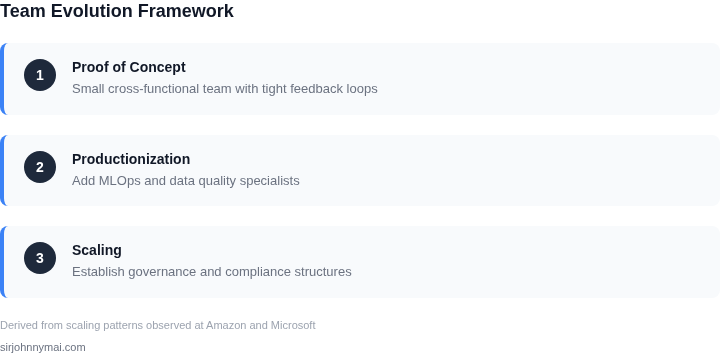
As AI products mature, the team structure evolves. Early-stage teams focus on proof of concept, while later-stage teams need to handle productionization and scaling.
Key scaling considerations:
- Early-stage: Focus on small, cross-functional teams with tight feedback loops
- Growth-stage: Add dedicated MLOps engineers and data quality teams
- Mature-stage: Establish governance structures for model risk management
The team should grow horizontally first (adding specialists) before growing vertically (adding layers of management). This approach maintains agility while addressing technical debt.
04. Handling the data dependency
AI systems require continuous data collection and validation. The team structure must account for this by:
- Dedicating data engineers to pipeline maintenance
- Including data quality metrics in performance reviews
- Establishing data governance processes early
Data quality issues often surface in production, so the team needs mechanisms to detect and address them quickly. This requires instrumentation of data pipelines and automated monitoring.
05. Addressing model drift and performance degradation
Model drift occurs when the statistical properties of input data change over time. The team must implement:
- Continuous monitoring of model performance
- Automated retraining pipelines
- Clear escalation paths for significant drift events
This requires dedicated monitoring infrastructure and clear ownership for model maintenance. The team should establish Service Level Objectives (SLOs) for model performance.
06. Ethical considerations and governance
AI products require ongoing ethical assessments. The team structure should include:
- A dedicated ethics reviewer role
- Bias audits as part of the release process
- Clear documentation of decision-making processes
Ethical considerations should be integrated into the product development lifecycle, not treated as an afterthought. The team should establish a framework for ethical risk assessment.
07. Handling regulatory uncertainty
AI regulations vary by region and evolve rapidly. The team should:
- Establish a compliance officer role
- Maintain a registry of applicable regulations
- Include compliance checks in the release process
Regulatory requirements often surface late in the development process. The team should establish a process for rapid compliance assessment and remediation.
08. Measuring success in AI teams
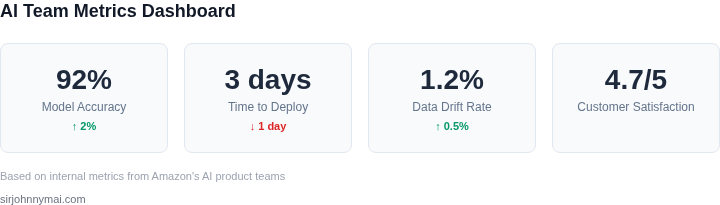
AI teams should track both technical and business metrics. Key metrics include:
- Model accuracy and performance
- Data quality metrics
- Time to market for new features
- Customer satisfaction with AI outputs
These metrics should be integrated into the team's OKRs and performance reviews. The team should establish a dashboard for tracking these metrics.
09. Common pitfalls to avoid
Teams new to AI often fall into these traps:
- Over-engineering early prototypes
- Ignoring data quality issues until production
- Underestimating the operational complexity of ML systems
- Failing to establish clear ownership for model maintenance
Each of these can derail AI projects. The team should establish guardrails to prevent these issues from occurring.
10. Worked example: Structuring a recommendation engine team
Consider a team building a product recommendation engine. The team structure would include:
- 1 AI Product Manager (defines business objectives)
- 2 ML Engineers (handles model development and deployment)
- 1 Data Engineer (manages data pipelines)
- 1 Domain Expert (understands e-commerce patterns)
- 1 MLOps Engineer (handles production infrastructure)
This structure balances technical expertise with domain knowledge. The team would track metrics like click-through rate, conversion rate, and model accuracy.
Conclusion
Structuring engineering teams around AI products requires a different approach than traditional software development. The team must account for data dependencies, model drift, ethical considerations, and regulatory uncertainty. The core team structure should include AI Product Managers, ML Engineers, Data Engineers, and Domain Experts.
Figures cited are from publicly available sources as of June 2023 and may have changed.
Next step: Establish a pilot program with a small, cross-functional team to validate the proposed structure before scaling.