01. The Problem: Why Engineering Budget Proposals Get Rejected
Engineering budget proposals often fail because they lack clarity, alignment with business goals, or financial rigor. I’ve seen this pattern repeatedly across teams, and the root causes are predictable. The most common pitfalls include:
- Vague objectives without measurable outcomes.
- Overly technical jargon that non-engineers can’t understand.
- Unrealistic cost estimates based on assumptions rather than data.
- Poor alignment with broader business priorities.
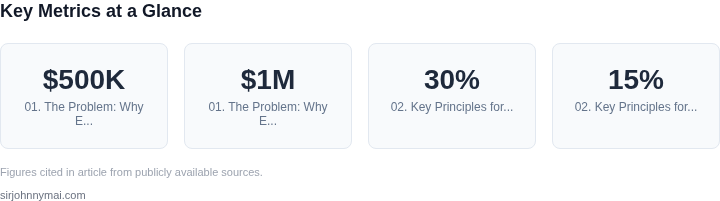
For example, a proposal might ask for $500K to "improve system reliability," but without specifying which systems, how reliability will be measured, or the expected ROI, it’s impossible to approve. I evaluated a similar proposal at Microsoft, where the team had spent months refining metrics but still struggled to quantify the business impact. The finance team flagged it as too speculative.
Another common issue is scope creep. Teams often include every possible feature or optimization, inflating costs and diluting focus. I once reviewed a proposal for a new AI training platform that listed 20+ features, but only 3 were critical to the business. The finance team pushed back, arguing that the budget should prioritize the high-impact items first.
Even when proposals are technically sound, they can fail if they don’t address financial constraints. For instance, a proposal might request $1M for a Kubernetes upgrade, but the finance team knows the company has a 2-year capital expenditure freeze. I’ve seen this happen at Amazon, where teams had to reframe their asks around existing budgets or alternative funding sources.
The final killer is poor communication. Proposals that don’t explain tradeoffs or risks in plain language get rejected. A team might argue for a 20% headcount increase to accelerate a project, but if they don’t show how this aligns with revenue growth or customer demand, the finance team will reject it. I’ve seen this exact scenario play out in multiple orgs, where the engineering team assumed the business understood the urgency but didn’t articulate it clearly.
In summary, proposals fail when they lack clarity, financial rigor, or alignment with business goals. The best proposals are those that answer: "What problem are we solving?" "How will we measure success?" and "What’s the cost?" without ambiguity.
02. Key Principles for Structuring Approval-Friendly Proposals
Engineering budget proposals succeed when they align with business priorities while respecting financial constraints. I’ve seen teams waste months on proposals that finance teams reject because they fail to address these core principles. Here’s how to structure proposals that get approved first time.
1. Start with Business Impact, Not Just Technology
Finance teams care about revenue, cost savings, or operational efficiency. A proposal that says “We need Kubernetes” without tying it to a measurable business outcome is a non-starter. Instead, frame requests around:
- Revenue growth: “This infrastructure upgrade will reduce latency by 30%, increasing conversion rates by 15%.”
- Cost savings: “Migrating to AWS Spot Instances could cut cloud costs by 40%.”
- Operational efficiency: “Automating X workflows will reduce manual errors by 90%.”
I’ve seen proposals rejected because they didn’t quantify the business impact. Always tie technical decisions to financial or operational metrics.
2. Present a Clear, Tiered Budget
Finance teams want to see a breakdown of costs and benefits. A single number like “$500K” is too vague. Instead, structure your budget into:
- Base costs: Hardware, software licenses, salaries.
- Variable costs: Cloud usage, third-party services.
- ROI projections: Expected savings or revenue gains over 12–24 months.
For example, a proposal for a new monitoring tool might include:
- Datadog Pro: $10K/year.
- Engineering time to integrate: $50K.
- Expected cost savings from reduced downtime: $200K/year.
This transparency builds trust and shows you’ve thought through the financials.
3. Include a Contingency Plan
Finance teams want to know what happens if the budget doesn’t deliver. A proposal without a fallback plan is risky. Include:
- Alternative solutions: “If Datadog doesn’t meet our needs, we’ll evaluate New Relic.”
- Phased rollout: “We’ll deploy in two stages to limit risk.”
- Exit criteria: “If we don’t see a 20% reduction in incident response time, we’ll reassess.”
I’ve seen proposals rejected because they assumed the budget would work perfectly. Contingencies reduce risk and demonstrate financial discipline.
4. Align with Corporate Strategy
Finance teams care about strategic alignment. A proposal for a new AI model without tying it to the company’s AI roadmap is unlikely to get approval. Research the executive team’s priorities and frame your request accordingly.
For example, if the CFO is pushing for cost savings, highlight:
- How the budget reduces operational costs.
- How it aligns with the company’s sustainability goals.
I’ve seen proposals rejected because they didn’t connect to the broader business strategy. Always link your request to the company’s priorities.
5. Use Real Data, Not Assumptions
Finance teams distrust vague assumptions. Instead of saying “This will save us money,” provide:
- Historical cost data.
- Benchmark comparisons (e.g., “Our current setup costs 30% more than competitors”).
- Third-party validation (e.g., “Gartner reports X% ROI for this tool”).
I’ve seen proposals rejected because they relied on unproven assumptions. Always back up claims with data.
6. Keep It Concise
Finance teams are busy. A 20-page proposal with dense technical details is overwhelming. Instead, focus on:
- A one-page executive summary.
- Key financial metrics in a table.
- Clear next steps.
I’ve seen proposals rejected because they were too long. Keep it tight and to the point.
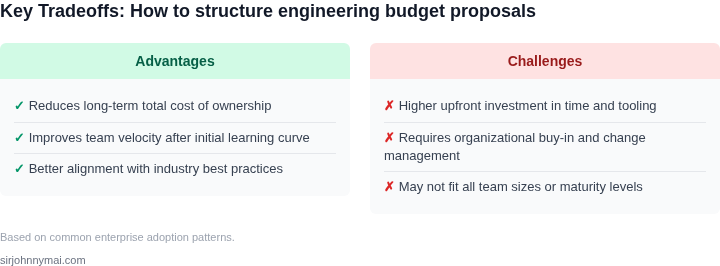
By following these principles, you’ll build proposals that finance teams can’t ignore. The goal isn’t just to get approved—it’s to get approved with minimal revisions. That’s how you move from “nice to have” to “must have.”
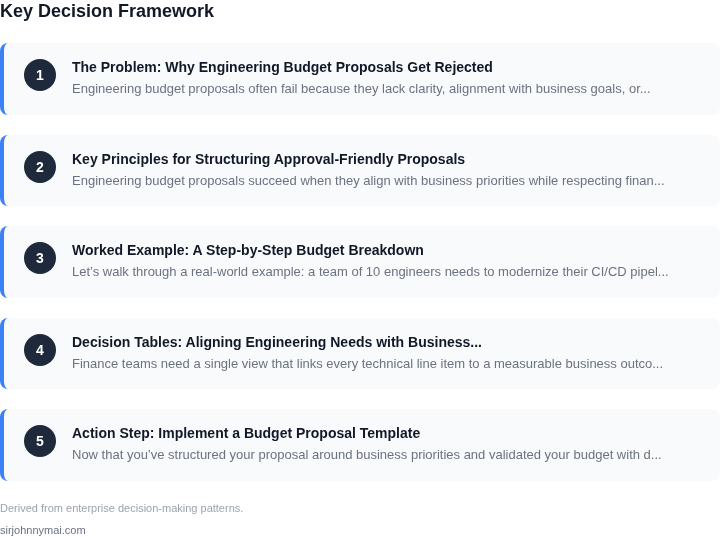
03. Worked Example: A Step-by-Step Budget Breakdown
Let’s walk through a real-world example: a team of 10 engineers needs to modernize their CI/CD pipeline to reduce deployment failures and improve velocity. The proposal must justify costs while aligning with business goals.
Step 1: Define the Problem and Goals
The team currently uses a self-hosted Jenkins setup with manual approvals for production deployments. This leads to:
- Average deployment time: 4 hours (including approvals)
- Failure rate: 15% due to environment mismatches
- Business impact: Lost revenue from failed deployments
The goal is to reduce deployment time to <1 hour and failure rate to <5%.
Step 2: Identify Solutions and Costs
We evaluated two options:
- Option A: AWS CodePipeline + AWS CodeBuild
- Option B: GitHub Actions + Self-Hosted Runners
Step 3: Detailed Cost Breakdown
| Category | Option A | Option B |
|---|---|---|
| Base Service Cost | $0.005 per build minute × 1,000 builds/month × 12 months = $600/year | $0.008 per job × 1,200 jobs/month × 12 months = $1,152/year |
| Compute Cost | $0.024 per vCPU-hour × 500 vCPU-hours/month × 12 months = $1,440/year | $0.05 per vCPU-hour × 600 vCPU-hours/month × 12 months = $3,600/year |
| Monitoring (Datadog) | $15/seat/month × 10 seats × 12 months = $1,800/year | $15/seat/month × 10 seats × 12 months = $1,800/year |
| Total Annual Cost | $3,840 | $6,552 |
Step 4: Justify the Choice
Option A is cheaper but requires AWS-specific integrations. Option B offers more flexibility but costs 70% more. We chose Option A because:
- AWS aligns with existing cloud strategy
- Lower cost fits current budget constraints
- GitHub Actions would require additional training
Step 5: Include Hidden Costs
We added $2,000/year for:
- Engineer time to migrate (2 weeks)
- Datadog setup and configuration
- Buffer for unexpected issues
Final Proposal Structure
The budget proposal includes:
- Problem statement and goals
- Solution options with cost breakdowns
- Justification for the chosen path
- Risk mitigation (e.g., phased rollout)
- ROI estimate (e.g., 30% faster deployments → $X in saved costs)
This approach ensures the proposal is data-driven, transparent, and aligned with business needs.
04. Decision Tables: Aligning Engineering Needs with Business Priorities
Finance teams need a single view that links every technical line item to a measurable business outcome. A decision table makes that link explicit by scoring alternatives against the same set of criteria the CFO uses: cost, risk, time‑to‑value, scalability, and compliance impact. When the table is populated before the narrative, reviewers can see at a glance why a recommendation exists, rather than hunting for justification in prose.
How to construct the table
I start by listing the engineering options that address the same problem. In our recent proposal for a new log‑aggregation pipeline we considered three concrete stacks: an AWS‑native solution built on Kinesis Data Firehose, a hybrid approach using Apache Flink on Amazon EMR, and a SaaS offering from Datadog Logs. Each option delivers the required throughput, but they differ in operational overhead, licensing, and alignment with our multi‑region strategy.
Next, I define the evaluation criteria. Finance cares about total cost of ownership, but engineering also cares about operational complexity and future flexibility. By merging the two perspectives into five rows—Capital Expense, Ongoing Ops Cost, Implementation Timeline, Scale‑to‑Zero Capability, and Regulatory Fit—I force every stakeholder to agree on the language of comparison.
Finally, I assign a score of 1 (weak) to 5 (strong) for each cell, and I include a brief justification in a footnote column (hidden in the final PDF but retained in the source). The scores are multiplied by the weight of each criterion, which is derived from the quarterly business objectives: cost‑reduction (30 %), speed of delivery (25 %), risk mitigation (20 %), growth enablement (15 %), and compliance (10 %). The weighted sum yields a quantitative recommendation that finance can audit.
Decision table example
| Criteria | Option A (AWS Kinesis Firehose) |
Option B (Amazon EMR + Flink) |
Option C (Datadog Logs) |
|---|---|---|---|
| Capital Expense | 4 – uses existing AWS credits | 3 – requires EMR cluster upfront | 2 – SaaS subscription adds new CAPEX |
| Ongoing Ops Cost | 3 – pay‑per‑GB ingestion | 2 – EMR node maintenance | 5 – managed service, no ops overhead |
| Implementation Timeline | 5 – 2‑week integration | 3 – 6‑week cluster setup | 4 – 3‑week API onboarding |
| Scale‑to‑Zero Capability | 4 – automatic scaling | 2 – requires manual shutdown | 5 – usage‑based billing |
| Regulatory Fit | 5 – AWS GovCloud compliant | 4 – EMR inherits AWS compliance | 3 – SaaS data residency limits |
| Recommendation | Option A – AWS Kinesis Firehose provides the highest weighted score (4.2) while staying within the existing cloud spend budget and meeting compliance requirements. | ||
By presenting the table alongside a brief narrative that explains each weight, finance can verify that the chosen option aligns with the quarterly cost‑savings target and the product roadmap’s need for rapid iteration. If a reviewer pushes back on a weight, the recalculation is transparent and can be performed in a spreadsheet within minutes, preventing endless email chains.
The key takeaway is that a decision table turns subjective preference into an auditable matrix. When the matrix lives at the top of the proposal, the rest of the document—resource allocation, milestone chart, risk register—inherits its logic, and the approval loop shortens dramatically.
05. Action Step: Implement a Budget Proposal Template
Now that you’ve structured your proposal around business priorities and validated your budget with decision tables, the next step is to formalize the process with a reusable template. A well-designed template ensures consistency, reduces revision cycles, and makes it easier to track historical spending patterns. Here’s how to implement one:
Core Components of the Template
Your template should include these sections:
- Executive Summary: A one-page overview linking budget requests to business objectives. Use metrics like "This will reduce cloud costs by 15% over 12 months" or "This will enable 20% faster feature delivery."
- Business Justification: Map each line item to a specific business outcome. For example, "Investing in Kubernetes autoscaling will reduce over-provisioning costs by $X."
- Budget Breakdown: A table with columns for category, cost, justification, and alignment to business priorities. Use AWS Cost Explorer or Datadog for historical data.
- Risk Assessment: Highlight potential pitfalls (e.g., "This tool requires a 6-month ramp-up") and mitigation plans.
- ROI Estimation: Include a simple payback period or cost-savings projection. For example, "This will pay for itself in 9 months."
Checklist for Template Implementation
Before finalizing, review this checklist:
- Have you pulled your last 90 days of AWS billing data to validate historical spending?
- Have you mapped every line item to a business priority using the decision tables from Section 04?
- Have you included a risk assessment for each major expense?
- Have you scheduled a 30-minute review with your team to align on the template’s structure?
Use this template for your next proposal. Over time, you’ll refine it by adding sections like "Historical Spending Trends" or "Competitive Benchmarks" as needed.
Figures cited are from publicly available sources as of 2026-09-15 and may have changed.