How to set up a data platform team from scratch and avoid the most common mistakes
Building a data platform from the ground up is not primarily a technology selection problem; it is an organizational design and resource allocation problem. Many organizations fail because they begin with a tool-first mentality, choosing an expensive modern data stack before defining their data product taxonomy or team structure. This article outlines a systematic, battle-tested framework for building a data platform team from zero, drawing on engineering patterns from Microsoft and robotics scale-ups.
01: Defining the Platform's Operating Model
Before hiring engineers or signing contracts with cloud providers, you must define how your data team will interface with the rest of the business. There are three primary patterns: centralized, decentralized (embedded), and federated (data mesh). For an organization building a data platform from scratch, choosing the wrong model early creates architectural debt that is exceptionally difficult to unwind.
A centralized model places all data engineers, analytics engineers, and data scientists under a single functional leader. This approach works best when the organization's data maturity is low, infrastructure is fragmented, and core datasets (such as customer records or financial transactions) require strict definition. The primary limitation is the bandwidth bottleneck; the central team becomes a service desk, fielding ticket requests from product and business units that they do not fully understand contextually.
Conversely, a fully decentralized model embeds data engineers directly into product teams. While this accelerates delivery for individual business units, it inevitably leads to fragmented architectures, duplicated pipelines, inconsistent metric definitions, and astronomical cloud bills. Team A might build a pipeline using AWS Lambda and PostgreSQL, while Team B builds one using Snowflake and dbt, with no cross-team metadata sharing.
The optimal starting point is a hub-and-spoke model. The central "hub" team—the Data Platform Team—owns the platform infrastructure, ingestion frameworks, orchestration, governance, and storage layer. The "spokes"—analytics engineers or data analysts embedded in business units—own the domain-specific transformation logic and data models. This division of labor keeps the platform team focused on building high-leverage infrastructure while enabling business units to move quickly and retain ownership of their domain data.
02: Staffing the Core Team (The First Three Hires)
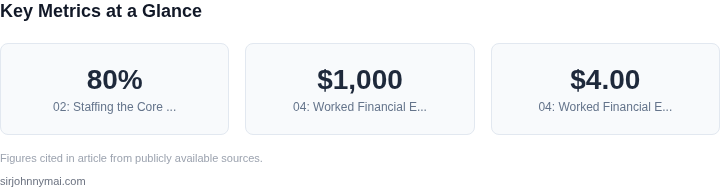
The sequence of your hiring is critical. A common anti-pattern is hiring a Data Scientist as the first team member. Without a robust data platform, a data scientist spends 80% of their time performing manual data extraction, cleansing, and infrastructure setup. This leads to rapid frustration, low productivity, and high attrition.
Your first hire must be a Principal Data Platform Engineer or a Data Architect. This individual must possess deep expertise in cloud infrastructure, distributed systems, and storage engines. They are responsible for setting up the cloud landing zones, IAM policies, networking, orchestration engines, and base storage layers. They must write clean, production-grade infrastructure-as-code (IaC) using tools like Terraform or AWS CloudFormation.
Your second hire should be an Analytics Engineer. This role bridges the gap between raw data infrastructure and business logic. They understand data modeling practices (such as dimensional modeling or Data Vault), write highly optimized SQL, and build the consumption layer using tools like dbt. They establish the testing frameworks, documentation standards, and version control processes for analytical code.
Your third hire must be a Technical Product Manager (TPM) for the Data Platform. The TPM treats the data platform as an internal product. They gather requirements from business stakeholders, define service level objectives (SLOs) for data availability and quality, prioritize the platform roadmap, and ensure that the engineering team is building platform capabilities rather than one-off custom pipelines for individual stakeholders.
03: Architectural Selection (Lakehouse vs. Warehouse and Open Table Formats)
The architecture of your platform must balance ease of implementation with long-term cost efficiency and scalability. Historically, organizations had to choose between the structure and speed of a data warehouse (e.g., Snowflake, Google BigQuery) or the scale and low cost of a data lake (e.g., AWS S3, Azure ADLS). Today, the convergence of these two paradigms—the Lakehouse—has changed the decision matrix.
For organizations with data volumes under 50 Terabytes, a cloud data warehouse (such as Snowflake or BigQuery) coupled with an ingestion tool (such as Fivetran or Airbyte) is the most pragmatic choice. The operational overhead is minimal, and the time-to-value is measured in weeks. The storage costs are marginally higher than raw object storage, but the savings in engineering headcount easily offset this delta.
When data volumes exceed 100 Terabytes, or when a significant portion of the workload involves unstructured data (such as images, video, or raw telemetry), a Lakehouse architecture utilizing open table formats becomes highly cost-effective. Technologies such as Apache Iceberg or Delta Lake provide ACID transactions, schema evolution, and time travel directly on top of object storage. This decoupled architecture allows you to run multiple query engines (e.g., Trino for interactive SQL, Apache Spark for heavy ETL workloads) over the same physical data files, preventing vendor lock-in.
04: Worked Financial Example - Cost and ROI Calculation
To demonstrate the economic tradeoffs of architectural selection, let us calculate the Total Cost of Ownership (TCO) for a company processing 10 Terabytes of active analytical data per month, comparing a Managed Data Warehouse approach with a Custom Open Source Platform approach over a 12-month period.
First, we define our inputs for the Managed Platform (Snowflake + Fivetran + dbt Cloud):
- Data Ingestion: Fivetran syncing 10 million active rows monthly. Cost: $1,000 per month.
- Compute & Storage: Snowflake running a Medium warehouse for 8 hours daily. 4 credits/hour * 8 hours = 32 credits/day. 32 credits * 30 days = 960 credits/month. At Enterprise Edition pricing of $4.00 per credit, this equates to $3,840 per month. Storage for 10 TB compressed (assuming a 5:1 compression ratio, yielding 2 TB stored) at $23 per TB/month equals $46 per month. Total Snowflake cost: $3,886 per month.
- Orchestration and Transformation: dbt Cloud Developer seats for 5 users at $150 per user/month. Cost: $750 per month.
- Engineering Resources: 1 Platform Engineer ($150,000/year) and 1 Analytics Engineer ($120,000/year). Total payroll including benefits and taxes (estimated at 1.25x multiplier): $337,500/year.
Let us calculate the total annual cost for the Managed Platform:
Managed Tooling Cost = (Fivetran + Snowflake + dbt Cloud) * 12
Managed Tooling Cost = ($1,000 + $3,886 + $750) * 12 = $67,632

Total Managed TCO = Managed Tooling Cost + Managed Payroll
Total Managed TCO = $67,632 + $337,500 = $405,132
Now, let us calculate the inputs for the Custom Open Source Platform (Self-hosted Airflow, Trino, Kubernetes on AWS):
- Infrastructure Compute: AWS EKS cluster running 3 m5.2xlarge nodes to host Airflow and Trino. Cost per node: $0.384/hour * 24 hours * 30 days = $276.48. Three nodes equal $829.44 per month. Kubernetes management fee: $72 per month. Total infrastructure compute: $901.44 per month.
- Infrastructure Storage: 10 TB raw data on Amazon S3 Standard at $0.023 per GB/month. Cost: 10,240 GB * $0.023 = $235.52 per month.
- Engineering Resources: Due to the complexity of maintaining Kubernetes clusters, security patches, network routing, and custom Python ingestion scripts, this path requires 2 Platform Engineers ($150,000/year each) and 1 Dedicated DevOps Engineer ($140,000/year) to support infrastructure scaling. Total payroll with 1.25x multiplier: $550,000/year.
Let us calculate the total annual cost for the Custom Open Source Platform:
Custom Tooling Cost = (AWS Compute + AWS Storage) * 12
Custom Tooling Cost = ($901.44 + $235.52) * 12 = $13,643.52

Total Custom TCO = Custom Tooling Cost + Custom Payroll
Total Custom TCO = $13,643.52 + $550,000 = $563,643.52
This comparison reveals a critical platform engineering truth: while open-source software reduces direct licensing and infrastructure costs by $53,988.48 annually, it introduces an additional $212,500 in personnel costs to manage the operational complexity. The managed approach yields a net savings of $158,511.52 in year one, while significantly reducing the time-to-market for business insights.
05: Common Traps and Mitigation Strategies
The first major trap is the "Build Everything" Syndrome. Platform teams often fall into the trap of writing custom framework code for tasks that have been commoditized. Unless your data ingestion scale exceeds hundreds of terabytes or requires real-time sub-second latency, you should not write custom