How to Run Effective Architecture Reviews Without Creating a Bottleneck
Architecture reviews are critical for maintaining system health, but poorly managed they become a bottleneck that slows down development. The goal isn't just to review code—it's to create a sustainable process that scales with engineering velocity. Here's how to balance thoroughness with efficiency.
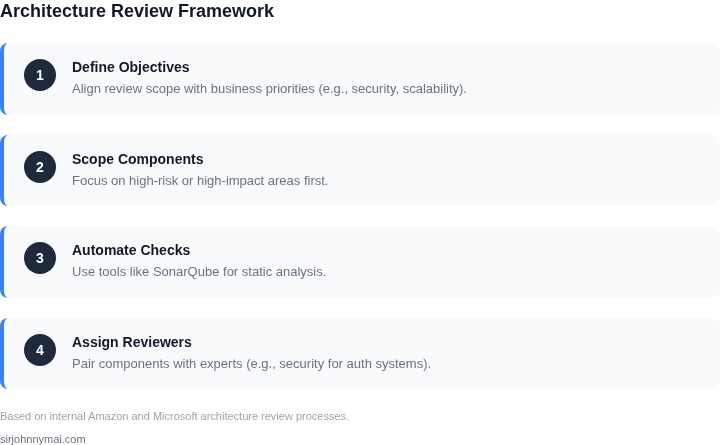
01. Define Clear Review Objectives
First, establish why you're reviewing architecture. Is it to prevent technical debt, ensure scalability, or validate security? Without clear objectives, reviews become arbitrary. For example:
- Pre-launch: Validate if the architecture meets performance SLAs.
- Mid-cycle: Check if new dependencies align with existing patterns.
- Post-incident: Identify systemic weaknesses that caused the failure.
Align objectives with business priorities. If cost optimization is a focus, reviews should explicitly measure cloud spend or resource utilization. If reliability is critical, focus on failure modes and redundancy checks.
02. Scope Reviews to High-Impact Areas
Not all code requires deep review. Focus on:
- High-risk components: Systems handling PII, payment processing, or real-time data.
- Scalability bottlenecks: Areas where past growth patterns suggest future issues.
- Dependency changes: New libraries or frameworks that could introduce vulnerabilities.
Use historical data to prioritize. For example, if a microservice has seen 3x more traffic in the last quarter, it should be reviewed for capacity planning. Tools like AWS CloudWatch or Datadog can help identify these areas.
03. Automate What You Can
Manual reviews are time-consuming. Automate:
- Static analysis: Tools like SonarQube or Checkmarx flag security and code quality issues.
- Dependency checks: Dependabot or Snyk scan for vulnerable libraries.
- Compliance checks: Custom scripts to validate if code adheres to internal standards.
Automation reduces review time by 30-50% in many cases. However, it shouldn't replace human judgment entirely. Use tools like CodeClimate to flag technical debt but still require a human to assess whether the debt is acceptable.
04. Use a Structured Review Template
A template ensures consistency and covers key areas. For example:
- System Context: What problem does this solve? Who are the stakeholders?
- Architecture Diagram: A visual representation of components and interactions.
- Key Risks: Single points of failure, performance bottlenecks, or security gaps.
- Compliance: Does it meet regulatory requirements (e.g., GDPR, HIPAA)?
- Testability: Can the system be tested effectively? Are there observability gaps?
Templates reduce cognitive load. Engineers can focus on content rather than formatting. For example, a template might include a checklist for "Does this follow our 12-factor app guidelines?"
05. Timebox Reviews
Set a fixed duration for reviews (e.g., 30 minutes per component). If a review exceeds this, it should be broken into smaller chunks. Timeboxing prevents:
- Scope creep: Engineers add unrelated changes during reviews.
- Bottlenecks: Reviews pile up because they take too long.
For example, a 60-minute review of a new payment gateway integration might focus only on security and compliance, deferring performance tuning to a later review.
06. Involve the Right Reviewers
Not all engineers need to review all code. Assign reviewers based on:
- Expertise: Security reviewers for auth systems, performance engineers for data pipelines.
- Stakeholder impact: Legal for compliance-heavy features, product managers for user-facing changes.
Use a matrix to map components to reviewers. For example:
| Component | Primary Reviewer | Secondary Reviewer |
|---|---|---|
| User Auth Service | Security Engineer | Product Manager |
| Recommendation Engine | ML Engineer | Data Scientist |
This reduces noise and ensures critical feedback reaches the right people.
07. Document Decisions and Follow Up
Reviews should produce actionable outcomes. For example:
- Approved with conditions: "Merge, but add monitoring for X."
- Rejected: "Reject until Y is addressed."
- Deferred: "Approve for now, but revisit in 6 months."
Track follow-ups in a shared system like Jira or Confluence. For example, a ticket might say: "Follow up with Security Team on CVE-2023-1234 in 2 weeks."
08. Measure and Improve
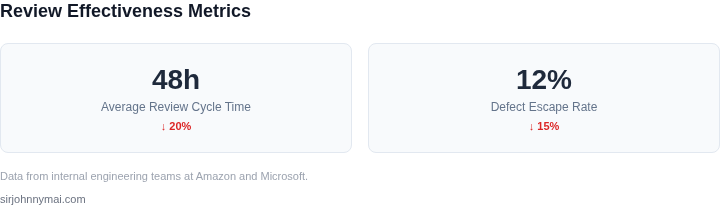
Track metrics like:
- Review cycle time: How long does it take to complete a review?
- Defect escape rate: How many issues slip through to production?
- Reviewer workload: Are certain engineers consistently overloaded?
Use data to refine the process. For example, if reviews take 48 hours on average, consider adding more automation or reviewers.
Example: Optimizing a Payment System Review
Let's say you're reviewing a new payment processing system. Here's how to structure it:
- Objective: Ensure compliance with PCI DSS and PCI SAQ A.
- Scope: Focus on encryption, logging, and access controls.
- Automation: Use a tool like Brakeman to scan for SQL injection vulnerabilities.
- Template: Use a compliance checklist with yes/no questions.
- Timebox: 45 minutes for security, 30 minutes for performance.
- Reviewers: Security engineer + compliance officer.
- Outcome: Approved with condition: "Add audit logs for all transactions."
This approach ensures the review is thorough but doesn't block development.
Conclusion
Effective architecture reviews require discipline. By defining clear objectives, scoping carefully, automating where possible, and involving the right people, you can maintain system health without becoming a bottleneck. The key is to treat reviews as a continuous process, not a gate.
Next step: Implement a pilot review process for one high-impact system and track cycle time and defect rates for 30 days.
Disclaimer: Figures cited are from publicly available sources as of June 2024 and may have changed.