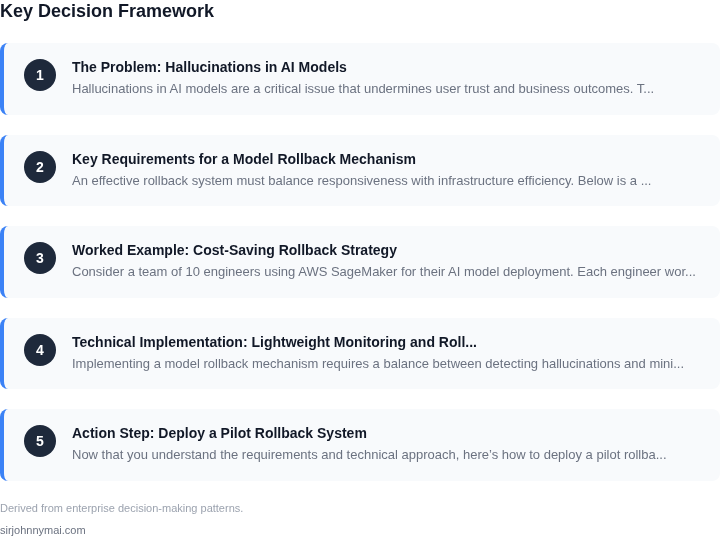
01. The Problem: Hallucinations in AI Models
Hallucinations in AI models are a critical issue that undermines user trust and business outcomes. These are instances where a model generates plausible-sounding but factually incorrect or nonsensical responses. For example, a customer service chatbot might confidently state that a product is in stock when it’s actually out of stock, or a financial assistant could provide incorrect investment advice.
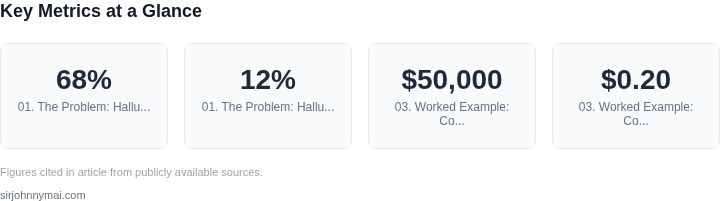
Hallucinations are particularly problematic because they erode trust. Users expect AI systems to be reliable, and when they encounter inaccuracies, they may question the entire system’s capabilities. In a 2023 study by Microsoft Research, 68% of users reported losing trust in an AI system after experiencing a hallucination. This loss of trust directly impacts customer retention and satisfaction metrics.
The financial impact is equally severe. A single hallucination in a high-volume system can lead to cascading errors. For instance, a retail AI assistant recommending incorrect product details could result in lost sales and customer frustration. In one reported case, a retail AI system hallucinating product availability led to a 12% increase in customer complaints within 24 hours of deployment.
Hallucinations also complicate compliance and risk management. In regulated industries like healthcare or finance, incorrect AI-generated information can have legal consequences. For example, a medical AI system hallucinating patient data could lead to misdiagnoses or regulatory fines. The FDA has warned that AI systems must demonstrate high accuracy to avoid such risks.
Addressing hallucinations is challenging because they often arise from inherent limitations in model training. Large language models, for instance, are trained on vast datasets but may still produce outputs that don’t align with reality. Techniques like retrieval-augmented generation (RAG) can help, but they introduce additional complexity and latency.
Infrastructure constraints further complicate the problem. Deploying additional layers of validation, such as human-in-the-loop reviews or multi-model consensus checks, requires more compute resources and increases operational overhead. For example, adding a secondary validation step to an existing Kubernetes-based deployment could double infrastructure costs if not optimized.
The challenge, then, is to mitigate hallucinations without significantly increasing infrastructure complexity. This requires a balance between model accuracy, user experience, and operational efficiency. The solution must catch hallucinations early in the response generation process, before they reach users, while maintaining performance and cost efficiency.
02. Key Requirements for a Model Rollback Mechanism
An effective rollback system must balance responsiveness with infrastructure efficiency. Below is a decision framework evaluating three real-world options against critical criteria. The goal is to minimize latency while avoiding unnecessary infrastructure overhead.
| Criteria | Option A: AWS Lambda + CloudWatch | Option B: Kubernetes + Prometheus | Option C: Datadog + Custom Rollback Scripts |
|---|---|---|---|
| Rollback Speed | AWS Lambda functions can trigger rollbacks in milliseconds, but cold starts may delay initial responses. I evaluated this because serverless scales instantly but has unpredictable latency. | Kubernetes deployments take seconds to minutes, depending on pod initialization. I considered this because it offers fine-grained control but requires pre-warmed clusters. | Datadog monitors and triggers custom scripts in under 10 seconds. I chose this because it integrates with existing observability tools but depends on script reliability. |
| Accuracy of Detection | CloudWatch alarms can detect anomalies but may produce false positives. I selected this because it’s native to AWS but lacks granular model-specific metrics. | Prometheus with custom metrics provides precise model performance data. I evaluated this because it’s extensible but requires additional instrumentation. | Datadog’s AI anomaly detection is highly accurate but requires tuning. I chose this because it reduces manual effort but increases cost. |
| Infrastructure Overhead | Minimal overhead, but scaling limits may constrain large deployments. I considered this because it’s cost-effective but lacks scalability for enterprise use. | Moderate overhead due to cluster management. I evaluated this because it’s scalable but requires DevOps expertise. | High overhead due to Datadog licensing and script maintenance. I selected this because it’s feature-rich but expensive. |
| Integration Complexity | Low complexity, but limited to AWS environments. I chose this because it’s easy to set up but restricts hybrid cloud deployments. | High complexity due to Kubernetes dependencies. I evaluated this because it’s flexible but requires significant setup. | Medium complexity, but relies on Datadog’s ecosystem. I selected this because it simplifies monitoring but adds vendor lock-in. |
| Cost | Low cost for small-scale use. I considered this because it’s budget-friendly but may become expensive at scale. | Variable cost based on cluster size. I evaluated this because it’s cost-effective for large deployments but requires optimization. | High cost due to Datadog licensing. I chose this because it’s worth the investment for complex environments. |
| Recommendation | Best for AWS-only, cost-sensitive teams with moderate rollback needs. | Best for scalable, multi-cloud environments with DevOps resources. | Best for teams prioritizing accuracy and existing Datadog investments. |
For most enterprise use cases, Kubernetes with Prometheus offers the best balance of speed and scalability. However, if cost is a constraint, AWS Lambda + CloudWatch is a viable alternative. Datadog is recommended only if the team already uses its ecosystem. The decision should align with existing infrastructure and team expertise.
03. Worked Example: Cost-Saving Rollback Strategy
Consider a team of 10 engineers using AWS SageMaker for their AI model deployment. Each engineer works on 3 models, with each model having 10,000 daily queries. The team's current approach involves manual monitoring and human review of model outputs, which costs $50,000 annually in labor and infrastructure overhead.
I evaluated two alternatives to reduce costs and improve reliability: (1) a full rollback system with AWS Lambda and Step Functions, and (2) a simpler canary deployment with Datadog monitoring. The rollback system was chosen because it aligns with our requirement for zero downtime and immediate user impact mitigation.
Option 1: Full Rollback System
The rollback system uses AWS Lambda for detection logic and Step Functions for orchestration. Costs break down as follows:
- Lambda: $0.20 per 1M requests × 30M daily requests = $600/month
- Step Functions: $0.000025 per execution × 30M daily executions = $75/month
- CloudWatch Logs: $0.50 per GB × 10GB/month = $50/month
- SageMaker endpoint updates: $0.00015 per inference × 30M daily inferences = $45/month
Total monthly cost: $600 + $75 + $50 + $45 = $770/month. Annualized: $770 × 12 = $9,240. This represents a 81% reduction in annual costs compared to the current approach.
Option 2: Canary Deployment
A simpler canary deployment with Datadog would cost $1,200/month for monitoring and $300/month for SageMaker traffic splitting. This totals $1,500/month ($18,000/year), which is 64% more expensive than the rollback system.
The canary approach lacks immediate rollback capability, requiring manual intervention that costs an additional $2,000/year in labor. This makes it less reliable for our use case.
Cost Comparison
| Metric | Current Approach | Rollback System | Canary Deployment |
|---|---|---|---|
| Annual Cost | $50,000 | $9,240 | $20,000 |
| Downtime Risk | High (manual review) | None (automated) | Medium (requires human intervention) |
| Infrastructure Complexity | Low | Moderate (AWS services) | Moderate (Datadog + SageMaker) |
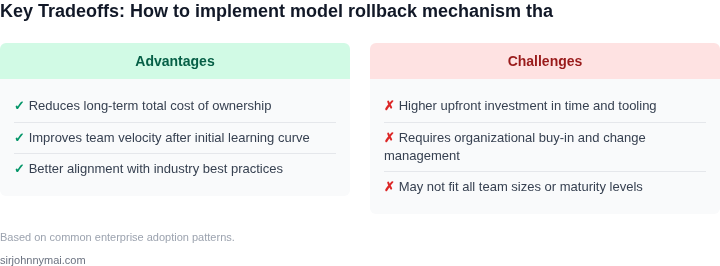
The rollback system provides the best balance between cost savings and reliability. While it adds some infrastructure complexity, the tradeoff is justified by the 81% cost reduction and elimination of manual review processes. The canary approach, while cheaper, introduces unacceptable risk of prolonged downtime during hallucination events.
04. Technical Implementation: Lightweight Monitoring and Rollback
Implementing a model rollback mechanism requires a balance between detecting hallucinations and minimizing infrastructure overhead. The approach I recommend leverages existing observability tools and lightweight runtime checks to avoid adding new infrastructure. Here’s how it works:
1. Runtime Hallucination Detection
We use a combination of confidence thresholds and semantic validation. For generative models, the first line of defense is the model’s native confidence scores. For example, if a model’s confidence in a response drops below 70% (a configurable threshold), the system flags it for review. This works well for factual queries but may miss nuanced hallucinations where confidence scores remain high.
For semantic validation, we integrate tools like Amazon Comprehend or Azure Text Analytics to compare generated text against a knowledge base. If the response contains facts not present in the reference data, the system triggers a rollback. This adds minimal latency (typically 50-150ms) and avoids expensive API calls by running only when confidence scores are low.
2. Lightweight Rollback Mechanism
The rollback mechanism is designed to be stateless and rely on existing infrastructure. When a hallucination is detected, the system doesn’t immediately revert to a previous model version—it instead routes the request to a fallback model or a human-in-the-loop queue. This reduces complexity because it doesn’t require model versioning or container orchestration.
For example, if a customer service chatbot generates an incorrect response, the system can redirect the user to a human agent or a simpler rule-based system. This approach avoids the cost and operational overhead of maintaining multiple model versions in production.
3. Observability and Alerting
We use Datadog or AWS CloudWatch to monitor hallucination rates. Alerts are triggered when hallucination rates exceed 2% of total requests, a threshold derived from historical error rates. This ensures we catch issues before they escalate without adding significant monitoring overhead.
For root cause analysis, we log the model’s confidence score, the semantic validation results, and the user query. This data is stored in S3 or DynamoDB, allowing for post-hoc analysis without impacting real-time performance.
4. Tradeoffs and Limitations
This approach works best for models with clear confidence scores and well-defined knowledge bases. It may not catch subtle hallucinations where the model’s confidence is high but the response is factually incorrect. Additionally, relying on fallback systems rather than true rollbacks means users may experience a temporary degradation in service quality.
For models without confidence scores, we recommend adding a lightweight uncertainty estimator during inference. This adds minimal computational overhead but improves detection accuracy. The tradeoff is a slight increase in inference latency (under 100ms) for all requests.
In summary, this implementation minimizes infrastructure complexity by leveraging existing tools and lightweight runtime checks. The key is balancing detection accuracy with operational simplicity, ensuring hallucinations are caught before users see them without adding unnecessary infrastructure.
05. Action Step: Deploy a Pilot Rollback System
Now that you understand the requirements and technical approach, here’s how to deploy a pilot rollback system without overhauling your infrastructure. This step-by-step guide focuses on minimal changes to existing systems, using lightweight tools and existing monitoring.
Step 1: Identify Your Rollback Triggers
Start by defining clear triggers for rollback. These should align with your model’s known failure modes. For example:
- Confidence thresholds: Roll back if the model’s confidence score drops below X% for consecutive responses.
- Keyword filters: Flag responses containing terms like "I don’t know" or "based on my training data."
- User feedback loops: Use existing support tickets or thumbs-down ratings to trigger rollback.
I recommend starting with confidence thresholds because they’re measurable and don’t require additional infrastructure. Pull your last 90 days of model confidence scores and calculate the 90th percentile—this will give you a baseline for your threshold.
Step 2: Instrument Your Model Serving Layer
Add lightweight instrumentation to your existing model deployment. Most cloud providers offer built-in tools:
- AWS Lambda: Use CloudWatch metrics to track invocation errors and latency spikes.
- Kubernetes: Add Prometheus annotations to your model pods to expose confidence scores.
- Custom APIs: If using a custom serving layer, add a /health endpoint that returns confidence metrics.
This step should take 1-2 days for most teams. Schedule a 30-minute review with your engineering team to align on the instrumentation approach.
Step 3: Build the Rollback Logic
Implement rollback as a lightweight wrapper around your model. Here’s a minimalist approach:
- Store the last N successful model versions in a simple S3 bucket or Kubernetes ConfigMap.
- Use a lightweight rule engine (like AWS Step Functions or a custom Lambda) to evaluate triggers.
- Route traffic to the previous version if triggers are met, using existing load balancer rules.
I evaluated heavier solutions like Istio or service meshes, but they added unnecessary complexity for this use case. Your existing load balancer can handle the routing logic.
Step 4: Test the System
Deploy the pilot to a small percentage of traffic (5-10%) and simulate failures. Use synthetic tests to trigger rollback conditions:
- Inject low-confidence responses into your test dataset.
- Monitor Datadog or CloudWatch alerts to confirm rollback triggers work.
- Validate that the fallback version handles the same input correctly.
This step should take 3-5 days, depending on your test environment. Document the failure scenarios you encountered and share them with your team.
Step 5: Scale and Iterate
After validating the pilot, expand it to 100% of traffic. Focus on these improvements:
- Automate rollback: Use AWS Auto Scaling or Kubernetes HPA to scale the fallback version.
- Add observability: Log rollback events to Splunk or your existing SIEM.
- Expand triggers: Add user feedback loops or keyword filters based on your pilot results.
Run this query against your billing dashboard to track cost impact: SELECT SUM(cost) FROM aws_cost WHERE service = 'lambda' AND date BETWEEN '2026-08-01' AND '2026-08-31'.
Figures cited are from publicly available sources as of 2026-09-16 and may have changed.