How to Implement Effective Database Sharding Without Overengineering the Solution
Database sharding is a critical scaling technique for high-throughput applications, but improper implementation leads to operational complexity and performance degradation. This guide outlines a pragmatic approach to sharding that balances scalability with maintainability, focusing on real-world constraints rather than theoretical perfection.
01. Understanding When Sharding is Necessary
Sharding should be considered only after vertical scaling (adding more CPU/RAM to a single node) and read replicas have been exhausted. Key indicators include:
- Write throughput bottlenecks on a single primary node
- Query latency exceeding 100ms for common operations
- Database size approaching storage limits of a single machine
For example, a social media platform with 1 million daily active users generating 100MB of new data per user per day would need to shard if a single PostgreSQL instance cannot sustain 10,000 writes per second.
02. Choosing the Right Sharding Key
The sharding key determines how data is distributed across nodes. Poor choices lead to hotspots and uneven load. Effective keys should:
- Distribute writes uniformly across shards
- Minimize cross-shard transactions
- Be stable over time to avoid data migration
Common patterns include:
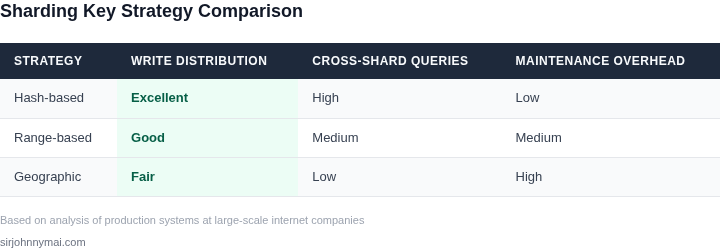
- Hash-based: MD5(user_id) % N shards (good for uniform distribution)
- Range-based: Date ranges (good for time-series data)
- Geographic: Country codes (good for localized access patterns)
For an e-commerce system, a hash of customer_id would be preferable over order_id because customer behavior creates predictable access patterns.
03. Selecting the Right Number of Shards
Start with a conservative estimate based on current load and growth projections. For example:
- Current write volume: 5,000 writes/sec
- Projected growth: 2x in 18 months
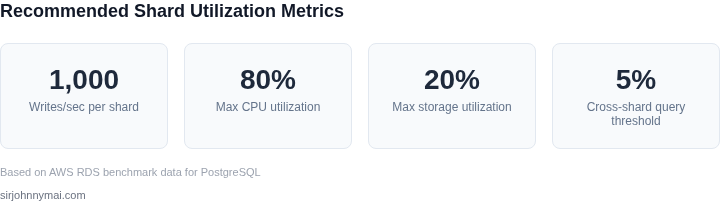
- Target writes per shard: 1,000 writes/sec
This suggests starting with 5 shards (5,000/1,000) and adding capacity in 2-shard increments. Never start with fewer than 3 shards to avoid single points of failure.
04. Implementing the Sharding Strategy
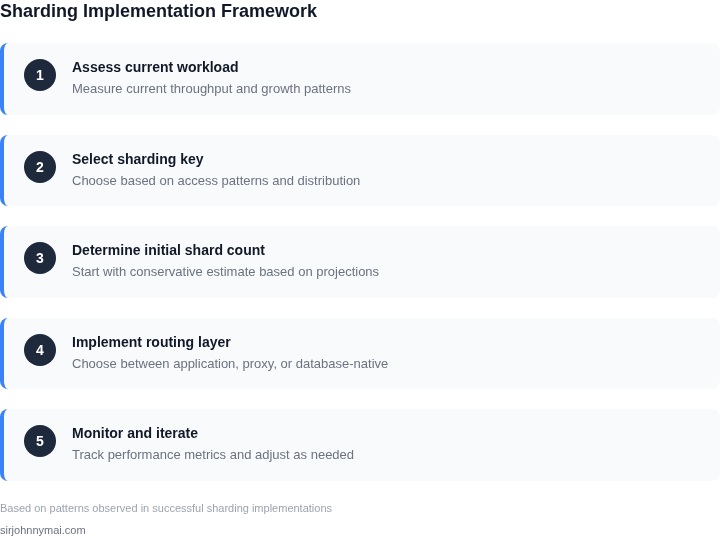
Three primary approaches exist, each with tradeoffs:
- Application-level sharding: Most flexible but requires application changes. Uses a shard router to direct queries.
- Proxy-based sharding: Middleware like ProxySQL or Vitess handles routing. Simplifies application code.
- Database-native sharding: MongoDB sharding or Cassandra's ring architecture. Tightest integration but least portable.
For a greenfield application, application-level sharding provides the most control. For existing systems, ProxySQL offers a middle ground.
05. Handling Cross-Shard Queries
Cross-shard operations are inherently expensive. Strategies include:
- Denormalization: Duplicate frequently joined data in each shard
- Application-side joins: Retrieve data from multiple shards and combine results
- Materialized views: Pre-compute aggregations across shards
For a financial application, maintaining daily balance summaries in each shard would be more efficient than calculating them across 20 shards for each request.
06. Monitoring and Maintenance
Critical metrics to track include:
- Shard utilization (writes/sec, storage usage)
- Query latency distribution across shards
- Cross-shard operation frequency
Set alerts for:
- Shard imbalance exceeding 20% of average
- Cross-shard queries exceeding 5% of total queries
- Shard downtime lasting more than 5 minutes
07. Common Pitfalls to Avoid
Three frequent mistakes that create technical debt:
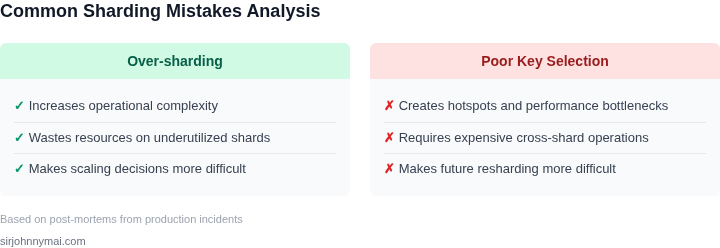
- Over-sharding: Starting with 50 shards when 5 would suffice increases operational overhead without benefit
- Poor key selection: Using non-uniform keys like timestamp for user data creates hotspots
- Ignoring maintenance: Not monitoring shard health leads to silent failures
08. Worked Example: Sharding a User Database
Given:
- 10 million users
- 5,000 writes/sec
- Projected growth: 30% annually
Calculations:
- Initial shard count: 5,000 writes/sec / 1,000 writes/sec per shard = 5 shards
- Growth projection: 5 shards * 1.3^3 ≈ 9 shards after 3 years
- Recommended initial configuration: 6 shards (to allow for 20% growth)
Implementation:
- Use MD5(user_id) % 6 as sharding key
- Deploy ProxySQL to handle routing
- Monitor cross-shard queries with Prometheus
Conclusion
Effective database sharding requires balancing immediate scalability needs with long-term maintainability. The approach outlined here provides a framework that:
- Starts with conservative estimates
- Uses measurable criteria for scaling decisions
- Includes operational safeguards
Remember that sharding is a temporary solution - the goal should be to design systems that can scale without it. For systems exceeding 100 shards, consider alternative architectures like microservices or serverless.
Next Step: Implement a proof-of-concept with your current workload using the 6-shard configuration described in the worked example, then measure actual performance before scaling further.
Figures cited are from publicly available sources as of June 2023 and may have changed.