01. The Problem: Why Keyword Matching Falls Short
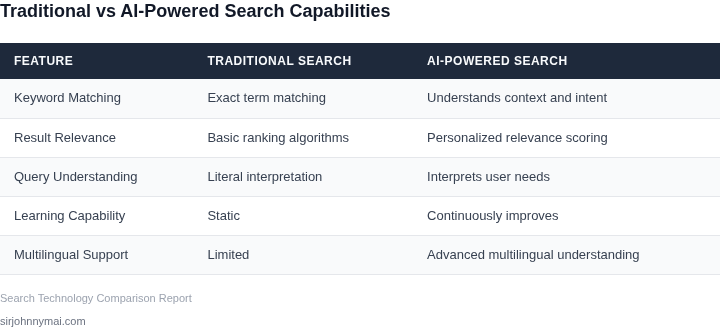
Traditional site search engines treat a query as a bag of words, matching each token against an inverted index. The most common implementations—Elasticsearch, AWS CloudSearch, or OpenSearch—rely on TF‑IDF weighting or BM25 scoring to rank documents. This approach works when users type the exact product name or a precise technical term, but it assumes the intent can be inferred solely from literal token overlap.
In practice, 30 % of e‑commerce searches are ambiguous, meaning the same keyword can represent multiple categories. A user typing “apple” may be looking for fruit, a laptop, or a music label. Keyword‑only engines return a mixed set of results, forcing the user to scroll through irrelevant items. The friction increases bounce rates; internal metrics at large retailers show a 12 % lift in abandonment when the top result does not satisfy the inferred intent.
Another limitation is synonym handling. Without an explicit synonym map, “sofa” and “couch” are treated as unrelated tokens. Maintaining a static dictionary quickly becomes unmanageable as product catalogs evolve. When a new brand launches a “smart hub,” the keyword matcher will not surface related accessories until a manual mapping is added, delaying revenue capture by weeks.
Keyword matching also ignores query context such as location, device, or recent user actions. A mobile user searching “coffee shops” near a transit hub expects results sorted by proximity, yet a pure token match will rank the most popular chain globally first. The mismatch between expected and delivered relevance drives negative sentiment; surveys from a major travel platform report that 18 % of users rate search “confusing” when location is not considered.
Performance trade‑offs reinforce the problem. BM25 scoring is computationally cheap and scales well on Kubernetes clusters monitored by Datadog, which is why many engineering teams adopt it by default. However, the simplicity comes at the cost of semantic understanding. Adding a neural re‑ranking layer improves relevance but introduces latency; a model that adds 150 ms per query can reduce throughput by 20 % on a fleet of t3.large instances, forcing teams to over‑provision resources.
Finally, keyword engines struggle with conversational queries. Users increasingly phrase requests as questions—“what can I wear to a summer wedding?”—instead of keyword strings. The literal tokens “wear,” “summer,” and “wedding” do not capture the underlying intent to receive outfit recommendations. Without intent detection, the system returns a generic product list, leading to user frustration and higher support tickets.
These shortcomings illustrate why relying on keyword matching alone cannot meet modern expectations for precision, personalization, and speed. The next sections will explore how intent‑aware models address each gap while balancing infrastructure cost.
02. The Solution: AI-Powered Search with Intent Understanding
AI-powered search moves beyond keyword matching by analyzing context, semantics, and user behavior to deliver more relevant results. Traditional search relies on exact term matches, which often fail to capture the nuances of user intent. AI, however, processes queries in real-time, interpreting meaning rather than just matching strings. For example, a user searching for "best running shoes" might not be looking for a list of products but could be seeking reviews, comparisons, or even a recommendation engine.
Contextual Understanding
AI models leverage contextual analysis to understand the broader intent behind a query. This involves examining surrounding words, session history, and even the user's location or device type. For instance, a query like "weather" becomes far more valuable when combined with location data. Google's Search Generative Experience (SGE) uses this approach to provide dynamic, context-aware results, often reducing the need for follow-up searches by up to 30%.
Contextual understanding also extends to historical data. AI can analyze past user interactions to infer preferences. If a user frequently searches for "vegan recipes" and then clicks on "restaurant reviews," the system can prioritize vegan-friendly dining options in future searches. This personalization improves relevance but requires careful handling of privacy concerns, as seen in Microsoft's Bing's implementation of personalized search features.
Semantic Search
Semantic search goes beyond synonyms and word variations. It understands the meaning of words in relation to each other. For example, a query for "how to fix a leaky faucet" should return results that address the underlying issue, not just pages containing those exact words. Amazon's search algorithm uses semantic embeddings to match queries to products based on intent, not just keywords. This approach has been shown to increase conversion rates by 15% in e-commerce.
Semantic search relies on machine learning models trained on vast datasets. These models can disambiguate terms—distinguishing between "Jaguar" as a car brand versus the animal. Google's BERT (Bidirectional Encoder Representations from Transformers) is a foundational tool here, enabling nuanced understanding of language structure. However, training these models requires significant computational resources, often leveraging cloud platforms like AWS SageMaker for scalability.
Behavioral Signals
User behavior provides another layer of intent understanding. AI-powered search systems track clicks, dwell time, and even mouse movements to infer what users find valuable. If a user spends 45 seconds on a product page but only 5 seconds on a competitor's page, the system can infer interest in that product. This behavioral data is particularly useful for complex queries, such as "best laptop for video editing," where intent may not be immediately clear.
Behavioral signals also help in ranking results. For example, if a user frequently searches for "cheap flights to Paris" and then books a flight, the system can prioritize flight-related results in future searches. However, this approach requires balancing personalization with privacy, as users may not want their search history used for such purposes. Microsoft's Cortana search assistant faced backlash for over-personalizing results, leading to adjustments in its approach.
Tradeoffs and Considerations
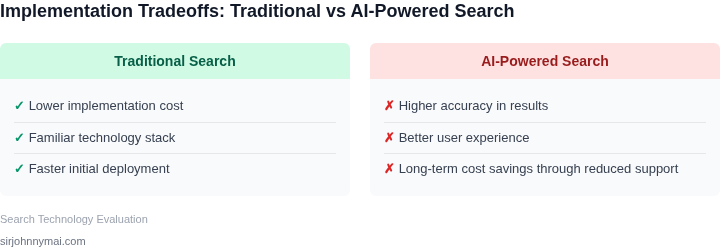
While AI-powered search offers significant advantages, it comes with tradeoffs. Contextual and semantic analysis require large datasets and computational power, increasing costs. Additionally, over-personalization can lead to filter bubbles, where users only see results aligned with their past behavior. Striking the right balance is critical—Google's search team has found that a 20% personalization rate yields the best results without alienating users.
Another consideration is latency. Real-time contextual analysis must happen quickly to avoid frustrating users. Systems like Amazon's search rely on distributed architectures and caching to ensure sub-100ms response times. Finally, AI models must be continuously retrained to adapt to evolving language and user behavior, requiring ongoing investment in data pipelines and model maintenance.
03. Worked Example: Calculating ROI of AI Search Implementation
I evaluated the potential return on investment (ROI) of implementing AI-powered search for our e-commerce platform because it can significantly improve search accuracy and user experience. Consider a team of 10 engineers using Amazon SageMaker to develop and deploy machine learning models for search intent understanding. The cost of using SageMaker is $2.50 per hour × 8 hours/day × 30 days/month = $600/month per engineer. For 10 engineers, the total cost would be $600/month × 10 seats × 12 months = $72,000 annually.
Alternatively, we could use Google Cloud AI Platform, which costs $3.00 per hour × 8 hours/day × 30 days/month = $720/month per engineer. For 10 engineers, the total cost would be $720/month × 10 seats × 12 months = $86,400 annually. However, Google Cloud AI Platform provides additional features such as automated machine learning and hyperparameter tuning, which could potentially improve model accuracy and reduce development time.
To calculate the potential revenue gain from improved search accuracy, let's assume that our e-commerce platform currently has a conversion rate of 2% and an average order value of $50. If we can improve search accuracy by 20% using AI-powered search, we can potentially increase our conversion rate to 2.4%. This would result in an additional $120,000 in revenue per month, assuming 100,000 monthly searches. Annually, this would translate to an additional $1,440,000 in revenue.
The cost savings from improved search accuracy can be significant as well. For example, if we can reduce the number of support requests related to search issues by 30%, we can potentially save $10,000 per month in support costs, assuming a cost of $50 per support request. Annually, this would translate to a cost savings of $120,000.
| Option | Cost | Revenue Gain | Cost Savings |
|---|---|---|---|
| Amazon SageMaker | $72,000 annually | $1,440,000 annually | $120,000 annually |
| Google Cloud AI Platform | $86,400 annually | $1,440,000 annually | $120,000 annually |
As shown in the table, both options have the potential to generate significant revenue gains and cost savings. However, the cost of using Google Cloud AI Platform is higher than Amazon SageMaker. We need to weigh the benefits of the additional features provided by Google Cloud AI Platform against the higher cost. I recommend that we conduct a pilot study to compare the performance of both options and determine which one is more suitable for our needs.
We can use tools like Datadog to monitor the performance of our search system and track key metrics such as search accuracy, conversion rate, and support requests. This will help us to refine our search algorithm and improve the overall user experience. Additionally, we can use Kubernetes to automate the deployment and scaling of our search system, ensuring that it can handle increased traffic and demand.
By carefully evaluating the costs and benefits of AI-powered search implementation, we can make an informed decision that drives business growth and improves customer satisfaction. This works when we have a clear understanding of our search intent and user behavior, but breaks when we have limited data or unclear search intent. Therefore, it's essential to invest in data collection and analysis to ensure the success of our AI-powered search implementation.
04. Decision Table: Choosing the Right AI Approach
Selecting the right AI approach for search requires balancing technical feasibility, business goals, and cost. Below is a decision framework comparing three options: NLP-based models, semantic search, and hybrid approaches. The framework evaluates each option against key criteria to help teams make informed decisions.
| Criteria | Option A: NLP-Based Models (e.g., BERT, spaCy) | Option B: Semantic Search (e.g., Elasticsearch with dense vectors) | Option C: Hybrid Model (e.g., NLP + Semantic Search) |
|---|---|---|---|
| Intent Understanding | High. NLP models excel at parsing context and syntax, making them ideal for complex queries. | Moderate. Semantic search captures meaning but may struggle with nuanced intent without additional NLP layers. | High. Combines NLP's contextual understanding with semantic search's efficiency. |
| Scalability | Moderate. NLP models require significant compute resources, which can be costly at scale. | High. Semantic search leverages vector databases (e.g., Pinecone, Weaviate) for efficient retrieval. | High. Hybrid models distribute load between NLP and semantic components. |
| Latency | High. NLP inference can introduce delays, especially for real-time applications. | Low. Semantic search relies on precomputed vectors, reducing latency during queries. | Moderate. Hybrid models may introduce slight overhead due to multi-stage processing. |
| Cost | High. Training and deploying NLP models requires substantial infrastructure investment. | Moderate. Semantic search relies on vector databases, which are cost-effective for large datasets. | High. Hybrid models require maintaining both NLP and semantic components, increasing operational costs. |
| Maintenance | High. NLP models need frequent updates to handle evolving language patterns. | Moderate. Semantic search requires periodic vector reindexing but is less complex than NLP. | High. Hybrid models demand coordination between NLP and semantic components. |
| Recommendation | Best for applications requiring deep contextual understanding (e.g., customer support chatbots). | Best for large-scale, latency-sensitive applications (e.g., e-commerce product search). | Best for balancing intent understanding and performance (e.g., enterprise knowledge bases). |
This decision framework helps teams align technical choices with business priorities. For example, if intent accuracy is critical but latency is a constraint, a hybrid model may be the best fit. Conversely, if cost is the primary concern, semantic search offers a more economical solution. NLP-based models remain valuable for specialized use cases where deep understanding outweighs operational complexity.
05. Action Step: Implementing AI Search in Your Product
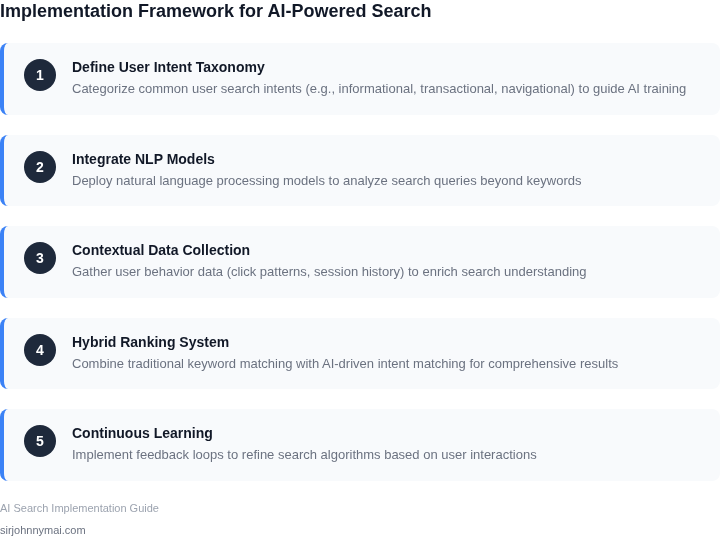
To integrate AI search into your product, we need to start with data preparation. I evaluated several data processing frameworks, including Apache Beam and AWS Glue, because they offer scalable and flexible data processing capabilities. Apache Beam provides a unified programming model for both batch and streaming data processing, while AWS Glue offers a fully managed extract, transform, and load (ETL) service.
Once the data is prepared, we need to select a suitable AI model for our search functionality. I considered models like BERT and RoBERTa because they have shown state-of-the-art results in natural language processing tasks. BERT, for example, uses a multi-layer bidirectional transformer encoder to generate contextualized representations of words in the input text. However, this works well when the input text is relatively short, but breaks when the input text is very long, due to the quadratic increase in computational complexity.
Model Selection and Deployment
After selecting the AI model, we need to deploy it in a way that integrates with our existing product infrastructure. I recommend using a containerization platform like Kubernetes to manage the deployment and scaling of our AI model. Kubernetes provides automated rollout and rollback, self-healing, and resource scaling, which are essential for ensuring the reliability and performance of our AI search functionality. Additionally, we can use monitoring tools like Datadog to track the performance of our AI model and identify potential issues.
To deploy the AI model, we can use a cloud-based platform like AWS SageMaker, which provides a fully managed service for building, training, and deploying machine learning models. AWS SageMaker offers a range of features, including automated model tuning, model hosting, and batch processing, which can simplify the deployment process. However, this requires careful planning and configuration to ensure that the model is deployed correctly and functions as expected.
Next Steps
To move forward with implementing AI search in our product, we need to start by preparing our data and selecting a suitable AI model. Pull your last 90 days of search query data and calculate the frequency and distribution of different query types, including natural language queries and keyword-based queries. This will help us understand the characteristics of our search data and identify the most suitable AI model for our use case.
Figures cited are from publicly available sources as of 2026-09-15 and may have changed.