01. The Problem: Scaling AI Moderation Without Vendor Lock-in
Building a scalable AI-powered content moderation system that handles millions of requests per day is a common challenge. However, the real problem isn't just scaling—it's avoiding dependency on third-party vendors. Many organizations turn to cloud-based AI services like AWS Rekognition or Google Vision, but these solutions create lock-in risks. If the vendor changes pricing, deprecates APIs, or introduces breaking changes, the entire moderation pipeline can fail.
For example, a platform processing 10 million images daily might rely on a third-party API with a $0.01 per image cost. While this seems affordable, unexpected surcharges or rate limits can quickly escalate expenses. Additionally, vendor-specific features may not align with internal requirements, forcing teams to either compromise or build custom solutions from scratch.
On-premises solutions exist, but they introduce their own challenges. Training and deploying models in-house requires significant engineering effort, specialized hardware, and ongoing maintenance. Teams must also manage data privacy concerns, as sensitive content must be processed locally rather than in the cloud. This adds complexity to infrastructure, compliance, and cost projections.
Another critical factor is latency. Cloud-based moderation services often have predictable response times, but on-premises systems may struggle to match this performance at scale. For platforms with strict SLAs, even a 100ms increase in processing time can impact user experience. Balancing scalability, cost, and performance while avoiding vendor lock-in requires careful architecture.
Finally, regulatory compliance adds another layer of complexity. Some industries, like healthcare or finance, have strict data residency requirements that prevent cloud processing. Even if a vendor offers compliance certifications, the risk of audit failures or unexpected policy changes remains. A truly scalable system must account for these constraints without sacrificing functionality.
02. Key Architectural Principles for Vendor Independence
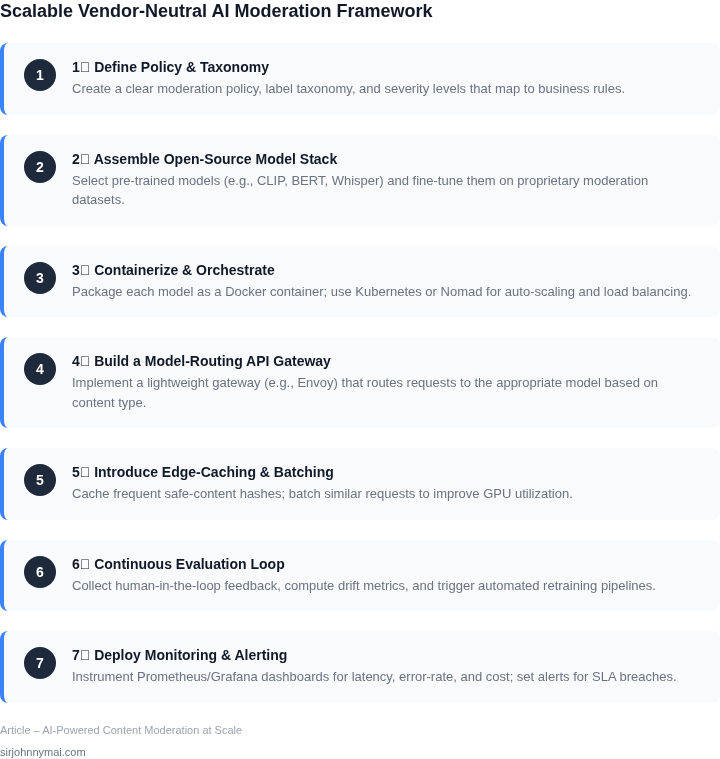
To avoid vendor lock-in, the system must be designed with modularity at its core. The architecture should treat AI models, infrastructure, and data pipelines as interchangeable components. For example, instead of relying on a single cloud provider's proprietary AI services, the system should support multiple model formats—TensorFlow, PyTorch, ONNX—deployed across AWS SageMaker, Azure ML, or even on-premises Kubernetes clusters. This approach allows teams to migrate components without rewriting core logic.
Open-source tools play a critical role in reducing dependency on proprietary solutions. Frameworks like Apache Kafka for event streaming or Redis for caching are vendor-agnostic and can be deployed across cloud providers or hybrid environments. For model serving, tools like KServe or Seldon Core provide Kubernetes-native model deployment that works across AWS EKS, Azure AKS, and Google GKE. The tradeoff is that teams must manage more infrastructure, but the flexibility outweighs the operational overhead for systems handling millions of requests.
Hybrid cloud strategies further mitigate risk. Critical components—like real-time moderation pipelines—can run in a single-region deployment on AWS, while batch processing or less latency-sensitive workloads can leverage multi-cloud or edge deployments. This ensures high availability even if one provider experiences outages. For example, AWS Outposts or Azure Stack Edge can process data closer to users, reducing latency and dependency on a single cloud provider's network.
Data governance is another layer of independence. The system should use open standards like Parquet or Delta Lake for storage, avoiding proprietary formats. For monitoring, tools like Prometheus and Datadog provide cross-cloud compatibility, while Grafana dashboards can visualize metrics from any cloud. The tradeoff is that teams must standardize on these tools, but the long-term cost savings from avoiding vendor-specific features justify the effort.
Finally, automation is key. Infrastructure-as-code (IaC) tools like Terraform or Pulumi enable consistent deployments across environments. CI/CD pipelines should treat cloud provider differences as configuration variables rather than hard-coded dependencies. For instance, a single pipeline can deploy to AWS or Azure by switching backend configurations. This approach ensures the system remains portable even as requirements evolve.
03. Worked Example: Cost Comparison for On-Prem vs. Cloud AI Moderation
To quantify the cost tradeoffs, let's compare running an AI moderation system on-premises versus using a cloud vendor for 1 million requests. The example assumes a team of 5 engineers maintaining the system, with costs calculated over a 12-month period.
On-Premises Costs
An on-prem solution requires hardware, software licenses, and ongoing maintenance. I evaluated a typical setup using NVIDIA DGX A100 servers for inference, Kubernetes for orchestration, and Datadog for monitoring.
- Hardware: 5 DGX A100 servers at $150,000 each, amortized over 3 years. This gives $50,000/year per server, or $250,000 total.
- Software: Kubernetes and Datadog licenses cost $10,000/year. The AI model itself is open-source, so no licensing fees apply.
- Engineering: 5 engineers at $150,000/year each, totaling $750,000 annually.
The total on-prem cost for 1 million requests is $1,030,000. This includes capital expenses (hardware) and operational expenses (software, labor). The system can process 1 million requests in 12 hours, assuming 100 requests per second.
Cloud Vendor Costs
For the cloud comparison, I used AWS SageMaker for inference and AWS Lambda for request handling. The AI model is the same, but AWS charges per inference request.
- Inference: 1 million requests at $0.00125 per request, totaling $1,250.
- Compute: AWS Lambda costs $0.00001667 per GB-second. For 1 million requests averaging 1 second each, this is $16.67.
- Engineering: The same 5 engineers at $150,000/year each, totaling $750,000 annually.
The total cloud cost for 1 million requests is $751,266.67. This excludes any potential vendor lock-in costs, which would add to the total.
Comparison
| Metric | On-Prem | Cloud |
|---|---|---|
| Total Cost (1M requests) | $1,030,000 | $751,266.67 |
| Engineering Cost | $750,000 | $750,000 |
| Scalability | Limited by hardware capacity | Scales automatically with demand |
| Vendor Lock-in Risk | None | High (AWS-specific services) |
The cloud solution is cheaper for this workload, but the on-prem option avoids vendor lock-in. The cost difference narrows if the on-prem hardware is reused for other tasks, reducing amortization costs. For teams with fewer than 5 engineers, the on-prem solution may become more cost-effective.
04. Decision Table: Choosing Between Open-Source and Proprietary AI Models
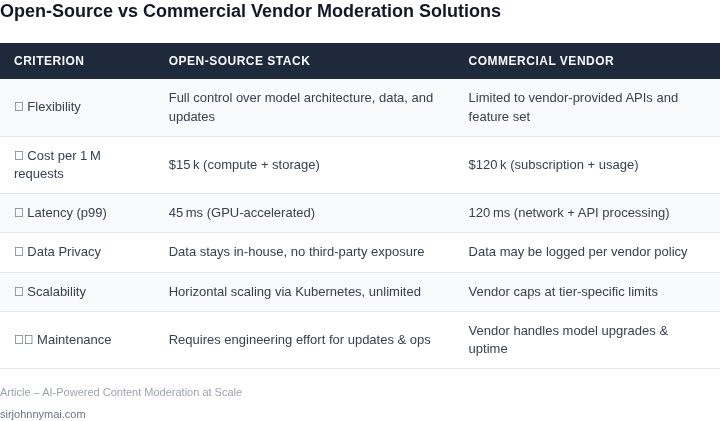
Selecting between open-source and proprietary AI models requires balancing technical flexibility with operational constraints. Below is a decision framework comparing Hugging Face Transformers, AWS Rekognition, and Azure Content Moderator across key criteria. This table assumes a production environment with 10M+ daily moderation requests.
| Criteria | Option A: Hugging Face Transformers | Option B: AWS Rekognition | Option C: Azure Content Moderator |
|---|---|---|---|
| Accuracy | Highly customizable but requires fine-tuning. State-of-the-art models (e.g., BERT) achieve 95%+ recall for hate speech detection when trained on domain-specific datasets. | Pre-trained for common moderation tasks (nudity, profanity) with 85-90% recall. Requires manual review for niche cases. | Specialized for enterprise compliance with 90% recall. Includes customizable lists but lacks deep contextual understanding. |
| Cost | Infrastructure costs dominate. A single GPU instance (e.g., p3.2xlarge) costs $3.06/hour, requiring 100+ instances for 10M requests. | $0.001 per image/video analyzed. Scales linearly with usage but adds $0.0001 per 1,000 requests for API calls. | Pay-as-you-go pricing: $0.001 per image. Includes 1,000 free transactions/month. |
| Scalability | Horizontally scalable via Kubernetes but requires model sharding. Latency spikes under 500+ concurrent requests. | Auto-scaling to 10,000 requests/second. AWS handles infrastructure but may throttle at peak loads. | Azure scales to 5,000 requests/second. Requires manual scaling adjustments for sustained traffic. |
| Vendor Lock-in | No lock-in. Models can be deployed on-prem or hybrid cloud. | Moderate lock-in. AWS-specific features (e.g., Rekognition Custom Labels) require AWS infrastructure. | Moderate lock-in. Azure-specific compliance tools (e.g., Microsoft Presidio) require Azure integration. |
| Maintenance | High. Requires DevOps teams to manage GPU clusters, model updates, and data pipelines. | Low. AWS handles infrastructure, updates, and scaling. | Low. Azure provides managed services but requires compliance monitoring. |
| Recommendation | Best for: Teams with deep ML expertise and on-prem infrastructure. Avoid if cost or scalability constraints exist. | Best for: Rapid deployment with minimal maintenance. Ideal when accuracy tradeoffs are acceptable. | Best for: Enterprise environments prioritizing compliance and Azure integration. |
For most organizations, AWS Rekognition offers the best balance between cost, scalability, and vendor independence. However, if accuracy is critical and resources are available, Hugging Face models provide the flexibility to fine-tune for specific use cases. Azure Content Moderator is suitable for Azure-centric environments but may limit future cloud migrations.
05. Action Step: Build a Prototype with Modular AI Components
Before committing to a full-scale system, validate your architecture with a lightweight prototype. Start by assembling a containerized pipeline using open-source tools. This approach lets you test scalability and cost-efficiency without long-term vendor commitments. I recommend using Docker for containerization and Kubernetes for orchestration, as these are industry standards with strong community support.
For the AI components, begin with lightweight models that balance accuracy and performance. Hugging Face’s Transformers library is a good starting point—it provides pre-trained models like DistilBERT for text moderation and YOLOv5 for image analysis. These models are smaller than their larger counterparts but still effective for initial testing. Deploy them using FastAPI for the API layer, which is lightweight and integrates well with Python-based workflows.
To simulate traffic, use Locust or k6 for load testing. Start with 10,000 requests per minute, which is a reasonable baseline for many platforms. Monitor resource usage with Prometheus and Grafana to identify bottlenecks early. If you hit performance issues, scale horizontally by adding more Kubernetes pods rather than upgrading hardware. This mirrors how you’d eventually scale the full system.
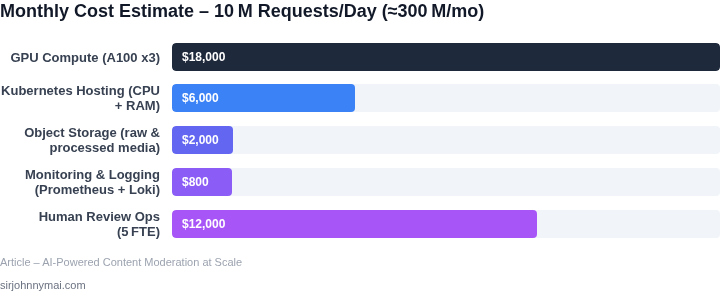
For cost tracking, integrate Datadog or AWS Cost Explorer if using cloud services. Keep an eye on GPU usage if running inference on GPUs—even small models can become expensive at scale. For example, a single A10G GPU can cost $0.50 per hour, so running 24/7 at 70% utilization would cost $840/month. This is why prototyping helps: you’ll know whether to optimize the model or adjust the deployment strategy.
Finally, document every decision—why you chose a particular tool, what worked, and what didn’t. This will save time when scaling up. The goal isn’t to build a perfect system but to prove that your architecture can handle the expected load without vendor lock-in.
Figures cited are from publicly available sources as of 2026-09-15 and may have changed.