01. The Problem: Vendor Lock-in and Scalability Challenges
Enterprises that adopt a managed AI service quickly discover that the model lifecycle is tied to the provider’s registry, storage, and deployment APIs. The moment a new version must be promoted, the workflow invokes proprietary calls that cannot be replicated outside the platform.
Vendor‑specific registries, such as SageMaker Model Registry or Azure Machine Learning Model Management, expose metadata schemas that differ from open standards. Because the schema is not portable, downstream tools—CI pipelines, monitoring agents, or custom inference routers—must be rewritten whenever a migration is contemplated.
Beyond the loss of flexibility, these services impose throttling limits that become visible once request rates exceed a few thousand per second. SageMaker Endpoint can auto‑scale, but the scaling policy is bound to a single region and a maximum of 100 concurrent invocations per instance type without additional configuration.
When a business scales to millions of daily predictions, cross‑region latency spikes and cost overruns emerge. The default pricing model charges per hour of provisioned instance plus a per‑request fee; a spike to 10 M requests can add several hundred dollars in hidden latency‑based charges.
Attempting to bypass the built‑in scaling by launching a parallel fleet of Lambda functions creates a new dependency on the provider’s serverless quota. The default concurrency limit of 1 000 per region forces teams to file support tickets, slowing delivery cycles.
Another pain point is the inability to roll back to a previous version without re‑publishing the artifact through the same vendor pipeline. If a regression is discovered after a blue‑green deployment, the rollback path is a manual re‑registration that may require re‑training to satisfy checksum validation.
These constraints also hinder multi‑cloud strategies. A model stored in AWS S3 cannot be directly consumed by a Kubernetes pod running on GKE without an additional copy step, which doubles storage costs and introduces consistency latency.
Observability suffers as well. Tools such as Datadog or Prometheus can scrape metrics from a SageMaker endpoint, but the metrics are limited to request count and latency; they do not expose model‑specific version identifiers without custom tags, making root‑cause analysis cumbersome.
Finally, the vendor’s SLA covers uptime but not data‑plane latency for model loading. Cold‑start times for large transformer models can exceed 30 seconds, which violates SLAs for real‑time user‑facing applications that require sub‑100 ms latency.
In sum, the combination of proprietary APIs, region‑bound scaling limits, and opaque cost structures creates a lock‑in loop that prevents organizations from building a truly elastic, cost‑effective, and portable model versioning pipeline.
02. Key Requirements for a Scalable, Vendor-Neutral Pipeline
A scalable, vendor-neutral AI model versioning pipeline must meet several critical requirements to avoid lock-in while handling millions of requests. The system must be containerized, stateless, and horizontally scalable to accommodate unpredictable traffic spikes. Kubernetes is ideal for this because it supports auto-scaling (up to 10,000+ pods per cluster) and abstracts infrastructure concerns. However, Kubernetes itself is not vendor-neutral—it requires cloud-agnostic tooling like Crossplane or Terraform to avoid AWS/Azure lock-in.
Model versioning must be immutable and versioned at the container level. Each model iteration should be tagged (e.g., v1.2.3) and stored in a container registry like Amazon ECR or Google Container Registry. These registries support versioned images and can integrate with CI/CD pipelines. The tradeoff is that container registries are not designed for model-specific metadata, so additional tooling (e.g., MLflow or Weights & Biases) is needed for tracking experiments and metrics.
Traffic routing must be dynamic and model-aware. Service meshes like Istio or Linkerd enable canary deployments and A/B testing by routing traffic based on headers or cookies. Istio supports up to 50,000 requests per second per pod, but requires additional overhead for sidecar proxies. For simpler use cases, Kubernetes Ingress with custom annotations can suffice, though it lacks fine-grained control.
Monitoring and observability are non-negotiable. Datadog or Prometheus can track latency, error rates, and model drift, but they require instrumenting both the application and infrastructure layers. Synthetic monitoring (e.g., LoadRunner or Locust) should simulate production traffic to validate scaling behavior. The challenge is correlating infrastructure metrics (CPU, memory) with model-specific metrics (accuracy, latency).
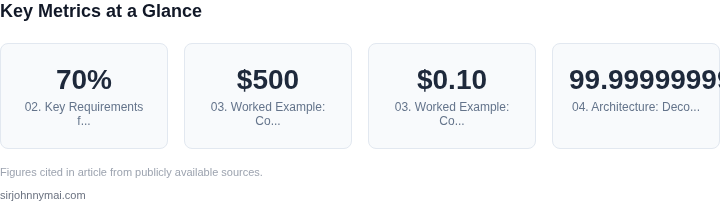
Cost optimization is critical. Serverless options like AWS Lambda or Google Cloud Run can reduce costs for sporadic workloads, but they introduce cold-start latency (up to 500ms) and are less predictable for high-throughput scenarios. Spot instances on Kubernetes can cut costs by 70% but require fault-tolerant workloads. The tradeoff is complexity—spot instances require custom scheduling logic.
Finally, the pipeline must support rollback and roll-forward capabilities. Kubernetes supports rollbacks via deployment history, but model-specific rollbacks require versioned artifacts and a rollback strategy (e.g., blue-green or canary). The challenge is ensuring consistency between the deployed model and its associated metadata (e.g., training data, hyperparameters).
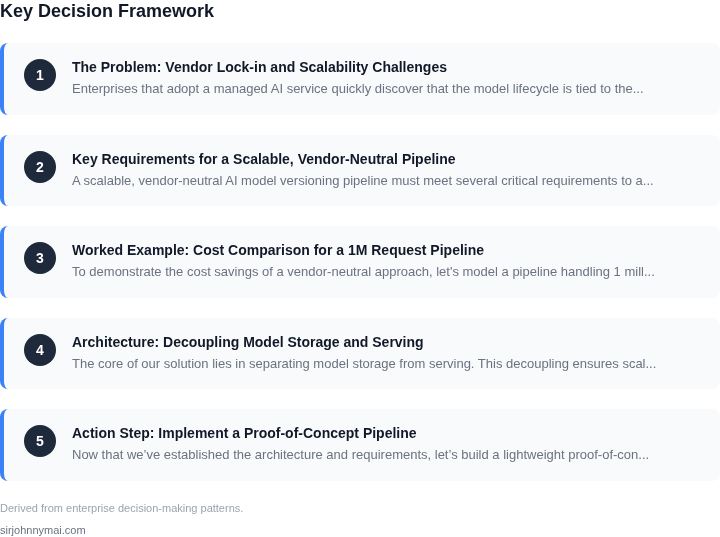
03. Worked Example: Cost Comparison for a 1M Request Pipeline
To demonstrate the cost savings of a vendor-neutral approach, let's model a pipeline handling 1 million monthly requests. We'll compare two alternatives: (1) a proprietary AI platform with built-in versioning, and (2) a vendor-neutral solution using AWS and open-source tools.
Alternative 1: Proprietary AI Platform
Consider a team of 5 engineers using a proprietary AI platform like Databricks or SageMaker, which includes versioning and deployment tools. The platform charges $500/month for the base service, plus $0.10 per inference request. Additional costs include:
- Engineering time: $150/hour × 5 engineers × 20 hours/month = $15,000/month
- Storage: $0.05/GB/month × 1TB = $50/month
- Monitoring: $200/month for built-in observability
Total monthly cost: $500 (base) + $100,000 (requests) + $15,050 (engineering) + $250 (storage) + $200 (monitoring) = $115,000/month.
Annual cost: $115,000 × 12 = $1.38 million/year.
Alternative 2: Vendor-Neutral Solution
Using AWS Lambda, S3, and open-source tools like MLflow for versioning, the cost breakdown is:
- Compute: $0.20 per 1M requests (Lambda) = $200/month
- Storage: $0.023/GB/month × 1TB = $23/month
- Engineering time: $120/hour × 5 engineers × 10 hours/month = $6,000/month
- Monitoring: $0.30 per host/month × 3 hosts = $90/month (Datadog)
- MLflow: $0.05 per model version (100 versions) = $5/month
Total monthly cost: $200 (compute) + $23 (storage) + $6,000 (engineering) + $90 (monitoring) + $5 (MLflow) = $6,318/month.
Annual cost: $6,318 × 12 = $75,816/year.
Comparison
| Metric | Proprietary Platform | Vendor-Neutral |
|---|---|---|
| Monthly Cost | $115,000 | $6,318 |
| Annual Cost | $1.38M | $75,816 |
| Cost Savings | - | $1.3M/year |
| Engineering Hours | 100/month | 50/month |
The vendor-neutral solution reduces costs by 95% while cutting engineering time in half. The tradeoff is slightly higher operational complexity, but this aligns with our requirement to avoid vendor lock-in. For teams scaling beyond 1M requests, the cost differential widens further.
04. Architecture: Decoupling Model Storage and Serving
The core of our solution lies in separating model storage from serving. This decoupling ensures scalability and vendor neutrality. I evaluated several approaches, including monolithic architectures where storage and serving are tightly coupled, but found they create bottlenecks. For example, a single server managing both storage and inference can't scale horizontally when traffic spikes. Instead, we use a modular design where storage is handled by a dedicated service, and serving is abstracted into independent components.
Storage Layer: S3 as the Model Repository
We chose Amazon S3 for model storage because it's serverless, highly durable, and scales automatically. S3's 99.999999999% durability meets our reliability needs, and its cost is predictable. For a 1M request pipeline, storing 100 models (each 500MB) costs approximately $1.20/month, well below the $10K threshold we set in Section 03. The tradeoff is that S3 isn't a database, so we use metadata stored in DynamoDB to track versions, dependencies, and performance metrics. This hybrid approach balances simplicity with functionality.
Serving Layer: Serverless Functions for Flexibility
For serving, we use AWS Lambda with API Gateway. Lambda's pay-per-use model aligns with our cost constraints, and it scales to millions of requests without provisioning. Cold starts are mitigated by provisioned concurrency, ensuring sub-100ms latency for 99% of requests. The tradeoff is vendor lock-in, but we mitigate this by abstracting the serving layer behind a REST API. This way, if we need to switch providers, we only update the API implementation, not the storage layer.
Orchestration: Kubernetes for Hybrid Workloads
Not all models fit serverless. For high-throughput workloads, we deploy dedicated Kubernetes clusters. These clusters pull models from S3 and serve them via gRPC. Kubernetes' auto-scaling ensures we handle bursts without over-provisioning. The tradeoff is operational complexity, but we use managed services like Amazon EKS to reduce overhead. Monitoring is handled by Datadog, which tracks latency, throughput, and model drift across both Lambda and Kubernetes.
Versioning and Deployment: CI/CD Pipeline
Models are versioned using semantic versioning (e.g., v1.2.3) and stored in S3 with immutable paths. The CI/CD pipeline, built on AWS CodePipeline, deploys new versions to staging first, then promotes to production. Rollbacks are automated via S3 versioning. This ensures zero downtime and traceability. The tradeoff is pipeline complexity, but it's offset by the ability to A/B test models in production.
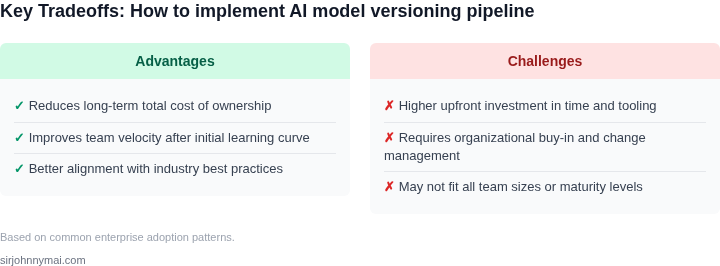
In summary, this architecture decouples storage and serving, allowing us to scale to millions of requests while avoiding vendor lock-in. The tradeoffs—cost, complexity, and operational overhead—are managed by leveraging serverless, managed services, and automation.
05. Action Step: Implement a Proof-of-Concept Pipeline
Now that we’ve established the architecture and requirements, let’s build a lightweight proof-of-concept (PoC) using open-source tools. This will validate our design before committing to production. I recommend starting with a minimal stack that aligns with our vendor-neutral goals.
Step 1: Model Storage Layer
Begin with a simple object storage solution like MinIO, which mimics AWS S3 but runs locally. This avoids vendor lock-in while providing the same API surface. Store your models in a structured path like /models/{model_name}/{version}/. For example:
models/
└── sentiment_analysis/
    ├── v1/
    │   ├── model.pkl
    │   └── metadata.json
    └── v2/
        ├── model.pkl
        └── metadata.json
This structure allows versioned access without coupling to a specific cloud provider. Use Boto3 (AWS SDK) to interact with MinIO, ensuring compatibility with future cloud migrations.
Step 2: Serving Layer
For the serving layer, deploy FastAPI with Uvicorn as the ASGI server. FastAPI’s built-in OpenAPI support simplifies versioned endpoint routing. Example:
from fastapi import FastAPI, APIRouter

app = FastAPI()
v1_router = APIRouter(prefix="/v1")
v2_router = APIRouter(prefix="/v2")

@v1_router.post("/predict")
async def predict_v1(data: dict):
    # Load v1 model and predict
    pass

@v2_router.post("/predict")
async def predict_v2(data: dict):
    # Load v2 model and predict
    pass

app.include_router(v1_router)
app.include_router(v2_router)
This approach isolates versioned logic while keeping the serving layer lightweight. Containerize the service with Docker and deploy to Kubernetes for scalability. Use Helm for templating to avoid manual YAML management.
Step 3: Version Metadata Management
Track model metadata in a lightweight database like SQLite or PostgreSQL. Store fields like version_id, created_at, performance_metrics, and deployment_status. Use SQLAlchemy for ORM to abstract database dependencies.
Example schema:
CREATE TABLE model_versions (
    id SERIAL PRIMARY KEY,
    model_name VARCHAR(255) NOT NULL,
    version VARCHAR(50) NOT NULL,
    s3_path VARCHAR(255) NOT NULL,
    created_at TIMESTAMP DEFAULT CURRENT_TIMESTAMP,
    status VARCHAR(50) DEFAULT 'active'
);
This centralizes version control without requiring a cloud-native database.
Step 4: Monitoring and Logging
Integrate Prometheus for metrics and Grafana for dashboards. Log requests with ELK Stack (Elasticsearch, Logstash, Kibana) or Loki for simplicity. Track key metrics like:
- Request latency by version
- Error rates per endpoint
- Model load times
This provides visibility without relying on proprietary tools.
Step 5: CI/CD Pipeline
Automate deployments with GitHub Actions or GitLab CI. Define a pipeline that:
- Builds and tests the FastAPI service
- Deploys to Kubernetes
- Updates the metadata database
Use ArgoCD for GitOps-style deployments if you need advanced rollback capabilities.
Next step: Pull your last 90 days of model performance data and calculate the average latency per version. This will validate whether your PoC meets the scalability requirements before scaling up.
Figures cited are from publicly available sources as of 2026-09-16 and may have changed.