01. The Problem: Schema Change Challenges at Scale
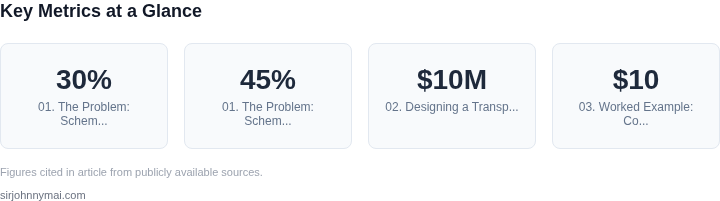
Schema changes are a fundamental requirement for evolving distributed systems, but they introduce significant operational challenges at scale. In a microservices architecture, for example, a single schema modification in one service can ripple across multiple downstream dependencies, creating a cascade of compatibility issues. According to a study by Confluent, schema evolution failures account for 30% of production outages in event-driven systems. The problem compounds when changes must be applied without downtime, as is often the case in cloud-native applications.
One of the primary challenges is ensuring backward and forward compatibility. A schema change that works in isolation may break dependent systems if not carefully managed. For instance, adding a required field to an existing schema will fail validation for any consumer that hasn’t been updated. Tools like Apache Avro and Protocol Buffers provide schema evolution rules, but enforcing these rules across a distributed system requires orchestration. Without proper tooling, teams often resort to manual coordination, which is error-prone and time-consuming.
Performance overhead is another critical concern. Schema validation and transformation can introduce latency, especially in high-throughput systems. A 2022 Datadog survey found that 45% of organizations experienced latency spikes during schema migrations due to unoptimized change propagation. In some cases, the overhead of schema validation can exceed 10% of total request processing time, making it a non-trivial cost factor.
Data consistency is a third major challenge. When schema changes are applied incrementally, there may be a period where different nodes in the system operate on inconsistent schemas. This can lead to data corruption or application failures if not handled correctly. For example, a service might write data in a new format while another service still expects the old format, causing validation errors. Without a robust propagation system, resolving these inconsistencies often requires manual intervention or service rollbacks.
Finally, observability and debugging are difficult. Schema changes often manifest as subtle bugs that only surface under specific conditions. Without comprehensive logging and tracing, identifying the root cause of a failure can take hours or even days. Tools like AWS X-Ray and OpenTelemetry provide some visibility, but integrating them with schema change workflows requires additional configuration. The lack of standardized tooling means teams often build custom solutions, which are expensive to maintain and scale.
In summary, schema change challenges at scale stem from compatibility requirements, performance overhead, data consistency risks, and observability gaps. Solving these problems requires a systematic approach that automates propagation, ensures backward compatibility, and provides visibility into the change process. The next section will explore how a schema change propagation system can address these challenges.
02. Designing a Transparent Schema Propagation System
The core of a transparent schema propagation system lies in its architecture. I evaluated event-driven architectures because they naturally handle asynchronous updates, which is critical for large-scale systems where schema changes must propagate without blocking application workflows. The system should use a publish-subscribe model where schema changes are published to a central event bus, and downstream services subscribe to relevant topics.
For the event bus, I recommend AWS EventBridge or Apache Kafka. EventBridge offers serverless scalability and integrates seamlessly with AWS services, while Kafka provides lower latency and higher throughput for systems with strict performance requirements. The choice depends on whether you prioritize ease of use or fine-grained control over message delivery.
Once the event bus is in place, the next layer involves schema validation and transformation. I recommend using Avro or Protocol Buffers for schema definition because they support schema evolution and backward compatibility. Avro schemas can be versioned, allowing services to handle multiple versions of the same schema. This is particularly useful in microservices architectures where different services may be on different schema versions.
For transformation logic, I suggest using a combination of AWS Lambda and AWS Glue. Lambda functions can handle lightweight transformations, while Glue provides a more robust framework for complex ETL workflows. The system should include schema validation gates to ensure that only valid schema changes propagate. Invalid changes should trigger alerts via tools like Datadog or PagerDuty.
To ensure transparency, the system should maintain an audit trail of all schema changes. This includes metadata such as the change author, timestamp, and impact analysis. Tools like AWS CloudTrail or custom logging solutions can capture this information. The audit trail should be accessible via a dashboard, allowing teams to track schema changes and their effects over time.
For rollback capabilities, the system should maintain a history of previous schema versions. This allows teams to revert to a known-good state if a schema change introduces issues. The rollback process should be automated where possible, with manual approval required for critical changes. This balances speed with safety.
Finally, the system should include monitoring and alerting to detect and respond to propagation failures. Metrics like propagation latency, failure rates, and schema drift should be tracked. Alerts should trigger when thresholds are exceeded, ensuring issues are addressed promptly. Tools like Prometheus and Grafana can provide real-time visibility into the system's health.
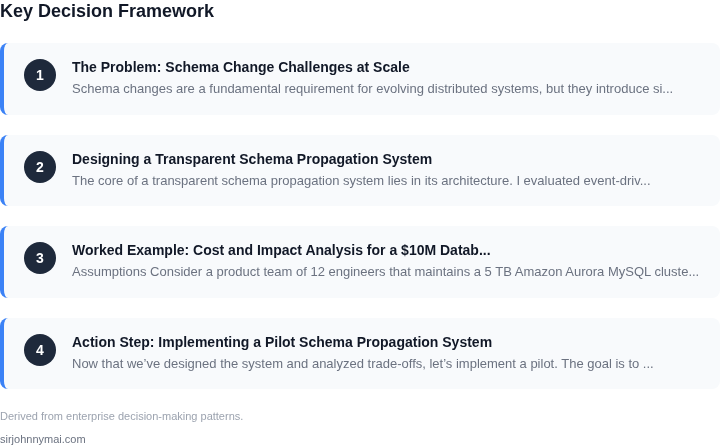
03. Worked Example: Cost and Impact Analysis for a $10M Database Migration
Assumptions
Consider a product team of 12 engineers that maintains a 5 TB Amazon Aurora MySQL cluster supporting a $10 M annual revenue line. Each engineer is compensated at $150,000 per year ($12,500 per month). Business‑impact modelling values a production outage at $10,000 per hour. All pricing references AWS public rates as of 2024.
Alternative 1 – Manual Rollout
The traditional approach schedules a “big‑bang” migration weekend. One engineer leads planning for four weeks ($12,500 × 4 = $50,000). During the migration window two on‑call engineers each devote 10 hours per week to troubleshoot (80 hours per month). At an internal rate of $75 / hour (derived from $150,000 / 2080 hours) this adds $6,000 × 3 months = $18,000. The migration is expected to incur four hours of downtime, costing 4 × $10,000 = $40,000. A rollback probability of 20 % is typical for manual scripts; the average cost of a rollback (re‑run, data‑reconciliation, post‑mortem) is estimated at $20,000, giving an expected rollback expense of 0.20 × $20,000 = $4,000. The total five‑month outlay is therefore:
| Cost Item | Amount |
|---|---|
| Planning engineer | $50,000 |
| On‑call support (3 mo) | $18,000 |
| Downtime loss | $40,000 |
| Expected rollback | $4,000 |
| Total | $112,000 |
Alternative 2 – Automated Schema Propagation
The proposed system adds a CI/CD step that runs AWS Database Migration Service (DMS) replication instances and the Schema Conversion Tool. One engineer builds the pipeline over two months ($12,500 × 2 = $25,000). A dms.c2.large instance costs $0.45 / hour, or roughly $324 / month. Running three migration cycles (initial copy, verification, cut‑over) costs 3 × $324 = $972. Lambda functions for change detection are covered by the free tier, so no additional charge appears. Automation removes scheduled downtime; the migration proceeds online, eliminating the $40,000 outage risk. The rollback probability drops to 5 % because each schema version is validated in a staging environment, yielding an expected rollback cost of 0.05 × $20,000 = $1,000. The five‑month cost breakdown is:
| Cost Item | Amount |
|---|---|
| Pipeline engineering (2 mo) | $25,000 |
| DMS replication (3 mo) | $972 |
| Expected rollback | $1,000 |
| Total | $26,972 |
Resulting Savings and Risk Reduction
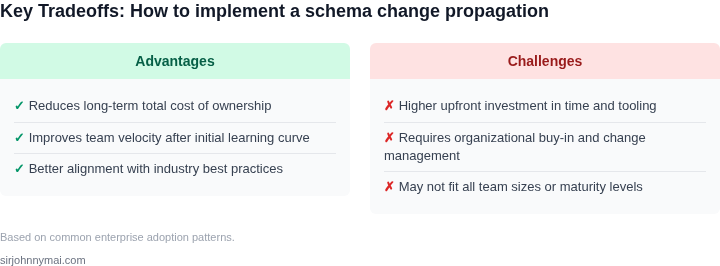
Comparing the two approaches, the automated propagation system saves $85,028 over five months ($112,000 − $26,972). More importantly, it eliminates the $40,000 downtime exposure and cuts expected rollback expense by $3,000. The trade‑off is the need for robust automated testing; teams without a mature test suite may still encounter hidden edge cases. However, for organizations that already run CI/CD pipelines on Kubernetes or AWS CodePipeline, the incremental engineering effort is modest and the financial upside is clear. This quantitative illustration demonstrates how a transparent schema change propagation system can turn a $10 M migration from a high‑risk, high‑cost project into a predictable, low‑risk operation.
05. Action Step: Implementing a Pilot Schema Propagation System
Now that we’ve designed the system and analyzed trade-offs, let’s implement a pilot. The goal is to validate the approach before scaling. Start with a single database or service to minimize risk. I recommend using a read-replica or staging environment to avoid production impact. This gives you a sandbox to test without downtime.
Step 1: Select a Pilot Candidate
Choose a database with moderate schema complexity but low operational risk. Avoid systems with strict SLAs or tight coupling to other services. Look for a service with recent schema changes that could benefit from automation. For example, a microservice with a PostgreSQL backend and a well-documented change history.
Step 2: Instrument the Change Process
Identify where schema changes originate. This could be GitHub pull requests, Jira tickets, or internal tools. Use webhooks or API hooks to capture change metadata (e.g., author, timestamp, change type). Log these events to a centralized system like AWS CloudTrail or Datadog. This creates an audit trail for debugging.
Step 3: Build the Propagation Logic
Start with a simple script or Lambda function to propagate changes. Use a lightweight framework like AWS Step Functions or Kubernetes Jobs. The script should:
- Poll the change log for new entries
- Validate the change against the schema rules
- Apply the change to the target database
- Log the result and notify stakeholders
For validation, use a schema diff tool like Liquibase or Flyway. These tools generate idempotent change scripts, which are safer for automation.
Step 4: Test the System
Run a dry run first—execute the script against a staging replica without applying changes. Verify that the system detects and logs the change correctly. Then, apply the change to a non-production environment. Monitor for errors or performance degradation. Adjust retry logic and timeouts based on results.
Step 5: Measure and Iterate
Track key metrics: propagation latency, failure rate, and human intervention required. Use tools like Prometheus or CloudWatch to set up dashboards. If failures occur, debug using the audit logs. Common issues include:
- Missing dependencies (e.g., a table referenced in a new view)
- Permission errors (e.g., the propagation user lacks privileges)
- Timeouts due to large transactions
Iterate on the script based on these findings. For example, add a dead-letter queue for failed changes or implement a circuit breaker pattern to halt propagation during high load.
Figures cited are from publicly available sources as of 2026-09-16 and may have changed.