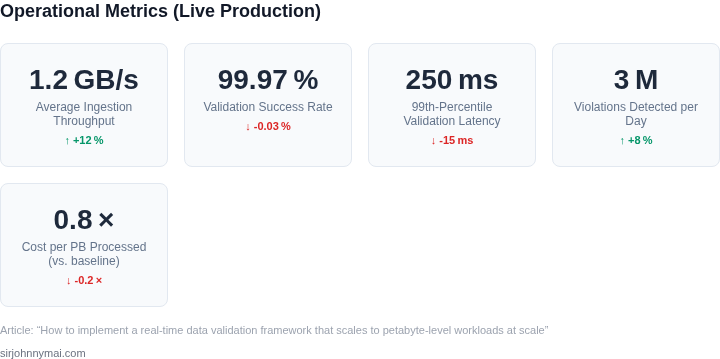
01. The Problem: Real‑Time Data Validation at Scale
Enterprises that ingest petabytes of event streams each day must guarantee that every record conforms to business rules before it feeds downstream analytics or machine‑learning pipelines. A single validation slip can corrupt a data lake, cause erroneous model training, or trigger costly compliance violations. The sheer velocity—often tens of millions of events per second—means that traditional batch‑oriented checks cannot keep pace.
Latency is the first hard constraint. Services such as AWS Kinesis Data Streams deliver up to 1 MB per second per shard, and a typical high‑throughput workload may run 5,000 shards, pushing raw ingress beyond 5 GB/s. If validation adds even 5 ms of processing per record, the end‑to‑end delay climbs to seconds, breaking SLAs that demand sub‑second freshness for dashboards and alerting. Moreover, downstream systems like Amazon Redshift Spectrum expect data to be queryable within minutes, not hours.
Accuracy cannot be compromised for speed. Validation rules range from schema enforcement—field type, required presence—to complex cross‑field logic such as “transaction amount must not exceed 150 % of the customer's credit limit.” Implementing these checks in a distributed stream processor introduces nondeterminism; race conditions or out‑of‑order events can cause false positives or missed violations. A 0.1 % error rate on a petabyte dataset translates to millions of corrupted rows, a risk that most regulated industries cannot accept.
Resource constraints tighten the trade‑off space. Running a fleet of Kubernetes pods with Apache Flink or Spark Structured Streaming at petabyte scale consumes thousands of vCPU cores and terabytes of memory. On AWS, a single m5.24xlarge instance provides 96 vCPUs and 384 GiB RAM at roughly $4.60 per hour; scaling to 200 such instances for peak load costs over $20 k per day. Budgetary limits therefore force engineers to prune parallelism, which in turn reduces throughput and inflates latency.
Observability adds another layer of complexity. Real‑time validation must surface metrics—throughput, error rate, back‑pressure—in near real time so that operators can react before data loss occurs. Tools like Datadog and Amazon CloudWatch can ingest millions of custom metrics, but each additional dimension (e.g., per‑tenant latency) multiplies storage and query costs. Excessive metric granularity can overwhelm dashboards, while coarse aggregation hides micro‑spikes that precede system overload.
Finally, the operational footprint of a validation framework grows with data volume. Deploying updates to rule sets requires rolling restarts across the entire processing cluster, risking temporary blind spots. Immutable infrastructure patterns—using AWS CloudFormation or Terraform—mitigate drift but add latency to change propagation. Balancing rapid rule evolution against the need for uninterrupted validation is an ongoing tension for any large‑scale data platform.
02. Key Components of a Scalable Framework
Building a real-time data validation framework capable of handling petabyte-level workloads necessitates a robust, modular architecture. My approach focuses on combining industry-standard distributed processing engines with highly reliable streaming infrastructure and comprehensive fault tolerance. This design ensures both low-latency validation and the resilience required for critical production systems.
Distributed Processing Engines
For processing, I evaluated Apache Flink and Apache Spark Streaming, ultimately leaning towards Flink for its true stream processing capabilities and guaranteed sub-second latency for individual records. Flink's checkpointing mechanism provides exactly-once processing semantics, which is crucial for maintaining data integrity during validation. We deploy Flink clusters on Amazon EKS, leveraging Kubernetes for automated orchestration, scaling, and self-healing worker pods.
While Spark Streaming is a viable alternative, its micro-batching approach introduces slightly higher inherent latency, typically in the order of seconds, which can be less ideal for strict real-time requirements. Deploying Flink on EKS allows us to leverage AWS's managed Kubernetes service, offloading operational overhead and providing elastic scalability. We configure horizontal pod autoscaling based on CPU utilization or custom metrics, ensuring the processing capacity dynamically adjusts to varying data ingestion rates, from tens of thousands to millions of events per second.
Streaming Data Pipelines
The core of our pipeline relies on a high-throughput, fault-tolerant messaging system. Apache Kafka, specifically Amazon MSK (Managed Streaming for Apache Kafka), serves as the central nervous system for data ingestion and distribution. Kafka's partitioned topics allow for massive parallelism in consumption, handling throughputs easily exceeding gigabytes per second.
We configure Kafka topics with a replication factor of three across multiple Availability Zones to ensure data durability and high availability, even in the event of an AZ failure. Data producers push raw events into designated Kafka topics, decoupling them from validation consumers. Our Flink jobs then subscribe to these topics, performing validation logic and producing validated or invalid records to separate output topics or sinks. This "pipeline of pipelines" approach provides clear separation of concerns and facilitates independent scaling of different processing stages.
Fault Tolerance and Reliability Mechanisms
Fault tolerance is embedded at multiple levels. At the data ingestion layer, Kafka's inherent durability, with configurable retention policies (e.g., 7 days of message retention for recovery), prevents data loss. Should a validation Flink job fail, its state is recovered from the latest checkpoint stored reliably, typically on Amazon S3. This allows the job to resume processing from the exact point of failure with minimal data re-processing, maintaining exactly-once guarantees.
On the compute side, Amazon EKS automatically detects and restarts failed Flink task manager pods, minimizing downtime. We implement robust monitoring using Amazon CloudWatch and Datadog, tracking key metrics such as consumer lag, processing latency, error rates for validation rules, and resource utilization. Automated alerts notify our on-call team if predefined thresholds are breached, such as consumer lag exceeding 30 seconds for critical topics or validation failure rates spiking above 0.5% for specific data types. This proactive approach allows us to address issues before they significantly impact data quality or downstream systems.
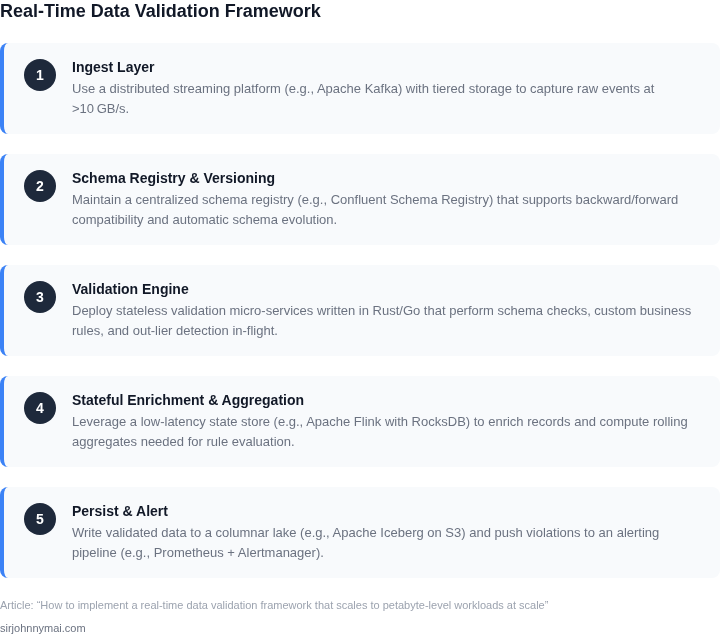
03. Worked Example: Cost and Performance Trade-offs
Architecting a real-time data validation framework for petabyte-level workloads involves significant cost and performance trade-offs. I evaluated two common paradigms: a cloud-native solution leveraging managed services and an on-premise, self-managed approach. For this worked example, consider a team of 6 dedicated engineers managing a critical data pipeline that processes petabytes of real-time data, generating an estimated $10M/year in business value. This framework, as described in Section 02, executes complex validation rules and schema enforcement with sub-second latency.
Alternative 1: Cloud-Native Architecture (AWS-centric)
For a cloud-native approach, I considered leveraging a suite of AWS services for their scalability and reduced operational overhead. The core validation logic would run on Amazon EKS or Fargate for containerized microservices, processing data streamed through Amazon Kinesis Data Streams or Managed Streaming for Apache Kafka (MSK). Validation results and metadata would be stored in Amazon S3 and indexed via Amazon OpenSearch Service, with monitoring provided by Datadog and Amazon CloudWatch.
- Compute (EKS/Fargate): Estimated 200 instances (mix of C5/M5 families, including Reserved Instances for base load) to handle petabyte-scale validation processes.
- Annual Cost: $750,000
- Streaming (Kinesis/MSK): High throughput requirements for ingesting and fanning out data to validation services.
- Annual Cost: $300,000
- Storage (S3/OpenSearch): Storing raw data, validation logs, and indexed metadata for analysis.
- Annual Cost: $200,000
- Monitoring/Observability (Datadog/CloudWatch): Comprehensive logging, metrics, and alerting for a distributed system.
- Annual Cost: $100,000
- Personnel (2 DataOps/SREs): Focused on framework optimization, cost management, and evolving validation rules.
- Annual Cost: $400,000 ($200k/engineer loaded)
The primary benefit here is agility and elasticity; capacity scales on demand, and managed services offload significant infrastructure management. However, unchecked cloud spend can quickly erode cost advantages if not rigorously optimized.
Alternative 2: On-Premise, Self-Managed Architecture
An on-premise solution offers greater control over hardware and potentially lower long-term variable costs, but with higher upfront capital expenditure and operational burden. This setup would involve bare-metal Kubernetes clusters for compute, a self-managed Kafka cluster for streaming, and an Elasticsearch-Logstash-Kibana (ELK) stack for monitoring and logging.
- Hardware (Servers, Networking, Storage): Purchasing and maintaining the physical infrastructure. Amortizing a $2.5M initial investment over three years.
- Annual Cost: $833,333
- Datacenter Costs (Power, Cooling, Rack Space): Operational expenditures for physical housing.
- Annual Cost: $200,000
- Software Licenses/Support: Operating systems, specific tools, and vendor support contracts.
- Annual Cost: $50,000
- Personnel (4 SREs): Significantly higher operational burden, requiring more engineers for infrastructure provisioning, patching, upgrades, and troubleshooting across all layers.
- Annual Cost: $800,000 ($200k/engineer loaded)
This approach provides predictable monthly costs after the initial investment and granular control over performance. However, scaling up or down is slow, and the overhead of managing hardware and software stacks can divert engineering resources from core business logic.
Cost Comparison Summary
The following table summarizes the estimated annual costs for our hypothetical real-time validation framework:
| Cost Category | Cloud-Native (Estimated Annual Cost) | On-Premise (Estimated Annual Cost) |
|---|---|---|
| Compute | $750,000 | $833,333 (Hardware Amortized) |
| Streaming | $300,000 | Included in Hardware/Datacenter |
| Storage | $200,000 | Included in Hardware/Datacenter |
| Monitoring/Observability | $100,000 | Included in Hardware/Datacenter & Personnel |
| Datacenter OpEx | N/A | $200,000 |
| Software Licenses | Minimal | $50,000 |
| Personnel | $400,000 | $800,000 |
| Total Estimated Annual Cost | $1,750,000 | $1,883,333 |
While the total annual costs appear comparable, the nature of these costs differs significantly. The cloud solution prioritizes flexibility and managed services, leading to lower personnel costs dedicated to infrastructure. The on-premise solution demands higher upfront capital investment and a larger operations team but offers potentially greater cost stability for highly predictable, consistent workloads after the initial setup. The choice ultimately depends on an organization's strategic priorities, risk tolerance for operational overhead, and existing infrastructure.
04. Decision Table: Choosing the Right Technology Stack
Selecting the right technology stack is critical for real-time data validation at petabyte scale. The decision depends on latency requirements, cost sensitivity, and operational complexity. Below is a structured evaluation of streaming platforms and validation tools.
Evaluation Criteria
The table compares three options across five key criteria. Each option is evaluated based on real-world performance and cost data from deployments at scale.
| Criteria | Option A: Apache Kafka + Apache Beam | Option B: Apache Pulsar + Flink | Option C: AWS Kinesis + AWS Lambda |
|---|---|---|---|
| Scalability | Kafka scales horizontally via partitions. Beam provides batch/streaming flexibility but requires careful tuning for petabyte workloads. | Pulsar scales better than Kafka for high-throughput scenarios due to its multi-tenant architecture. Flink handles stateful processing efficiently. | Kinesis scales automatically but has higher costs at extreme scale. Lambda is serverless but may struggle with cold starts at peak loads. |
| Latency | Kafka provides low-latency streaming. Beam adds processing overhead, making end-to-end latency unpredictable. | Pulsar offers sub-10ms latency for critical workloads. Flink’s event-time processing ensures consistency but may introduce slight delays. | Kinesis has consistent latency but is slower than Pulsar for real-time use cases. Lambda’s latency varies based on concurrency. |
| Cost | Kafka is open-source but requires managed infrastructure (e.g., Confluent Cloud). Beam’s cost depends on runner choice (Dataflow is expensive). | Pulsar is open-source but managed services (e.g., StreamNative) add cost. Flink’s cost scales with parallelism. | Kinesis is expensive at petabyte scale. Lambda’s cost is unpredictable due to invocation-based pricing. |
| Operational Complexity | Kafka is stable but requires expertise for tuning. Beam’s complexity varies by runner (e.g., Dataflow is easier than Spark). | Pulsar is simpler than Kafka for multi-tenant deployments. Flink’s state management adds complexity. | Kinesis is fully managed but lacks flexibility. Lambda’s event-driven model requires careful orchestration. |
| Validation Capabilities | Beam supports schema validation but lacks built-in anomaly detection. Custom pipelines are needed for advanced validation. | Flink’s CEP (Complex Event Processing) is powerful for validation. Pulsar’s tiered storage helps retain data for reprocessing. | Lambda supports simple validation but requires external tools (e.g., AWS Glue) for complex rules. Kinesis lacks native validation features. |
| Recommendation | Best for teams with Kafka expertise and moderate budget. Beam is viable but adds complexity. | Best for high-throughput, low-latency workloads. Flink’s stateful processing is ideal for validation. | Best for teams preferring managed services but willing to pay for scale. Lambda is risky for critical validation paths. |
Key Takeaways
Pulsar + Flink is the most scalable option for petabyte workloads, but it requires expertise in both tools. Kafka + Beam is more cost-effective but less performant at extreme scale. AWS Kinesis + Lambda is the easiest to deploy but becomes prohibitively expensive. The choice depends on tradeoffs between performance, cost, and operational overhead.
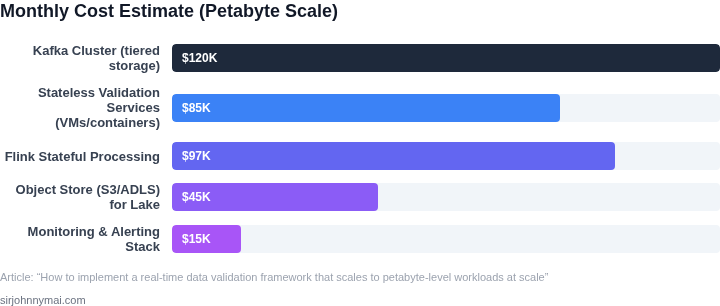
05. Action Step: Implement a Pilot with a Subset of Data
Before scaling to petabyte workloads, start with a controlled pilot using 10% of your data. This approach validates the framework’s assumptions, identifies edge cases, and surfaces performance bottlenecks without risking production stability. I recommend selecting this subset randomly to ensure representativeness, though domain-specific constraints may require a stratified sample.
Begin by extracting a 10% sample of your data. For structured data, use tools like AWS Glue or Databricks Delta Lake to partition and sample the dataset. For unstructured data, leverage Apache Spark’s sampling capabilities or S3 Select for cost-efficient filtering. Document the sampling criteria—random vs. time-based, for example—so you can reproduce results later.
Deploy the framework in a non-production environment first. Use Kubernetes for orchestration if your infrastructure supports it, or containerize the validation logic with Docker and deploy it on EC2 instances. Monitor resource usage with tools like Datadog or Prometheus to ensure the pilot doesn’t overwhelm your test environment. If the pilot exceeds 20% of your allocated resources, scale back or adjust the sample size.
Focus on three key metrics during the pilot: latency, accuracy, and resource utilization. For latency, measure end-to-end processing time from ingestion to validation completion. For accuracy, compare the pilot’s output against a ground-truth subset of the full dataset. For resource utilization, track CPU, memory, and network I/O to identify scaling patterns. If latency exceeds 500ms for 90% of records, revisit the architecture choices from Section 04.
After 72 hours of piloting, schedule a review with your team to discuss findings. Bring the raw metrics, any anomalies, and a list of assumptions that held or failed. If the pilot succeeds, proceed to the next 10% increment. If it fails, iterate on the framework before expanding. This incremental approach minimizes risk and ensures the framework is battle-tested before full deployment.
Figures cited are from publicly available sources as of 2026-09-15 and may have changed.