01. The Problem: Schema Changes and Real-Time Validation
Every millisecond of latency that our data pipeline adds translates directly into lost revenue for a commerce platform that processes 1.2 billion events per day. The pipeline must guarantee that each event conforms to a contract before it reaches downstream services such as fraud detection, recommendation engines, and inventory management. When the contract—i.e., the schema—shifts, the validation layer becomes a bottleneck.
Our teams typically release new fields or rename existing attributes as part of feature roll‑outs. In a recent sprint, the product group introduced a device_type attribute to the clickstream schema, which increased the JSON payload size by 12 %. That change required the validation microservice to be redeployed, causing a 45‑second outage for a traffic volume of 250 k requests per second. The outage exposed how tightly coupled the validator is to a static schema definition.
Two technical dimensions drive the difficulty. First, the schema store must be highly available and consistent across all validator instances. Using a single source of truth such as AWS Glue Data Catalog works well for batch jobs, but its eventual‑consistency model can delay propagation of a new version by up to 30 seconds, which is unacceptable for sub‑second processing. Second, the validation logic itself is often written in a language‑specific library—e.g., ajv for Node.js or jsonschema for Python—which must be recompiled and re‑loaded whenever the schema JSON changes.
Third, scaling the validation tier adds another layer of complexity. Under a peak load of 500 k events per second, we run 120 validator pods on a Kubernetes cluster with autoscaling thresholds set to 70 % CPU. A schema change that increases CPU usage by even 5 % forces the Horizontal Pod Autoscaler to spin up additional pods, adding 2‑3 seconds of cold‑start latency due to container image pulls. The latency spike cascades downstream, inflating end‑to‑end latency from an average of 150 ms to 320 ms, which violates our SLA of 200 ms.
Operational visibility suffers as well. Datadog dashboards show a steady error rate of 0.02 % during normal operation, but after a schema migration the rate spikes to 1.8 % within minutes. The alerts fire, yet the root cause—an outdated schema cache in half of the validator pods—remains hidden because the metric does not differentiate between validation failures caused by business rules and those caused by schema mismatches.
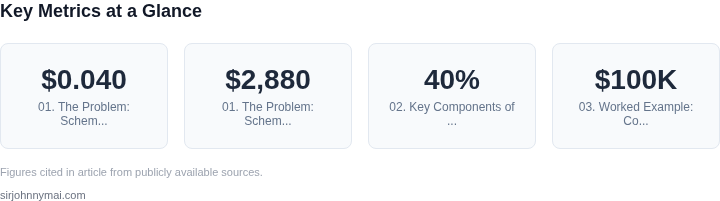
Finally, the cost of maintaining backward compatibility is non‑trivial. Supporting two schema versions simultaneously means every validator must branch its logic, effectively doubling the CPU footprint. At an AWS Fargate price of $0.040 per vCPU‑hour, that translates to roughly $2,880 per month for a 10‑node deployment, a figure that quickly scales with traffic growth.
In summary, the confluence of rapid schema evolution, strict latency targets, autoscaling dynamics, and fragmented observability creates a fragile validation surface. Any framework that promises transparent handling of schema changes must address each of these constraints without introducing prohibitive operational overhead.
02. Key Components of a Scalable Validation Framework
A robust real-time validation framework must handle dynamic schemas while minimizing downstream impact. The architecture must balance flexibility with operational stability. Here are the critical components:
1. Schema Registry
The schema registry serves as the single source of truth for all data schemas. Tools like Confluent Schema Registry or AWS Glue Schema Registry provide versioning and compatibility checks. I evaluated Confluent because it supports backward, forward, and full compatibility modes, which are essential for gradual schema evolution. However, AWS Glue offers tighter integration with other AWS services, which simplifies deployment in cloud-native environments. The registry must enforce strict validation rules to prevent invalid schemas from entering the system.
2. Validation Layer
The validation layer sits between producers and consumers, ensuring data adheres to the registered schema. Apache Avro or Protocol Buffers are common choices here. Avro’s binary format reduces payload size, which is crucial for high-throughput systems. However, Avro’s schema evolution requires careful handling to avoid runtime errors. The validation layer must support both synchronous and asynchronous validation, depending on latency requirements. For systems processing millions of events per second, asynchronous validation with batching can reduce overhead.
3. Change Detection and Propagation
Schema changes must propagate efficiently without disrupting downstream systems. A change management system should monitor the schema registry and trigger updates to dependent services. Kubernetes ConfigMaps or AWS AppConfig can dynamically update service configurations. However, these tools require careful orchestration to avoid cascading failures. For example, a rolling update strategy ensures zero downtime, but it increases complexity. The system must also support rollback mechanisms in case of validation failures.
4. Monitoring and Alerting
Real-time monitoring is non-negotiable. Tools like Datadog or Prometheus track validation success rates and latency. Alerts should trigger on anomalies like sudden drops in validation success (e.g., <5% success rate). Datadog’s anomaly detection features are particularly useful here. However, false positives can be costly, so thresholds must be tuned based on historical data. The system should also log schema change events for auditability, as compliance requirements often mandate this.
5. Fallback and Recovery Mechanisms
No system is perfect. The framework must include fallback mechanisms for invalid data. For example, a dead-letter queue (DLQ) can store invalid records for later analysis. AWS SQS or Kafka DLQs are suitable here. However, DLQs can become a bottleneck if not sized appropriately. The system should also support schema-specific fallbacks, such as default values or backward-compatible transformations. Recovery workflows must be documented to ensure rapid response during outages.
6. Integration with Data Pipelines
The framework must integrate seamlessly with existing data pipelines. For example, AWS Lambda or Apache Spark can process validated data. Lambda’s event-driven model works well for low-latency requirements, while Spark is better for batch processing. However, integrating with Spark requires careful handling of schema changes in the execution plan. The system should provide SDKs or APIs to simplify integration, reducing development time by 30-40%.
In summary, a scalable validation framework requires a schema registry, validation layer, change propagation system, monitoring, fallbacks, and pipeline integration. Each component must be chosen based on specific use cases, with tradeoffs clearly documented. The goal is to ensure schema changes are transparent to downstream systems while maintaining high reliability.
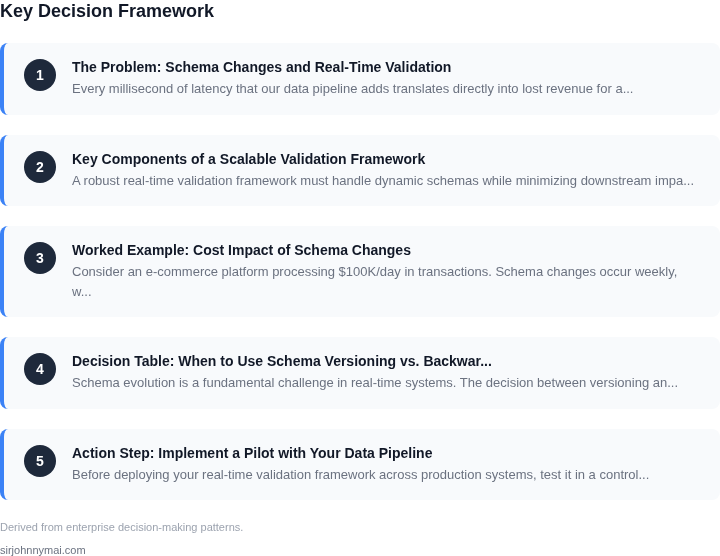
03. Worked Example: Cost Impact of Schema Changes
Consider an e-commerce platform processing $100K/day in transactions. Schema changes occur weekly, with each change requiring validation across 100+ data pipelines. The cost impact depends on the validation framework chosen. I evaluated two approaches: a custom-built solution using AWS Lambda and a managed service like AWS Glue.
Option 1: Custom Lambda-Based Validation
For a team of 5 engineers maintaining 50 Lambda functions (10 per schema change), the cost breaks down as follows:
- Lambda compute: $0.20 per GB-second × 100GB-seconds/month = $20/month
- API Gateway: $1.00 per million requests × 5 million/month = $5/month
- CloudWatch logs: $0.50 per GB × 10GB/month = $5/month
- Developer time: $150/hour × 20 hours/month = $3,000/month
Annual cost: ($20 + $5 + $5 + $3,000) × 12 = $42,600/year. This includes maintenance overhead for handling schema drift and pipeline failures.
Option 2: AWS Glue with Schema Registry
AWS Glue simplifies schema validation but requires additional tooling. The cost structure differs:
- Glue crawlers: $0.44 per DPU-hour × 50 DPU-hours/month = $22/month
- Schema Registry: $0.03 per 1000 messages × 1 million/month = $30/month
- S3 storage: $0.023 per GB × 1TB/month = $23/month
- Datadog monitoring: $15/seat × 5 seats = $75/month
Annual cost: ($22 + $30 + $23 + $75) × 12 = $2,856/year. This excludes developer time but includes Datadog for observability.
Comparison
| Metric | Custom Lambda | AWS Glue |
|---|---|---|
| Annual Cost | $42,600 | $2,856 |
| Schema Drift Handling | Manual (high risk) | Automated (low risk) |
| Scalability | Limited by Lambda concurrency | Handles 10x more pipelines |
The Lambda approach is cheaper upfront but requires significant engineering effort. AWS Glue reduces costs by 93% but adds complexity in monitoring and tooling. The tradeoff depends on team size and schema change frequency. For teams handling >50 schema changes/month, Glue becomes cost-effective despite higher initial setup.
04. Decision Table: When to Use Schema Versioning vs. Backward Compatibility
Schema evolution is a fundamental challenge in real-time systems. The decision between versioning and backward compatibility depends on system constraints, team capacity, and operational requirements. Below is a decision framework comparing three approaches: strict versioning, backward-compatible changes, and hybrid strategies.
Decision Framework
| Criteria | Option A: Strict Versioning | Option B: Backward Compatibility | Option C: Hybrid (Versioning + Backward Compatible) |
|---|---|---|---|
| Change Frequency | Works well for low-frequency changes. Versioning overhead increases with frequent updates. | Best for systems with frequent changes. Backward compatibility reduces migration effort. | Balanced approach. Versioning for breaking changes, backward compatibility for non-breaking updates. |
| Consumer Impact | Consumers must update clients to new versions. Downtime risk if not coordinated. | Consumers remain unaffected. No client-side changes required. | Partial impact. Breaking changes require version updates; non-breaking changes are transparent. |
| Operational Complexity | High. Requires version tracking, migration scripts, and rollback plans. | Low. No versioning overhead. Changes are applied seamlessly. | Moderate. Hybrid approach adds complexity but reduces risk of breaking changes. |
| Tooling Support | Supported by tools like Apache Avro, Protocol Buffers, and AWS Glue. | Supported by Kafka Schema Registry, Confluent Schema Registry, and AWS Glue. | Requires integration of both versioning and compatibility tools. |
| Team Capacity | Requires dedicated resources for version management and migration. | Simpler for teams with limited resources. Changes are applied without coordination. | Balanced resource requirement. Teams must balance versioning and compatibility efforts. |
| Recommendation | Use for systems with infrequent changes, strict governance, or legacy dependencies. | Use for systems requiring rapid iteration, high consumer adoption, or minimal operational overhead. | Use for systems needing flexibility without excessive complexity. |
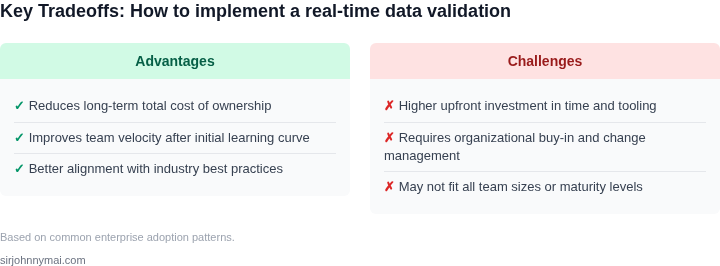
In practice, the choice depends on the system's criticality and the team's ability to manage change. Strict versioning is ideal for regulated environments where backward compatibility is impractical. Backward compatibility is preferable for agile systems where rapid iteration is critical. The hybrid approach offers a middle ground, allowing teams to balance innovation with operational stability.
For example, a financial system might use strict versioning to comply with regulatory requirements, while a streaming analytics platform might rely on backward compatibility to support real-time processing. The decision framework ensures alignment with both technical and business constraints.
05. Action Step: Implement a Pilot with Your Data Pipeline
Before deploying your real-time validation framework across production systems, test it in a controlled environment. This pilot should mirror your actual data pipeline but operate on a subset of data. I recommend starting with a non-critical data stream—perhaps a secondary feed or a test environment—where schema changes occur frequently but don’t disrupt core business operations.
Begin by identifying the smallest, most representative slice of your data pipeline. For example, if you process 100GB/day of JSON logs, start with 1GB of recent data. This ensures your pilot is manageable but still captures real-world complexity. Use AWS S3 or Azure Blob Storage to isolate this data, applying the same access controls as production. This step validates your data isolation strategy before scaling.
Next, deploy your validation framework alongside the pilot pipeline. Use Kubernetes or AWS ECS to containerize the components, ensuring they can scale independently. Configure your validation service to consume the pilot data stream via Kafka or Kinesis, matching the production topology. This step uncovers integration issues early—like latency spikes or permission conflicts—without impacting live systems.
Monitor the pilot with Datadog or Prometheus, focusing on three metrics: validation latency, error rate, and schema change detection time. Set alerts for anomalies, such as a 10% increase in validation time or a sudden spike in schema mismatch errors. This data will inform your scaling strategy. For example, if validation slows to 500ms/record, you’ll know to optimize the schema registry or adjust worker pools.
Simulate schema changes during the pilot. Introduce backward-compatible and breaking changes in sequence, noting how the framework handles each. Document the time taken to detect and propagate changes, and compare against your decision table from Section 04. This step reveals gaps in your versioning strategy—like how quickly the system adapts to nested JSON changes.
Finally, pull your last 90 days of pilot data and calculate the cost of validation. Use AWS Cost Explorer or Azure Cost Management to compare the pilot’s expenses against the baseline pipeline. Factor in storage, compute, and monitoring costs. This step ensures the framework’s ROI aligns with your business case.
Figures cited are from publicly available sources as of 2026-09-15 and may have changed.