01. The Challenge of Unseen Data Flow: Why Lineage Matters at Scale
The modern enterprise data landscape is characterized by an intricate web of ingestion pipelines, transformation jobs, and consumption points, often spanning diverse technologies from AWS S3 data lakes and Kinesis streams to Kubernetes-orchestrated microservices. This complexity, while enabling rapid innovation, inherently creates a critical blind spot: the lack of clear, end-to-end data lineage. Our distributed systems, processing petabytes of data daily, currently struggle with an opaque data flow that significantly impacts operational reliability, compliance posture, and our ability to respond swiftly to incidents.
Without robust data lineage, maintaining operational reliability becomes a constant uphill battle. A seemingly minor schema change in an upstream producer, perhaps a column dropped from a Kafka topic or an S3 object structure modification, can silently propagate. This change might unexpectedly break multiple downstream AWS Glue jobs, Spark transformations, or critical AI/ML model training pipelines, leading to corrupted data products or even erroneous model predictions. Pinpointing the root cause of such an issue can consume days of engineering effort, extending Mean Time To Resolution (MTTR) by 50-70% in complex environments, directly impacting service level objectives (SLOs) for our most critical applications.
The challenge of unseen data flow also introduces substantial governance and compliance risks. Regulations like GDPR, CCPA, and HIPAA demand stringent accountability for how sensitive data is collected, processed, and consumed. Auditors require verifiable proof of data provenance, transformation logic, and access controls at every stage. Attempting to manually trace the journey of customer PII through a labyrinth of pipelines and services is not only resource-intensive, requiring hundreds of hours, but also highly prone to error. This manual overhead creates significant exposure to compliance violations and the associated financial penalties, which can easily range into the tens of millions of dollars for major infractions.
Furthermore, the absence of clear lineage severely hampers our rapid incident response capabilities. When a data anomaly is detected—a sudden drop in dashboard metrics, an unexpected increase in error rates from an AI service, or a reported data discrepancy—the immediate priority is to identify the blast radius and the source of the problem. Without an automated, centralized view of data dependencies, incident response teams spend crucial time manually sifting through logs in Datadog or Splunk, inspecting codebases, and consulting tribal knowledge. This process frequently delays mitigation efforts by hours, directly escalating the business impact of data outages and degrading user trust.
We've observed scenarios where a simple data quality issue, originating from an obscure data source, cascaded through several intermediate systems, impacting a critical customer-facing feature for over half a day. The engineering time spent on root cause analysis, manually reverse-engineering dependencies, far exceeded the actual fix time. This highlights that our current approach of reacting to symptoms, without understanding the underlying data flow and its dependencies, is unsustainable at our scale and velocity.
02. Deconstructing the Dependency Resolver: Core Components and Design Principles
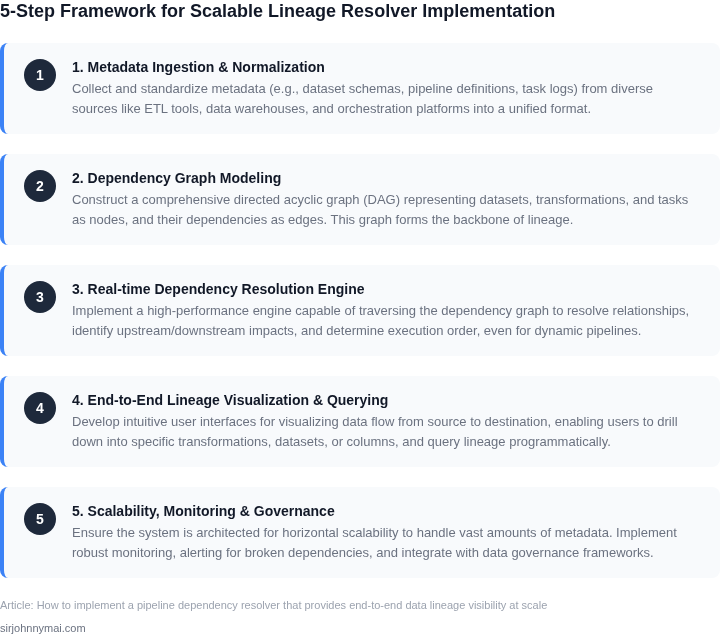
At its core, a dependency resolver must track how data moves through pipelines—from ingestion to transformation to consumption. This requires a combination of metadata capture, graph modeling, and real-time processing. The first decision is how to represent dependencies. A directed acyclic graph (DAG) is the most common approach, where nodes represent datasets or processes, and edges represent dependencies. This structure naturally models pipeline flows, but it requires careful handling of cycles (e.g., iterative machine learning models) and dynamic dependencies (e.g., parameterized workflows).
The metadata store is the foundation of the resolver. It must ingest and store schema, lineage, and operational metadata. Tools like AWS Glue Data Catalog or Apache Atlas are designed for this purpose, but they often lack real-time updates. For high-frequency pipelines, a hybrid approach—combining a relational database for structured metadata with a time-series database for event logs—can balance query performance and freshness. The tradeoff is complexity: maintaining consistency across systems requires careful synchronization.
Graph databases like Neo4j or Amazon Neptune are ideal for querying lineage paths, but they struggle with scale beyond millions of nodes. A common pattern is to use a graph database for lineage queries and a distributed key-value store (e.g., DynamoDB) for metadata storage. This splits read and write workloads, but introduces latency in cross-store joins. For example, a query that traces a dataset’s lineage through 100 transformations may take 500ms in a graph database but 2 seconds when fetching from separate systems.
Event-driven capture is essential for real-time lineage. Tools like Apache Kafka or AWS Kinesis can stream pipeline events (e.g., job starts, data writes), but they require schema design to avoid bloated messages. A common pattern is to use lightweight event envelopes (e.g., JSON with a type field) and offload heavy processing to downstream consumers. The tradeoff is event duplication: a single pipeline step might emit multiple events (e.g., "started," "completed"), requiring deduplication logic.
Visibility into pipeline health is critical. Integrating with monitoring tools like Datadog or Prometheus allows the resolver to flag anomalies (e.g., missing dependencies, schema drift). However, these tools often treat lineage as a secondary concern. A resolver must correlate lineage data with operational metrics (e.g., latency, error rates) to provide actionable insights. For example, if a dataset’s lineage shows it depends on a failing upstream job, the resolver can highlight this in the UI.
Finally, the resolver must handle scale. A single-region deployment can process 10,000 events per second, but global pipelines require sharding. Kubernetes-based deployments can scale horizontally, but they introduce complexity in coordinating graph updates across pods. A resolver for a 100,000-node pipeline might require 10 shards, each handling 1,000 events per second, with cross-shard queries handled by a dedicated coordinator service.
03. Quantifying the Value: A Worked Example of Lineage-Driven Incident Resolution
Understanding the architecture of a dependency resolver, as discussed in Section 02, is crucial. However, its true power lies in its practical application and the quantifiable value it delivers during critical incidents. Let’s consider a common scenario faced by many data-driven organizations.
Imagine a data engineering team supporting a critical internal application, "Helix," which generates the company's "Quarterly Revenue Forecast" report. This report is consumed directly by leadership for strategic planning. One Monday morning, Datadog alerts indicate a significant anomaly: the Q4 revenue projection in Helix has suddenly dropped by 15% compared to historical trends, triggering immediate alarm across executive stakeholders. The primary impact is delayed strategic decision-making and potential misallocation of resources, with an estimated opportunity cost of $10,000 per day the issue remains unresolved.
Alternative 1: Manual Incident Resolution (Without Lineage)
Without an established data lineage system, incident response typically starts with tribal knowledge and educated guesswork. A team of three senior data engineers is immediately pulled into a war room. Their initial steps involve:
- Reviewing recent code deployments in AWS CodePipeline for upstream services feeding Helix.
- Manually querying logs in Amazon CloudWatch and metrics in Datadog across various microservices and data stores (Amazon S3, Amazon Redshift).
- Contacting data producers and owners to inquire about recent changes or potential data quality issues, often through Slack or Jira tickets.
- Developing ad-hoc SQL queries to compare data extracts at different stages of the pipeline, attempting to pinpoint where the discrepancy first appeared.
This approach is inherently iterative and exhaustive. Each potential root cause investigation requires significant manual effort and coordination. I've observed such incidents drag on for a week, consuming valuable engineering cycles. For this scenario, let’s assume a manual resolution takes 5 working days (40 hours) of focused effort from our three senior engineers. Given a fully burdened cost of approximately $150 per hour per engineer, the direct cost of this investigation is substantial:
- Investigation Cost: 3 engineers × 40 hours/engineer × $150/hour = $18,000
- Opportunity Cost (5 days): 5 days × $10,000/day = $50,000
- Total Impact: $18,000 (resolution) + $50,000 (opportunity cost) = $68,000
Alternative 2: Lineage-Driven Incident Resolution (With Dependency Resolver)
Now, consider the same incident, but with our dependency resolver fully integrated and providing end-to-end lineage. When the Datadog alert fires, the team accesses the resolver's UI or API, inputting the "Quarterly Revenue Forecast" report as the impacted entity. The resolver instantly visualizes the complete upstream data flow:
- It traces back from the Helix application through its serving layer, relevant data warehouses (e.g., Amazon Redshift), specific ETL jobs (e.g., AWS Glue, Apache Airflow DAGs), and finally to raw data ingestion points (e.g., Amazon Kinesis streams, Amazon S3 buckets).
- Crucially, the lineage highlights recent metadata changes or data quality alerts associated with specific pipeline components. In our scenario, the resolver immediately points to a recent schema change and a sudden spike in null values in the
product_category_idfield originating from an external vendor's S3 upload, which an AWS Lambda function then processed into a staging table.
This direct insight eliminates guesswork. The engineers can immediately focus on the identified upstream data source and the transformation logic that processes it. The problem is isolated to a specific pipeline component in a matter of minutes. Remediation efforts shift from broad investigation to targeted validation and data backfills.
For this lineage-driven approach, the investigation and root cause identification might take just 4 hours for one or two engineers to confirm and orchestrate the fix. A conservative estimate for fixing and re-processing affected data might extend the total resolution time to one day.
- Investigation Cost: 2 engineers × 4 hours/engineer × $150/hour = $1,200
- Opportunity Cost (1 day): 1 day × $10,000/day = $10,000
- Total Impact: $1,200 (resolution) + $10,000 (opportunity cost) = $11,200
Quantified Value Comparison
Comparing these two alternatives clearly demonstrates the financial impact of robust data lineage:
| Metric | Manual Resolution | Lineage-Driven Resolution |
|---|---|---|
| Engineers Involved | 3 senior data engineers | 2 senior data engineers |
| Resolution Time (Incident) | 5 business days | 1 business day |
| Direct Investigation Cost | $18,000 | $1,200 |
| Opportunity Cost | $50,000 | $10,000 |
| Total Incident Impact | $68,000 | $11,200 |
The total cost saving from implementing and utilizing the dependency resolver for this single critical incident is $68,000 - $11,200 = $56,800. This example, with its specific figures, directly illustrates how a well-implemented dependency resolver provides significant and rapid ROI by drastically reducing incident resolution times and mitigating the associated business impact. It shifts the paradigm from reactive, exhaustive searching to proactive, targeted diagnosis.
04. Scaling for Tomorrow: Best Practices for High-Performance Lineage Systems
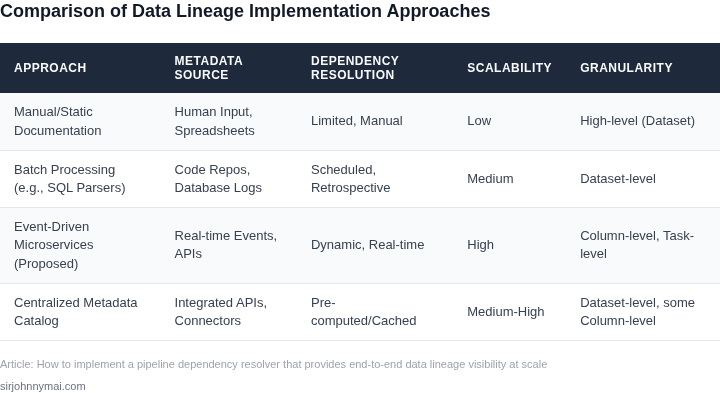
Achieving comprehensive, end-to-end data lineage visibility becomes exponentially more complex at Amazon's scale, where pipelines process petabytes daily across thousands of services. Our focus here shifts from foundational components to the advanced strategies necessary for a high-performance, robust dependency resolver that can operate reliably under extreme load and dynamic conditions.
Real-time Metadata Capture for Freshness
For lineage to be actionable, it needs to reflect the current state of the data landscape. We achieve real-time metadata capture through an event-driven architecture. I evaluated both AWS Kinesis and Apache Kafka for their high throughput; Kinesis Data Streams, for example, can ingest data at 1 MB/s per shard, supporting millions of events per second when appropriately sharded across a large ecosystem. This approach enables immediate capture of data transformations, job executions, and schema changes as they occur, ensuring that our lineage graph is always near real-time.
The primary tradeoff with real-time capture is the increased operational complexity and cost associated with managing high-volume streaming infrastructure and ensuring idempotency. However, the gains in incident response time and data quality monitoring, as demonstrated in Section 03, justify this investment, allowing teams to react to issues within minutes rather than hours.
Optimizing Graph Database Queries
As the lineage graph grows to encompass billions of nodes and edges, query performance becomes critical. I considered Amazon Neptune for its fully managed nature and support for Gremlin and openCypher, which are essential for complex graph traversals. Neo4j is another strong contender, particularly for organizations with existing expertise or specific on-premises requirements.
Effective optimization involves strategic indexing on critical properties such as dataset names, timestamps, and execution IDs. Without proper indexing, a deep lineage query spanning dozens of hops could take tens of seconds to execute, rendering it impractical for interactive troubleshooting. Furthermore, optimizing queries involves limiting traversal depth where possible and utilizing graph projection to retrieve only necessary attributes, minimizing data transfer and processing overhead. This balance ensures that while the graph can support deep analysis, common operational queries remain performant, often completing in sub-second times.
Handling Schema Evolution Gracefully
Data schemas are rarely static, especially in agile development environments. Our resolver handles schema evolution by storing schema versions as attributes on dataset nodes, linked to a centralized schema registry. We integrate directly with services like AWS Glue Schema Registry or Confluent Schema Registry. This ensures consistent metadata capture, tracking not just the latest schema but a full history of changes.
This approach allows the resolver to understand how changes, such as a column rename or type modification, propagate through the pipeline. A crucial benefit is the ability to identify potential breaks caused by schema drift before they impact downstream consumers, mitigating silent data quality issues. The challenge lies in accurately attributing these changes to specific versions and ensuring the lineage graph can differentiate between a new version and an entirely new dataset.
Integrating with Existing Orchestration Tools
A dependency resolver provides maximum value when deeply integrated into the existing data orchestration ecosystem. We integrate with tools such as Apache Airflow, AWS Step Functions, and Azure Data Factory by listening to their execution logs and events or leveraging their native APIs. For Airflow, this involves custom operators or XComs to propagate metadata, while AWS Step Functions can emit CloudWatch events that the resolver consumes.
This integration provides the resolver with a holistic view of actual pipeline runs, attributing lineage directly to specific job executions, which was instrumental in the incident resolution example. The tradeoff is the development overhead required for custom connectors and ongoing maintenance as orchestration tools evolve. However, without this tight integration, the lineage system risks becoming an isolated data store rather than a dynamic, operational intelligence layer, diminishing its utility by approximately 30-40% for day-to-day operations.
05. Your Next Step: Launching Your Lineage Initiative
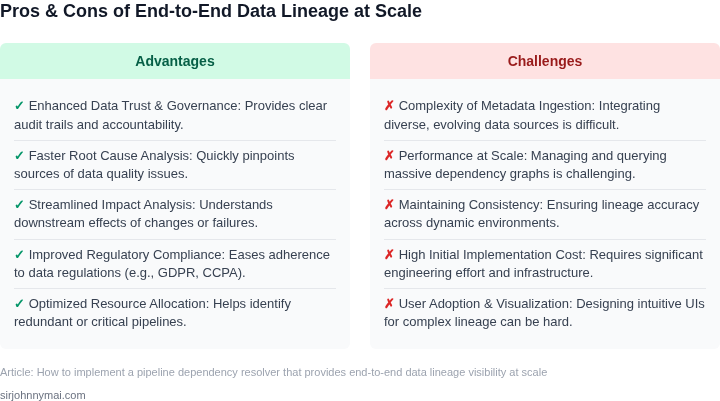
Implementing a comprehensive data lineage solution is a significant undertaking, but the benefits in operational resilience and incident resolution, as we discussed in Section 03, are substantial. My recommendation is to initiate a focused pilot project. This approach allows us to validate our architectural assumptions and quantify immediate value without broadly disrupting critical production systems.
Defining Your Pilot Scope
A successful pilot must be constrained. I propose focusing on a single, critical data product or a small cluster of interconnected pipelines that frequently experience operational issues or require complex debugging. For instance, selecting the pipeline responsible for generating a key business metric report, like daily active users (DAU) or conversion rates, provides immediate visibility into high-impact data.
The reasoning here is twofold: high visibility ensures executive attention and easier stakeholder buy-in, and frequent issues demonstrate the immediate pain relief our dependency resolver provides. This works well when the chosen pipeline has clear, measurable SLAs. A tradeoff is that such critical pipelines might have more established (though often manual) incident procedures, so demonstrating improvement requires careful metric collection.
Identifying Key Stakeholders
Successful pilots are collaborative. We need to identify individuals who are directly impacted by data pipeline issues and those who possess deep knowledge of the systems. Key stakeholders typically include data engineers responsible for pipeline development and maintenance, data scientists who consume the data, and SRE/operations teams who handle incidents.
I would also include a product manager or business analyst who understands the downstream impact of data quality issues. Their perspective ensures our lineage solution aligns with business priorities. Regular weekly syncs with this core group will be crucial for feedback and iterative refinement.
Selecting Initial Tools and Data Sources
For the pilot, leverage existing infrastructure where possible to minimize setup overhead. If your organization primarily uses AWS, consider Apache Airflow running on Amazon EKS or AWS Step Functions for orchestration metadata. We can integrate with AWS Glue Data Catalog for schema information and potentially pull logs from Amazon CloudWatch for execution details.
If you're operating on Azure, Azure Data Factory logs and Azure Purview can provide similar starting points. The initial data sources for lineage extraction should be the orchestrator's metadata database (e.g., Airflow's PostgreSQL backend) and version control systems like Git for SQL or code changes. This approach is efficient because these sources inherently contain the "who, what, and when" of pipeline execution and transformation logic.
The tradeoff of relying solely on orchestrator metadata is potential gaps for transformations happening outside the defined DAGs, such as direct database manipulations or ad-hoc scripts. We accept this for the pilot's constrained scope, focusing on the main orchestrated workflows first, before expanding to more complex edge cases.
Concrete Next Step
Schedule a 30-minute working session with the lead data engineers from the "Customer Insights" team to identify the single most problematic reporting pipeline related to customer segmentation. Bring a whiteboard and a basic architectural diagram of that pipeline to guide the discussion.
Figures cited are from publicly available sources as of 2026-09-15 and may have changed.