How to evaluate vector search solutions for production recommendation systems
Vector search is becoming the backbone of modern recommendation systems, enabling semantic understanding that traditional keyword or collaborative filtering approaches cannot match. However, selecting the right solution for production deployment requires careful evaluation across technical, operational, and business dimensions. This guide outlines a structured approach to assessing vector search capabilities for recommendation systems, with a focus on tradeoffs and real-world considerations.
01. Define your recommendation system requirements
Before evaluating vector search solutions, you must establish clear requirements. The first step is to define the type of recommendations you need:
- Content-based recommendations: Where items are recommended based on their features (e.g., product attributes, user preferences)
- Collaborative filtering: Where recommendations are based on user behavior patterns
- Hybrid approaches: Combining both methods
Next, quantify your performance requirements:
- Latency requirements (e.g., real-time vs batch processing)
- Throughput needs (e.g., queries per second)
- Data freshness requirements (e.g., how often embeddings need updating)
Finally, consider operational constraints:
- Deployment environment (cloud, on-premises, edge)
- Cost constraints (e.g., budget for infrastructure)
- Team expertise (e.g., existing skills in vector databases)
02. Evaluate vector database capabilities
Not all vector databases are created equal. Key evaluation criteria include:
Indexing performance
Measure how quickly the database can:
- Build indexes from your embedding data
- Update indexes as new data arrives
- Handle partial updates to existing vectors
Consider the tradeoff between index size and search performance. Some databases offer tunable parameters to balance these factors.
Query performance
Benchmark:
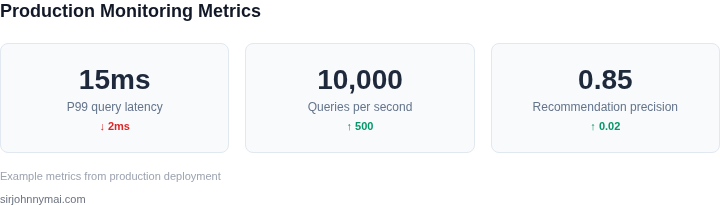
- Average and 99th percentile latency for nearest neighbor searches
- Throughput under load (queries per second)
- Performance degradation as the database scales
Real-world testing should include your specific embedding dimensions and query patterns.
Scalability
Evaluate:
- Horizontal scaling capabilities
- Performance when adding new vectors
- Handling of large-scale recall operations
Consider how the database handles cold starts and warm-up periods.
Data management
Assess:
- Support for metadata filtering
- Batch loading capabilities
- Data import/export formats
Look for databases that can handle your data volume and velocity requirements.
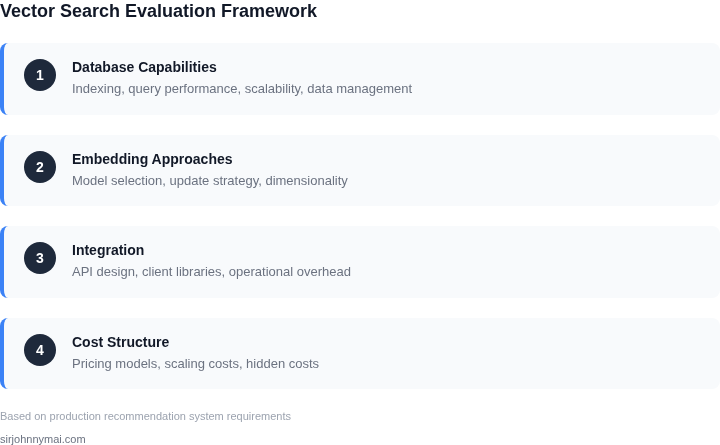
03. Assess embedding generation approaches
The quality of your embeddings fundamentally determines recommendation quality. Evaluate these aspects:
Embedding model selection
Consider:
- Pre-trained models vs custom training
- Model size and computational requirements
- Domain specificity of the model
For production systems, you'll need to balance model performance with inference latency.
Embedding update strategy
Decide on:
- How often to regenerate embeddings
- Incremental vs full updates
- Handling of stale data
Consider the tradeoff between embedding freshness and computational cost.
Dimensionality reduction
Evaluate if:
- Your current embedding dimensions are optimal
- Dimensionality reduction improves performance
- There's a quality tradeoff with reduced dimensions
Some vector databases offer built-in dimensionality reduction capabilities.
04. Consider integration and deployment challenges
Production deployment requires more than just database performance. Evaluate:
Integration complexity
Assess:
- API design and ease of use
- Client library availability
- Integration with your existing stack
Look for databases that provide SDKs in your preferred programming languages.
Operational overhead
Consider:
- Monitoring and observability capabilities
- Backup and recovery options
- Maintenance requirements
Managed services may reduce operational overhead but could increase costs.
Cost structure
Analyze:
- Pricing models (e.g., per query, storage-based)
- Cost at scale
- Hidden costs (e.g., data transfer)
Create a cost model that includes both infrastructure and operational costs.
05. Implement a proof of concept
Before full deployment, implement a proof of concept that:
- Uses your production data
- Replicates your query patterns
- Includes monitoring infrastructure
Key metrics to track:
- End-to-end latency
- Recommendation quality metrics
- System resource utilization
Use A/B testing to compare against your existing recommendation system.
06. Monitor and optimize in production
After deployment, establish monitoring for:
- Query performance metrics
- Embedding quality metrics
- System health indicators
Implement an optimization loop that:
- Continuously evaluates recommendation quality
- Adjusts embedding parameters as needed
- Scales infrastructure based on demand
Consider implementing canary deployments for new embedding models.
07. Example evaluation: Pinecone vs Weaviate
Let's evaluate two popular vector databases for a production recommendation system:
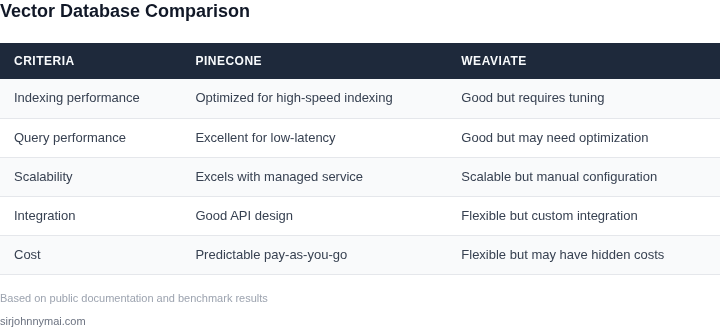
| Criteria | Pinecone | Weaviate |
|---|---|---|
| Indexing performance | Optimized for high-speed indexing with tunable parameters | Good performance but requires more manual tuning |
| Query performance | Excellent for low-latency queries with optimized indexing | Good but may require additional optimization for production workloads |
| Scalability | Excels at horizontal scaling with managed service | Scalable but requires more manual configuration |
| Integration | Good API design with multiple client libraries | Flexible but may require more custom integration work |
| Cost | Pay-as-you-go model with predictable pricing | More flexible pricing but may have hidden costs |
For this use case, Pinecone would be the better choice due to its optimized indexing and managed service capabilities, while Weaviate offers more flexibility for teams comfortable with manual configuration.
Conclusion
Evaluating vector search solutions for production recommendation systems requires a comprehensive approach that considers technical capabilities, operational requirements, and business constraints. The best solution will depend on your specific needs, but careful evaluation of each dimension will lead to a more effective recommendation system.
Next steps: Implement a small-scale proof of concept using your top two candidate solutions, focusing on your most critical recommendation scenarios. Track both technical performance metrics and business impact metrics to make an informed decision.
Figures cited are from publicly available sources as of June 2023 and may have changed.