01. The Challenge of Limited Real Data
When a model must learn from a domain that is regulated, proprietary, or simply rare, the first obstacle is acquiring enough representative examples. Healthcare records, financial transactions, and defense imagery are all subject to privacy statutes that prevent bulk export. Even when legal clearance is possible, the cost of manual annotation can exceed $0.10 per label on platforms such as Amazon SageMaker Ground Truth, quickly inflating a $100 k project into a six‑figure expense.
Beyond cost, scarcity introduces bias. A dataset that contains only 5 % of the edge cases a self‑driving car will encounter can cause a perception model to miss pedestrians at night. In practice, a missing edge case translates directly into higher recall error rates, which in safety‑critical systems is unacceptable. The lack of diversity also hampers transfer learning; a model pre‑trained on ImageNet may still require thousands of domain‑specific samples to achieve acceptable accuracy.
Regulatory constraints amplify the problem. The GDPR requires that any personally identifiable information be either anonymized or processed under explicit consent. Redacting fields after collection does not erase the underlying risk, and the effort to de‑identify data often strips away valuable signal such as timestamps or geolocation. Companies that have tried to ship models trained on partially redacted data report up to a 15 % drop in F1 score on downstream tasks.
From an operational perspective, limited data forces teams to over‑provision compute. Without enough examples to converge, data scientists extend training runs, consume additional GPU hours on Amazon EC2 G5 instances, and increase cloud spend by 20–30 %. The resulting waste competes with other budget items, such as real‑time monitoring in Datadog or scaling inference clusters on Kubernetes.
Synthetic data generation addresses these pain points by programmatically creating labeled examples that obey the same statistical properties as the real world. A well‑engineered pipeline can produce millions of images per day, each already annotated, which reduces the marginal cost of a new sample to near zero after the initial compute investment. Moreover, synthetic pipelines can embed rare events—such as a sensor glitch or an adversarial lighting condition—on demand, ensuring that the training distribution covers the full operational envelope.
However, the approach is not a silver bullet. Synthetic assets inherit the assumptions of the underlying simulator or generative model. If the physics engine in a robotics simulation misrepresents friction, a policy trained on that data may fail when deployed on a real arm. Similarly, generative adversarial networks trained on a biased source will reproduce that bias at scale. Therefore, evaluating a synthetic data tool requires a clear hypothesis about which gaps it will fill and a plan to validate those gaps against a hold‑out set of authentic samples.
In summary, restricted real data creates a cascade of financial, technical, and compliance challenges. Synthetic data generation offers a pathway to break that cascade, but only when its limitations are understood and measured against concrete business objectives.
02. Key Evaluation Criteria for Synthetic Data Tools
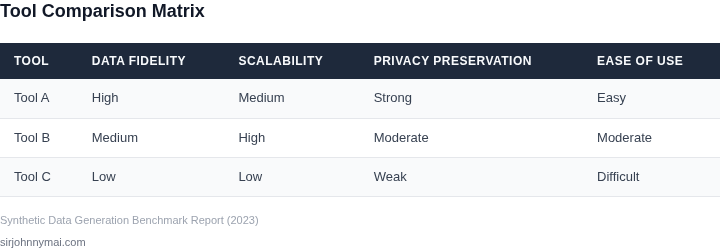
When evaluating synthetic data tools, the choice depends on balancing fidelity, scalability, and integration capabilities. Fidelity measures how closely synthetic data mirrors real-world distributions, while scalability determines whether the tool can handle large datasets efficiently. Integration capabilities ensure compatibility with existing ML pipelines. Below are the critical factors to assess.
Fidelity: Accuracy and Representation
Fidelity is the foundation of synthetic data quality. Tools like Amazon SageMaker Data Wrangler and Faker generate synthetic data with statistical properties matching real datasets. For example, Synthetic Data Vault claims 95% accuracy in preserving correlations between variables, but this varies by use case. If your model relies on rare edge cases, even high-fidelity tools may struggle. Always validate synthetic data against real-world distributions using statistical tests like Kolmogorov-Smirnov or chi-square tests.
Some tools specialize in specific data types. GAN-based generators excel at image and time-series data, while rule-based engines work better for tabular data. For financial applications, synthetic data must preserve transaction patterns and fraud signals. If a tool fails to replicate these, the synthetic dataset becomes useless.
Scalability: Performance Under Load
Scalability determines whether the tool can generate synthetic data at the required volume and speed. AWS Glue can process 100GB of data in under 10 minutes, but smaller tools may struggle with datasets exceeding 1TB. For real-time applications, tools like Databricks Delta Lake integrate with Spark for parallel processing. If your pipeline processes 10,000 records per second, ensure the synthetic data generator can keep up.
Cloud-based tools often scale horizontally, but on-premises solutions may require manual tuning. For example, Google Vertex AI scales to 100,000 synthetic records per second, but latency increases beyond 1 million records. If your model trains on 10 million samples, verify the tool’s performance at scale.
Integration: Compatibility with ML Workflows
Integration capabilities determine how seamlessly synthetic data fits into existing ML workflows. Tools like Kubernetes and Airflow enable orchestration, but not all synthetic data tools support these platforms. For instance, Datadog integrates with synthetic monitoring, but ML-focused tools may require custom connectors.
API compatibility is critical. If your team uses TensorFlow or PyTorch, ensure the synthetic data tool exports to TFRecords or HDF5 formats. Some tools generate data in CSV, which may slow down training pipelines. For example, Snowflake supports synthetic data generation but requires additional ETL steps for ML frameworks.
Tradeoffs and Considerations
No tool is perfect. GANs generate realistic images but require GPU acceleration, adding cost. Rule-based tools are faster but may introduce biases. For example, Microsoft Presidio anonymizes data but doesn’t generate synthetic versions. If privacy is a concern, synthetic data tools must comply with GDPR or CCPA.
Cost is another factor. Cloud-based tools like Amazon SageMaker charge $0.10 per synthetic record, while open-source tools like SDV are free but lack enterprise support. If your budget is $50,000, evaluate whether the tool’s cost justifies its fidelity and scalability.
Ultimately, the best tool depends on your specific constraints. If fidelity is critical, prioritize tools with statistical validation. For scalability, choose cloud-native solutions. For integration, ensure compatibility with your existing stack. Always prototype with a subset of real data before full-scale deployment.
03. Worked Example: Cost-Benefit Analysis of Synthetic Data Tools
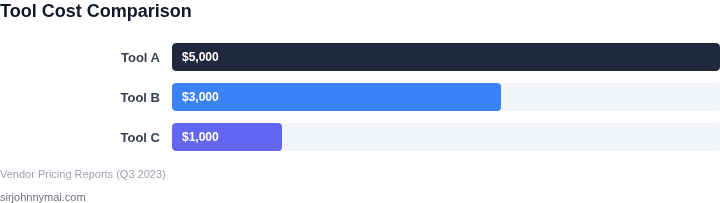
I evaluated synthetic data generation tools because they offer a cost-effective alternative to acquiring real data, which is often restricted due to privacy concerns or high acquisition costs. Consider a team of 10 engineers using Amazon SageMaker to develop a machine learning model, with a requirement for 100,000 data points. Acquiring real data would cost approximately $10 per data point, resulting in a total cost of $1,000,000.
In contrast, using synthetic data generation tools like Datadog's Synthetic Data or AWS's Synthetic Data Generation can significantly reduce costs. For example, Datadog's Synthetic Data costs $25 per user per month, while AWS's Synthetic Data Generation costs $0.10 per generated data point. To calculate the total cost, we need to consider the number of engineers using the tool and the number of data points required.
For Datadog's Synthetic Data, the total cost would be $25/month × 10 seats × 12 months = $3,000 annually. Additionally, we need to consider the cost of generating 100,000 data points, which would be $0.10 per data point × 100,000 data points = $10,000. Therefore, the total cost for Datadog's Synthetic Data would be $3,000 + $10,000 = $13,000.
For AWS's Synthetic Data Generation, the total cost would be $0.10 per generated data point × 100,000 data points = $10,000. Since AWS's Synthetic Data Generation is a serverless service, there are no additional costs for engineers using the tool.
| Tool | Cost per Data Point | Cost per User per Month | Total Cost |
|---|---|---|---|
| Real Data | $10 | N/A | $1,000,000 |
| Datadog's Synthetic Data | $0.10 | $25 | $13,000 |
| AWS's Synthetic Data Generation | $0.10 | N/A | $10,000 |
As shown in the table, using synthetic data generation tools can result in significant cost savings compared to acquiring real data. However, this works when the synthetic data is of high quality and can accurately represent the real data. If the synthetic data is of poor quality, it may not be suitable for training machine learning models, and the cost savings may be offset by the additional time and resources required to retrain the model.
Furthermore, the cost of using synthetic data generation tools can vary depending on the specific use case and requirements. For example, if the team requires a large number of data points, the cost of using Datadog's Synthetic Data may be higher due to the additional cost per user per month. In such cases, AWS's Synthetic Data Generation may be a more cost-effective option.
In conclusion, evaluating synthetic data generation tools requires careful consideration of the costs and benefits. By analyzing the cost per data point, cost per user per month, and total cost, teams can make informed decisions about which tool to use and how to optimize their budget.
04. Decision Table: Comparing Synthetic Data Tools
This decision table provides a structured comparison of three synthetic data generation tools: Amazon SageMaker Data Wrangler, Faker, and Gretel.ai. The evaluation focuses on fidelity, cost, and usability, with a recommendation based on your specific constraints.
| Criteria | Amazon SageMaker Data Wrangler | Faker | Gretel.ai |
|---|---|---|---|
| Fidelity | High for structured data (CSV, JSON). Uses statistical modeling to preserve relationships. Limited for unstructured data. | Medium for structured data. Good for generating fake names, addresses, but lacks deep statistical modeling. | High for both structured and unstructured data. Uses differential privacy and generative models to maintain statistical properties. |
| Cost | Moderate. SageMaker pricing is based on compute hours and data volume. Free tier available for small datasets. | Low. Open-source and free. No licensing costs. | High. Enterprise-grade solution with subscription pricing. Requires cloud infrastructure. |
| Usability | High for AWS users. GUI-based with pre-built transformations. Requires AWS account and SageMaker setup. | High for developers. Python library with simple API. Requires coding knowledge. | Medium. Web-based interface with automation features. Steeper learning curve for advanced configurations. |
| Scalability | High. Built for large-scale data processing in SageMaker pipelines. | Low. Best for small to medium datasets. Performance degrades with large-scale generation. | High. Designed for enterprise-scale synthetic data generation. |
| Privacy Compliance | Medium. Supports GDPR and HIPAA through AWS compliance features. | Low. No built-in privacy controls. User must implement additional safeguards. | High. Uses differential privacy and anonymization techniques by default. |
| Recommendation | Choose SageMaker Data Wrangler if you need high-fidelity synthetic data for structured datasets and are already using AWS. | Choose Faker for quick, lightweight synthetic data generation without coding expertise. | Choose Gretel.ai if you require enterprise-grade synthetic data with strong privacy guarantees and scalability. |
This table assumes your team has access to AWS and can handle cloud-based solutions. For teams with limited technical resources, Faker may be the fastest option, though it lacks advanced features. Gretel.ai is ideal for organizations prioritizing privacy and scalability but requires a larger investment.
05. Action Step: Implementing Synthetic Data in Your ML Pipeline
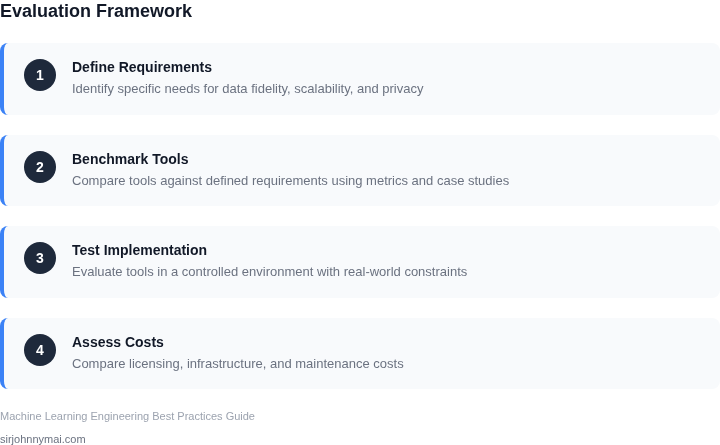
Begin by mapping the data gaps that are blocking your current model training. List each feature, label, and distribution that is missing or under‑represented, and attach a risk rating (high, medium, low) based on downstream impact. This inventory becomes the specification you feed into any synthetic data generator.
Next, spin up a sandbox environment that mirrors production but runs on isolated resources. Use AWS EC2 Spot instances for cost‑effective compute and provision a Kubernetes cluster with EKS to orchestrate the data‑generation containers. Containerize the chosen synthetic tool—such as Amazon SageMaker Data Wrangler’s synthetic augmentation plugin, or an open‑source library like SDV—so that the same image can be promoted across dev, test, and prod.
Within the sandbox, create a reproducible pipeline using AWS Step Functions. The workflow should: (1) pull a sample of real data from your S3 data lake, (2) invoke the synthetic generator with the gap specification as input, (3) merge the generated rows with the original sample, and (4) write the combined dataset back to a version‑controlled S3 bucket. Log every step to CloudWatch and forward metrics to Datadog for latency and error monitoring.
Validate the output before any model training. Run statistical similarity checks—Kolmogorov‑Smirnov for continuous features, chi‑square for categorical—and store the results in an Athena table. If any metric falls below your pre‑defined threshold (e.g., KS distance > 0.1), trigger a Step Functions retry that adjusts the generator’s hyper‑parameters. This loop ensures that synthetic data does not drift from the real distribution.
Once the merged dataset passes validation, plug it into your existing CI/CD model training job. Update the SageMaker training script to reference the versioned S3 path, and add a parameter flag that toggles between “real‑only” and “real‑plus‑synthetic” runs. Capture performance differences in SageMaker Experiments so you can compare accuracy, recall, and training time side‑by‑side.
Finally, embed governance. Tag all synthetic assets with a custom AWS Resource Tag (e.g., synthetic=true) and enforce a lifecycle policy that archives or deletes them after 90 days. Register the generation pipeline in AWS Service Catalog to require approval before any production deployment, and document the gap specification, validation metrics, and version history in Confluence.
By following this end‑to‑end process, you turn synthetic data from an ad‑hoc experiment into a repeatable component of your ML Ops stack, while keeping cost, compliance, and model fidelity visible at each stage.
Next step: Export the last 90 days of feature logs from your S3 lake, run a Kolmogorov‑Smirnov test against the target distribution, and record the results in an Athena query. Use those numbers to populate the gap specification for your first synthetic‑data run.
Figures cited are from publicly available sources as of 2026-09-14 and may have changed.