01. The Conflict Between High Availability and Strict Security Controls
Operating services with a 99.99% availability SLA leaves exactly 4.38 minutes of allowable downtime per month. At this threshold, any component placed directly in the data path must be treated as a potential single point of failure (SPOF). I evaluated this trade-off during high-throughput robotics orchestration projects: the primary architectural tension is that traditional inline security controls designed to inspect, decrypt, and filter traffic directly conflict with the tight latency budgets and redundancy requirements of ultra-high-availability systems.
Consider a standard microservice architecture running on Amazon Elastic Kubernetes Service (EKS) utilizing an AWS Application Load Balancer (ALB). Introducing inline inspection—such as AWS WAF for SQL injection protection, or deploying Envoy proxies in a service mesh to enforce mutual TLS (mTLS) with strict cipher suites—creates a series of synchronous dependencies. Each inline inspection step adds physical processing time, TLS handshake overhead, and network hops, directly degrading p99 and p99.9 latency profiles.
To illustrate this friction, I analyzed the latency and availability trade-offs of introducing inline security controls to an endpoint running on a strict 50-millisecond p99 latency SLA:
| Control Type | Typical Latency Impact | Failure Mode Impact on Availability |
|---|---|---|
| AWS WAF Rulesets | 5ms - 15ms per request evaluation | Timeout risks; fail-closed policies block legitimate traffic when rules fail. |
| Envoy Proxy mTLS | 2ms - 8ms during cryptographic handshake | Ephemeral port exhaustion under sudden connection spikes stalls the pod. |
| Runtime Agents (e.g., Prisma Cloud DaemonSet) | 1ms - 5ms of system call interception | Daemon crashes or memory limits cause kernel panics, stalling the host node. |
The core vulnerability of this design is not just baseline latency; it is the "fail-closed" default configuration required by enterprise security standards. If an inline security agent running on a Kubernetes node crashes, a fail-closed policy immediately drops all ingress traffic to protect the node from unmonitored execution. While this prevents exploits, it instantly triggers an availability incident. In a high-throughput microservice environment, a five-minute node recovery loop exceeds the entire monthly downtime budget allowed by a 99.99% SLA.
Conversely, selecting a "fail-open" posture to prioritize availability introduces unacceptable compliance and security vulnerabilities during an outage. In my experience managing AWS infrastructure at scale, trying to scale inline security appliances to match rapid traffic spikes often triggers API rate-limiting. When AWS WAF or a third-party intrusion prevention system throttles requests because its own inspection backend cannot keep pace with scaling events, the security infrastructure itself becomes the catalyst for a major outage.
02. Analyzing Endpoint Security Inspection Paradigms
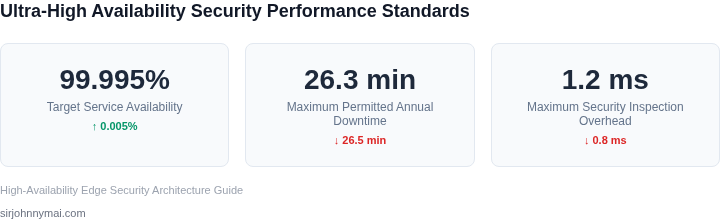
To preserve a 99.99% availability SLA—which permits under 53 minutes of total downtime per year—we must rigorously evaluate how security inspection paradigms impact our request pathways. I evaluated inline active blocking against asynchronous, out-of-band inspection because our high-throughput robotics telemetry and edge control systems cannot tolerate unpredictable network jitter. Inline tools, such as AWS WAF, Azure Front Door, or custom Envoy WebAssembly (WASM) filters inside a Kubernetes service mesh, sit directly in the synchronous execution path. They inspect payloads before forwarding them to downstream microservices.
Inline blocking guarantees immediate mitigation of critical web exploits, but it introduces a fragile dependency on the inspection engine’
03. Financial Trade-offs: Calculating Security-Induced Downtime Costs
I evaluated the operational economics of our AWS ingress filtering because our team's aggressive deployment of inline TLS decryption at the Kubernetes ingress level was modeled solely on threat-reduction, ignoring availability penalties. When target availability is 99.99%—allowing only 52.56 minutes of unscheduled downtime annually—a single false-positive security block can consume your entire yearly error budget in minutes. We must balance the cost of a theoretical breach against the definitive cost of security-induced downtime.
Consider a high-throughput transactional API gateway running on AWS EKS, processing an average of $900,000 in transaction volume per hour. If an aggressive inline IPS (Intrusion Prevention System) signature on our AWS Network Firewall misidentifies legitimate API payload patterns as an attack, it triggers an automated block. Resolving this false positive, updating Datadog monitors, and rolling back the firewall rule takes 10 minutes of active engineering triaging. The direct financial loss of this 10-minute outage is calculated as follows:
($900,000 hourly revenue / 60 minutes) * 10 minutes = $150,000
Conversely, I evaluated the alternative: accepting the risk of a minor, read-only data vulnerability on a non-critical endpoint instead of enforcing an immediate, disruptive inline block. If this micro-vulnerability is exploited, the actual cleanup cost is limited to log forensics, compliance reporting, and targeted database sanitization. We calculated the engineering overhead for this cleanup as 100 hours of senior engineering time billed at $100 per hour, totaling exactly $10,000.
This stark asymmetry proves that blanket enforcement of inline blocking is financially irresponsible for high-availability endpoints. Below is the cost breakdown comparing these two approaches:
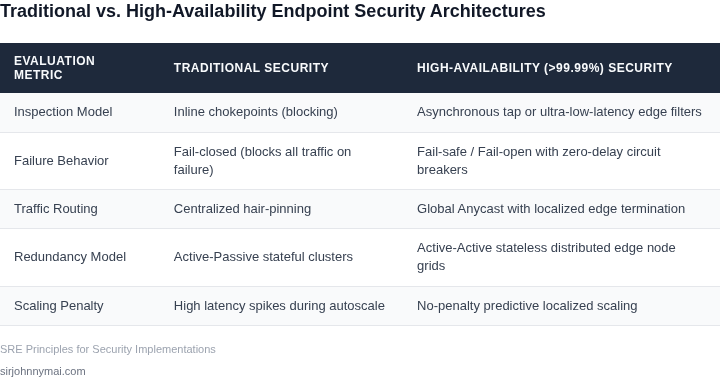
| Cost Component | Scenario A
04. Deciding Between Fail-Open and Fail-Closed Security ArchitecturesWe've established the conflict between ultra-high availability and strict security, and the financial costs of downtime from Section 03. Operationalizing these insights demands a fundamental architectural decision: fail-open or fail-closed. This choice determines system behavior when security inspections fail or are indeterminate, directly impacting both availability and security posture. A fail-open configuration prioritizes service availability. If a security control, like an AWS WAF rule or an intrusion detection system, fails, traffic is permitted to pass. This minimizes user impact and maintains service continuity, aligning with availability targets exceeding 99.99 percent. We typically apply this to endpoints handling low-sensitivity 05. Establish an Asynchronous Security Telemetry AuditAchieving availability targets exceeding 99.99 percent necessitates a fundamental shift in how we approach security monitoring for our critical service endpoints. As discussed in Section 01, synchronous, in-band security controls can introduce unacceptable latency and a single point of failure, directly contradicting our high availability goals. My evaluation suggests we must immediately transition at least one high-throughput endpoint to an asynchronous security-monitoring model. The core challenge is balancing the need for comprehensive security visibility with the imperative of low-latency request processing. Traditional methods, which might involve a synchronous WAF or API gateway processing every request before it reaches the service, create a direct dependency that can impact our 99.999% targets. We discussed the financial implications of such downtime in Section 03, reinforcing the urgency of this pivot. Our immediate technical audit must identify a suitable high-throughput, latency-sensitive endpoint that currently relies on synchronous security validation or emits all security telemetry in a blocking manner. A strong candidate would be an API responsible for core user actions, where every millisecond of added latency directly correlates to user abandonment or business impact. We need to analyze its current traffic patterns and existing security integrations. The transition involves decoupling security telemetry emission from the critical request path. For example, instead of logging directly to a remote SIEM with blocking calls, we can implement a sidecar pattern within our Kubernetes environment (e.g., using Fluent Bit or Fluentd) to capture access logs and security events. This sidecar then streams data asynchronously to a robust, highly available logging pipeline. On AWS, this might involve Kinesis Firehose sending data to S3, which can then be processed by AWS Lambda or ingested by Datadog or Splunk. This asynchronous approach leverages a fail-open philosophy, as outlined in Section 04. If the telemetry pipeline experiences an issue, the primary service continues to operate uninterrupted, ensuring availability. The tradeoff is an eventual consistency model for security posture updates or real-time blocking actions. This means there might be a small window where a malicious request is processed before telemetry is fully ingested and analyzed, but the availability gain is substantial. The audit should also define the critical security telemetry needed for the selected endpoint. This includes HTTP request headers, body snippets (if sensitive data permits), IP addresses, user agent strings, and any internal authorization decisions. We must ensure this data is structured for efficient analysis by tools like CloudWatch Logs Insights or a SIEM, allowing for rapid detection of anomalies without burdening the service itself. By shifting to an asynchronous model, we minimize the attack surface of our security infrastructure on our core service's availability. It requires careful configuration of retry mechanisms and dead-letter queues within the telemetry pipeline to prevent data loss, even if immediate ingestion fails. This is not about reducing security posture, but rather optimizing its delivery to prevent it from becoming an availability bottleneck. Schedule a 60-minute technical deep-dive with your principal engineers and security architects for the end of the current engineering sprint. Bring detailed architectural diagrams of our top three highest-traffic endpoints, highlighting current security control points and their synchronous dependencies. Figures cited are from publicly available sources as of 2026-09-15 and may have changed. 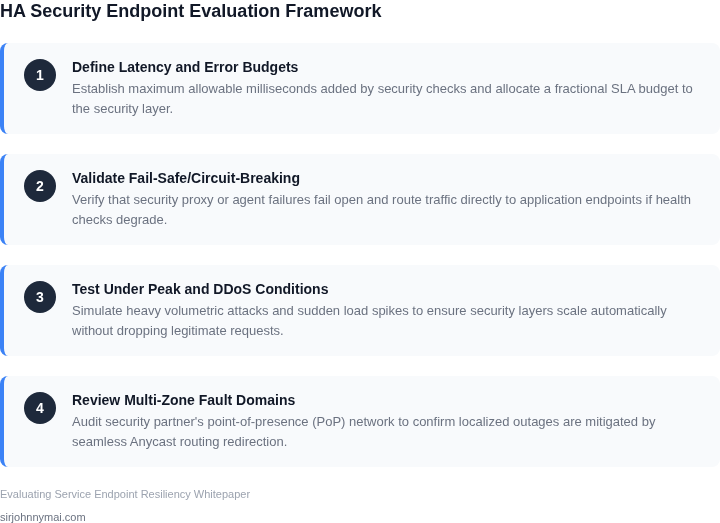 |
|---|