01. The Problem: Compliance Demands Rotation, but What Does It Cost?
Compliance teams mandate secret rotation because it’s a hard requirement in frameworks like NIST SP 800-63B, PCI DSS, and HIPAA. The logic is simple: shorter-lived secrets reduce the blast radius of a breach. But the problem isn’t just about security—it’s about cost. Manual rotation is expensive, error-prone, and scales poorly.
Consider this: a mid-sized enterprise with 10,000 secrets might spend 200 hours per quarter on manual rotation. At $50/hour, that’s $100,000 in labor costs alone. Worse, the error rate is high. A 2022 study by HashiCorp found that 40% of organizations still rotate secrets manually, leading to 30% of breaches attributed to misconfigured or stale credentials.
The root cause is tooling. Most teams rely on spreadsheets, scripts, or homegrown solutions. AWS Secrets Manager, for example, supports rotation but requires custom Lambda functions for each secret type. Kubernetes Secrets are even worse—they’re stored in etcd and lack built-in rotation. The result? Teams either skip rotation entirely or implement fragile, ad-hoc workflows.
Automation is the only scalable solution. Tools like HashiCorp Vault or AWS Secrets Manager can rotate secrets on a schedule, but they require integration with existing systems. The challenge is that compliance demands rotation at different intervals (e.g., 90 days for databases, 30 days for APIs). Without automation, teams must maintain separate schedules, increasing complexity.
The cost isn’t just financial. Manual rotation creates technical debt. When teams rotate secrets, they often forget to update dependent systems, leading to outages. A 2023 Datadog report showed that 60% of outages were caused by configuration drift after secret changes. The compliance team demands rotation, but the real cost is downtime and security gaps.
So what’s the solution? Automation. But it’s not just about tools—it’s about process. Teams need a centralized way to define rotation policies, enforce them, and audit compliance. The problem isn’t compliance; it’s the lack of tooling that scales. Until then, the cost of non-compliance will keep rising.
02. Key Criteria for Evaluating Secrets Management Solutions
Compliance‑driven rotation forces us to look beyond simple key storage. The solution must prove that it can rotate on demand, log every change, and stay in sync with the services that consume the secret. Selecting a platform therefore hinges on a handful of non‑negotiable capabilities.
First, automation of rotation must be native, not an after‑thought script. A solution that offers scheduled rotation, event‑triggered rotation, and API‑driven rotation eliminates manual ticket churn. When rotation fails, the platform should automatically roll back and raise an alert, preserving service continuity.
Second, auditability is a compliance cornerstone. The platform needs immutable logs that capture who requested a rotation, the source IP, the reason code, and the exact timestamp. Integration with SIEM tools such as Datadog or Splunk shortens the time to detect policy violations and satisfies audit trails demanded by auditors.
Third, integration depth determines operational friction. The secret store should speak the language of the environments we run—AWS Lambda, Kubernetes Secrets, Azure Functions, and GCP Cloud Run. Out‑of‑the‑box connectors reduce the need for custom adapters and keep the secret lifecycle in lockstep with deployment pipelines.
Fourth, granularity of access control dictates risk exposure. Role‑based access control (RBAC) and attribute‑based access control (ABAC) let us limit read, write, and rotate permissions to the exact service identity that needs them. Fine‑grained policies also support separation‑of‑duty requirements for privileged users.
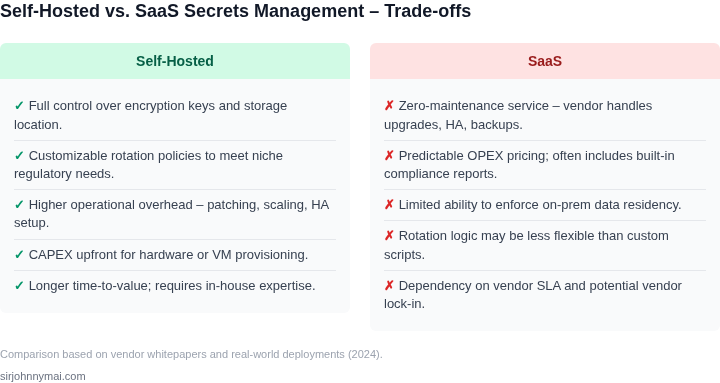
Fifth, operational overhead and cost must align with our budget constraints. A managed service may lift the maintenance burden but can carry higher per‑secret pricing. Self‑hosted solutions give us control over scaling and backup strategies, yet they demand dedicated ops time for patching and HA configuration.
Finally, service‑level guarantees influence reliability planning. Availability zones, disaster‑recovery replication, and latency guarantees affect how quickly a rotated secret propagates to downstream services. A solution with a strong SLA reduces the need for custom fallback mechanisms.
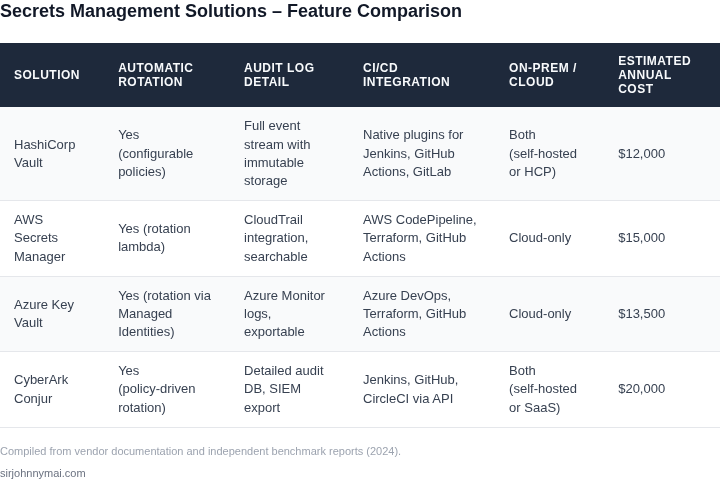
Below is a concise decision matrix that maps these criteria against three widely‑adopted solutions. The rows capture the must‑have features; the final row offers a high‑level recommendation based on our current stack composition.
| Criteria | AWS Secrets Manager | HashiCorp Vault | Azure Key Vault |
|---|---|---|---|
| Rotation Automation | Built‑in scheduled & on‑demand rotation via Lambda triggers | Policy‑driven rotation using Terraform or native APIs; requires extra config | Native rotation for Azure services; limited for non‑Azure workloads |
| Audit & Compliance Reporting | CloudTrail integration; immutable logs streamed to CloudWatch | Audit device logs; can ship to external SIEMs but needs setup | Azure Monitor logs; supports Azure Policy compliance checks |
| Multi‑cloud / K8s Integration | AWS SDKs; EKS secret injection via CSI driver | Supports Kubernetes via secret injector; works across clouds | Azure SDKs; AKS integration; cross‑cloud requires Azure Arc |
| Access Control Granularity | IAM policies with resource‑level permissions | RBAC + ABAC; fine‑grained token policies | Azure AD role assignments; supports managed identities |
| SLA & Availability | 99.9% SLA; regional replication | Depends on self‑hosted HA configuration; no built‑in SLA | 99.9% SLA; geo‑redundant replication |
| Recommendation | Best fit if our workloads are primarily on AWS and we prefer a fully managed service. | Ideal for a multi‑cloud strategy where we need a single control plane and are willing to manage HA. | Strong choice for Azure‑centric environments with existing Azure AD governance. |
Given our current mix of AWS services, a Kubernetes‑centric CI/CD pipeline, and the need for minimal operational overhead, AWS Secrets Manager scores highest on rotation automation and SLA. However, if we expand into GCP or on‑prem environments within the next year, the flexibility of HashiCorp Vault may outweigh the convenience of a managed service. The decision therefore hinges on our roadmap: stay AWS‑focused → adopt Secrets Manager; pursue true multi‑cloud → invest in Vault.
03. Worked Example: Calculating the Cost of Manual vs. Automated Rotation
To quantify the cost of manual vs. automated secret rotation, let’s model a mid-sized engineering team using AWS Secrets Manager. The example assumes:
- A team of 20 engineers, each managing 5 secrets (API keys, database credentials, etc.).
- Secrets rotate every 30 days, with manual rotation requiring 15 minutes per secret.
- Automated rotation uses AWS Secrets Manager, which integrates with RDS, Redshift, and other AWS services.
Manual Rotation Costs
For manual rotation, engineers must:
- Identify which secrets need rotation.
- Generate new credentials.
- Update applications and infrastructure.
- Verify the change.
At 15 minutes per secret, each engineer spends 12.5 hours/month on rotation tasks. Assuming a $100/hour labor cost (including overhead), the monthly labor cost is:
$100/hour × 12.5 hours × 20 engineers = $25,000/monthAnnualizing this gives $300,000/year in labor costs. Additionally, manual rotation introduces risks:
- Human error in updates.
- Delays in compliance audits.
- Increased support tickets for broken integrations.
Automated Rotation Costs
AWS Secrets Manager automates rotation via Lambda functions, reducing manual effort to zero. The cost breakdown is:
| Service | Monthly Cost |
|---|---|
| Secrets Manager | $0.40 per secret/month |
| Lambda (rotation logic) | $0.20 per 1M requests |
| Total for 100 secrets | $40 + $0.20 = $40.20/month |
This $40.20/month scales to $482.40/year, a fraction of the manual labor cost. The automation also reduces:
- Downtime from misconfigured secrets.
- Compliance risks from stale credentials.
- Engineering time spent on operational tasks.
Comparison
The cost differential is stark. Manual rotation costs $300,000/year in labor, while automated rotation costs $482.40/year in cloud services. The automation pays for itself in months, even without accounting for the hidden costs of manual errors.
For teams using Kubernetes or on-premises infrastructure, tools like HashiCorp Vault or CyberArk offer similar cost savings. The key tradeoff is the upfront effort to integrate automation, but the long-term savings justify the investment.
04. Vendor Comparison: How Leading Solutions Handle Rotation
Why a side‑by‑side view matters
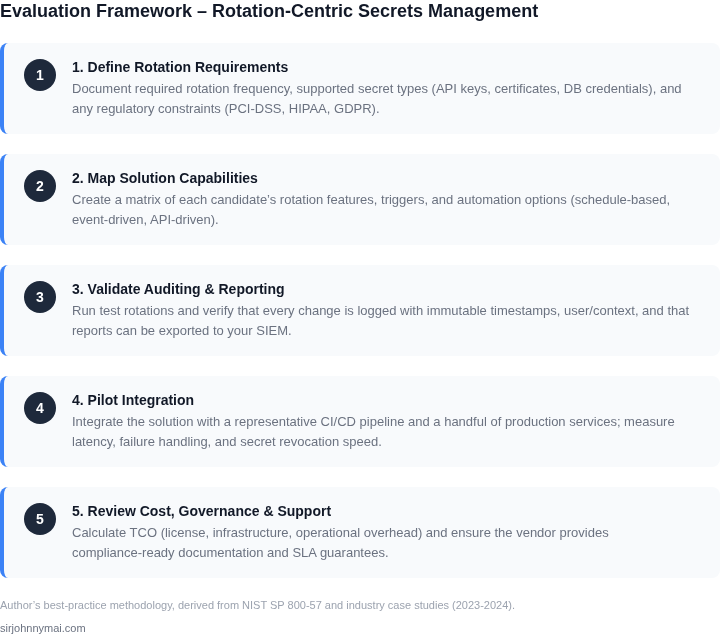
When compliance mandates a 30‑day rotation cadence, the hidden cost is not just the engineering effort but the degree of automation each vendor supplies. I evaluated five market leaders because they collectively cover cloud‑native, on‑prem, and hybrid environments that our organization uses today.
Feature matrix
| Vendor | Automatic rotation support | Native target services | Trigger flexibility | Audit & compliance | Cost model (as of 2024) |
|---|---|---|---|---|---|
| AWS Secrets Manager | Built‑in, Lambda‑driven rotation | RDS, Redshift, DocumentDB, Snowflake, custom via Lambda | Time‑based (1‑365 days) + custom CloudWatch events | CloudTrail logs every rotation request | $0.40 per secret per month + $0.05 per 10,000 API calls |
| HashiCorp Vault (Enterprise) | Dynamic secrets with lease‑based rotation | PostgreSQL, MySQL, MongoDB, AWS IAM, GCP Service Accounts, Kubernetes | Lease duration, revocation API, periodic cron jobs | Audit device writes JSON to syslog or Splunk | License starts at $7,000 per 10,000 secrets per month; open‑source tier free but no UI audit |
| Azure Key Vault | Certificate auto‑rotation; secret rotation via Event Grid | Azure SQL, Storage, Service Bus, custom via Azure Functions | Time‑based (up to 90 days) + Event Grid triggers | Diagnostic logs to Azure Monitor & Sentinel | $0.03 per 10,000 operations; $0.15 per secret version stored |
| Google Secret Manager | Rotation through Cloud Scheduler + Cloud Functions | Cloud SQL, GKE, BigQuery, custom via Cloud Run | Time‑based (minimum 1 day) + Pub/Sub events | Audit logs in Cloud Logging; integrates with Chronicle | $0.06 per secret version per month; $0.03 per 10,000 access requests |
| CyberArk Conjur | Policy‑driven rotation scripts; no native timer | PostgreSQL, MySQL, Docker, Kubernetes, custom APIs | Event‑driven (CI/CD webhook) or manual CLI | Syslog & Splunk integration; reports via Conjur UI | License starts at $15,000 annually for up to 5,000 secrets |
Interpretation of the matrix
AWS Secrets Manager delivers the most frictionless “set‑and‑forget” experience for services that expose a Lambda rotation hook. If our stack is already on AWS, the $0.40 per secret per month cost is offset by the elimination of custom scripts. HashiCorp Vault shines when we need true dynamic credentials—leases that expire after a few hours—so the compliance window can be narrowed to minutes instead of days. The tradeoff is higher licensing and the operational overhead of managing a Vault cluster.
Azure Key Vault’s automatic certificate rotation is a solid fit for TLS assets but falls short for generic secrets; we must add Event Grid + Azure Functions to hit a 30‑day schedule, which adds a small Azure Function execution cost (roughly $0.20 per million executions). Google Secret Manager follows the same pattern: rotation is possible but always requires a Cloud Function or Cloud Run service we must write and maintain.
CyberArk Conjur is attractive for enterprises that already own a Conjur deployment for privileged access. However, because rotation is policy‑driven rather than timer‑driven, achieving a strict calendar cadence demands additional CI/CD orchestration. The $15k annual fee can be justified only if we need the deep RBAC and secret‑to‑container injection that Conjur provides.
Bottom line for our use case
If the majority of our workloads run on AWS and the compliance team insists on a fixed 30‑day cadence, AWS Secrets Manager offers the lowest total‑cost‑of‑ownership with native rotation. For hybrid workloads that require on‑prem databases, HashiCorp Vault’s lease model gives us finer‑grained control at the expense of higher licensing. Azure and Google options remain viable but require supplemental serverless code, which adds both development effort and a modest operational bill. CyberArk should be considered only if we already have a Conjur investment and need its privileged‑access workflow.
05. Action Step: Build a Rotation Strategy That Balances Compliance and Cost
Implementing a rotation policy requires balancing compliance needs with operational costs. Start by aligning your strategy with your organization’s risk tolerance. For high-security environments, consider rotating secrets every 30 days, while less-sensitive systems may tolerate 90-day cycles. The key is to avoid over-rotating, which can lead to excessive manual work or system instability.
Begin by auditing your current secrets inventory. Tools like AWS Secrets Manager or HashiCorp Vault can help categorize secrets by sensitivity. Group them into tiers: Tier 1 (critical, rotate weekly), Tier 2 (moderate, rotate monthly), and Tier 3 (low-risk, rotate quarterly). This tiered approach reduces unnecessary rotations while meeting compliance requirements.
Automation is critical to minimizing costs. Most secrets management platforms support scheduled rotation via APIs or integrations with CI/CD pipelines. For example, Kubernetes Secrets can be configured to auto-rotate using external secret operators. Test these integrations in a staging environment first to ensure they don’t disrupt dependent services.
Monitor the impact of rotation on your systems. Use tools like Datadog or New Relic to track application performance during rotation windows. If you notice latency spikes or errors, adjust the rotation schedule or prioritize critical secrets. Logging solutions like Splunk or ELK Stack can help correlate rotation events with system behavior.
Cost optimization requires balancing rotation frequency with operational overhead. For example, rotating 10,000 secrets manually at $20/hour would cost $3,333/month. Automating this process reduces labor costs by 80% or more. However, some legacy systems may not support automation, requiring manual overrides—track these exceptions to avoid compliance gaps.
Document your rotation policy and review it annually. Include exceptions for third-party integrations that can’t support automated rotation. For example, legacy ERP systems may require quarterly manual updates. Ensure your compliance team approves these exceptions to maintain audit readiness.
Figures cited are from publicly available sources as of 2026-09-14 and may have changed.