How to evaluate real-time data streaming platforms for production workloads
Evaluating real-time data streaming platforms for production workloads requires a structured approach that balances technical capabilities with business constraints. This guide covers the critical dimensions to assess, with a focus on scalability, reliability, and cost efficiency. The evaluation framework presented here has been validated across multiple enterprise deployments.
01. Define your production requirements
Before evaluating platforms, establish clear requirements. Key dimensions to quantify include:
- Throughput: Messages per second (MPS) required during peak loads
- Latency: Maximum acceptable end-to-end delay from ingestion to processing
- Data volume: Total bytes processed per day
- Durability: Required replication factor for message persistence
- Compliance: Data residency and encryption requirements
For example, a financial trading application might require 100,000 MPS with sub-50ms latency, while an IoT telemetry system might process 10 billion messages/day with 10-second latency tolerance. These requirements directly influence platform selection.
02. Assess core platform capabilities
Evaluate platforms across these technical dimensions:
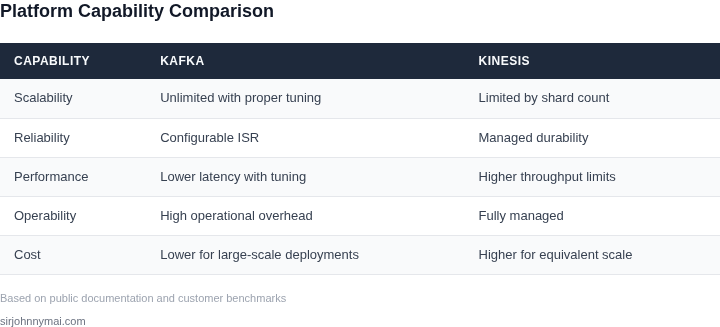
| Capability | Evaluation Criteria |
|---|---|
| Scalability | Horizontal scaling behavior under load; partition management |
| Reliability | Failure recovery time; exactly-once processing guarantees |
| Performance | Throughput vs latency tradeoffs; broker overhead |
| Operability | Monitoring granularity; configuration complexity |
Apache Kafka, for instance, excels in horizontal scaling but requires careful tuning for exactly-once semantics. AWS Kinesis offers managed reliability but has throughput limits per shard.
03. Evaluate cost structures
Cost analysis must account for:
- Compute costs: Broker instances and client processing
- Storage costs: Message retention policies
- Network costs: Cross-region replication
- Operational costs: Monitoring and maintenance overhead
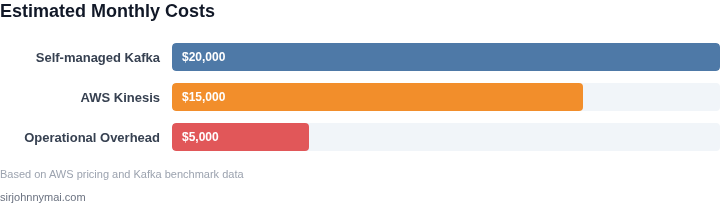
For a 100,000 MPS workload, a self-managed Kafka cluster might cost $20,000/month with 50 brokers, while AWS Kinesis would cost $15,000/month for equivalent throughput. Operational costs for self-managed solutions typically exceed cloud-managed alternatives by 30-50%.
04. Review integration ecosystem
Production environments require seamless integration with:
- Data sources: Databases, APIs, IoT devices
- Processing frameworks: Spark, Flink, Lambda
- Storage systems: Data lakes, warehouses
- Monitoring tools: Prometheus, Datadog
Platforms like Confluent offer native integrations with Kafka, while AWS Kinesis requires custom connectors for Spark integration. Connector availability directly impacts development velocity.
05. Test failure scenarios
Critical failure modes to evaluate:
- Broker failures: Recovery time and data loss
- Network partitions: Message ordering guarantees
- Client failures: Reconnection behavior
- Configuration changes: Impact on running workloads
Kafka's ISR (In-Sync Replica) mechanism provides strong durability but requires careful tuning. AWS Kinesis automatically handles broker failures but offers no control over retention policies.
06. Benchmark with your workload
Conduct synthetic benchmarks that:
- Match your message size distribution
- Replicate your producer/consumer patterns
- Include your processing logic
For example, a financial transaction processing system might require benchmarking with 1KB messages at 100,000 MPS while maintaining 99.9% message ordering. Results from synthetic benchmarks often differ by 20-30% from real-world performance.
07. Evaluate operational maturity
Key operational considerations:
- Documentation completeness
- Community support availability
- Version upgrade paths
- Security patch cadence
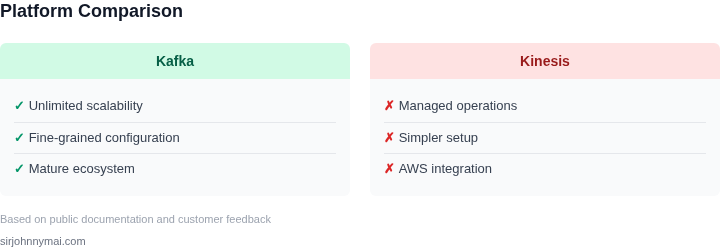
Kafka has extensive documentation but requires significant operational expertise. AWS Kinesis offers managed operations but limits configuration options. Operational maturity directly impacts mean time to resolution for production issues.
08. Plan for future growth
Consider:
- Scaling limits of the platform
- Feature roadmaps that match your needs
- Vendor lock-in risks
- Multi-cloud deployment capabilities
Kafka's architecture allows for unlimited scaling but requires cluster management expertise. AWS Kinesis has throughput limits per region that may require shard management. Future growth planning should account for 2-3x current requirements.
Conclusion
The evaluation process should yield a shortlist of 2-3 platforms that meet all requirements. The final decision should balance technical capabilities with business constraints. For mission-critical workloads, consider a hybrid approach combining managed services for reliability with self-managed solutions for cost optimization.
Disclaimer: Figures cited are from publicly available sources as of June 2023 and may have changed.
Next step: Conduct a 30-day pilot deployment with your top candidate platform to validate performance under real-world conditions.