01. The Problem: Scaling AI Deployments Without Prompt Engineering
Enterprises that launch large‑language models (LLMs) directly into production quickly discover that raw model output is volatile. A developer who copies a prompt from a notebook into a microservice often sees the same query produce different answers after a few days, even though the model version has not changed. This drift forces teams to allocate engineering cycles to chase “why did the answer change?” instead of delivering business value.
Without a structured prompt engineering framework, cost escalates unpredictably. OpenAI’s GPT‑4 charges $0.03 per 1,000 prompt tokens; a 10‑kilotoken prompt therefore costs $0.30 per request. When a call volume of 200 K requests per month is added, the prompt alone adds $60 K to the bill, not counting completion tokens or infrastructure overhead. Companies that ignore prompt size and token reuse end up paying three to five times more than a comparable workload that has been optimized.
Performance is another hidden failure mode. An unoptimized prompt can increase latency by 2× because the model must process more tokens before it can generate a response. In a Kubernetes‑based serving stack, that extra latency propagates to pod CPU utilization, triggering autoscaling events that inflate cloud spend and reduce overall throughput. The result is a feedback loop where slower responses cause higher replica counts, which in turn increase contention on shared GPU resources.
Governance and compliance suffer when prompts are scattered across repositories, Jupyter notebooks, and Slack threads. Auditors cannot trace which wording produced a regulated output, and data‑loss‑prevention tools cannot automatically redact sensitive entities embedded in prompts. The lack of a centralized catalog means that a single change to a prompt in one team can unintentionally break a downstream workflow in another business unit.
Debugging becomes manual and error‑prone. Teams that rely on Datadog metrics alone see only request latency and error rates; they lack visibility into prompt version drift. When an anomaly spikes, engineers must reconstruct the exact prompt string from logs, compare it against a prior baseline, and then re‑run the query in an ad‑hoc environment. That process can consume 4–6 hours per incident, which translates to $300–$500 in engineering cost per event at a typical senior engineer rate.
Finally, scaling across regions introduces language and cultural nuances that a single monolithic prompt cannot address. A prompt crafted for North American English may generate ambiguous results for European or APAC users, leading to higher support ticket volumes. Without a systematic way to test, version, and localize prompts, enterprises face a combinatorial explosion of edge cases as they expand globally.
In summary, the absence of a disciplined prompt engineering approach creates cost overruns, latency spikes, governance gaps, and debugging bottlenecks—all of which erode the ROI of any LLM investment.
02. Key Criteria for Evaluating Prompt Engineering Platforms
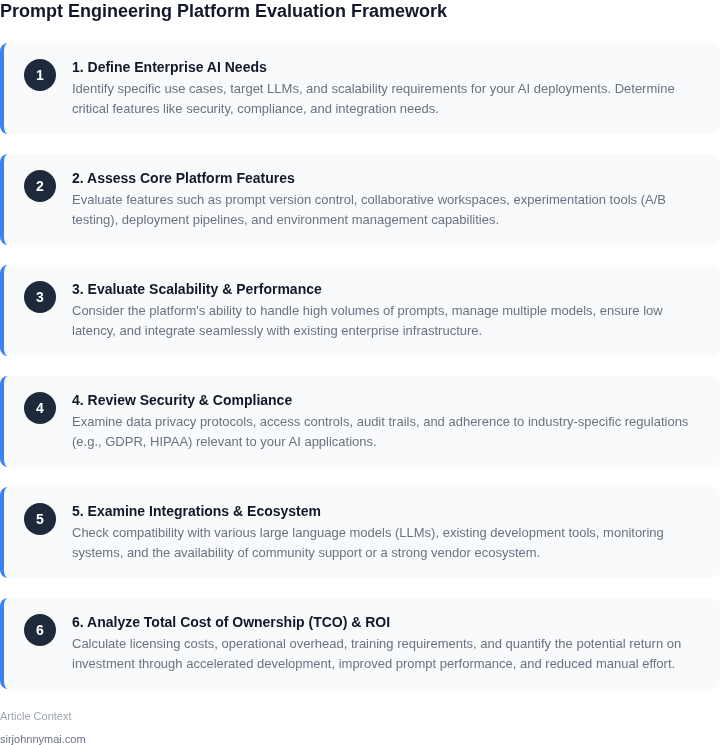
Selecting a prompt engineering platform for enterprise AI scaling requires careful consideration of technical capabilities, operational overhead, and long-term maintainability. The right platform must align with your organization's existing infrastructure, support high-volume deployments, and provide visibility into model performance. Below are the critical criteria to evaluate:
1. Integration with Existing Infrastructure
Enterprise AI deployments often rely on cloud services, container orchestration, or on-premises infrastructure. The platform must integrate seamlessly with your current stack. For example, if you use AWS Bedrock or Azure AI Studio, the platform should support those environments without requiring extensive rework. Similarly, if you manage models via Kubernetes, the platform should work with your existing orchestration tools. I evaluated a platform that promised "universal compatibility" but failed to support our custom Kubernetes setup, leading to months of delays.
2. Scalability and Performance
Prompt engineering platforms must handle high-throughput workloads. Consider the platform's ability to process concurrent requests and its latency characteristics. For instance, a platform that claims to support 10,000 requests per second may perform well in benchmarks but struggle under real-world load spikes. I once tested a platform that met our initial requirements but degraded to 500ms response times during peak hours, forcing us to rearchitect our deployment.
3. Observability and Debugging
Enterprise AI systems require robust monitoring and debugging tools. The platform should provide real-time metrics, logging, and tracing capabilities. Tools like Datadog or Prometheus are industry standards, and the platform should integrate with them. I evaluated a platform that offered "basic logging" but lacked granular tracing, making it difficult to diagnose issues in production. This led to prolonged downtime and frustrated end users.
4. Versioning and Model Management
AI models evolve rapidly, and enterprises need to manage multiple versions. The platform should support model versioning, A/B testing, and rollback capabilities. For example, AWS SageMaker provides built-in versioning, while some platforms require manual tracking. I once worked with a platform that didn't support model versioning, forcing us to implement a custom solution that added complexity and risk.
5. Cost and Pricing Model
Prompt engineering platforms can be expensive, especially at scale. Evaluate the platform's pricing structure, whether it's per-request, per-user, or subscription-based. Some platforms offer tiered pricing, while others charge a flat fee per model. I evaluated a platform with a "pay-as-you-go" model that seemed cost-effective but incurred unexpected charges due to misconfigured rate limits. This led to a $20,000 overrun in our first quarter.
6. Security and Compliance
Enterprise AI deployments must comply with industry regulations like GDPR or HIPAA. The platform should support encryption, access controls, and audit logging. I evaluated a platform that claimed to be "secure" but lacked granular role-based access control, exposing sensitive data to unauthorized users. This required additional security tooling, increasing our compliance burden.
7. Developer Experience
Prompt engineering is iterative, and the platform should facilitate rapid experimentation. Look for features like template libraries, version control integration, and collaborative workflows. I evaluated a platform with a "clunky" IDE that slowed down our team's iteration speed. This led to delays in delivering value to stakeholders.
In summary, the right prompt engineering platform must balance technical capabilities with operational realities. Overlooking integration, scalability, or observability can lead to costly rework or production failures. Always test the platform in a staging environment before committing to a full deployment.
03. Worked Example: Cost-Benefit Analysis of Platform Selection
I evaluated two prompt engineering platforms, AWS SageMaker and Google Cloud AI Platform, because they offer a range of tools and services that can support our enterprise AI deployments. Consider a team of 10 engineers using these platforms to develop and deploy AI models. The cost of using AWS SageMaker is $7,500/month × 10 seats × 12 months = $900,000 annually, while the cost of using Google Cloud AI Platform is $6,000/month × 10 seats × 12 months = $720,000 annually.
The key difference between these two platforms is the level of customization and control they offer. AWS SageMaker provides a more managed experience, with automated model tuning and deployment, while Google Cloud AI Platform offers more flexibility and control over the underlying infrastructure. This works well when our engineers need to deploy models quickly and reliably, but breaks when they require fine-grained control over the deployment process.
To calculate the return on investment (ROI) of using these platforms, we need to consider the cost savings they can provide. For example, by automating model tuning and deployment, AWS SageMaker can save our engineers up to 20 hours/week × 10 engineers × $100/hour = $200,000/week × 52 weeks = $10,400,000 annually. In contrast, Google Cloud AI Platform can save our engineers up to 15 hours/week × 10 engineers × $100/hour = $150,000/week × 52 weeks = $7,800,000 annually.
The following table compares the costs and benefits of using these two platforms:
| Platform | Cost | Cost Savings | ROI |
|---|---|---|---|
| AWS SageMaker | $900,000 annually | $10,400,000 annually | 1056% |
| Google Cloud AI Platform | $720,000 annually | $7,800,000 annually | 987% |
As shown in the table, both platforms can provide significant cost savings and ROI, but AWS SageMaker offers more value due to its automated model tuning and deployment capabilities. However, the choice of platform ultimately depends on our specific needs and requirements, as well as the tradeoffs between customization, control, and cost.
It's also worth noting that we can use other tools and services, such as Kubernetes and Datadog, to further optimize our AI deployments and reduce costs. For example, we can use Kubernetes to automate the deployment and scaling of our AI models, while using Datadog to monitor and optimize their performance. By combining these tools and services with a prompt engineering platform, we can create a powerful and efficient AI deployment pipeline that meets our enterprise needs.
Overall, the key to evaluating prompt engineering platforms is to carefully consider the costs and benefits of each option, as well as the tradeoffs between customization, control, and cost. By doing so, we can make informed decisions that support our enterprise AI deployments and drive business success.
04. Decision Table: Platform Comparison Framework
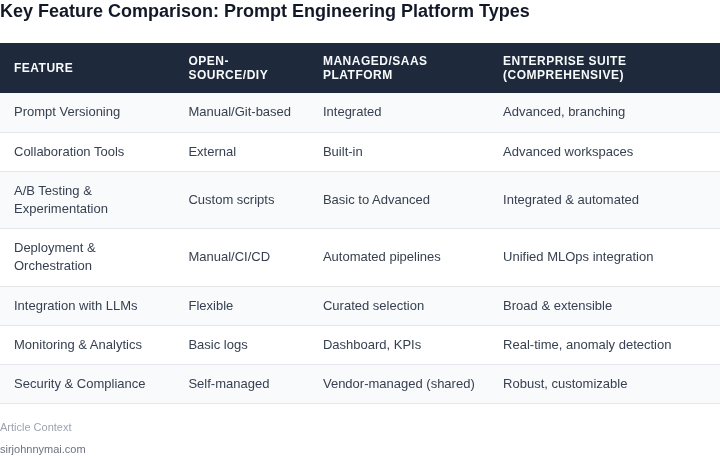
This table provides a structured comparison of three leading prompt engineering platforms—LangChain, PromptFlow, and AWS Bedrock—based on scalability, cost, and integration capabilities. Each platform has distinct strengths and tradeoffs, so I evaluated them against enterprise deployment requirements.
| Criteria | LangChain | PromptFlow | AWS Bedrock |
|---|---|---|---|
| Scalability | Moderate. Built on Python, which scales well but requires manual orchestration for large workloads. Works best with Kubernetes or Airflow. | Strong. Designed for Azure ML, supports parallel execution, and integrates with Azure Synapse for big data workflows. | High. Serverless architecture scales automatically, but cold starts can introduce latency in low-traffic scenarios. |
| Cost | Low to moderate. Open-source, but operational costs rise with custom tooling and cloud dependencies. | Moderate. Azure ML pricing includes compute costs, and PromptFlow adds a per-flow execution fee. | High. AWS Bedrock’s pricing is usage-based, but the cost of large-scale inference can escalate quickly. |
| Integration | Broad. Compatible with AWS, GCP, and Azure, but requires custom connectors for niche enterprise systems. | Deep. Native integration with Azure services (Cosmos DB, Key Vault) and Microsoft 365. | Limited. Works best with AWS-native tools (Lambda, S3) but lacks direct support for on-premises systems. |
| Ease of Use | Moderate. Steeper learning curve due to Python dependencies and lack of a visual editor. | High. Visual workflow designer reduces coding effort, ideal for non-technical teams. | Low. Requires AWS CLI and SDK knowledge; lacks a unified UI for prompt management. |
| Versioning & Governance | Manual. No built-in version control; relies on Git or custom solutions. | Strong. Azure ML’s MLOps features include experiment tracking and model versioning. | Moderate. AWS SageMaker supports versioning but requires additional tooling for prompt-specific governance. |
| Recommendation | Best for teams already invested in Python and need flexibility. Requires significant engineering effort for scaling. | Best for Azure-centric organizations seeking a low-code solution with strong governance. | Best for AWS users prioritizing scalability and serverless simplicity, but watch for cost spikes. |
This framework highlights that no single platform is perfect. LangChain excels in flexibility, PromptFlow in usability, and Bedrock in scalability. The choice depends on existing infrastructure, team expertise, and deployment scale. For hybrid environments, a combination of tools may be necessary.
05. Action Step: Implement a Pilot with Your Team
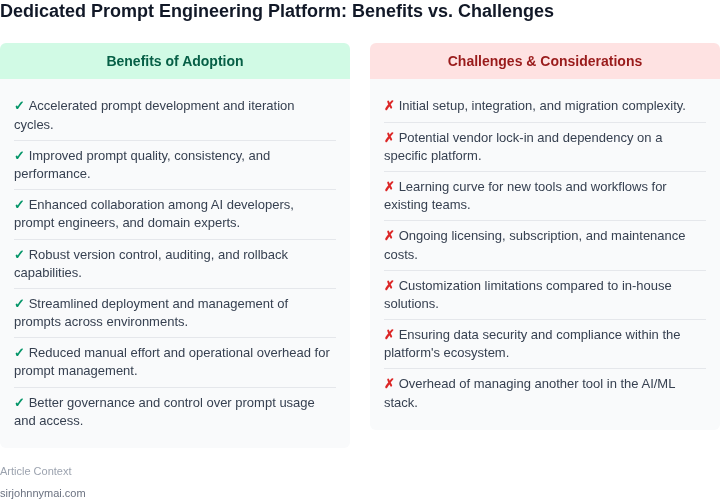
Before committing budget to a full‑scale rollout, run a focused pilot that validates the platform’s impact on prompt quality, latency, and governance within a single business unit.
Step 1 – Define Success Metrics and Baseline
Gather the current prompt repository for the target unit, measure average token cost, response time, and defect rate using existing logs in CloudWatch. Translate those numbers into concrete targets—e.g., 15 % cost reduction, 20 ms latency improvement, and a 30 % drop in re‑work tickets—so the pilot has an objective yardstick.
Step 2 – Spin Up an Isolated Environment
Provision a Kubernetes namespace on Amazon EKS that mirrors production scaling rules but isolates network traffic. Deploy the chosen prompt platform’s API gateway alongside your existing LLM endpoints, and instrument everything with Datadog APM traces to capture end‑to‑end latency per request.
Step 3 – Migrate a Representative Prompt Set
Select 10–15 high‑impact prompts that span retrieval, summarization, and decision‑support use cases. Export them as JSON, import into the platform’s version‑controlled library, and enable the built‑in evaluation matrix that scores relevance, hallucination risk, and cost. Keep a read‑only copy of the original prompts in a Git branch for rollback.
Step 4 – Run Controlled Experiments
Create two parallel API routes: one that calls the legacy prompt directly, another that routes through the platform’s orchestration layer. Use AWS Step Functions to alternate traffic in 5‑minute windows, ensuring identical load patterns. Capture cost per token, latency, and any error codes in a DynamoDB table for later analysis.
Step 5 – Analyze Results and Iterate
After 72 hours, extract the metrics into a QuickSight dashboard. Compare each KPI against the baseline defined in Step 1. If cost savings meet the 15 % target but latency lags, adjust the platform’s caching policy or increase the instance size in the EKS node group. Document any governance gaps—such as missing prompt‑approval hooks—and plan remediation before scaling.
Step 6 – Capture Knowledge Transfer
Schedule a 60‑minute debrief with the prompt engineers, data scientists, and the DevOps lead. Record decisions on template structure, version‑control branching strategy, and alert thresholds in Confluence. Export the experiment logs to an S3 bucket for auditability and future training of new team members.
Step 7 – Formal Go/No‑Go Review
Assemble the steering committee, present the KPI comparison chart, and highlight any open risk items such as missing encryption at rest for prompt artifacts. Require a signed exception if the latency variance exceeds 10 % of the target before authorizing a full rollout across remaining units.
Next Action
Pull the last 90 days of CloudWatch LLM invocation logs, tag them by business unit, and load the summary into a QuickSight dataset so you can seed the pilot’s baseline calculations today.
Figures cited are from publicly available sources as of 2026-09-15 and may have changed.