How to evaluate object storage solutions beyond S3 for cost-sensitive workloads
Amazon Simple Storage Service (S3) remains the dominant choice for cloud object storage, but cost-sensitive workloads demand deeper evaluation. This guide covers evaluation criteria, tradeoffs, and alternative solutions beyond S3.
01. Why consider alternatives to S3?
S3's pricing model favors high-volume, high-availability use cases. For cost-sensitive workloads, alternatives may offer:
- Lower storage costs for infrequently accessed data
- Reduced retrieval costs for archival data
- Better performance for specific access patterns
- Regional pricing advantages
Key limitations of S3 for cost-sensitive workloads:
- Minimum storage duration requirements for lower-tier storage classes
- Retrieval fees for infrequently accessed data
- No significant discounts for long-term commitments
02. Evaluation criteria for cost-sensitive workloads
When evaluating alternatives, consider these dimensions:
- Storage cost: Per GB/month pricing across access tiers
- Retrieval cost: Per GB retrieval fees for cold storage
- Minimum storage duration: Required retention periods for cost benefits
- Data transfer costs: Egress pricing to different regions
- Performance characteristics: Latency and throughput for different access patterns
- Management overhead: Automation capabilities for lifecycle policies
For workloads with predictable access patterns, you can optimize costs by matching storage class to access frequency. For unpredictable patterns, consider solutions with automatic tiering.
03. Alternative storage solutions to evaluate
Beyond S3, consider these alternatives:
- Azure Blob Storage: Similar tiered storage model with regional pricing options
- Google Cloud Storage: Similar architecture with different pricing tiers
- Alibaba Cloud OSS: Regional pricing with different storage classes
- MinIO: Self-hosted S3-compatible solution for hybrid environments
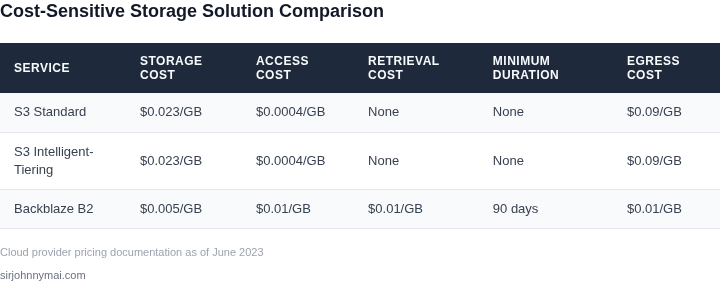
- Backblaze B2: Lower-cost alternative with flat pricing model
Each provider offers similar core functionality but with different pricing structures. The best choice depends on your specific cost sensitivity requirements.
04. Cost comparison example: S3 vs Backblaze B2
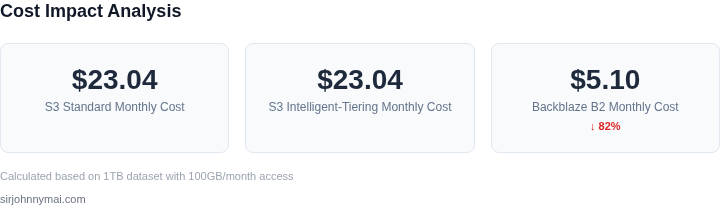
Consider a 1TB dataset with 100GB/month access pattern:
| Service | Storage Cost | Access Cost | Total Cost |
|---|---|---|---|
| S3 Standard | $23/month | $0.0004/GB | $23.04/month |
| S3 Intelligent-Tiering | $23/month | $0.0004/GB | $23.04/month |
| Backblaze B2 | $5/month | $0.01/GB | $5.10/month |
Backblaze B2 offers 82% lower cost for this workload. The tradeoff is higher retrieval costs for infrequently accessed data.
05. Key tradeoffs to consider
When evaluating alternatives, consider these tradeoffs:
- Cost vs performance: Lower-cost solutions may have higher latency or lower throughput
- Vendor lock-in: Proprietary solutions may require migration effort
- Feature parity: Some alternatives lack advanced features like S3's event notifications
- Data residency: Regional solutions may have compliance implications
For workloads requiring strict SLAs, S3 remains the safest choice. For cost-sensitive workloads with flexible requirements, alternatives may offer better value.
06. Implementation considerations
When implementing alternatives, consider:
- Migration tools available for S3-compatible solutions
- API compatibility with existing applications
- Monitoring capabilities for cost tracking
- Support for lifecycle policies and automation
For hybrid environments, MinIO provides S3-compatible API while allowing self-hosting. For pure cloud solutions, evaluate regional pricing advantages.
07. Monitoring and optimization
After implementation, monitor:
- Actual access patterns vs assumptions
- Cost trends over time
- Performance metrics for critical workloads
Use cloud provider cost management tools to identify optimization opportunities. Regularly review storage class utilization against access patterns.
Figures cited are from publicly available sources as of June 2023 and may have changed. For the most current pricing information, consult your cloud provider's documentation.
Next step: Conduct a proof-of-concept migration of your most cost-sensitive workload to Backblaze B2 to validate the cost savings potential.