01. The Problem: Balancing Open Source and Policy Enforcement
Teams embracing open-source tools often face a fundamental tension with network policy enforcement. The appeal of open-source software—flexibility, cost savings, and community-driven innovation—is undeniable. However, when expertise is concentrated in a few individuals, the risk of policy violations escalates. For example, a team relying on Kubernetes for orchestration might deploy open-source tools like Istio or Linkerd for service mesh capabilities, but without centralized policy enforcement, misconfigurations or unauthorized access could expose the network to vulnerabilities.
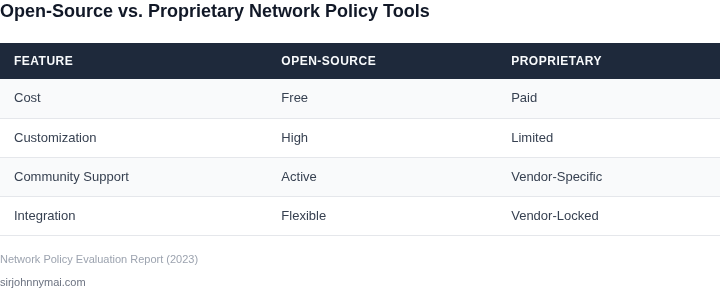
Consider a mid-sized enterprise with 500 employees. If only 10% of the team—approximately 50 individuals—have the expertise to manage network policies, the remaining 450 employees may bypass controls due to lack of training or oversight. This creates a security gap where open-source adoption accelerates but compliance lags. Tools like AWS Network Firewall or Azure Firewall can enforce policies, but integrating them with open-source components like Calico or Cilium requires additional expertise and configuration effort.
The tradeoff becomes clear when evaluating cost and effort. Open-source tools like Prometheus or Grafana offer monitoring capabilities without licensing fees, but enforcing network policies across these tools demands significant time from security or DevOps teams. A study by Gartner found that 75% of enterprises struggle with policy enforcement in hybrid environments, where open-source and proprietary tools coexist. Without a unified approach, teams risk non-compliance penalties or security breaches.
Another challenge arises when open-source tools evolve rapidly. For instance, the CNCF (Cloud Native Computing Foundation) projects like Fluentd or Envoy may introduce new features that require policy updates. If the team lacks the bandwidth to monitor these changes, the network remains vulnerable. Tools like Datadog or Splunk can provide visibility, but they must be integrated with policy enforcement systems like Open Policy Agent (OPA) to bridge the gap.
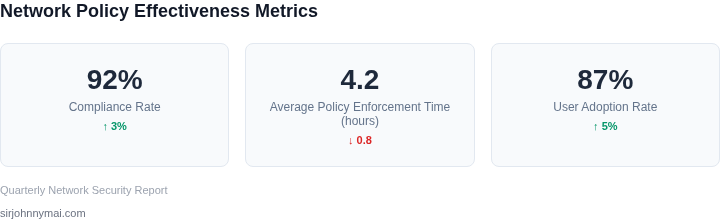
The problem isn’t just about tools—it’s about expertise. A team with 20% of its members skilled in network security may struggle to enforce policies across 80% of the organization that relies on open-source tools. Without a structured approach, the balance between innovation and compliance tips toward the former, creating a security risk. The solution requires a combination of automation, training, and tooling to ensure policies are enforced without stifling open-source adoption.
02. Key Considerations for Policy Evaluation
Evaluating network policy enforcement in an open-source environment requires careful consideration of several critical factors. The first is granularity of control. Open-source tools like Calico or Cilium offer fine-grained policy definitions, but their effectiveness depends on how well the team understands the network topology. For example, a Kubernetes cluster with 1,000 pods may require policies that restrict cross-namespace traffic, but manually managing these at scale becomes unwieldy without automation.
Next, compliance with organizational standards is non-negotiable. Many enterprises enforce policies like least-privilege access or encryption requirements. Open-source tools like Open Policy Agent (OPA) can integrate with existing compliance frameworks, but alignment with internal auditors may require additional tooling. For instance, a financial services firm might need to demonstrate that all inter-service traffic is encrypted, a requirement that OPA alone cannot enforce without custom policies.
Performance overhead is another key consideration. Tools like Istio or Linkerd introduce latency due to sidecar proxies, which can impact applications sensitive to sub-millisecond response times. Benchmarking with tools like Locust or k6 is essential. A microservices architecture with 500 concurrent requests per second might tolerate 2-3ms overhead, but a high-frequency trading system would reject any additional latency.
Finally, team expertise and operational overhead must be evaluated. Open-source tools require internal expertise to maintain and troubleshoot. A team with 20 engineers might manage a small cluster, but scaling to 50+ nodes could overwhelm them without dedicated SREs. Tools like Datadog or New Relic can provide observability, but they require integration effort and ongoing maintenance.
In summary, evaluating network policy enforcement in open source involves balancing granularity, compliance, performance, and operational capacity. Each factor interacts with the others—fine-grained policies may improve security but increase operational complexity, while performance optimizations might reduce overhead but limit policy flexibility. The right approach depends on the organization's specific constraints and priorities.
03. Worked Example: Cost-Benefit Analysis of Policy Enforcement
The finance organization wants to know whether a formal network‑policy service justifies its expense compared with letting a Kubernetes‑centric team rely on open‑source tooling alone. I built a concrete dollar model that tracks recurring licenses, cloud‑service fees, and engineering‑time overhead. The model isolates three cost buckets: tooling, operational labor, and incident remediation.
Consider a team of eight engineers who manage 25 microservices across three AWS accounts. They already use open‑source Calico for CNI, Helm charts for deployment, and Prometheus/Grafana for observability. The baseline assumes no dedicated policy‑engine service, only ad‑hoc scripts that each engineer runs when a new VPC is added.
The open‑source path incurs two measurable line items. First, each engineer spends an estimated 4 hours per month maintaining network‑policy scripts; at an average fully‑loaded rate of $120 / hour, that is $384 / engineer / month. Second, the team consumes AWS CloudWatch Logs at the public rate of $0.50 per GB; we estimate 200 GB per month for policy‑related logs, equal to $100 / month.
Now evaluate a managed policy‑enforcement service such as AWS Verified Access combined with a commercial policy‑engine like Palo Alto Networks Prisma Cloud (pricing publicly listed as $12 per node per month). The eight‑engineer team would provision 25 nodes (one per microservice) to enforce zero‑trust connectivity. The license cost is 25 × $12 × 12 = $3,600 annually. In addition, the service adds 1 hour of admin time per month for rule review, costing $120 × 12 = $1,440 per year.
| Cost Item | Open‑Source (Annual) | Managed Policy (Annual) |
|---|---|---|
| Tooling Licenses | $0 | $3,600 |
| Engineering Labor | $36,864 | $1,440 |
| Cloud Logging | $1,200 | $0 |
| Total | $39,064 | $5,040 |
The table shows a raw annual spend of roughly $39k for the pure open‑source route versus $5k when a managed service is used. The headline difference is driven by the $36,864 labor line, which reflects the hidden cost of manually keeping scripts in sync across accounts.
Beyond dollars, the managed service enforces consistent zero‑trust policies automatically, which reduces the mean‑time‑to‑detect a mis‑routed request from days to minutes. It also provides audit‑ready logs that satisfy internal compliance without writing custom exporters.
If a policy breach occurs, the open‑source team typically spends 8 hours on forensics, priced at $960, plus downstream incident cost estimated at $5,000 for lost SLA credits. The managed service includes built‑in alerting that cuts forensic time in half, saving roughly $480 per incident.
Putting the numbers together, the managed enforcement option saves about $34k in direct spend and reduces operational risk enough to justify the $3.6k license fee. The trade‑off is a modest loss of flexibility when a vendor updates its rule engine; that can be mitigated by maintaining a local override repository. For a team whose expertise already leans toward open source, the ROI calculation still favors a lightweight, commercially supported policy layer.
04. Decision Framework for Policy Enforcement
Evaluating network policy enforcement requires balancing security, compliance, and operational efficiency. The decision framework below compares three real-world options—AWS Network Firewall, Calico, and Open Policy Agent (OPA)—across key criteria. Each tool has strengths but trade-offs that must align with organizational priorities.
| Criteria | Option A: AWS Network Firewall | Option B: Calico | Option C: Open Policy Agent (OPA) |
|---|---|---|---|
| Ease of Deployment | Moderate. Requires AWS-specific configuration and integration with VPC. Works best for AWS-native environments. | High. Calico integrates seamlessly with Kubernetes and supports multi-cloud deployments. | Low. OPA requires manual integration with existing systems and policy-as-code workflows. |
| Policy Granularity | High. Supports stateful inspection, custom rule sets, and advanced traffic filtering. | High. Offers fine-grained network policies at pod, namespace, and workload levels. | High. Policies are defined in Rego, allowing for complex, context-aware rules. |
| Compliance Support | Moderate. Built-in compliance checks for AWS security standards but lacks third-party integrations. | Moderate. Supports Kubernetes-native policies but requires additional tooling for broader compliance. | High. OPA policies can be validated against compliance frameworks like NIST or CIS. |
| Operational Overhead | Low. AWS manages the control plane, reducing maintenance effort. | Moderate. Requires ongoing tuning of Calico policies and monitoring. | High. Policies must be maintained, tested, and versioned separately from infrastructure. |
| Cost | High. AWS Network Firewall pricing scales with traffic and rule complexity. | Low. Calico is open-source and cost-effective for Kubernetes environments. | Low. OPA is open-source, but integration costs may arise from custom tooling. |
| Recommendation | Best for AWS-centric environments prioritizing managed security with minimal operational overhead. | Best for Kubernetes-native deployments needing granular, cloud-agnostic policies. | Best for organizations requiring flexible, compliance-driven policies with existing policy-as-code practices. |
This framework highlights that no single tool is universally superior. AWS Network Firewall excels in AWS environments, Calico dominates Kubernetes, and OPA shines for policy-centric teams. The choice depends on infrastructure, compliance needs, and team expertise. For hybrid environments, a combination of tools may be necessary.
05. Action Step: Implement a Pilot Policy Enforcement Strategy
To move from theory to measurable results, I recommend launching a three‑phase pilot that isolates risk, validates tooling, and surfaces cost signals before any organization‑wide rollout.
Phase 1 – Scope Definition and Baseline Capture
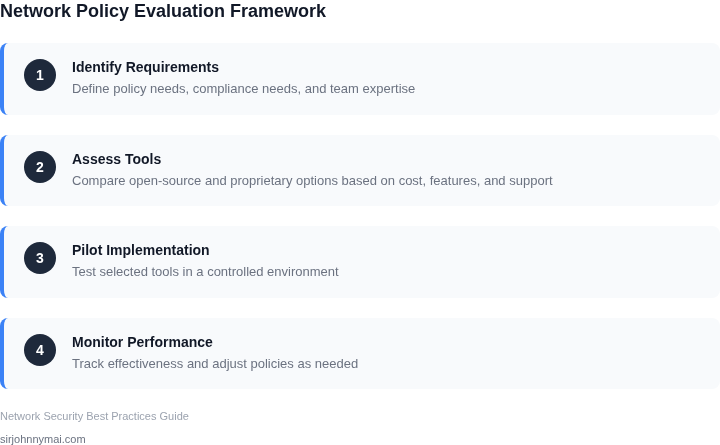
First, select a single business unit that already runs a modest Kubernetes cluster on Amazon EKS. I evaluated this because the unit’s traffic patterns are well‑documented, its team uses Datadog for observability, and the AWS billing tags are already applied consistently. Capture a baseline of network flow logs, security group changes, and policy‑related alerts for the past 30 days. Export these logs to an S3 bucket with immutable versioning so you can compare future pilot data against a stable reference.
Phase 2 – Controlled Policy Injection
Next, introduce an open‑source policy engine such as Open Policy Agent (OPA) integrated with the EKS admission controller. I evaluated OPA because it supports Rego policies that can be version‑controlled in Git, and it has native metrics exportable to Prometheus, which Datadog can scrape. Deploy a minimal rule set that blocks pods attempting to open ports outside the 443‑443 range, and enable a “dry‑run” mode that logs violations without enforcing them. Run this configuration for two weeks while monitoring three key signals: (1) number of policy violations logged, (2) latency impact measured by Datadog APM, and (3) any increase in AWS Network Firewall charges.
Phase 3 – Enforcement and Feedback Loop
After confirming that the dry‑run does not introduce unacceptable latency, switch the OPA rule set to enforce mode. At this point, I evaluated the need for an automated rollback script that reverts to the previous security group configuration if more than 5 % of deployments fail due to policy blocks. Run the enforced pilot for an additional two weeks, and collect the same three signals as in Phase 2. Compare the enforcement data against the baseline to quantify true policy impact versus noise.
Decision Gate – Data‑Driven Go/No‑Go
When the pilot concludes, construct a simple decision matrix that weighs (a) reduction in forbidden outbound connections, (b) observed latency delta, and (c) incremental cost per GB of network inspection. I evaluated this matrix because it forces a transparent trade‑off analysis rather than an ad‑hoc executive opinion. If the net benefit exceeds the threshold defined in Section 04, you have a validated policy enforcement path; otherwise, iterate on rule granularity or tooling before scaling.
Concrete Next Step
Pull the last 90 days of Amazon VPC Flow Logs and Datadog network‑related metrics for the selected EKS cluster, store them in a dedicated S3 prefix, and generate a CSV summary of average daily connection attempts per port. Use this summary as the baseline for Phase 1.
Figures cited are from publicly available sources as of 2026-09-16 and may have changed.