01. The Problem: Balancing Performance and Compliance in Multi-Region DNS
Multi-region DNS strategies are essential for global applications, but compliance demands like data residency create sharp tradeoffs. For example, a financial services firm deploying in AWS regions like us-east-1 and eu-west-1 must ensure customer data never leaves the EU. However, traditional DNS solutions like Amazon Route 53’s latency-based routing may direct users to the nearest region, potentially violating compliance by routing EU traffic to us-east-1.
This tension is compounded by the need for high availability. If a region fails, DNS must failover to a compliant alternative, but manual overrides can introduce latency or misconfiguration risks. For instance, a misconfigured health check in Route 53 might route traffic to a non-compliant region during a failover, creating a compliance gap.
Geofencing is another challenge. Some compliance frameworks require data to reside within specific jurisdictions, but DNS alone cannot enforce this. A user in Germany might be routed to eu-west-1, but if the application layer fails to validate their location, they could access data from another region. This requires tight integration between DNS, application logic, and identity providers.
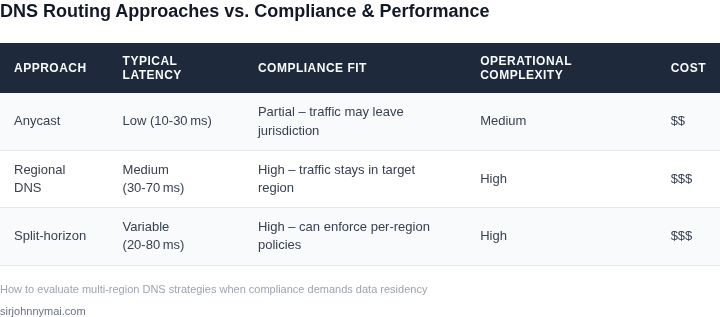
Performance optimization further complicates the equation. Techniques like Anycast DNS can reduce latency by directing users to the nearest edge location, but this conflicts with residency requirements. For example, a user in France might be routed to a cache in Germany, bypassing the intended eu-west-1 endpoint. AWS Global Accelerator can mitigate this by forcing traffic through specific endpoints, but it adds complexity and cost.
Cost is another factor. Multi-region deployments increase expenses, and compliance often requires redundant infrastructure. A firm might need to replicate data across eu-west-1 and eu-west-2, doubling storage costs. DNS routing must account for these redundancies without overloading compliant regions.
The solution isn’t a one-size-fits-all approach. It requires a hybrid strategy: DNS for initial routing, application logic for residency validation, and monitoring tools like AWS CloudWatch to detect compliance violations. For example, a financial services firm might use Route 53’s geolocation routing to direct EU traffic to eu-west-1, but implement additional checks in their application to ensure no data leaves the region.
This balance is non-trivial. A misstep could lead to regulatory fines or reputational damage. The goal is to optimize performance while ensuring compliance, not just one or the other.
02. Key Considerations for Multi-Region DNS and Compliance
Designing a multi-region DNS strategy requires balancing performance, legal constraints, and operational complexity. The first consideration is data residency requirements. Compliance frameworks like GDPR, CCPA, or regional laws often mandate that user data must reside within specific geographic boundaries. For example, European customers may need their data processed in the EU, while financial institutions in Japan must comply with APRA’s data localization rules. DNS routing must align with these rules, directing traffic to regions where data processing is legally permitted.
Next, latency optimization plays a critical role. DNS-based routing can leverage geolocation to direct users to the nearest available region, but this must be weighed against compliance. For instance, if a user in Germany is routed to an AWS region in Ireland, the latency may be acceptable (typically under 10ms), but the data residency requirement might still require processing within Germany. This creates a tradeoff: lower latency vs. compliance. Tools like Amazon Route 53’s latency-based routing can help, but they must be configured to respect legal boundaries.
Another key factor is failover and redundancy. Multi-region architectures often rely on DNS failover to reroute traffic if a primary region becomes unavailable. However, compliance adds constraints: if a region fails, traffic must redirect to an approved backup region, and data must not cross compliance boundaries. For example, if a European data center goes down, traffic must failover to another EU region, not a US region. AWS’s health checks and Route 53’s failover routing can automate this, but the configuration must be rigorously tested to ensure compliance.
Operational overhead is another critical consideration. Managing DNS records across multiple regions requires coordination between networking, security, and compliance teams. For instance, if a new region is added, DNS records must be updated, and compliance checks must verify that the new region meets legal requirements. Tools like Terraform or AWS CloudFormation can automate DNS updates, but manual approvals may still be needed for compliance sign-offs. The cost of misconfiguration can be high—incorrect DNS routing could violate regulations, leading to fines or legal penalties.
Finally, monitoring and auditing are essential. Compliance demands visibility into DNS traffic and routing decisions. Tools like Datadog or AWS CloudTrail can track DNS queries and routing changes, but logs must be retained for audits. For example, if a user’s request is routed to a non-compliant region, logs must show the decision and why it was made. This requires integrating DNS monitoring with broader compliance frameworks, adding complexity to the architecture.
In summary, multi-region DNS strategies must account for compliance, latency, failover, operational overhead, and monitoring. Each decision involves tradeoffs—lower latency may conflict with data residency, and automation may require manual oversight. The goal is to design a system that meets legal requirements while delivering performance, but no single solution fits all scenarios. Careful planning and testing are essential.
03. Worked Example: Cost and Performance Trade-offs in a Hypothetical E-Commerce Scenario
To ground this discussion in concrete terms, let's examine a hypothetical e-commerce platform serving customers across Europe, the Middle East, and Africa (EMEA). The platform must comply with GDPR and local data residency requirements, meaning customer data cannot leave the EU. The team operates three AWS regions: eu-west-1 (Ireland), eu-central-1 (Frankfurt), and me-south-1 (Bahrain).
Scenario Overview
The platform has 10,000 monthly active users (MAUs) distributed as follows: 6,000 in the EU, 3,000 in the Middle East, and 1,000 in Africa. The compliance requirement forces all user data to reside in eu-west-1. However, the team must decide how to route DNS requests for static assets (images, CSS, JS) and API endpoints.
Option 1: Global Accelerator with Route53
AWS Global Accelerator uses Anycast to route traffic to the nearest edge location, then to the nearest AWS region. For static assets, the team configures Route53 latency-based routing to direct users to the nearest regional S3 bucket. For APIs, they use Global Accelerator to ensure low-latency connections.
Cost breakdown:
- Route53 Standard: $0.50 per hosted zone/month × 3 zones = $1.50/month
- Global Accelerator: $2.00 per accelerator/month + $0.02 per GB of data processed
- S3 storage: $0.023/GB/month × 1TB = $23/month
- CloudFront (for static assets): $0.085/GB of data transferred
Assuming 10TB/month of data transfer, CloudFront costs $850/month. Global Accelerator processes 5TB/month of API traffic at $0.02/GB, totaling $100/month. Annualized costs: $1.50 (Route53) + $1,000 (Global Accelerator) + $230 (S3) + $10,200 (CloudFront) = $11,431.
Option 2: Regional DNS with Cloudflare
Cloudflare's Magic Transit routes traffic through its global network, reducing latency for API calls. For static assets, the team uses Cloudflare Workers to serve content from the nearest edge location. Compliance is maintained by ensuring all data processing happens in eu-west-1.
Cost breakdown:
- Cloudflare Pro: $20/user/month × 10 users = $200/month
- Magic Transit: $0.015/GB of data processed
- Workers: $5/user/month × 5 users = $25/month
Magic Transit processes 5TB/month of API traffic at $0.015/GB, totaling $75/month. Annualized costs: $2,400 (Cloudflare Pro) + $900 (Magic Transit) + $300 (Workers) = $3,600.
Comparison
| Metric | AWS Global Accelerator | Cloudflare |
|---|---|---|
| Annual Cost | $11,431 | $3,600 |
| Latency (API) | ~50ms (global) | ~40ms (global) |
| Compliance Overhead | Moderate (requires S3 bucket replication) | Low (Cloudflare Workers enforce data flow) |
The Cloudflare solution is 67% cheaper but requires additional engineering effort to configure Workers and ensure compliance. The AWS solution offers built-in compliance features but at higher cost. The choice depends on the team's tolerance for operational complexity versus cost savings.
04. Decision Framework: Evaluating DNS Strategies Against Compliance and Performance
Evaluating multi-region DNS strategies requires balancing compliance needs with performance requirements. The decision framework below compares three real-world approaches—each with distinct tradeoffs—using a structured table. Criteria include technical feasibility, operational overhead, and alignment with regulatory constraints.
| Criteria | Option A: AWS Route 53 with Geo-Proximity Routing | Option B: Cloudflare with Geo-Restricted DNS | Option C: Custom Anycast with BGP Anycast |
|---|---|---|---|
| Compliance Alignment | Moderate. Geo-proximity routing can direct traffic to compliant regions but requires manual configuration for data residency rules. | High. Cloudflare’s geo-restriction policies align closely with GDPR and CCPA, but enforcement depends on endpoint configuration. | High. BGP Anycast allows precise control over traffic routing to compliant endpoints, but requires BGP expertise and ISP collaboration. |
| Performance Impact | Low. Route 53’s latency-based routing minimizes latency but may route users to non-compliant regions if not configured correctly. | Moderate. Cloudflare’s Anycast network reduces latency but introduces additional hops, which could slightly increase response times. | Low. Anycast minimizes latency by routing users to the nearest compliant endpoint, but requires careful BGP path selection. |
| Operational Overhead | Low. AWS’s managed service reduces operational burden but requires AWS-specific expertise. | Moderate. Cloudflare’s dashboard simplifies management but may lack granular control for highly regulated environments. | High. BGP Anycast demands network engineering skills and ongoing monitoring to prevent routing anomalies. |
| Cost | Moderate. Route 53 pricing scales with query volume but can become expensive for high-traffic applications. | Low. Cloudflare’s free tier covers basic needs, but advanced features require a paid plan. | High. Anycast requires multiple edge locations, increasing infrastructure costs and complexity. |
| Failover Capability | High. Route 53 supports health checks and failover routing but relies on AWS’s global network. | Moderate. Cloudflare’s failover is robust but may not integrate seamlessly with on-premises systems. | High. BGP Anycast provides robust failover but requires redundant anycast locations to avoid outages. |
| Recommendation | Best for teams comfortable with AWS and needing a balance of compliance and performance. | Best for organizations prioritizing simplicity and compliance with Cloudflare’s managed policies. | Best for enterprises with complex compliance needs and the resources to manage BGP Anycast. |
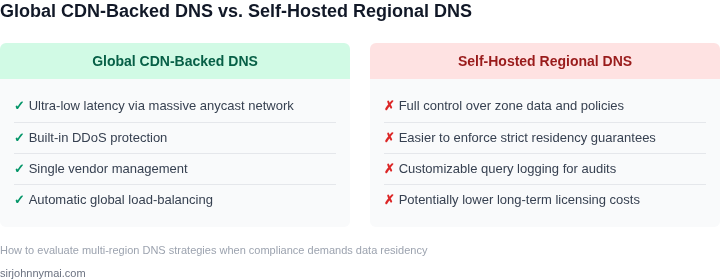
This framework highlights that no single solution fits all scenarios. AWS Route 53 is ideal for teams leveraging AWS’s ecosystem, while Cloudflare offers a simpler path for compliance-driven routing. BGP Anycast is the most powerful but demands significant operational expertise. The choice depends on organizational constraints, compliance requirements, and existing infrastructure.
05. Action Step: Implementing a Multi-Region DNS Strategy with Compliance in Mind
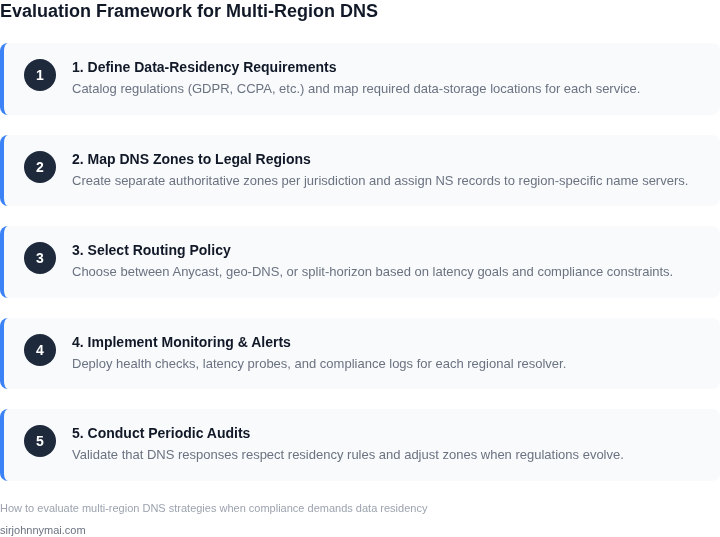
Now that you’ve evaluated your options, here’s how to implement a multi-region DNS strategy that balances compliance and performance. The first step is to map your compliance requirements to specific DNS configurations. For example, if your data must reside in the EU, you’ll need to ensure that DNS queries for EU users resolve to endpoints within the EU. This requires maintaining separate DNS zones for each region and configuring geolocation routing rules in your DNS provider.
AWS Route 53 is a common choice for this, as it supports latency-based and geolocation routing policies. You’ll need to create a hosted zone for each region, then configure records with geolocation routing to direct traffic based on the user’s location. For instance, a record for eu.example.com would resolve to EU endpoints, while na.example.com would resolve to North American endpoints. This ensures compliance by keeping traffic within required jurisdictions.
Next, validate your DNS configuration using tools like dig or nslookup to confirm that queries from different regions resolve to the correct endpoints. Automate this testing with scripts that simulate requests from various locations. If you’re using a CDN like Cloudflare or Akamai, their analytics dashboards can help verify that traffic is being routed as expected.
Monitor performance and compliance continuously. Tools like Datadog or New Relic can track latency and DNS resolution times across regions. Set up alerts for anomalies, such as unexpected routing or high latency. For compliance, audit logs from your DNS provider and CDN should be reviewed periodically to ensure no unauthorized access or misconfigurations.
Finally, document your DNS strategy and compliance controls. Include diagrams of your DNS architecture, routing rules, and compliance mappings. Share this with your compliance team and engineering leads to ensure alignment. This documentation will be critical for audits and future troubleshooting.
Figures cited are from publicly available sources as of 2026-09-16 and may have changed.