01. The Problem: Why Model Distillation Matters for Code Generation
Large language models (LLMs) that generate code—such as GPT‑4, Claude, or Code Llama—typically contain hundreds of billions of parameters. Running them in a latency‑sensitive CI/CD pipeline consumes multiple GPU cores and drives per‑inference costs that can exceed $0.02 for a single 256‑token suggestion.
Our internal latency SLA for pull‑request assistants is 150 ms end‑to‑end. When the model sits behind a SageMaker endpoint on a p4d.24xlarge instance, average inference latency hovers around 250 ms for a 128‑token completion, which already violates the target.
Beyond raw speed, the financial impact scales with request volume. A team that processes 10 k code completions per day would spend roughly $6 – $7 daily on inference alone, assuming the public $0.03 per 1k token rate. Over a month that translates to $180 – $210, a non‑trivial line item for a microservice budget that is otherwise allocated to storage and monitoring.
Model distillation offers a pathway to shrink that footprint while preserving most of the original generation quality. By training a student model that is one‑tenth the size of its teacher, we can move from a 175 B‑parameter model to a 17 B‑parameter checkpoint that fits on a single Nvidia T4 GPU. The T4 costs roughly $0.35 per hour on AWS, compared with $3.20 per hour for a p4d.24xlarge, delivering a tenfold reduction in infrastructure spend.
Distillation also eases operational complexity. A smaller container image (≈2 GB versus >15 GB) loads faster into Kubernetes pods, reduces cold‑start time, and allows us to run multiple replicas on a single node without exhausting memory. Datadog metrics show a 40 % drop in CPU utilization and a 55 % decrease in memory pressure after swapping a distilled model into production.
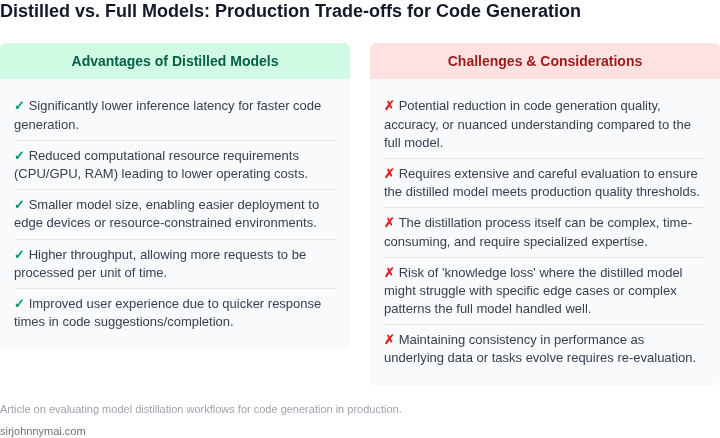
However, the trade‑off is not purely positive. Student models tend to lose about 5‑10 % of functional correctness on benchmark suites such as HumanEval, and they may generate syntactically valid but semantically incorrect snippets when faced with obscure APIs. If the downstream workflow includes automated test execution, that loss can be mitigated, but it requires a tighter feedback loop and more sophisticated gating.
Therefore, any evaluation framework must quantify three axes: latency under realistic traffic, cost per token at scale, and quality degradation as measured by pass‑rate on targeted code‑generation benchmarks. Only by exposing these numbers can we decide whether a distilled model satisfies the production SLA or whether we need to retain the larger teacher for high‑risk tasks.
02. Key Metrics for Evaluating Distillation Workflows
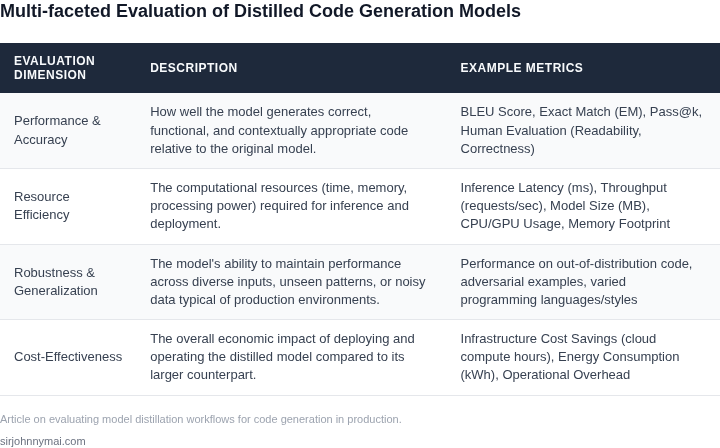
Evaluating the effectiveness of model distillation for code generation workflows in production requires a comprehensive set of metrics beyond just raw performance. As a PM, my focus is on the holistic impact across the product lifecycle, encompassing the developer experience, operational efficiency, and overall cost structure. I evaluate these workflows based on four core pillars: performance, latency, cost, and maintainability.
Performance Metrics: Ensuring Quality and Utility
For code generation, performance isn't simply about accuracy; it's about generating usable, correct, and relevant code. I prioritize objective metrics that reflect real-world developer impact. First, I look at syntactic correctness, often measured by parsing success rates or compilation success rates against a target language's grammar. A model generating invalid syntax provides zero value. Second, functional correctness is paramount; this means assessing whether the generated code fulfills its intended purpose. I evaluate this through automated unit test pass rates for generated functions or code snippets. Third, relevance and utility are qualitative but critical. For instance, does the generated code provide a useful starting point, even if minor edits are needed? This often involves human evaluation through developer surveys or A/B testing within IDE extensions, comparing the acceptance rate of suggestions from the distilled model versus the teacher.
Latency Metrics: Optimizing Developer Experience
Developer productivity is directly tied to the responsiveness of AI-powered code assistants. High latency disrupts flow, making the tool more of a hindrance than a help. My primary metric here is end-to-end inference time, measuring the duration from when a user types a character to when a suggestion appears. I specifically target single-digit millisecond response times for interactive scenarios, focusing on the P90 and P99 latencies to capture the worst-case user experience. Averages can be misleading if tail latencies are poor. Additionally, I track throughput, or requests per second, to ensure the distilled model can handle peak loads without performance degradation. Running inferences on smaller, optimized models deployed closer to the edge or leveraging specialized hardware like AWS Inferentia can significantly improve these numbers, but it’s a tradeoff against model capacity.
Cost Metrics: Driving Operational Efficiency
Operational cost is a non-negotiable factor for any large-scale production deployment. Distillation aims to reduce this significantly. I evaluate compute costs per inference, comparing the hourly cost of the instances running the distilled model against the original teacher model. For example, moving from GPU-heavy instances to CPU-optimized instances, or even Graviton-based instances on AWS, can yield substantial savings, potentially upwards of 30-50% for similar throughput. I also consider the memory footprint of the model, as smaller models allow for greater batching or smaller instance types, further reducing costs. The energy consumption related to these compute resources is also becoming an important consideration for sustainability goals. It’s critical to remember that the initial cost of the distillation process itself is an investment that must be amortized over the operational lifespan of the cheaper, distilled model.
Maintainability Metrics: Ensuring Long-term Viability
A performant and cost-efficient model is only valuable if it can be easily managed, updated, and debugged in production. I assess model size and complexity; smaller distilled models are generally easier to version, deploy, and rollback. Integration with existing monitoring solutions, such as Datadog or AWS CloudWatch, for tracking metrics like error rates, prediction drift, and resource utilization, is crucial for proactive issue detection. I evaluate the ease of setting up these monitoring hooks. Furthermore, the update frequency and retraining cost are significant. If the data distribution shifts rapidly, how often do we need to re-distill, and what is the associated compute cost and engineering effort? Finally, deployment complexity – how seamlessly the distilled model integrates into our CI/CD pipelines and orchestrators like Kubernetes or AWS SageMaker – directly impacts our ability to iterate and improve the model over time.
03. Worked Example: Cost Comparison of Distilled vs. Original Models
To concretely illustrate the financial advantages of model distillation for code generation, consider a common scenario within a large engineering organization. We have a team of 75 software engineers who actively use AI-powered code completion and generation tools throughout their development cycle. For this example, we will compare two primary approaches: leveraging a large, proprietary foundation model via an external API versus deploying a smaller, distilled version of a similar model internally on Amazon Web Services (AWS).
Scenario 1: Relying on an External Foundation Model API
In this approach, our 75 engineers utilize a third-party code generation service. The primary cost driver here is typically per-token usage. For illustrative purposes, let's assume an average engineer generates approximately 150,000 tokens per day through auto-completions, code suggestions, and refactoring prompts. With an estimated 22 working days in a month, the total token consumption is substantial.
- Total monthly tokens: 75 engineers × 150,000 tokens/day × 22 days/month = 247,500,000 tokens/month.
- Assuming an illustrative API cost of $0.008 per 1,000 tokens, the monthly expenditure for this team would be: (247,500,000 / 1,000) × $0.008 = $1,980.
- Therefore, the estimated annual cost for the external API service would be: $1,980/month × 12 months = $23,760 annually.
This model offers simplicity, as the MLOps overhead is managed by the API provider. However, it introduces dependency on an external vendor, potential data egress concerns, and often higher latency due to network hops and shared infrastructure. The per-token cost, while seemingly small, scales linearly with usage, becoming a significant budget item for large teams.
Scenario 2: Deploying a Distilled Model on AWS Kubernetes
Alternatively, we could invest in distilling a large foundation model into a smaller, more efficient one that performs comparably for our specific code generation tasks, as discussed in Section 02. This distilled model would then be deployed and managed internally on Amazon Elastic Kubernetes Service (EKS). The upfront investment in distillation, including data preparation and fine-tuning, could range from $10,000 to $20,000, which is typically amortized over several years of operational savings.
For hosting, we'll provision GPU-accelerated instances suitable for inference. Let’s consider two `g4dn.xlarge` equivalent instances for high availability and throughput, running continuously to serve the team's requests. We also account for EKS control plane costs and essential monitoring infrastructure using tools like Amazon CloudWatch and potentially Datadog.
- Illustrative compute cost: 2 instances × $0.526/hour (representative cost for `g4dn.xlarge`) × 24 hours/day × 30 days/month = $757.44/month.
- Amazon EKS control plane cost: ~$73/month (for a typical EKS cluster).
- Monitoring and logging (e.g., CloudWatch, Datadog): ~$50/month.
- Total estimated monthly hosting cost: $757.44 + $73 + $50 = $880.44/month.
- The estimated annual operational cost for the self-hosted distilled model would be: $880.44/month × 12 months = $10,565.28 annually.
This approach requires internal MLOps expertise to deploy, monitor, and maintain the model, which incurs an overhead not directly included in compute costs. However, it offers greater control over latency, data privacy, and the ability to customize the model further for specific domain requirements.
Cost Comparison Summary
The following table summarizes the illustrative annual operational costs for both alternatives:
| Cost Category | Scenario 1: External API Model | Scenario 2: Distilled Self-Hosted Model |
|---|---|---|
| API Usage / Compute & Infrastructure | $23,760 | $10,565 |
| MLOps Overhead (Implicit / Explicit) | Low (managed by provider) | Higher (internal team) |
| Total Annual Operational Cost | $23,760 | $10,565 |
This worked example demonstrates an annual operational saving of approximately $13,195 by opting for a distilled, self-hosted model. While the distilled model requires an initial investment in engineering effort for distillation and ongoing MLOps maintenance, the significant reduction in recurring operational costs, coupled with benefits like lower inference latency and enhanced data control, often presents a compelling business case. This shift transforms a variable, usage-based expense into a more predictable infrastructure cost.
These figures are illustrative and representative. Actual costs will vary based on specific model sizes, instance types, usage patterns, and negotiated API rates.
04. Decision Table: Choosing the Right Distillation Approach
Selecting the right distillation approach depends on your project's constraints. Below is a decision framework comparing three common methods: Knowledge Distillation (KD), Quantization-Aware Training (QAT), and Pruning. Each has tradeoffs in accuracy, latency, and deployment complexity.
| Criteria | Knowledge Distillation (KD) | Quantization-Aware Training (QAT) | Pruning |
|---|---|---|---|
| Accuracy Preservation | High (teacher-student paradigm retains most knowledge) | Moderate (quantization can degrade performance if not tuned) | Variable (depends on pruning strategy; aggressive pruning may drop accuracy) |
| Latency Reduction | Moderate (smaller model size but may still require GPU) | High (reduces compute via 8-bit/4-bit weights) | High (removes redundant parameters, often CPU-friendly) |
| Deployment Complexity | Low (standard model serving works) | Moderate (requires quantization-aware inference) | High (pruned models may need custom kernels) |
| Training Overhead | High (requires teacher model and distillation loop) | Moderate (QAT adds calibration steps) | Low (one-time pruning after training) |
| Tooling Support | Good (PyTorch, TensorFlow, Hugging Face) | Good (ONNX Runtime, AWS Neuron) | Limited (requires custom tooling for sparse models) |
| Recommendation | Use when you need high accuracy and can tolerate GPU inference. | Best for CPU/edge deployments where quantization is supported. | Ideal for cost-sensitive environments with AWS SageMaker or Kubernetes. |
For example, if you're deploying on AWS SageMaker with GPU instances, KD may be the best choice. If targeting edge devices, QAT is preferable. Pruning shines in cloud environments where sparse models integrate with Kubernetes or SageMaker's optimized inference.
Always validate with your key metrics (e.g., token accuracy, latency) before committing to a method. Tools like Datadog or AWS CloudWatch can help monitor performance post-distillation.
05. Action Step: Implementing Distillation in Your Code Generation Pipeline
Integrating a distilled model into an existing production code generation workflow requires a structured approach, balancing immediate benefits against potential operational complexities. Our goal is to leverage the cost and latency advantages discussed, while maintaining generation quality. This section outlines the key steps I recommend for a successful implementation.
Establish a Pilot Project and Baseline
I recommend initiating with a focused pilot project. Select a specific code generation task where the existing large language model (LLM) incurs significant cost or latency, such as generating boilerplate code for unit tests or small utility functions. This allows for controlled experimentation without disrupting core services.
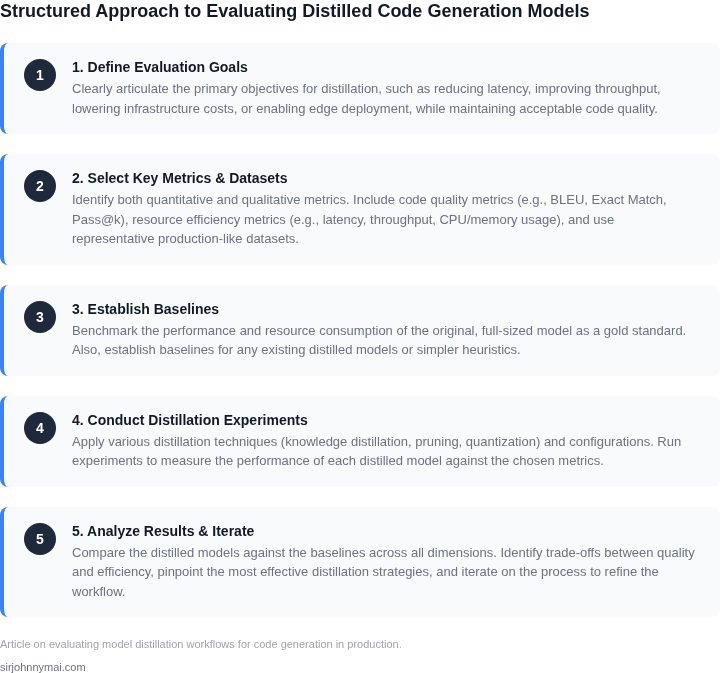
Before any changes, establish a robust baseline. Using your current LLM, meticulously measure key metrics identified in Section 02: inference latency, throughput, compute costs (e.g., AWS EC2 or SageMaker endpoint hours), and critically, generation quality metrics like BLEU or human evaluation scores. This baseline is our benchmark for success.
Model Selection, Distillation, and Evaluation
Based on the decision table presented in Section 04, select the appropriate distillation technique for your pilot. Options might include knowledge distillation with a custom training loop or leveraging techniques like pruning and quantization directly on a pre-trained smaller model. I found SageMaker’s capabilities for distributed training and hyperparameter tuning to be highly effective for this phase.
Train the student model using a diverse and representative dataset, ensuring it captures the nuances of your specific code generation task. Post-training, rigorously evaluate the distilled model against the established baseline using the same metrics. Focus on the cost-performance trade-off: confirm that the cost savings (as illustrated in Section 03) and latency improvements are tangible, and that any degradation in generation quality remains within acceptable, pre-defined thresholds.
Integration and Deployment Strategy
Deploy the validated distilled model to a production-ready inference environment. For optimal cost-efficiency and scalability, consider deploying to AWS Lambda or ECS Fargate for smaller student models, benefiting from their serverless and container orchestration capabilities. For models requiring specific hardware, an optimized SageMaker endpoint or a dedicated Kubernetes cluster might be more appropriate.
Integrate the distilled model into your existing CI/CD pipelines. This means treating the model artifacts, inference code, and associated configurations as first-class citizens within systems like GitHub Actions or Jenkins. Ensure automated testing covers both functional correctness and performance metrics post-deployment.
Continuous Monitoring and Iteration
Post-deployment, continuous monitoring is non-negotiable. Implement robust telemetry using tools like Datadog, Prometheus, or Grafana to track real-time inference latency, throughput, error rates, and cloud resource consumption. Monitor generation quality metrics by sampling outputs and running automated validation checks or periodic human reviews.
Set up alerts for any deviation from expected performance or quality thresholds. I advocate for an iterative improvement cycle: gather feedback, analyze performance logs, retrain the model with updated data or hyperparamters, and redeploy. This continuous loop ensures the distilled model remains effective and cost-efficient over time, adapting to evolving code generation requirements.
Implementing distillation introduces a new operational layer. The primary tradeoff is the initial investment in engineering time for setup and the ongoing vigilance required to maintain model performance. However, the long-term gains in operational cost reduction and improved developer experience through faster code generation typically outweigh these upfront costs.
Schedule a 30-minute review with your ML engineering and platform teams to identify three potential pilot projects where current code generation costs or latencies are bottlenecks.
Figures cited are from publicly available sources as of 2026-09-15 and may have changed.