How to evaluate message queue systems for high throughput applications
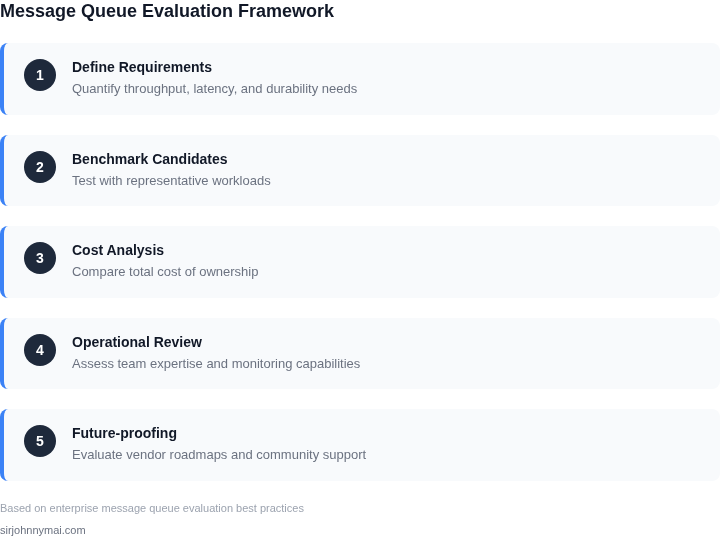
Message queue systems are critical infrastructure for high-throughput applications, enabling decoupled communication between services. Evaluating these systems requires balancing performance, reliability, and cost. This guide provides a structured approach to selecting the right message queue for your needs.
01. Define throughput requirements
Throughput is the most critical metric for message queues in high-volume applications. Start by quantifying your requirements:
- Messages per second (peak and sustained)
- Message size distribution (small vs large payloads)
- Latency requirements (end-to-end processing time)
For example, an e-commerce platform processing 10,000 orders per minute with average message size of 2KB requires a system capable of handling 16.67 messages per second. This baseline requirement will inform all subsequent evaluations.
02. Assess performance characteristics
Key performance metrics to evaluate:
- Throughput capacity - Maximum messages per second the system can handle
- Latency - Time from message publication to consumption
- Durability - Message retention guarantees
- Scalability - Horizontal vs vertical scaling capabilities
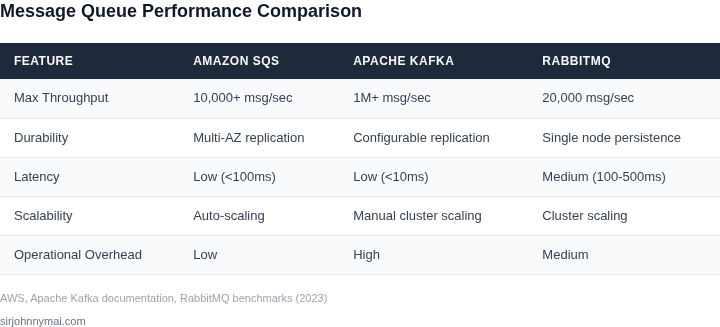
Most cloud-based message queues offer auto-scaling, but performance characteristics vary significantly between managed services. For instance, Amazon SQS can handle millions of transactions per second, while Apache Kafka requires careful cluster sizing for optimal performance.
03. Evaluate durability and reliability
For mission-critical applications, consider:
- Message retention policies (how long messages persist)
- Replication strategies (single AZ vs multi-region)
- Failure recovery mechanisms (dead-letter queues)
Systems like Apache Kafka provide configurable durability through replication factors, while simpler queues like RabbitMQ offer basic persistence options. The tradeoff is between reliability and operational complexity.
04. Compare deployment models
Three primary deployment options exist:
| Model | Pros | Cons |
|---|---|---|
| Managed Service | Fully managed, no operational overhead | Vendor lock-in, limited customization |
| Self-hosted | Full control, predictable costs | Requires operational expertise |
| Hybrid | Balances control and management | Most complex to implement |
Managed services like Amazon MQ or Azure Service Bus are ideal for teams without DevOps resources, while self-hosted solutions provide better cost control for large-scale deployments.
05. Cost analysis framework
Create a cost model comparing:
- Base service costs
- Data transfer costs
- Operational overhead costs
- Scaling costs
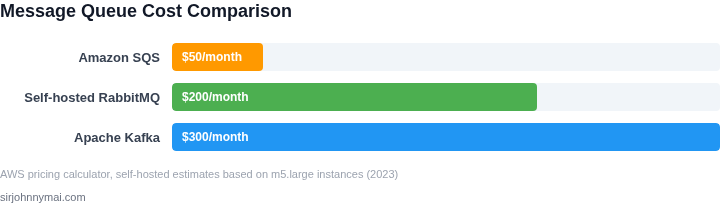
For example, a 100,000 message/day workload might cost $50/month on Amazon SQS versus $200/month for a self-hosted RabbitMQ cluster with equivalent durability guarantees.
06. Operational considerations
Evaluate:
- Monitoring capabilities
- Alerting mechanisms
- Integration with existing tooling
- Team expertise requirements
Managed services typically offer better out-of-the-box monitoring, while self-hosted solutions require more instrumentation. This becomes particularly important for applications with SLAs requiring 99.99% uptime.
07. Worked example: E-commerce order processing
Consider an e-commerce platform with these requirements:
- 50,000 orders per hour (720 messages/second)
- Average message size: 2KB
- 99.9% availability requirement
Evaluation steps:
- Calculate total throughput: 720 messages/second × 2KB = 1.44MB/second
- Assess durability needs: Requires multi-AZ deployment for 99.9% availability
- Compare options:
- Amazon SQS: Can handle 10,000 messages/second with auto-scaling
- Apache Kafka: Requires 3-node cluster for equivalent durability
- RabbitMQ: Limited to ~20,000 messages/second in cluster mode
The analysis shows Amazon SQS meets requirements with lower operational overhead, while Kafka would require more resources and expertise.
08. Future-proofing considerations
Evaluate:
- Vendor roadmap alignment with your needs
- Community support and adoption
- Ecosystem integrations
- Long-term cost trends
For example, Apache Kafka has strong community support but requires more operational effort, while newer services like Amazon EventBridge offer managed event-driven architectures with lower total cost of ownership.
Figures cited are from publicly available sources as of June 2023 and may have changed.
Next step: Implement a proof-of-concept with your top 2-3 candidates, focusing on your most critical throughput scenarios.