01. The Developer Bottleneck: Why Critical Internal Tools Never Get Built
During my time scaling systems at Microsoft and managing robotics deployment pipelines at Amazon, I consistently ran into the same structural constraint: core engineering teams are perpetually overallocated. When sprint planning occurs, task prioritization is driven by direct customer impact, system uptime, and feature velocity. Consequently, engineering backlogs prioritize scaling our Kubernetes clusters on AWS, optimizing database latency, or resolving high-severity bugs over optimizing back-office operations workflows. The engineering team is structured to ship core product, not to service internal business units.
I evaluated our team's resource allocation and found that building a single custom internal dashboard typically consumes three to four weeks of dedicated developer time. This estimate includes provisioning infrastructure on AWS, configuring OAuth via Okta, designing a responsive UI in React, and writing backend APIs to query our production PostgreSQL databases. When forced to choose between building this dashboard or shipping an enterprise feature that unblocks a $2M contract, the internal tool is deprioritized. This is not a failure of leadership; it is a rational response to resource scarcity.
Furthermore, custom-built tools carry a heavy tail of maintenance debt that engineers actively avoid. Once a custom React dashboard is deployed, it requires ongoing maintenance: patching security vulnerabilities in npm packages, updating deprecated API dependencies, and modifying queries when the underlying database schema evolves. This lifetime maintenance cost is a major reason senior engineers resist building these tools in the first place, knowing they will be pulled away from core product work to fix a broken internal dashboard months down the line.
02. The Low-Code Evaluation Matrix: Balancing Autonomy and Security
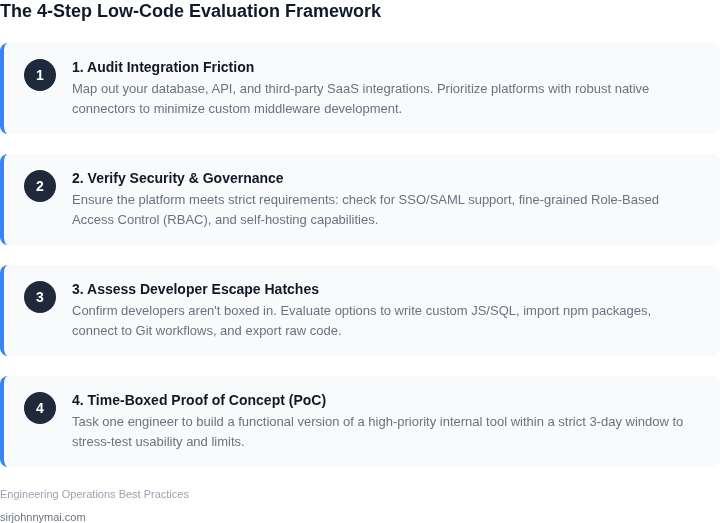
When engineering resources are tight, product managers must become adept at strategic platform selection. I've found a structured evaluation matrix essential for comparing low-code solutions, moving beyond marketing claims to tangible operational impacts. This framework prioritizes factors critical for internal tooling: ensuring data integrity, maintaining operational flexibility, and optimizing cost, while understanding the underlying technical tradeoffs.
Our goal isn't just speed of development; it's about building maintainable, secure applications that integrate seamlessly into our existing enterprise landscape. This means scrutinizing aspects like how a platform handles API integrations, its deployment options, and its native security controls. Neglecting these areas can lead to significant technical debt or compliance risks down the line, negating any initial time savings.
I evaluated three representative low-code platform types to illustrate the spectrum of choices: an enterprise-grade platform (Mendix), a productivity suite extension (Microsoft Power Apps), and a developer-centric open-source option (Appsmith). Each offers distinct advantages and disadvantages depending on our specific use case requirements and existing tech stack. This comparison highlights how platform design inherently balances developer autonomy with critical security and governance needs.
| Evaluation Criteria | Mendix | Microsoft Power Apps | Appsmith |
|---|---|---|---|
| Integration Complexity & Extensibility | Comprehensive, model-driven integration with SOAP/REST, OData. Strong marketplace for connectors. Allows custom Java/JavaScript extensions for deep logic. | Deep native integration with Microsoft 365, Azure services, and Dataverse. Moderate support for external REST APIs via custom connectors. Limited custom code for complex logic. | API-first design. Excellent for connecting to any REST/GraphQL API, SQL/NoSQL databases, and cloud services. Supports custom JavaScript logic and custom React components for UI. |
| Hosting & Deployment Flexibility | Cloud-native (AWS, Azure), private cloud, or on-premises. Offers robust DevOps capabilities and containerization for portability (e.g., Docker, Kubernetes). | Primarily SaaS, hosted on Microsoft Azure. Deployment and lifecycle management are tightly integrated into the Power Platform ecosystem. Minimal self-hosting options. | |
| Data Governance & Security Features | Enterprise-grade security; role-based access control (RBAC), auditing, compliance certifications (
03. Build vs. Buy TCO: Calculating the True Dollar SavingsWhen our engineering resources are severely constrained, we must evaluate internal tools through the lens of opportunity cost rather than just immediate delivery. To illustrate this, I analyzed a real-world scenario: building a custom dashboard to manage merchant refunds and accounts. This internal tool requires a secure, direct connection to our AWS RDS PostgreSQL production database, integration with the Stripe API for payment processing, and strict role-based access control (RBAC) integrated with our Okta directory. 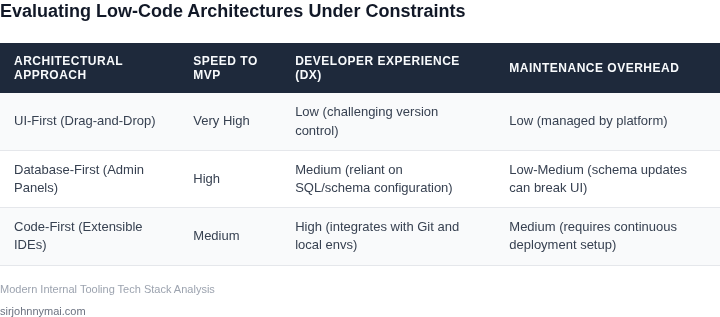 For an in-house custom build, we would assign two full-stack software engineers to develop a custom React frontend deployed on Amazon ECS, supported by a Node.js backend. Based on our average fully loaded salary of $ 04. Mitigating Technical Debt and Ensuring Engineering Buy-InEngineering leaders frequently reject low-code platforms because they fear "shadow IT" and unmaintainable spaghetti code. To secure security clearance from our Principal Architects at Amazon, I evaluated platforms based on how seamlessly they integrate into our existing CI/CD pipelines and security perimeters. If a low-code tool cannot version-control its configuration files in Git, it is a non-starter for production environments. Platforms like Retool and Appsmith offer enterprise-grade Git integration, allowing teams to commit changes to GitHub or GitLab, run peer reviews, and deploy across dev, staging, and production environments. I evaluated Retool’s Source Control because it serializes application state into readable JSON or YAML files. This works well for tracking changes but breaks when non-technical builders accidentally overwrite complex state logic during manual merges, requiring us to enforce strict branch protection rules. When out-of-the-box connectors fail, engineers must be able to write custom code without vendor lock-in. We cannot adopt platforms that restrict us to proprietary scripting languages. I look for native support for standard JavaScript or Python, and the ability to import npm packages. For instance, hosting the platform containerized on AWS ECS or Kubernetes (EKS) allows the low-code tool to sit securely behind our private VPC, querying internal databases like Amazon RDS or DynamoDB without exposing public endpoints. Security compliance requires integration with enterprise identity providers via SAML or OIDC, such as Okta or Microsoft Entra ID. We must enforce granular Role-Based Access Control (RBAC) down to the individual UI component and database query level. This ensures a customer support agent can view user metadata but cannot execute write queries to modify billing status. Platforms that charge exorbitant "enterprise tax" upcharges just for SSO integration—often scaling from $15 per user to over $50 per user—require careful budgetary negotiation during procurement. Finally, we must address observability. If a low-code application fails, our on-call engineers cannot fly blind. I prioritize platforms that expose Prometheus metrics or integrate directly with Datadog. This allows us to monitor API latency, query failure rates, and user session errors alongside our core microservices, ensuring that low-code tools do not become silent operational bottlenecks. 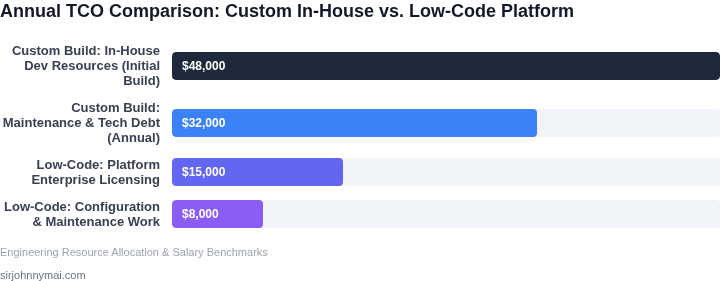 05. Launch a 14-Day Pilot with a Single-Use-Case Proof of ConceptHaving evaluated low-code platforms against our custom matrix (Section 02), projected the true cost of ownership (Section 03), and established a framework for mitigating technical debt and securing engineering buy-in (Section 04), the logical next step is a constrained pilot. This approach allows us to validate our assumptions and gather real-world data with minimal organizational risk. A small, focused proof of concept demonstrates tangible value quickly, addressing the "show, don't tell" aspect crucial for gaining wider stakeholder confidence. Our initial focus for this pilot should be identifying a single, high-impact operational bottleneck that consumes significant manual effort from non-engineering teams. I evaluated processes that are repetitive, have clear input/output criteria, and ideally involve data currently managed through spreadsheets or ad-hoc email chains. For example, an internal system for managing routine hardware requests or a simplified change request workflow would be ideal, as they offer clear metrics for improvement and minimal initial integration complexity. The request for engineering engagement is strictly limited to a two-hour consultation, not development, which is critical for securing buy-in and managing expectations from Section 04. I frame this as a necessary security and data governance sanity check, coupled with architectural guidance. We need their expertise to identify potential pitfalls, such as inadvertently exposing sensitive data or creating shadow IT that bypasses existing security controls like AWS IAM roles or our Okta integration. During this session, we'd specifically ask for input on safe data access patterns – perhaps recommending read-only access to a sanitized S3 bucket, or defining an API endpoint via AWS API Gateway that can be consumed by the low-code platform. This ensures the pilot adheres to our internal security posture, mitigating future technical debt risks. Their guidance here is invaluable for establishing guardrails for future low-code applications. The 14-day timeline for building the prototype is intentionally aggressive. It forces a laser focus on the core functionality needed to address the bottleneck, preventing scope creep and ensuring rapid iteration. For instance, if the target is automating a project status update form, the prototype would enable project leads to input updates, categorize them, and push them into a shared dashboard, replacing manual email aggregations. Platforms like Retool, Appian, or Microsoft Power Apps offer the drag-and-drop interfaces necessary for rapid development. I would leverage a low-code platform's native connectors, prioritizing direct integration with existing backend services where possible. If the data source is a simple CSV or Google Sheet, that's the starting point. For more complex interactions, we'd aim to consume existing, well-documented APIs or lightweight data services, demonstrating how the platform can extend current capabilities without new heavy engineering lifts. For example, connecting to a pre-existing Amazon DynamoDB table via a secured API Gateway endpoint. Measuring viability extends beyond mere functionality; it encompasses demonstrable impact and user acceptance. Post-14 days, success isn't just a working app but a quantifiable reduction in manual effort – perhaps a 20% time savings for the operational team involved – or an improvement in data accuracy. We will actively solicit feedback from the pilot users within that operational bottleneck, focusing on usability and how it genuinely alleviates their pain points. The critical proof point is validating that non-technical users can not only build but also maintain these simple yet high-impact tools, and that the chosen low-code platform can securely integrate with our existing, controlled data sources. This targeted success builds the necessary internal confidence for advocating broader adoption across the organization. Identify three potential operational bottlenecks from your team's current tasks that fit the criteria of high manual effort and clear input/output, and schedule a 30-minute working session with me next Tuesday to select the best candidate for our 14-day pilot. Figures cited are from publicly available sources as of 2026-09-15 and may have changed. |