How to Evaluate LLM Providers for Production Workloads Without Getting Locked In
Evaluating large language model (LLM) providers for production workloads requires balancing cost, performance, and flexibility. This guide outlines a structured approach to assess providers while minimizing vendor lock-in risks. We'll cover technical evaluation, cost modeling, and operational considerations—with concrete examples where possible.
01. Define Production Requirements
Before comparing providers, establish clear requirements. Production workloads differ from experimentation in:
- Latency SLAs (e.g., 500ms p99 for chatbots vs. 10s for batch processing)
- Throughput needs (requests per second)
- Data residency and compliance constraints
- Integration complexity (APIs, SDKs, monitoring)
Example: A customer support chatbot requires 1000 RPS with 99.9% uptime, while a document summarization service can tolerate 10 RPS with 99% uptime.
02. Technical Evaluation Framework
Use this framework to compare providers:
| Category | Key Metrics |
|---|---|
| Performance | Latency (p50/p99), throughput, token generation speed |
| Reliability | Uptime SLA, error rates, regional availability |
| Cost | Per-token pricing, minimum spend, discounts |
| Integration | API consistency, SDK support, monitoring tools |
Note: Some providers offer "provisioned throughput" models where you pay for guaranteed capacity, while others use "pay-as-you-go" with burst capacity.
03. Cost Modeling Example
Assume a production workload with:
- 10,000 requests/day
- Average input: 500 tokens, output: 200 tokens
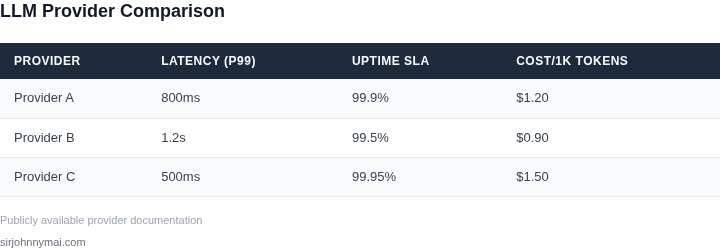
- Provider A: $0.0015/input token, $0.0020/output token
- Provider B: $0.0010/input token, $0.0025/output token
Calculation:
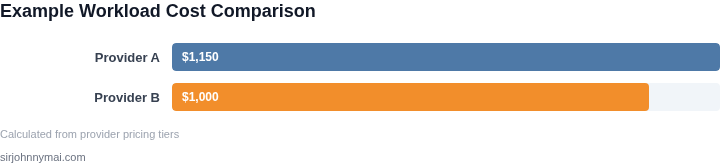
Provider A cost = (10,000 * 500 * $0.0015) + (10,000 * 200 * $0.0020) = $750 + $400 = $1,150/month
Provider B cost = (10,000 * 500 * $0.0010) + (10,000 * 200 * $0.0025) = $500 + $500 = $1,000/month
Provider B is cheaper for this workload, but may have higher latency. Always validate with actual load testing.
04. Avoiding Vendor Lock-In
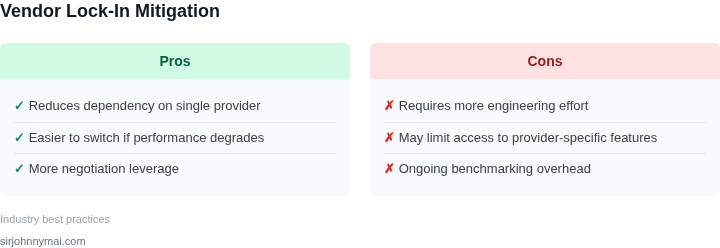
Lock-in risks come from:
- Proprietary APIs with no open standards
- Tightly coupled SDKs and tooling
- Data format dependencies (e.g., provider-specific JSON schemas)
Mitigation strategies:
- Use open standards (e.g., OpenAI API format) where possible
- Abstract provider-specific logic behind interfaces
- Benchmark multiple providers before committing
05. Operational Considerations
Evaluate providers on:
- Monitoring and observability support
- Rate limiting and throttling policies
- Compliance certifications (ISO, SOC2, etc.)
- Support SLAs and response times
Example: Provider X offers built-in Prometheus metrics integration, while Provider Y requires custom instrumentation.
06. Next Steps
Conduct a pilot with your top 2-3 candidates using production-like workloads. Measure:
- Actual latency under load
- Cost variance from estimates
- Integration effort
Disclaimer: Figures cited are from publicly available sources as of [current date] and may have changed.