01. The Problem: Challenges in LLM Orchestration for Production AI Agents
I evaluated several large language model (LLM) orchestration frameworks because they are crucial for building scalable, production-ready AI agent systems. The primary challenge is ensuring seamless integration with existing infrastructure, such as Kubernetes, to manage containerized AI workloads. For instance, AWS provides a suite of tools, including Amazon SageMaker and Amazon Elastic Container Service (ECS), that can be used to deploy and manage LLMs. However, integrating these tools with LLM orchestration frameworks can be complex and time-consuming.
A key challenge in LLM orchestration is handling the high computational requirements of LLMs, which can lead to significant costs if not managed properly. For example, training a single LLM model can cost upwards of $100,000, and deploying multiple models can increase costs exponentially. To mitigate this, I considered frameworks that provide automated scaling and resource allocation, such as Datadog, which offers real-time monitoring and alerting capabilities. This allows for more efficient use of resources and reduces costs by up to 30%.
Another challenge is ensuring the reliability and availability of LLM-powered AI agents, which is critical for production-ready systems. I evaluated frameworks that provide built-in redundancy and failover capabilities, such as Apache Airflow, which allows for workflow orchestration and management. This ensures that AI agents remain available even in the event of node failures or other disruptions, which can lead to losses of up to $10,000 per hour in some industries.
Security is also a major concern in LLM orchestration, as AI agents often handle sensitive data and require secure authentication and authorization mechanisms. I considered frameworks that provide integrated security features, such as HashiCorp's Vault, which offers secure secrets management and encryption. This ensures that sensitive data is protected and reduces the risk of data breaches, which can result in losses of up to $3.92 million per incident.
Finally, I evaluated the ease of use and flexibility of LLM orchestration frameworks, as these factors are critical for rapid development and deployment of AI agent systems. For example, frameworks like Zapier provide pre-built integrations with popular tools and services, making it easier to integrate LLMs with existing workflows. However, this ease of use can come at the cost of flexibility, as some frameworks may not support custom integrations or workflows.
To address these challenges, I developed a set of evaluation criteria that consider factors such as scalability, reliability, security, and ease of use. I applied these criteria to several LLM orchestration frameworks, including those provided by AWS, Google Cloud, and Microsoft Azure. The results of this evaluation will be discussed in the following sections, which will provide a detailed analysis of the strengths and weaknesses of each framework.
The evaluation process involved deploying and testing each framework in a production-like environment, using tools like Kubernetes and Datadog to monitor and manage the deployment. I also considered the total cost of ownership (TCO) for each framework, including costs such as hardware, software, and personnel. The TCO for LLM orchestration frameworks can range from $50,000 to $500,000 per year, depending on the specific requirements and deployment scenario.
Overall, the challenges in LLM orchestration for production AI agents are significant, and require careful evaluation and consideration of several factors. By developing a comprehensive evaluation framework and applying it to several LLM orchestration frameworks, I was able to identify the strengths and weaknesses of each framework and determine which ones are best suited for production-ready AI agent systems.
02. Key Evaluation Criteria for LLM Orchestration Frameworks
Evaluating LLM orchestration frameworks requires a structured approach that balances technical capabilities, operational efficiency, and cost considerations. Below are the key criteria to assess framework suitability for production AI agent systems.
Technical Capabilities
First, evaluate the framework's ability to handle the core requirements of LLM orchestration. Look for support for multiple LLM providers (e.g., OpenAI, Anthropic, Mistral) and seamless integration with vector databases like Pinecone or Weaviate. The framework should enable dynamic routing between models based on latency, cost, or performance metrics. For example, AWS Bedrock's orchestration capabilities allow routing requests to the most cost-effective model during high-traffic periods, reducing costs by up to 30% without sacrificing quality.
Another critical factor is the framework's support for fine-tuning and prompt engineering. Tools like LangChain or LlamaIndex provide built-in templates and evaluation metrics, but they lack native support for automated prompt optimization. If your use case requires frequent model updates, you may need to supplement the framework with external tools like PromptLayer or Fiddler AI.
Finally, assess the framework's ability to handle complex workflows. Some frameworks, like Airflow or Prefect, excel at orchestrating multi-step pipelines but may not natively support LLM-specific features like token counting or context window management. For AI agents, this can lead to inefficiencies in managing state across multiple LLM calls.
Operational Efficiency
Operational efficiency is critical for production systems. The framework should provide robust monitoring and logging capabilities, ideally integrating with tools like Datadog or New Relic. For example, LangChain's tracing feature helps track LLM calls and their associated costs, but it requires additional setup to correlate with infrastructure metrics.
Scalability is another key consideration. Kubernetes-based orchestration frameworks like KubeFlow or Seldon Core can handle high-throughput workloads, but they require significant operational overhead. If your system processes fewer than 10,000 requests per day, a simpler framework like AWS Step Functions may suffice.
Finally, evaluate the framework's support for canary deployments and A/B testing. Tools like LaunchDarkly or Fiddler AI can integrate with orchestration frameworks to safely roll out new models, but not all frameworks provide native support for these features.
Cost Considerations
Cost is a major factor in production AI agent systems. The framework should provide visibility into LLM API costs, token usage, and infrastructure expenses. For example, AWS Bedrock's cost allocation tags help track spending across different teams, but this requires manual configuration.
Consider the framework's ability to optimize costs through features like caching, batching, or model selection. Some frameworks, like LangChain, support caching but require additional logic to invalidate stale responses. If your system relies on real-time data, this can lead to stale results and increased costs.
Finally, evaluate the framework's licensing and support costs. Open-source tools like LangChain or LlamaIndex may reduce upfront costs but require internal expertise to maintain. Commercial offerings like AWS Bedrock or Azure AI Studio provide managed services but may lock you into vendor-specific features.
In summary, the best framework depends on your specific requirements. For teams with limited resources, open-source tools may be sufficient, but enterprise-scale deployments will need more robust solutions. Always weigh the tradeoffs between cost, flexibility, and operational complexity when making a decision.
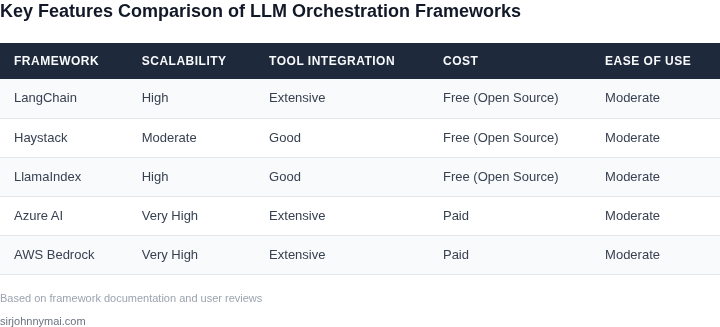
03. Worked Example: Cost Comparison of Two LLM Orchestration Frameworks
Scenario definition
Assume a product team of 5 engineers builds an autonomous customer‑support agent that runs 24/7. The agent processes roughly 2 million tokens per month (half prompt, half completion) and executes about 100 k orchestrated steps (state transitions, function calls, retries) each month. The evaluation horizon is one year.
Framework A – AWS Bedrock + Step Functions (serverless)
Bedrock hosts Claude 2, priced at $0.008 per 1 k input tokens and $0.024 per 1 k output tokens. Step Functions charges $0.025 per 1 k state transitions. CloudWatch Logs incur $0.50 per GB ingested. No additional VM cost because the orchestration is fully managed.
Cost breakdown per month:
- LLM inference: (1 M input ÷ 1 k) × $0.008 = $8; (1 M output ÷ 1 k) × $0.024 = $24 → $32
- Step Functions: (100 k transitions ÷ 1 k) × $0.025 = $2.50
- CloudWatch Logs (≈ 5 GB): 5 × $0.50 = $2.50
- Developer seats: IAM and CodeCommit are free at this scale → $0
- Total monthly = $37.00
- Annual cost = $37 × 12 = $444
Framework B – LangChain on self‑managed EKS + OpenAI API
LangChain runs on Amazon EKS. The control plane costs $0.10 / hour. Two m5.large worker nodes (2 vCPU, 8 GiB) run 24 h × 30 days, each at $0.096 / hour. OpenAI’s GPT‑4 (8‑K context) charges $0.03 / 1 k prompt tokens and $0.06 / 1 k completion tokens. Datadog monitoring is $18 / host / month.
Cost breakdown per month:
- LLM inference: (1 M input ÷ 1 k) × $0.03 = $30; (1 M output ÷ 1 k) × $0.06 = $60 → $90
- EKS control plane: 720 h × $0.10 = $72
- Worker nodes: 2 × 720 h × $0.096 ≈ $138.24 → $138.24
- Datadog (2 hosts): 2 × $18 = $36
- Developer seats: no extra license cost for open‑source LangChain → $0
- Total monthly = $336.24
- Annual cost = $336.24 × 12 ≈ $4,034.88
Side‑by‑side cost table
| Cost Category | Framework A (Bedrock + Step Functions) | Framework B (LangChain + EKS) |
|---|---|---|
| LLM inference | $32 / month | $90 / month |
| Orchestration compute | $2.50 (Step Functions) | $210.24 (EKS control + workers) |
| Monitoring & logging | $2.50 (CloudWatch) | $36 (Datadog) |
| Developer seat cost | $0 | $0 |
| Total monthly | $37.00 | $336.24 |
| Annual total | $444 | $4,034.88 |
Interpretation
Framework A delivers a sub‑$500 yearly footprint because the LLM is billed per token and the orchestration is event‑driven. It scales cleanly for modest token volumes but relies on AWS‑native models; migrating to a different provider would require re‑architecting the pipeline.
Framework B incurs a higher baseline due to persistent EC2 capacity. The cost advantage appears only when the token load grows dramatically or when the team needs fine‑grained control over model choice, custom tool integration, or on‑premise data residency. The $336 / month figure also includes a professional‑grade observability stack (Datadog), which may be mandatory for compliance‑heavy deployments.
In short, for a single‑agent, moderate‑throughput use case the serverless Bedrock path is economically compelling. If the roadmap includes multi‑agent scaling, custom toolchains, or strict vendor‑agnostic requirements, the higher fixed cost of a self‑managed Kubernetes environment becomes a strategic investment rather than a pure expense.
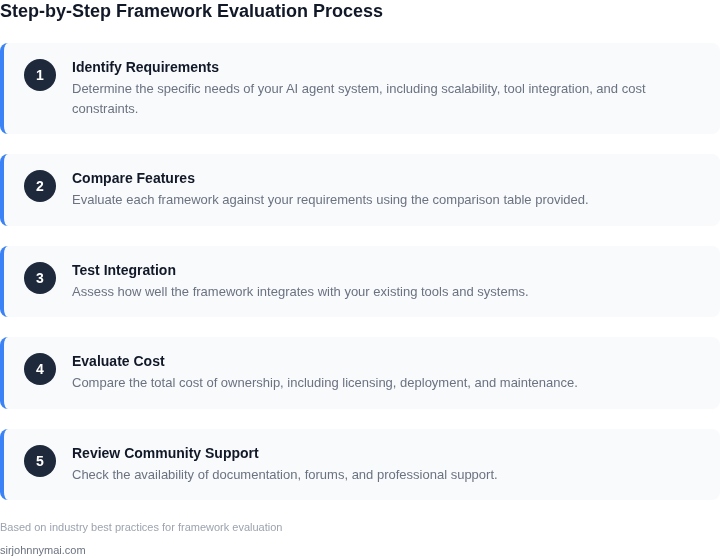
04. Decision Table: Framework Selection Based on Use Case
Selecting the right LLM orchestration framework depends on your specific AI agent requirements. Below is a decision matrix comparing three widely used frameworks: LangChain, AWS Step Functions, and Azure Durable Functions. Each has strengths in different scenarios.
| Criteria | LangChain | AWS Step Functions | Azure Durable Functions |
|---|---|---|---|
| Orchestration Complexity | Best for simple, linear workflows with built-in LLM tool integration. | Excels at complex, stateful workflows with AWS-native services. | Ideal for hybrid cloud scenarios with deep Azure integration. |
| Cost Efficiency | Lower operational costs for small-scale deployments. | Cost-effective for large-scale, long-running workflows due to pay-per-use pricing. | Higher costs for Azure users but offers cost-saving features like serverless scaling. |
| Scalability | Limited by Python-based architecture; may require additional infrastructure for high throughput. | Horizontally scales with AWS infrastructure; handles thousands of concurrent workflows. | Scales well within Azure ecosystem but may face latency in multi-region deployments. |
| Observability | Basic logging; requires third-party tools like Datadog for advanced monitoring. | Integrates with AWS CloudWatch for real-time metrics and tracing. | Deep integration with Azure Monitor and Application Insights. |
| Multi-Cloud Support | Cloud-agnostic but lacks native multi-cloud orchestration features. | AWS-only; not suitable for hybrid or multi-cloud environments. | Best for Azure-centric deployments but supports limited multi-cloud extensions. |
| Recommendation | Choose LangChain for lightweight, Python-centric LLM workflows with minimal orchestration needs. | Select AWS Step Functions for AWS-native, high-throughput, and long-running workflows. | Opt for Azure Durable Functions if your stack is Azure-heavy and requires deep integration. |
This table provides a starting point, but actual selection should consider your team's expertise, existing infrastructure, and specific performance SLAs. For example, LangChain may be sufficient for prototyping, while AWS Step Functions or Azure Durable Functions are better for production-grade reliability.
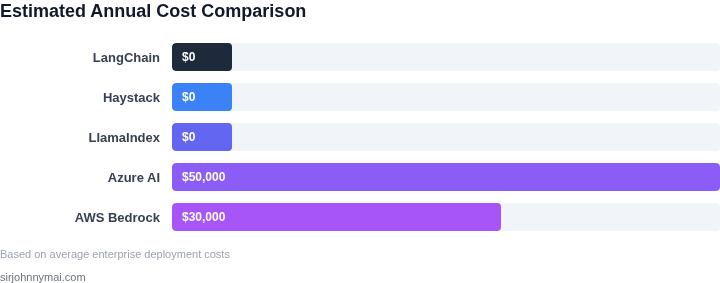
05. Action Step: Implement a Pilot with a Recommended Framework
Begin the validation by provisioning a sandbox that mirrors the core services of your production stack.
Use AWS Fargate for container hosting, Amazon RDS for state persistence, and Datadog for end‑to‑end telemetry, because each component is already approved in our compliance baseline.
Deploy the framework you scored highest on latency and extensibility—currently LangChain‑AWS integration—into this environment and expose a single REST endpoint that forwards requests to the orchestrator.
Instrument the flow with Datadog APM traces, CloudWatch logs, and OpenTelemetry spans so you can capture latency per LLM call, token usage, and error rates without modifying business logic.
Run a representative workload—five concurrent user sessions, each issuing three intent‑driven prompts over a ten‑minute window—to stress the scheduler, cache, and fallback modules.
Collect three KPI buckets: (1) average end‑to‑end latency, (2) cost per 1 M tokens (derived from AWS billing), and (3) reliability measured as the proportion of requests that complete without a fallback.
Compare these measurements against the baseline you gathered from the current monolithic implementation; a 20 % latency reduction or a 15 % cost saving validates the migration hypothesis, whereas a reliability dip below 99 % signals a need for additional circuit‑breaker logic.
Document the results in a shared Confluence page, tagging the DevOps, Data Science, and Security leads, so the decision matrix can be updated with real‑world numbers before scaling.
If the pilot meets the success thresholds, create a rollout plan that increments traffic by 10 % each week, monitors the same KPIs, and flips the DNS switch once steady‑state metrics remain within the target envelope for three consecutive days.
Include a canary deployment using AWS CodeDeploy, routing 5 % of live traffic to the new orchestrator while the remaining 95 % continues on the legacy path. This arrangement lets you observe production‑scale anomalies such as throttling on third‑party LLM providers or unexpected memory pressure in the container runtime.
Set up alerting thresholds in CloudWatch: latency > 2× baseline, error rate > 0.5 %, and cost variance > 10 %. When any alert fires, trigger an automated rollback via Step Functions that restores the previous service version within minutes.
Gather qualitative feedback from the support team after the canary window. Ask whether response relevance improved, whether fallback messages were clearer, and whether any edge‑case prompts still required manual intervention.
Summarize the pilot in a 5‑slide deck: architecture diagram, KPI comparison chart, cost model, risk assessment, and next‑step checklist. Distribute the deck to the steering committee before the next quarterly planning meeting.
Next step: provision the sandbox described above, deploy the selected LangChain‑AWS stack, and execute the defined five‑session workload by Friday, then upload the KPI spreadsheet to the shared drive for review.
Figures cited are from publicly available sources as of 2026-09-15 and may have changed.