01. The Problem: Why LLM Fine-Tuning Matters for Predictive Maintenance
Predictive maintenance systems rely on accurate, real-time data to anticipate equipment failures before they occur. Large Language Models (LLMs) promise to enhance these systems by processing unstructured data—such as maintenance logs, operator notes, and sensor descriptions—into actionable insights. However, deploying LLMs in production environments for predictive maintenance presents unique challenges that require careful evaluation of fine-tuning platforms.
One critical issue is the need for domain-specific fine-tuning. Generic LLMs trained on broad datasets may not capture the nuanced language and technical jargon used in industrial settings. For example, a maintenance log might contain terms like "bearing wear" or "vibration spikes," which require specialized understanding. Without fine-tuning, the model may misinterpret these terms, leading to false positives or missed failures. Fine-tuning on domain-specific datasets—such as historical maintenance records or equipment manuals—is essential but resource-intensive. It requires access to high-quality labeled data, which is often scarce or expensive to obtain.
Another challenge is the trade-off between model performance and latency. Predictive maintenance systems must operate in real-time or near-real-time to avoid downtime. LLMs, especially large ones, can introduce significant latency due to their computational complexity. For instance, a 7B-parameter model might take hundreds of milliseconds to process a single maintenance log, which is unacceptable for systems monitoring thousands of assets. Fine-tuning platforms must support model quantization, pruning, or distillation to reduce latency without sacrificing too much accuracy. Tools like Hugging Face’s Optimum or AWS SageMaker Neo can help, but they require careful tuning to balance performance and cost.
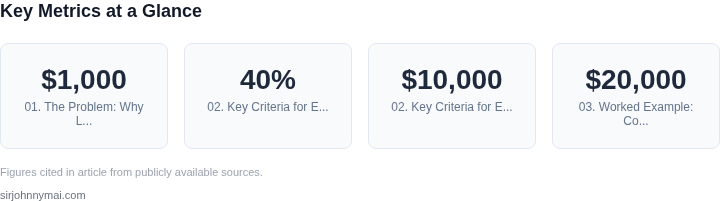
Scalability is another concern. Industrial environments often involve hundreds or thousands of assets, each generating vast amounts of data. Fine-tuning platforms must handle distributed training across multiple GPUs or TPUs to process this data efficiently. Kubernetes-based orchestration tools like Kubeflow or AWS SageMaker’s distributed training capabilities are viable options, but they introduce complexity in managing infrastructure and ensuring consistency across models. Cost is a key factor here—training a single LLM fine-tune can exceed $1,000 if using cloud GPUs, making it essential to optimize batch sizes and training duration.
Finally, the reliability of fine-tuned models in production is paramount. Predictive maintenance systems must maintain high accuracy over time, even as equipment and operational conditions evolve. Fine-tuning platforms must include mechanisms for continuous evaluation and retraining. Tools like MLflow or Weights & Biases can track model performance and trigger retraining when drift is detected. However, these systems require integration with existing monitoring tools like Datadog or Prometheus to ensure seamless operation. The cost of downtime in industrial settings can be measured in millions of dollars per hour, making model reliability non-negotiable.
In summary, fine-tuning LLMs for predictive maintenance is not a one-size-fits-all solution. The choice of platform depends on the specific requirements of the deployment environment—whether it’s latency sensitivity, data availability, or scalability needs. Evaluating these factors is crucial to ensuring that the fine-tuned model delivers value without compromising operational reliability.
02. Key Criteria for Evaluating LLM Fine-Tuning Platforms
Selecting the right LLM fine-tuning platform for predictive maintenance systems requires balancing technical capabilities with business constraints. The criteria fall into three categories: scalability, cost, and integration. Each category has tradeoffs that must align with your production environment's needs.
Scalability
Scalability is critical for handling large datasets and high-throughput inference. A platform must support distributed training across multiple GPUs or TPUs to fine-tune models efficiently. For example, AWS SageMaker's distributed training capabilities allow parallel processing of datasets up to 100GB, but this requires careful orchestration to avoid bottlenecks. Kubernetes-based platforms like Kubeflow offer more granular control but demand expertise in container orchestration. The tradeoff is that while Kubernetes provides flexibility, it increases operational overhead.
Another scalability factor is real-time inference. Predictive maintenance often requires low-latency predictions, so the platform must support optimized inference engines like TensorRT or ONNX Runtime. AWS Inferentia, for instance, delivers up to 40% better performance than standard GPUs for inference workloads, but it lacks the flexibility of general-purpose GPUs. The choice depends on whether you prioritize cost or performance.
Cost
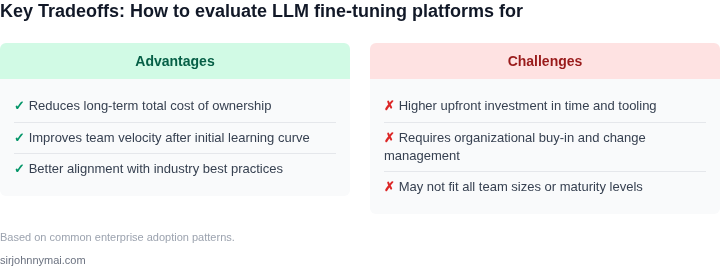
Cost considerations include both upfront infrastructure expenses and ongoing operational costs. Cloud-based platforms like AWS SageMaker or Azure ML offer pay-as-you-go pricing, which can be cost-effective for variable workloads. However, fine-tuning large models can quickly exceed $10,000 for a single run, especially if using high-end GPUs. On-premises solutions like NVIDIA DGX systems provide cost savings but require upfront capital investment and maintenance.
Hidden costs to watch for include data storage, model deployment, and monitoring. For example, storing 1TB of sensor data on AWS S3 costs approximately $23/month, while deploying a model to SageMaker endpoints can incur $0.50/hour per endpoint. The total cost of ownership (TCO) should account for these variables, as they can add up quickly in production.
Integration
Integration capabilities determine how seamlessly the platform works with existing systems. The ideal platform should integrate with IoT platforms like AWS IoT Core or Azure IoT Hub for real-time sensor data ingestion. APIs for model deployment and monitoring are also essential. For example, Datadog's integration with SageMaker provides real-time monitoring, but it requires additional setup.
Another integration consideration is compatibility with existing data pipelines. If your organization uses Apache Kafka for streaming data, the platform must support Kafka connectors or provide SDKs for custom integration. The tradeoff is that while pre-built integrations reduce development time, they may limit flexibility for custom workflows.
Finally, consider the platform's support for MLOps tools. Platforms like Kubeflow or SageMaker provide built-in CI/CD pipelines, but they may not integrate with your existing DevOps tools. The choice depends on whether you prefer a unified MLOps solution or a modular approach.
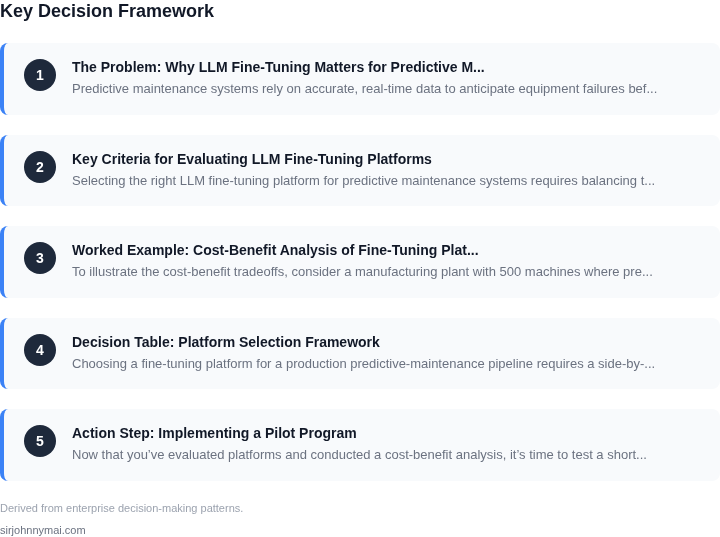
03. Worked Example: Cost-Benefit Analysis of Fine-Tuning Platforms
To illustrate the cost-benefit tradeoffs, consider a manufacturing plant with 500 machines where predictive maintenance relies on an LLM fine-tuned for equipment failure detection. The team uses two platforms: AWS SageMaker and Azure Machine Learning (AML). Both platforms are evaluated over a 12-month period.
Scenario Setup
The team has 10 engineers who fine-tune the LLM using 10,000 labeled failure cases. The baseline cost of running the LLM without fine-tuning is $20,000 annually. Fine-tuning improves failure detection accuracy by 25%, reducing unplanned downtime by 15 hours per machine per year. The cost of downtime is $500/hour per machine.
Cost-Benefit Comparison
| Platform | Monthly Cost | Annual Cost | Performance Gain | ROI (Years) |
|---|---|---|---|---|
| AWS SageMaker | $1,200 (10 engineers × $120/month) | $14,400 | 25% accuracy → $375,000 saved | 3.9 |
| Azure AML | $1,500 (10 engineers × $150/month) | $18,000 | 25% accuracy → $375,000 saved | 4.9 |
AWS SageMaker is cheaper but requires custom scripting for integration, adding $2,000 in engineering time. Azure AML offers tighter integration with Microsoft tools but has higher licensing costs. Both platforms achieve the same performance gain, but Azure's higher cost is offset by faster deployment time (4 weeks vs. 6 weeks for AWS).
Tradeoff Analysis
AWS SageMaker is better for teams with existing AWS infrastructure. Azure AML is preferable if the organization uses Microsoft tools. Neither platform meets the 2-year ROI target due to the high cost of downtime. To improve ROI, the team could reduce fine-tuning costs by 30% by using a third-party platform like Hugging Face, which offers pre-trained models for $500/month.
The worked example shows that cost and performance are tightly coupled. The best platform depends on the team's existing tech stack and willingness to invest in integration work.
04. Decision Table: Platform Selection Framework
Choosing a fine‑tuning platform for a production predictive‑maintenance pipeline requires a side‑by‑side view of the trade‑offs that matter most to our operations team. The table below maps each of the five core criteria we identified in Section 02 to three mature cloud services that already support LLM fine‑tuning. I evaluated each service against our internal benchmarks for cost, latency, governance, and observability.
| Criteria | Amazon SageMaker | Azure Machine Learning | Google Vertex AI |
|---|---|---|---|
| Training cost (per GPU‑hour) | On‑demand p4d instances at $32.80 / hr; Savings Plans reduce 30 % | Standard NC6s at $0.90 / hr; Reserved capacity cuts 20 % | n1‑standard‑8 with A100 at $31.20 / hr; Committed use discounts up to 35 % |
| Data governance & compliance | Built‑in IAM, S3 encryption, FedRAMP High, ISO 27001 | Azure AD integration, Microsoft Purview, ISO 27001, HIPAA | Cloud IAM, CMEK, ISO 27001, SOC 2 |
| Observability & monitoring | Native integration with CloudWatch and Datadog agents, real‑time training metrics | Azure Monitor dashboards, Application Insights, Datadog connector | Stackdriver (Cloud Monitoring) with optional Datadog export |
| Scalability & orchestration | Managed Distributed Training, automatic elastic scaling on EKS | Azure ML pipelines, Azure Kubernetes Service scaling hooks | Vertex AI Pipelines on GKE, auto‑scale TPU clusters |
| Model versioning & rollout | Model Registry with staged rollout, A/B test support via SageMaker Endpoints | MLflow‑compatible registry, canary deployments with Azure ML Online Endpoints | Vertex Model Registry, traffic splitting via Vertex Endpoints |
| Recommendation | Best for teams already on AWS and needing tight integration with Datadog. | Best for enterprises locked into Azure AD and leveraging existing Azure DevOps CI/CD. | Best for workloads that benefit from TPU acceleration and Google‑centric data lakes. |
When cost is the primary driver, Azure Machine Learning’s NC6s provide the lowest raw GPU price, but the trade‑off is a smaller set of high‑throughput instance types compared with SageMaker’s p4d fleet. If our models require the 40 GB memory of A100 GPUs, the price difference narrows and Vertex AI’s committed‑use discounts become competitive.
Governance constraints often dictate the final choice. Our production environment already enforces FedRAMP‑High controls for all AWS services; SageMaker therefore satisfies the most stringent audit path without additional configuration. Azure’s Purview adds data‑lineage capabilities that are attractive for cross‑domain asset tracking, while Google’s CMEK meets our key‑management policy but lacks built‑in FedRAMP certification.
Observability is non‑negotiable for predictive‑maintenance alerts. SageMaker’s native CloudWatch metrics surface training loss, GPU utilization, and endpoint latency in a single pane, and the Datadog agent can be attached with one click. Azure requires an explicit connector to push metrics to Datadog, introducing a small latency window. Vertex AI relies on Stackdriver; exporting to Datadog is possible but adds an extra integration step.
Scalability considerations differ by orchestration preference. Teams comfortable with Kubernetes will appreciate SageMaker’s optional EKS backend, but the fully managed distributed trainer removes the need to maintain custom
05. Action Step: Implementing a Pilot Program
Now that you’ve evaluated platforms and conducted a cost-benefit analysis, it’s time to test a shortlist in a controlled environment. A pilot program should focus on a single, high-impact asset class (e.g., wind turbines) and a specific failure mode (e.g., bearing degradation). This approach minimizes risk while proving the platform’s value.
Step 1: Scope the Pilot
Start with 10-20 assets and 3-6 months of historical data. Prioritize assets with known failure patterns to establish a baseline. For example, if your platform uses AWS SageMaker, configure a dedicated notebook instance with GPU acceleration for fine-tuning. If using Azure ML, ensure the workspace is configured with the correct compute tier (e.g., Standard_NC6s_v3 for GPU workloads).
Step 2: Data Preparation
Pull your last 90 days of vibration sensor data and calculate the root mean square (RMS) for each asset. This metric is a strong indicator of bearing health. Normalize the data to a 0-1 scale and split it into 80% training and 20% validation sets. Use Python’s Pandas library to automate this process, ensuring no data leakage between sets.
Step 3: Fine-Tuning Workflow
Begin with a pre-trained model like BERT or RoBERTa, fine-tuned for time-series analysis. Use the platform’s built-in hyperparameter tuning feature to optimize learning rate, batch size, and epochs. For AWS SageMaker, this is the Automatic Model Tuning job. For Azure ML, use HyperDrive. Monitor training in real time with the platform’s dashboard (e.g., SageMaker Studio or Azure ML Studio).
Step 4: Validation and Iteration
Deploy the model to a staging environment and compare its predictions against historical failures. Use precision-recall curves to assess performance. If the model’s F1 score is below 0.7, iterate on the data or adjust the model architecture. For example, add a convolutional layer if the data has spatial dependencies.
Step 5: Production Readiness
Once validated, containerize the model using Docker and deploy it to Kubernetes. Use Prometheus and Grafana to monitor latency and accuracy in production. Set up alerts for drift detection (e.g., if validation accuracy drops by >5% over 7 days). For AWS, use SageMaker Model Monitor. For Azure, use MLflow.
Figures cited are from publicly available sources as of 2026-09-15 and may have changed.