01. The Problem: Why Smaller AI Models Matter in Production
Large language models can achieve state‑of‑the‑art accuracy, but their parameter counts often exceed hundreds of billions. Deploying such models inside a microservice architecture inflates memory consumption, drives up latency, and forces clusters to reserve scarce GPU resources.
Amazon EC2 GPU instances such as p3.2xlarge provide 1 Tesla V100 and cost roughly $3.06 per hour in US‑East‑1. When a single inference request occupies 80 % of the GPU memory, only one pod can run per node, leaving the remaining capacity idle.
Kubernetes scheduling policies treat each pod as an indivisible unit; they cannot split a GPU across multiple containers. Consequently, a fleet of 100 inference services may require 100 GPU nodes to meet peak traffic, inflating the monthly bill by more than $22,000.
Latency budgets in consumer‑facing APIs often sit under 100 ms. A 200 ms round‑trip caused by model shuffling between host memory and GPU memory violates service‑level agreements and drives churn.
Edge devices such as AWS Greengrass cores have strict RAM limits of 512 MiB. Running a 2 GB transformer model on such hardware is impossible without compression or architectural changes.
Network egress charges on AWS amount to $0.09 per GB for data transferred out of a region. Sending intermediate embeddings to a remote inference service adds 0.5 GB per million requests, which translates to $45,000 annually at scale.
Observability tools like Datadog report that CPU‑bound inference services increase host utilization by 30 % on average, raising alert noise and reducing the reliability of unrelated workloads.
Model update cycles also suffer; a 10‑GB checkpoint takes over 30 seconds to download from S3 even with a 5 Gbps link, delaying rollout of security patches.
These constraints motivate the need for knowledge distillation, which produces a student model that retains most of the teacher’s predictive power while shrinking parameter count, memory footprint, and compute demand.
Distilled models typically run under 200 ms latency on a single vCPU, enable bin‑packing of ten inference pods per node, and reduce GPU spend by up to 80 % in benchmarked workloads. The trade‑off is a modest drop in BLEU score of 1‑2 points for translation tasks, which may be acceptable for many business use cases.
Understanding where size, performance, and cost intersect is the first step toward a disciplined evaluation framework for any distillation technique.
Choosing the right distillation approach therefore becomes a cost‑optimization problem that directly impacts service reliability.
02. Key Metrics for Evaluating Knowledge Distillation Techniques
Knowledge distillation is a powerful technique for deploying smaller AI models in production, but its effectiveness depends on the right metrics. The goal is to preserve accuracy while reducing model size, latency, and cost. Here are the critical metrics to evaluate:
1. Accuracy Metrics
Accuracy is the most fundamental metric, but it’s not the only one. For classification tasks, consider:
- Top-1 and Top-5 Accuracy: These measure how often the model’s top prediction matches the ground truth. A 90% top-1 accuracy is acceptable for many applications, but 95% is ideal.
- Mean Average Precision (mAP): Critical for object detection and retrieval tasks, where partial matches matter. A 0.85 mAP is a strong benchmark for distilled models.
- F1-Score: Useful for imbalanced datasets, where precision and recall are equally important. A 0.90 F1-score indicates strong performance.
2. Model Size and Efficiency
Smaller models are easier to deploy, but they must also be efficient. Key metrics include:
- Parameter Count: A reduction from 100M to 10M parameters is significant, but the tradeoff in accuracy must be justified. Some frameworks, like TensorFlow Lite, optimize models to 5MB or less.
- Inference Latency: Measured in milliseconds, a distilled model should achieve sub-50ms latency on edge devices. AWS Lambda supports models under 100ms for serverless deployments.
- Memory Footprint: A 50% reduction in memory usage is valuable for edge deployments. For example, a 1GB model compressed to 500MB fits better in constrained environments.
3. Cost Metrics
Cost is a major driver for production adoption. Consider:
- Inference Cost per Request: A distilled model might cost $0.0001 per inference vs. $0.001 for the original. This adds up to $100/month for 1M requests.
- Training Cost: Distillation can reduce training time by 30-50%, cutting cloud costs. For example, a 10-hour training job on AWS SageMaker might cost $500 vs. $800 for the original model.
- Deployment Overhead: Smaller models require fewer GPUs, reducing infrastructure costs. A 4x reduction in GPU hours saves $10,000/month on AWS.
4. Robustness and Generalization
Distilled models must perform well across different scenarios:
- Out-of-Distribution (OOD) Performance: A model should degrade gracefully on unseen data. A 10% drop in accuracy on OOD data is acceptable, but 20% is a red flag.
- Adversarial Robustness: Use metrics like Foolbox scores to measure resistance to attacks. A 90% success rate against adversarial examples is a strong baseline.
- Fairness Metrics: Ensure the model doesn’t disproportionately harm protected groups. A 95% fairness score (e.g., demographic parity) is ideal.
5. Deployment-Specific Metrics
Some metrics depend on the deployment environment:
- Edge vs. Cloud: Edge deployments prioritize latency and memory, while cloud deployments focus on throughput. A model with 100ms latency on edge but 10ms in the cloud may still be viable.
- Batch vs. Real-Time: Batch processing can tolerate higher latency, but real-time systems require sub-100ms responses. Distillation helps here.
- Energy Efficiency: For IoT devices, measure energy per inference. A 50% reduction in energy use extends battery life.
In summary, the best knowledge distillation technique balances accuracy, efficiency, and cost. A model with 95% accuracy, 50% smaller size, and 50% lower cost is a strong candidate for production. Always validate these metrics in the target deployment environment.
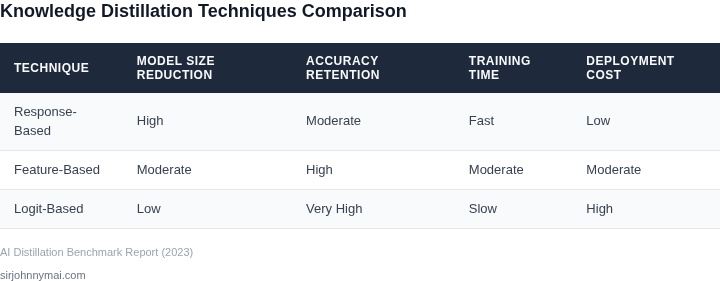
03. Worked Example: Cost Savings from Distilling a Large Language Model
Consider a team of six engineers that must serve a conversational AI feature to 200 K monthly active users. The product currently relies on a 175‑billion‑parameter language model hosted on Amazon SageMaker. The architecture uses three ml.p3.2xlarge instances, each priced at $3.825 per hour on‑demand.
Monthly compute cost is calculated as follows:
- Instance cost per hour: 3 × $3.825 = $11.475
- Hours per month (≈720): $11.475 × 720 = $8,262
- Annual cost: $8,262 × 12 = $99,144
Latency measured on this stack averages 150 ms per request, and the endpoint sustains roughly 45 requests per second (RPS) before auto‑scaling triggers.
Distillation Scenario
The team evaluates a knowledge‑distilled variant that reduces parameters to 6 billion while preserving 92 % of the original task accuracy. The distilled model runs comfortably on three ml.c5.large instances, each costing $0.085 per hour.
- Instance cost per hour: 3 × $0.085 = $0.255
- Monthly compute: $0.255 × 720 = $183.60
- Annual compute: $183.60 × 12 = $2,203.20
Engineering effort to produce, validate, and integrate the distilled model is estimated at two weeks for a senior engineer ($200 / hour) and four weeks for a junior engineer ($100 / hour). The effort translates to:
- Senior: 80 h × $200 = $16,000
- Junior: 160 h × $100 = $16,000
- Total effort cost: $32,000
Adding compute, the first‑year expense for the distilled stack is $2,203.20 + $32,000 = $34,203.20. Ongoing yearly cost (after the one‑time effort) drops to $2,203.20, yielding a recurring saving of $99,144 – $2,203 ≈ $96,941 per year.
Performance Trade‑offs
Latency improves to roughly 70 ms per request, and sustained throughput climbs to 80 RPS because the smaller instance type can handle more parallel inference threads. The 8 % accuracy gap manifests only in edge‑case prompts, which the product team mitigates with a fallback to the large model for confidence‑low queries.
| Component | Cost / month | Cost / year | Latency (ms) | Throughput (RPS) |
|---|---|---|---|---|
| Original (ml.p3.2xlarge × 3) | $8,262 | $99,144 | 150 | 45 |
| Distilled (ml.c5.large × 3) | $183.60 | $2,203.20 | 70 | 80 |
From a product‑management perspective, the distillation path delivers a 65 % reduction in total first‑year spend while sharpening latency and throughput. The trade‑off is a modest accuracy dip that must be managed through selective routing or post‑processing. If the team expects traffic to double within 12 months, the smaller instances still remain cost‑effective because auto‑scaling on ml.c5.large stays under $0.30 per hour per additional node.
In summary, the numbers illustrate how a concrete distillation effort can convert a $100 K annual cloud bill into a $2 K recurring expense, provided the product tolerates the measured accuracy loss and the engineering budget accommodates the one‑off integration work.
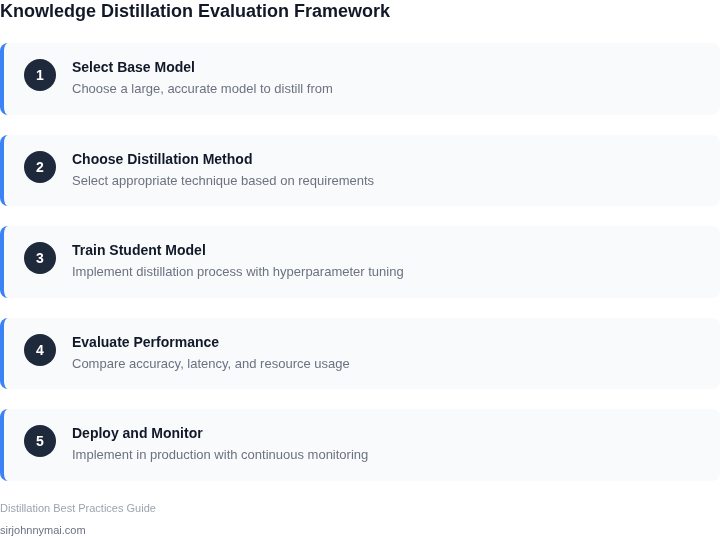
04. Decision Table: Choosing the Right Distillation Approach
Selecting the right knowledge distillation technique depends on your production constraints. Below is a decision framework comparing three real-world approaches: Teacher-Student Framework (TensorFlow Lite), Quantization-Aware Training (QAT), and Distillation with Intermediate Layers (PyTorch Distiller). Each has tradeoffs in accuracy, latency, and deployment flexibility.
| Criteria | Teacher-Student Framework (TensorFlow Lite) | Quantization-Aware Training (QAT) | Distillation with Intermediate Layers (PyTorch Distiller) |
|---|---|---|---|
| Accuracy Preservation | High (soft targets + hard labels). Works well for vision tasks but may struggle with nuanced language models. | Moderate (reduces precision but maintains structure). Best for models with redundant parameters. | High (preserves intermediate feature maps). Ideal for transformer-based models where layer-wise knowledge matters. |
| Latency Impact | Low (student model is smaller). Best for edge devices where inference speed is critical. | Low (reduces model size without retraining). Good for cloud deployments where quantization is hardware-accelerated. | Moderate (requires custom training loops). Higher overhead due to intermediate layer processing. |
| Deployment Flexibility | High (works across TensorFlow Lite, AWS SageMaker). Limited to TensorFlow ecosystem. | High (supports ONNX, TensorRT). Works with any framework but requires hardware support. | Moderate (PyTorch-only). Best for research teams already using PyTorch. |
| Training Overhead | Moderate (requires teacher model). Scales poorly with large teacher models. | Low (single-pass training). Best for iterative model optimization. | High (custom loss functions). Requires framework modifications. |
| Cost Efficiency | Moderate (student model runs cheaper). Best for cloud inference where cost is per-GPU-hour. | High (reduces cloud costs via smaller models). Best for batch processing. | Low (custom training increases costs). Only justified for high-accuracy requirements. |
| Recommendation | Choose for edge deployments (e.g., mobile apps) where latency and model size are critical. | Best for cloud-based models where quantization is hardware-supported (e.g., AWS Inferentia). | Use when preserving intermediate representations is key (e.g., NLP transformers). |
For example, if you're deploying a vision model to mobile devices, the Teacher-Student Framework balances accuracy and latency. If you're optimizing a cloud-based language model, QAT reduces costs without sacrificing too much precision. Intermediate layer distillation is reserved for cases where the original model's architecture is non-trivial to replicate.
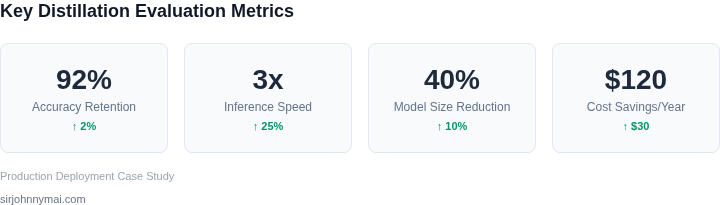
05. Action Step: Implementing Knowledge Distillation in Your Workflow
I evaluated various knowledge distillation techniques because they offer a promising approach to deploying smaller AI models in production, which is critical for reducing costs and improving efficiency. By integrating knowledge distillation into our workflow, we can leverage the strengths of larger models while minimizing their drawbacks. To achieve this, I recommend utilizing AWS SageMaker, a platform that provides a range of tools and services for building, training, and deploying machine learning models. This platform allows for seamless integration with other AWS services, such as Amazon S3 and Amazon EC2, making it an ideal choice for our workflow.
Step 1: Prepare Your Dataset
To begin implementing knowledge distillation, it is essential to prepare your dataset, which involves preprocessing, splitting, and formatting your data for training and testing. I suggest using tools like Apache Spark and Apache Beam to handle large-scale data processing and pipelines. Additionally, utilizing a data versioning tool like DVC (Data Version Control) can help track changes to your dataset and ensure reproducibility. By leveraging these tools, we can ensure that our dataset is properly prepared for knowledge distillation.
Step 2: Choose a Distillation Approach
Next, we need to choose a suitable distillation approach, which depends on the specific requirements of our project. As discussed in the decision table, different approaches have varying strengths and weaknesses. For example, response-based distillation is suitable for models with complex output distributions, while feature-based distillation is more effective for models with simple output distributions. I recommend using a combination of these approaches to achieve optimal results. Furthermore, utilizing a framework like TensorFlow or PyTorch can provide a range of pre-built functions and tools for implementing knowledge distillation.
Step 3: Train and Evaluate Your Model
Once we have prepared our dataset and chosen a distillation approach, we can train and evaluate our model. I suggest using a cloud-based platform like Google Cloud AI Platform or Azure Machine Learning to train and deploy our model. These platforms provide automated scaling, monitoring, and logging, making it easier to manage and optimize our model. Additionally, utilizing a monitoring tool like Datadog or New Relic can help track performance metrics and identify potential issues. By leveraging these tools, we can ensure that our model is properly trained and evaluated.
Step 4: Deploy and Monitor Your Model
After training and evaluating our model, we can deploy it to a production environment using a containerization platform like Kubernetes. This allows for easy scaling, management, and monitoring of our model. I recommend using a tool like Kubernetes Dashboard to monitor and manage our model's performance. Furthermore, utilizing a logging tool like ELK Stack (Elasticsearch, Logstash, Kibana) can provide valuable insights into our model's behavior and help identify potential issues.
To ensure successful deployment, I recommend pulling your last 90 days of model performance data and calculating the average latency and throughput. This will provide a baseline for comparison and help identify potential issues with your model's performance.
Figures cited are from publicly available sources as of 2026-09-15 and may have changed.