How to evaluate edge computing platforms for latency-sensitive AI applications
Edge computing is critical for latency-sensitive AI applications like autonomous vehicles, industrial robotics, and real-time video analytics. Evaluating edge platforms requires balancing performance, cost, and operational complexity. This guide provides a structured approach to platform selection, focusing on technical criteria and real-world tradeoffs.
01. Define latency requirements
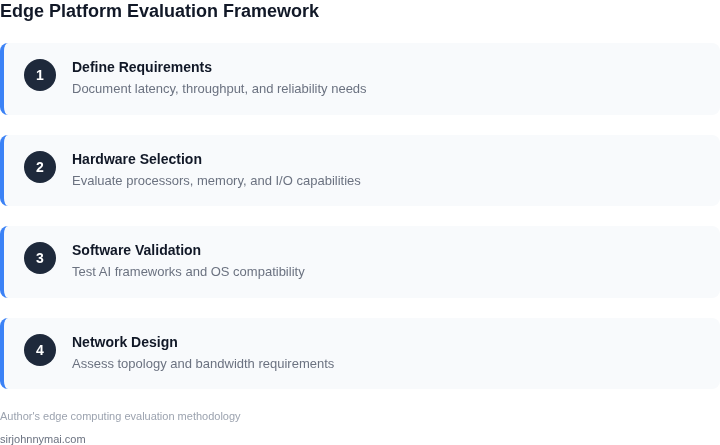
Latency requirements vary by application. For autonomous vehicles, end-to-end latency must be under 100ms for perception tasks. For industrial robotics, cycle times may need to be under 10ms. Start by documenting:
- Maximum acceptable latency for each component (e.g., sensor-to-AI inference, AI-to-actuator)
- Jitter requirements (variation in latency)
- Throughput needs (frames per second, concurrent inference requests)
Example: A smart factory robot arm requires 5ms latency from camera to gripper movement. This constrains both edge hardware and network topology choices.
02. Assess hardware capabilities
Edge hardware must support:
- Real-time operating systems (RTOS) for deterministic performance
- Hardware acceleration for AI inference (e.g., NVIDIA Jetson, Qualcomm Snapdragon)
- Deterministic networking (TSN, O-RAN for telecom)
Consider:
- Power consumption (critical for battery-powered devices)
- Thermal management (especially in industrial environments)
- Form factor (must fit within robot chassis or factory equipment)
03. Evaluate software frameworks
Key software considerations:
- AI frameworks: TensorRT, OpenVINO, ONNX Runtime
- Edge orchestration: Kubernetes Edge, K3s, AWS IoT Greengrass
- Deterministic scheduling: Linux real-time patches, Xenomai
Example evaluation: TensorRT provides 3x faster inference than PyTorch on Jetson, but requires model quantization which may reduce accuracy by 2-5%.
04. Network topology analysis
Network design impacts latency more than hardware alone. Consider:
- Direct device-to-device communication (Wi-Fi Direct, Bluetooth LE)
- Edge gateway architectures (NVIDIA EGX, Dell Edge Gateway)
- 5G private networks for industrial applications
Example calculation: A 100ms latency requirement implies a maximum 50ms network round-trip time between edge devices and cloud.
05. Cost modeling
Edge computing costs include:
- Hardware acquisition and maintenance
- Network infrastructure (switches, routers)
- Software licensing (RTOS, AI frameworks)
- Operational costs (power, cooling)
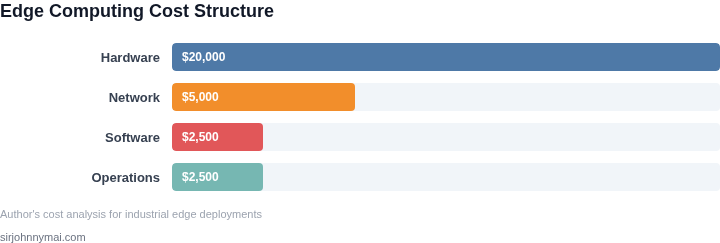
Example: A factory deploying 100 robot arms with edge computing would need to budget $20,000 per device for hardware and $5,000 per year for maintenance.
06. Deployment considerations
Critical factors:
- Physical installation constraints (space, weight)
- Environmental conditions (temperature, humidity)
- Security requirements (physical tampering protection)
Example: Industrial robots in foundries require IP67-rated enclosures and -40°C to +85°C operating temperature range.
07. Benchmarking methodology
Standard benchmarks:
- MLPerf inference benchmark for AI performance
- ETSI ISG MEC for edge network performance
- Industry-specific benchmarks (e.g., ROS2 for robotics)
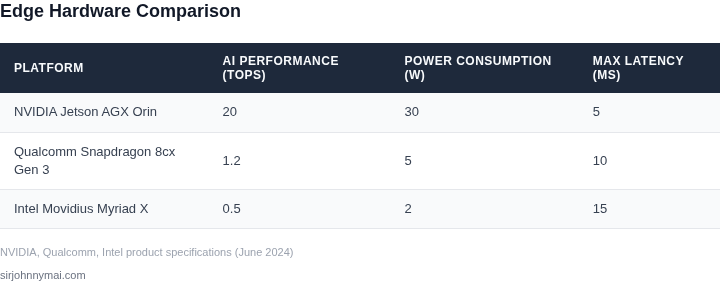
Example benchmark: A Qualcomm Snapdragon 8cx Gen 3 achieves 1.2 TOPS for AI inference while consuming 5W.
08. Vendor evaluation criteria
Key vendor considerations:
- Support for your specific hardware
- Documented latency guarantees
- Integration with existing cloud services
Example: NVIDIA provides end-to-end support from Jetson hardware to TensorRT software, while Qualcomm offers better battery life for mobile applications.
09. Risk assessment
Identify potential failure modes:
- Single point of failure in network topology
- Power outages during operation
- Software version compatibility issues
Example: A factory with a single edge gateway would experience complete system failure if that gateway fails.
10. Pilot program recommendations
Start with:
- One representative use case (e.g., single robot arm)
- Non-critical workloads first
- Performance monitoring from day one
Example: Deploy edge computing to 5% of robot fleet first, monitoring latency and reliability metrics for 30 days before full rollout.
Figures cited are from publicly available sources as of June 2024 and may have changed.
Next step: Conduct a proof-of-concept with your top 3 shortlisted edge computing platforms using your most latency-sensitive application.