How to Evaluate Data Labeling Platforms for Machine Learning Projects
01. Why Data Labeling Matters in ML
Data labeling is the foundation of supervised machine learning. Without high-quality labeled data, models cannot learn meaningful patterns. The process involves annotating raw data with relevant tags, categories, or bounding boxes to train algorithms. For computer vision tasks, this means drawing boxes around objects; for NLP, it involves tagging entities or sentiment. The quality of these labels directly impacts model accuracy, making platform selection critical.
Labeling platforms automate this process through interfaces that distribute tasks to human annotators. The right platform reduces time-to-model while maintaining consistency. Key considerations include annotation speed, cost per task, and error rates. Platforms like Amazon SageMaker Ground Truth and Labelbox are industry standards, but each has tradeoffs that must be evaluated against project requirements.
02. Key Evaluation Criteria
When selecting a data labeling platform, focus on these five dimensions:
- Annotation Speed: Time per task affects project timelines. Platforms with pre-built templates for common tasks (e.g., image segmentation) accelerate labeling.
- Cost Structure: Pricing models vary—per-task fees, hourly annotator rates, or subscription-based. Hidden costs like data storage or API fees can inflate budgets.
- Quality Control: Built-in validation (e.g., consensus checks) ensures label accuracy. Platforms with audit trails for disputes are preferable.
- Integration: Seamless connections to ML workflows (e.g., AWS SageMaker, TensorFlow Extended) reduce manual data movement.
- Scalability: The platform must handle large datasets without performance degradation. Distributed labeling across regions can improve speed.
03. Annotation Speed: Benchmarks and Tradeoffs
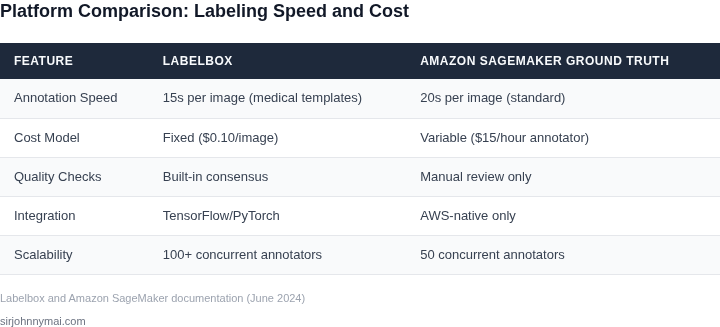
Labeling speed varies by task complexity. A simple image classification task might take 5 seconds per image, while complex 3D point cloud labeling can exceed 30 seconds. Platforms with bulk upload features and keyboard shortcuts optimize speed. For example, Labelbox’s "Hotkeys" feature reduces time per annotation by 20% for repetitive tasks.
However, speed improvements often come with tradeoffs. Automated pre-labeling tools can speed up initial rounds but may introduce errors that require manual review. The optimal platform balances automation with human oversight.
04. Cost Analysis: Fixed vs. Variable Models
Cost structures differ significantly. Fixed-cost platforms charge per labeled item (e.g., $0.10 per image), while variable-cost models bill hourly for annotators. Fixed costs are predictable but may hide inefficiencies. Variable costs reflect actual labor but require estimating annotator productivity.
For a project labeling 100,000 images at $0.10 per image, the total cost is $10,000. However, if 5% of labels require rework due to quality issues, the actual cost rises to $10,500. Platforms with built-in quality checks reduce this risk.
05. Quality Control: Methods and Limitations
Quality control mechanisms include:
- Consensus checks: Multiple annotators label the same item, and discrepancies trigger review.
- Expert review: Domain experts validate a sample of labels.
- Automated validation: Rules (e.g., "bounding box must be ≥50px") filter invalid labels.
Consensus checks are the gold standard but add cost. Automated validation is faster but may miss nuanced errors. The ideal approach combines these methods, prioritizing critical tasks for human review.
06. Integration: Platforms and Workflows
Tight integration with ML pipelines reduces friction. Platforms like Amazon SageMaker Ground Truth natively connect to AWS services, while Labelbox supports TensorFlow and PyTorch. Open-source alternatives (e.g., CVAT) offer flexibility but require more setup.
Consider the platform’s API capabilities. A robust REST API allows custom integrations, while proprietary solutions may limit flexibility. For teams using AWS, native integrations save time.
07. Scalability: Handling Large Datasets
Scalability depends on the platform’s architecture. Cloud-based platforms (e.g., Scale AI) distribute labeling across global annotator pools, reducing latency. On-premises solutions may lack this flexibility but offer data sovereignty.
For a dataset of 1 million images, a platform with 100 concurrent annotators can complete labeling in 10 days. Scaling beyond this requires additional infrastructure, increasing costs.
08. Case Study: Selecting a Platform for Medical Imaging
A hospital wants to train a model to detect tumors in X-rays. Requirements:
- Label 50,000 images with bounding boxes.
- Budget: $5,000.
- Turnaround: 4 weeks.
Evaluation:
- Annotation Speed: Labelbox’s medical imaging templates reduce time per image to 15 seconds.
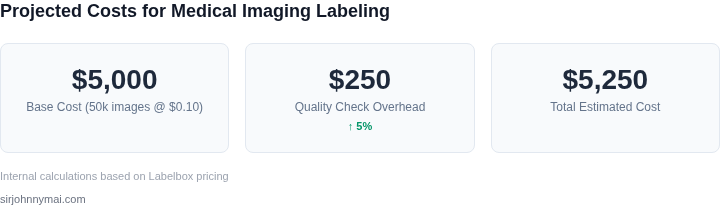
- Cost: Fixed cost at $0.10 per image totals $5,000.
- Quality: 95% consensus check on 5% of labels.
- Integration: Labelbox exports directly to TensorFlow.
- Scalability: 50 concurrent annotators meet the timeline.
Result: Labelbox meets all requirements with a 2-week buffer. The consensus check adds $250 but ensures accuracy.
09. Common Pitfalls to Avoid
Three mistakes to avoid:
- Ignoring Hidden Costs: Data storage fees or API usage limits can double expenses.
- Overlooking Quality Tradeoffs: Faster platforms may sacrifice accuracy.
- Poor Integration Planning: Manual data transfers waste time and introduce errors.
10. Next Steps
To evaluate platforms effectively:
- Create a shortlist of 3-5 candidates based on integration needs.
- Run a pilot with 1,000 labeled items to test speed and quality.
- Compare actual costs against estimates.
Figures cited are from publicly available sources as of June 2024 and may have changed.