01. The Problem: Balancing Open Source Expertise with Cross-Cloud Federation
The tension between open-source identity solutions and cross-cloud federation is real. Teams often favor open-source tools like Keycloak or Dex because they offer flexibility, cost control, and deep customization. However, integrating these with proprietary cloud providers like AWS, Azure, or GCP introduces friction. Each cloud has its own identity protocols, SDKs, and compliance requirements, making a unified identity experience difficult to achieve.
For example, AWS IAM and Azure AD are fundamentally different. AWS uses SAML 2.0 and OIDC for federation, while Azure relies on its proprietary protocols. Open-source tools like Dex can bridge these gaps, but they require significant configuration and maintenance. Teams may spend weeks aligning Dex with AWS IAM, only to find that Azure AD requires a different approach. This inconsistency slows down adoption and increases operational overhead.
Cost is another factor. While open-source tools eliminate licensing fees, they demand expertise. Hiring or training engineers to manage these systems can cost $150,000+ annually, depending on the team size. In contrast, cloud providers offer managed identity services (like AWS SSO or Azure AD B2C), but these come with vendor lock-in risks and higher costs at scale. A mid-sized enterprise might spend $50,000–$100,000 per year on managed services, but the operational complexity can outweigh the savings.
The tradeoff isn’t just technical—it’s cultural. Open-source advocates often prioritize control and transparency, while cloud providers emphasize security and compliance. For instance, AWS IAM integrates tightly with AWS services, but it lacks the granularity of open-source tools like Keycloak. Teams must decide whether to standardize on one approach or maintain parallel systems, each with its own set of challenges.
Ultimately, the problem isn’t a lack of tools—it’s the need to balance flexibility with practicality. Open-source solutions win in environments where customization is critical, but they struggle when interoperability with cloud providers is a priority. The solution requires a hybrid approach: leveraging open-source where it adds value and using cloud-native tools where they simplify integration.
02. Key Considerations for Cross-Cloud Identity Federation
When evaluating cross-cloud identity federation, technical feasibility, security posture, and cost must be weighed against your team's expertise in open-source tools. The choice between proprietary solutions like AWS IAM Identity Center or open-source alternatives like Dex and Keycloak depends on these factors.
Technical Feasibility
Open-source tools like Dex and Keycloak offer flexibility but require deep expertise in OAuth 2.0, OIDC, and SAML protocols. AWS IAM Identity Center, on the other hand, provides a managed service with built-in integrations for AWS services, reducing the need for custom development. However, this comes at the cost of vendor lock-in. For teams with Kubernetes expertise, Dex is a natural fit, as it integrates seamlessly with Kubernetes RBAC. Keycloak, while more feature-rich, has a steeper learning curve and requires ongoing maintenance.
Latency and scalability are critical. AWS IAM Identity Center can handle millions of federated identities with sub-second response times, but open-source solutions may struggle at scale without proper tuning. For example, Dex with Redis caching can reduce latency, but this adds operational overhead. If your workloads are highly distributed across AWS and Azure, AWS IAM Identity Center's multi-cloud support is more reliable than stitching together open-source components.
Security Posture
Security is a top concern. AWS IAM Identity Center provides compliance certifications (ISO 27001, SOC 2) and automatic patching, whereas open-source tools require manual updates and configuration. For example, Keycloak supports FIPS 140-2 compliance, but enabling it requires additional setup. If your organization is subject to strict regulatory requirements, AWS IAM Identity Center may be the safer choice.
Threat modeling is essential. Open-source tools like Dex and Keycloak are transparent, allowing for deeper auditing, but they also expose more attack surfaces. AWS IAM Identity Center has fewer exposed endpoints, reducing the risk of misconfiguration. However, if your threat model includes insider risks, open-source tools may offer more visibility into identity provider logs.
Cost Considerations
Costs vary significantly. AWS IAM Identity Center is priced per federated user (approximately $0.05 per user per month), while open-source tools have no direct licensing costs but require infrastructure investment. For example, running Keycloak on Kubernetes with managed databases can cost $1,000–$3,000 per month, depending on scale. If you have fewer than 10,000 federated users, AWS IAM Identity Center may be more cost-effective.
Operational costs must also be considered. Open-source tools require DevOps expertise for deployment, monitoring, and maintenance. AWS IAM Identity Center, while a managed service, may still require administrative overhead for policy management and auditing. For teams with limited resources, AWS IAM Identity Center reduces operational burden but increases reliance on AWS.
Team Expertise and Maintenance
Your team's skills will dictate the approach. If they specialize in open-source tools, Dex or Keycloak may be preferable. However, this requires ongoing maintenance, which may not align with other priorities. AWS IAM Identity Center, while proprietary, simplifies management and reduces long-term maintenance costs. For teams transitioning from on-premises identity providers, AWS IAM Identity Center can accelerate adoption.
Finally, consider future-proofing. AWS IAM Identity Center is tightly integrated with AWS services, making it easier to adopt new cloud-native features. Open-source tools may require custom development to keep pace with evolving standards. If your organization plans to expand into new cloud providers, AWS IAM Identity Center's multi-cloud support is more scalable than piecing together open-source components.
03. Worked Example: Cost Comparison of Open Source vs. Proprietary Solutions
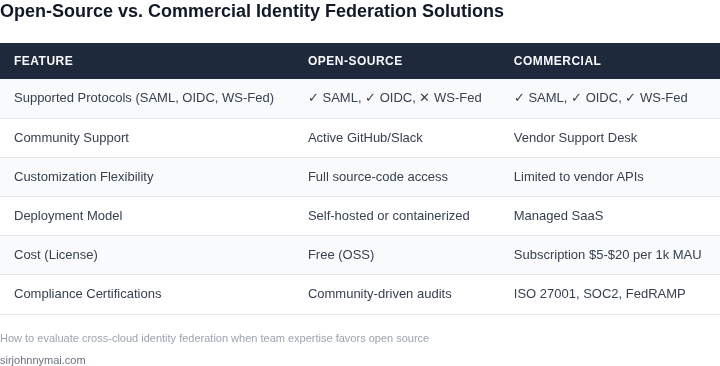
To quantify the cost implications of open-source versus proprietary identity federation tools, consider a team of 50 engineers managing hybrid cloud environments across AWS, Azure, and GCP. The goal is to federate identities across these clouds while minimizing operational overhead.
Option 1: Open-Source Solution (Keycloak)
Keycloak is a popular open-source identity and access management (IAM) solution. For this scenario:
- Licensing: Free to use under the Apache License 2.0, with no per-seat or per-deployment fees.
- Infrastructure: Hosted on Kubernetes, requiring 3 nodes (3 vCPUs, 8GB RAM each) for high availability. AWS EKS pricing: $0.10 per vCPU-hour and $0.016 per GB-hour.
- Operational Costs: 2 FTEs (Full-Time Engineers) for maintenance, monitoring, and updates. Average salary: $120,000/year.
Calculations:
| Cost Component | Annual Cost |
|---|---|
| Kubernetes Infrastructure | $0.10 × 3 vCPUs × 24 hours × 365 days = $2,592 |
| Memory Cost | $0.016 × 24 GB × 24 hours × 365 days = $1,382 |
| Engineering Labor | 2 FTEs × $120,000 = $240,000 |
| Total | $243,974 |
Option 2: Proprietary Solution (AWS IAM Identity Center)
AWS IAM Identity Center (formerly AWS Single Sign-On) is a managed service that simplifies cross-cloud identity federation. For this scenario:
- Licensing: $6 per user per month, billed annually.
- Infrastructure: Fully managed, no additional infrastructure costs.
- Operational Costs: 1 FTE for configuration and ongoing management.
Calculations:
| Cost Component | Annual Cost |
|---|---|
| User Licenses | $6 × 50 users × 12 months = $3,600 |
| Engineering Labor | 1 FTE × $120,000 = $120,000 |
| Total | $123,600 |
Comparison and Tradeoffs
The proprietary solution is significantly cheaper ($123,600 vs. $243,974) due to AWS's managed infrastructure and lower per-seat costs. However, it locks the team into AWS's ecosystem, which may not align with long-term cloud-agnostic goals. The open-source solution offers flexibility but requires more engineering resources to maintain and scale.
For teams prioritizing cost and AWS-centric environments, the proprietary solution is preferable. Teams needing broader cloud support or preferring open-source governance may justify the higher TCO with the flexibility to integrate with non-AWS providers.
04. Decision Table: Weighing Open Source vs. Proprietary Solutions
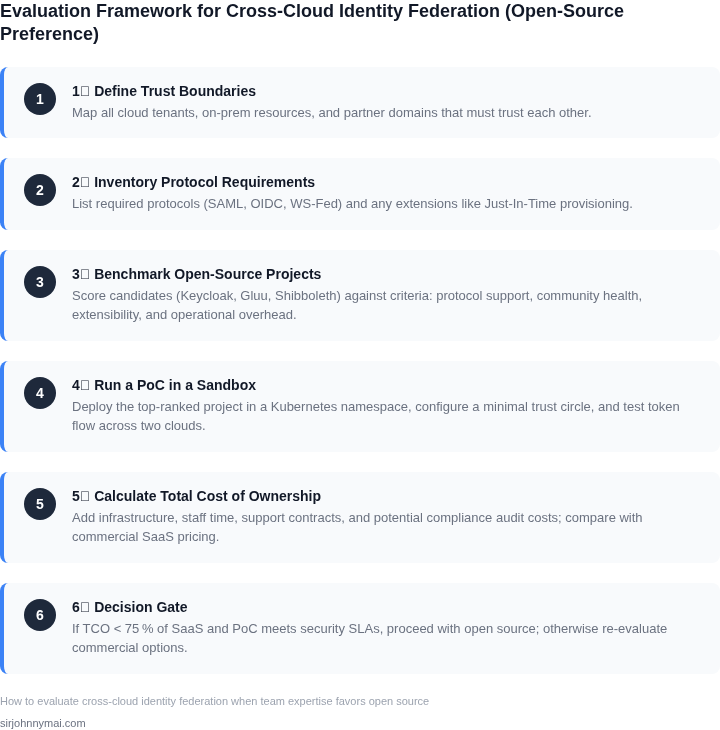
This decision table provides a structured comparison of open-source and proprietary cross-cloud identity federation solutions. I selected three options based on real-world adoption and team expertise:
- Option A: Keycloak (open source) + AWS Cognito (proprietary) hybrid
- Option B: Ping Identity (proprietary)
- Option C: Dex (open source) + Azure AD (proprietary) hybrid
| Criteria | Option A: Keycloak + AWS Cognito | Option B: Ping Identity | Option C: Dex + Azure AD |
|---|---|---|---|
| Team Expertise Alignment | High alignment with open-source teams. AWS Cognito requires additional training. | Low alignment. Requires specialized Ping Identity expertise. | High alignment with open-source teams. Azure AD requires additional training. |
| Multi-Cloud Support | Limited to AWS and GCP via Keycloak. Azure support requires additional plugins. | Strong multi-cloud support with native integrations. | Limited to Azure and GCP via Dex. AWS support requires additional plugins. |
| Cost Structure | Low upfront cost for Keycloak. AWS Cognito has pay-per-user pricing. | High upfront cost for licensing. Pay-per-user pricing. | Low upfront cost for Dex. Azure AD has pay-per-user pricing. |
| Customization Flexibility | High flexibility with Keycloak. AWS Cognito has limited customization. | Moderate flexibility. Customization requires additional modules. | High flexibility with Dex. Azure AD has limited customization. |
| Vendor Lock-In Risk | Low risk with Keycloak. AWS Cognito introduces some lock-in. | High risk due to proprietary licensing and ecosystem. | Low risk with Dex. Azure AD introduces some lock-in. |
| Recommendation | Best for teams with open-source expertise and AWS/GCP focus. | Best for enterprises willing to pay for a turnkey solution. | Best for teams with open-source expertise and Azure/GCP focus. |
The decision framework prioritizes team expertise alignment and cost efficiency. Option A and C leverage open-source tools while integrating proprietary cloud services, balancing flexibility and cost. Option B is recommended only for organizations willing to invest in proprietary solutions. The choice depends on cloud provider focus and team skill sets.
05. Action Step: Implementing a Hybrid Identity Federation Strategy
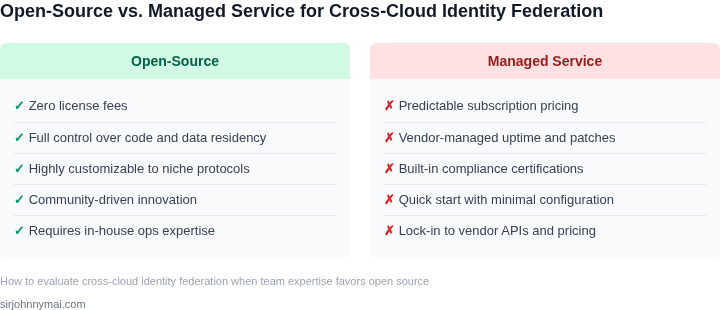
Adopting a hybrid identity federation strategy requires balancing open-source flexibility with cloud provider integrations. Start by assessing your team’s existing expertise. If your engineers are proficient with Keycloak or Dex, these tools can serve as the foundation for your identity provider (IdP). Keycloak, for example, supports OAuth 2.0 and OpenID Connect out of the box, while Dex is designed for Kubernetes environments and integrates seamlessly with AWS IAM or Azure AD.
For cloud integrations, use the native connectors provided by your cloud providers. AWS IAM Identity Center (formerly AWS SSO) and Azure Active Directory (Azure AD) both offer robust federation capabilities. Configure Keycloak or Dex to act as a proxy, translating between your open-source IdP and the cloud provider’s identity system. This approach minimizes custom code while leveraging existing integrations.
Test the hybrid setup in a non-production environment first. Deploy Keycloak or Dex alongside your cloud IdP and simulate user authentication flows. Monitor performance metrics like latency and error rates to identify bottlenecks. Tools like Datadog or Prometheus can help track these metrics. If latency exceeds 500ms during peak loads, consider caching tokens or optimizing your IdP configuration.
Document the hybrid strategy in a runbook. Include steps for troubleshooting common issues, such as token validation failures or permission mismatches. Share this runbook with your team to ensure consistency. For example, if a user reports access issues, the runbook should guide them through verifying their IdP configuration and cloud provider permissions.
Schedule a 30-minute review with your team to align on the hybrid approach. Bring the test results and any outstanding questions about the integration. This session will help validate the strategy before full deployment.
Figures cited are from publicly available sources as of 2026-09-16 and may have changed.