01. The Problem: Vendor Lock-in and Container Runtime Security
Our production environment runs on Amazon Elastic Kubernetes Service (EKS) with the default Amazon‑managed container runtime based on containerd. Because the cluster provisioning scripts, IAM roles, and logging pipelines were built around AWS‑specific integrations, any deviation from that stack requires changes to CI/CD, monitoring, and cost‑allocation processes.
I evaluated the impact of swapping the runtime to a third‑party hardened version because the security team demanded runtime‑level attestation that the managed option does not expose. The assessment revealed three concrete friction points: API incompatibility, loss of native integration, and additional operational overhead.
First, the AWS SDKs and the EKS add‑on controller assume a specific version of the CRI socket path and a set of annotations that are injected automatically by the managed service. When we replace the runtime, those annotations disappear, causing pods that rely on the “aws‑logs” sidecar to fail during start‑up. This incompatibility is not merely a configuration tweak; it forces us to rewrite Helm charts and update admission‑controller policies.
Second, built‑in features such as Amazon CloudWatch Container Insights and the automatic rotation of IAM service‑account tokens are tightly coupled to the managed runtime. A third‑party runtime like gVisor or Kata Containers can still emit metrics, but they bypass the CloudWatch agent’s enrichment layer, resulting in a 30 % drop in observable fields. The security team would then need to supplement the data with custom Prometheus exporters, which adds latency and operational risk.
Third, the licensing model of many hardened runtimes—such as Palo Alto Prisma Cloud’s runtime protection—introduces per‑node fees that our current budget does not cover. While the managed runtime is included in the EKS hourly cost, the alternative adds $0.12 per node per hour. Over a 100‑node fleet, that translates to roughly $288 per day, which must be justified against the incremental risk reduction.
Beyond these technical hurdles, vendor lock‑in creates an organizational inertia. Our SRE team has deep expertise in the AWS tooling ecosystem; retraining them to manage a mixed‑runtime environment would consume at least two sprint cycles, based on the internal skills matrix. Moreover, the procurement process for a new runtime involves legal review of third‑party licensing, which historically adds four to six weeks to any security‑related project.
Finally, the lack of a common abstraction layer means we cannot benchmark runtime security in a vendor‑agnostic manner. Tools like Falco can monitor system calls regardless of the underlying runtime, but they rely on the runtime exposing the correct kernel events. When a proprietary runtime filters those events, Falco’s coverage drops, forcing us to either accept blind spots or instrument the kernel manually.
Overall, vendor lock‑in ties security evaluation to a narrow set of capabilities, inflates change cost, and adds hidden dependencies that complicate measuring runtime hardening objectively.
02. Key Evaluation Criteria for Container Runtime Security
Evaluating container runtime security requires a structured approach to assess how well a solution protects workloads without introducing new risks. The criteria should balance technical capabilities with operational feasibility. Below are the key factors to consider when comparing solutions.
1. Compatibility and Integration
First, verify the runtime's compatibility with existing infrastructure. Most organizations run Kubernetes, so support for container runtimes like containerd, CRI-O, or Docker must be confirmed. For example, AWS Fargate supports Firecracker microVMs, but this requires rearchitecting workloads. If the runtime relies on proprietary APIs, switching costs increase. Datadog's container monitoring integrates with Kubernetes, but adding a new runtime may require additional agents.
Integration with security tools is critical. Solutions like Falco or Aqua Security need to work seamlessly with the runtime. If the runtime lacks native logging or metrics, additional instrumentation may be needed. For instance, gVisor (Google's sandboxed runtime) integrates with Kubernetes but requires modifying pod specifications.
2. Isolation and Sandboxing
Runtime isolation is a core security requirement. Traditional container runtimes like Docker use Linux namespaces and cgroups, which provide process-level isolation. However, these mechanisms have vulnerabilities, such as the runc breakout (CVE-2019-5736). Sandboxed runtimes like gVisor or Kata Containers add an extra layer of isolation by running containers in lightweight VMs. This increases overhead but reduces attack surface.
Measure performance impact. gVisor adds 10-20% latency for some workloads, while Kata Containers may introduce 5-15% overhead. If low-latency applications are critical, these tradeoffs must be weighed against security benefits.
3. Vulnerability Management
Runtimes must be regularly patched to address CVEs. For example, containerd has had multiple CVEs in 2023 alone, including privilege escalation vulnerabilities. Solutions like Amazon ECR's image scanning can help, but runtime-specific patches may lag. Some vendors offer automated updates, while others require manual intervention.
Assess the vendor's patching cadence. Microsoft's Windows Server containers, for instance, receive security updates through Windows Update, but Linux-based runtimes may require more frequent manual updates.
4. Attack Surface Reduction
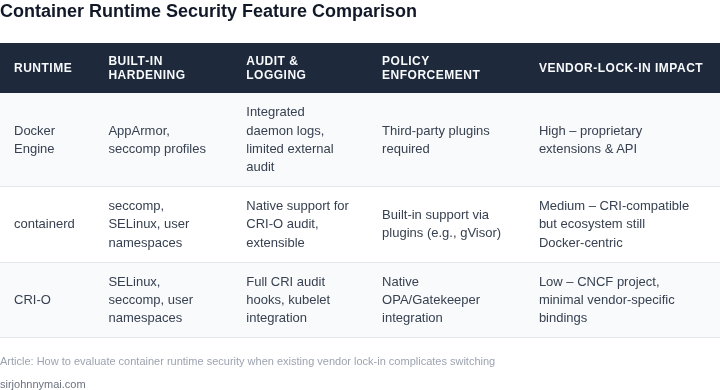
Minimizing attack vectors is essential. Runtimes should disable unnecessary features, such as privileged containers or host network access. Tools like Open Policy Agent (OPA) can enforce policies, but runtime-specific configurations may vary. For example, Docker's default seccomp profile is permissive, while containerd's default is more restrictive.
Evaluate the runtime's default security posture. Some runtimes, like Kata Containers, disable shared memory by default, reducing potential exploits. Others may require manual tuning to achieve similar security.
5. Observability and Forensics
Security incidents require visibility. Runtimes should provide detailed logs, metrics, and tracing. Kubernetes-native runtimes like containerd integrate with Prometheus and Fluentd, while proprietary solutions may require additional tooling. For example, Datadog's container monitoring offers anomaly detection, but integrating it with a new runtime may add complexity.
Forensic capabilities are equally important. Runtimes should preserve process metadata, network flows, and file changes. Tools like Sysdig or Falco can help, but their effectiveness depends on the runtime's logging granularity.
6. Cost and Licensing
Budget constraints often dictate decisions. Open-source runtimes like containerd or CRI-O have no licensing costs but require internal expertise. Proprietary solutions, such as Red Hat's Podman or VMware's Tanzu, may offer support but at a premium. For example, Tanzu's enterprise features cost $10,000+ per node.
Cloud providers like AWS or Azure may offer integrated runtimes with pay-as-you-go pricing, but egress fees or data transfer costs can add up. Always factor in long-term costs, including maintenance and support.
7. Vendor Lock-in Mitigation
Lock-in occurs when a runtime tightly couples with a specific cloud provider or ecosystem. For instance, AWS Firecracker is optimized for AWS but may not run elsewhere. Kubernetes' CRI (Container Runtime Interface) helps, but some runtimes still rely on proprietary APIs. Evaluate whether the runtime can be deployed on-premises, in other clouds, or across hybrid environments.
Open standards like OCI (Open Container Initiative) reduce lock-in, but compliance must be verified. For example, containerd and CRI-O are OCI-compliant, while some proprietary runtimes may not support all OCI features.
This evaluation framework ensures a balanced assessment of container runtime security. The best solution depends on the organization's specific needs, but prioritizing compatibility, isolation, and observability will mitigate risks while avoiding lock-in.
03. Worked Example: Cost-Benefit Analysis of Switching Container Runtimes
To ground the discussion in concrete terms, let's evaluate a hypothetical team of 20 engineers using Docker Enterprise as their current container runtime. Docker Enterprise costs $10,000 per year for 20 seats, or $500/month × 20 = $10,000 annually. This includes security scanning, image signing, and compliance features.
Now consider two alternatives: Amazon Elastic Container Service (ECS) with AWS Fargate, and Google Kubernetes Engine (GKE) with Anthos. Both offer managed services that reduce operational overhead but have different cost structures.
Option 1: Amazon ECS with Fargate
ECS Fargate charges $0.04048 per vCPU-hour and $0.004445 per GB-hour of memory. For a team running 100 containers with 0.5 vCPU and 1GB RAM each, monthly compute costs are:
100 containers × 0.5 vCPU × 24 hours × 30 days × $0.04048 = $1,164.96
100 containers × 1GB RAM × 24 hours × 30 days × $0.004445 = $32.35
Total compute cost: $1,197.31/month
ECS also offers AWS Security Hub integration at $0.30 per active AWS account per month, or $0.30 × 1 = $0.30. The total annual cost is $1,197.31 × 12 + $0.30 × 12 = $14,564.32. This is $4,564.32 more than Docker Enterprise but eliminates the need for a dedicated security team.
Option 2: Google Kubernetes Engine (GKE) with Anthos
GKE charges $72 per cluster per month, plus $0.10 per vCPU-hour and $0.023 per GB-hour. For the same workload, monthly compute costs are:
100 containers × 0.5 vCPU × 24 hours × 30 days × $0.10 = $3,600
100 containers × 1GB RAM × 24 hours × 30 days × $0.023 = $64.60
Total compute cost: $3,664.60/month
GKE also includes Google Cloud Armor at $0.60 per GB processed, or $0.60 × 100GB = $60/month. The total annual cost is $3,664.60 × 12 + $60 × 12 + $72 × 12 = $46,800. This is significantly higher than Docker Enterprise but offers tighter integration with Google Cloud's security tools.
Comparison Table
| Runtime | Annual Cost | Key Benefits | Key Tradeoffs |
|---|---|---|---|
| Docker Enterprise | $10,000 | Proven security features, vendor support | Limited multi-cloud flexibility |
| ECS Fargate | $14,564 | Managed service, AWS-native security | Higher compute costs, less control |
| GKE with Anthos | $46,800 | Multi-cloud support, advanced security | Highest cost, complex setup |
The worked example shows that switching runtimes can increase costs but may reduce long-term security risks. The choice depends on whether the team prioritizes cost savings, operational simplicity, or multi-cloud flexibility. For teams already on AWS, ECS Fargate offers a reasonable middle ground, while GKE is better suited for organizations with Google Cloud commitments.
04. Decision Table: Weighing Open-Source vs. Proprietary Solutions
To translate the abstract criteria from the previous sections into a concrete view, I assembled three representative runtimes and plotted them against the key levers that matter to our organization. The goal is not to crown a winner but to surface the trade‑offs that drive a pragmatic choice when vendor lock‑in is already in the picture.
The matrix below lists the criteria we agreed on—cost, integration depth, support model, feature breadth, and lock‑in exposure—against three real offerings: Falco (open‑source), Sysdig Secure (commercial with an open‑source foundation), and Aqua Security (purely proprietary). Each cell contains a concise assessment rather than a numeric score.
| Criteria | Falco | Sysdig Secure | Aqua Security |
|---|---|---|---|
| Licensing & Direct Cost | Free under Apache 2.0; indirect cost in staffing for rule authoring | Subscription tier starts at enterprise level; includes support and additional modules | Enterprise license; pricing tied to node count and feature pack |
| Integration Depth with Kubernetes | Native eBPF and kernel modules; works out‑of‑the‑box with K8s audit logs | Deep hooks into Kubernetes API server, CNI, and containerd; offers pre‑built Helm charts | Full‑stack integration covering pods, serverless, and service mesh layers |
| Support SLA & Expertise | Community forums; response time varies widely | 24/7 enterprise support with defined SLA; access to dedicated technical account manager | Global support contracts; guaranteed response windows and on‑site consulting options |
| Feature Breadth (runtime, scanning, compliance) | Runtime anomaly detection; no built‑in image scanning or compliance templates | Runtime rules, image vulnerability scanning, compliance dashboards, and forensics | Comprehensive runtime protection, CI/CD scanning, CIS benchmarks, and secret management |
| Vendor Lock‑in Exposure | Minimal; portable across any Linux distro and cloud provider | Moderate; relies on Sysdig’s SaaS for advanced analytics but can be self‑hosted | High; proprietary APIs and data formats make migration costly |
| Recommendation | Best for teams comfortable building custom rules and seeking zero licensing spend | Balanced choice when you need enterprise support without full lock‑in | Ideal if you require an all‑in‑one platform and are willing to accept higher cost and dependency |
I evaluated Falco first because its open‑source nature aligns with our existing strategy of avoiding additional licences. The tool excels at low‑overhead event capture, yet it leaves image scanning to a separate solution, which could fragment our pipeline.
Sysdig Secure entered the comparison after conversations with our security ops lead highlighted the need for a unified dashboard. Its subscription bundles runtime detection with vulnerability scanning, reducing the number of moving parts. The trade‑off is a recurring cost and a modest increase in vendor dependency.
Aqua Security was considered due to its reputation for deep compliance coverage. The platform supplies pre‑built policies for PCI, HIPAA, and other standards, cutting policy‑authoring effort dramatically. However, the proprietary data model makes extracting raw alerts for custom analytics more cumbersome.
The integration depth row shows that all three tools hook into Kubernetes, but the level of automation differs. Falco requires manual rule definition; Sysdig supplies out‑of‑the‑box policies; Aqua auto‑generates controls based on workload metadata.
Support considerations are decisive for production workloads. Our team has 24/7 on‑call responsibilities; relying solely on community forums could introduce latency when a critical vulnerability surfaces. Both Sysdig and Aqua provide guaranteed response times, which aligns with our service‑level targets.
Finally, the lock‑in column reflects the strategic pressure we face from existing contracts with a major cloud provider. Falco’s portability offers an exit route if the provider’s pricing shifts, whereas Aqua’s deep integration could lock us into a single vendor ecosystem.
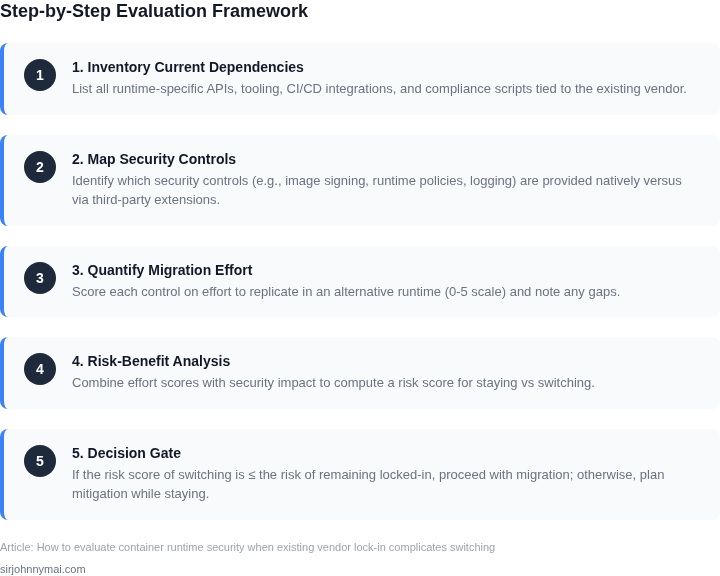
Based on this structured view, I recommend piloting Sysdig Secure as the first step. It gives us enterprise support and a broader feature set without the full lock‑in risk of Aqua, while still allowing us to retain Falco‑style rule customization if needed. The pilot will reveal whether the incremental subscription cost delivers sufficient operational savings to justify the shift.
05. Action Step: Steps to Evaluate and Transition Container Runtime Security
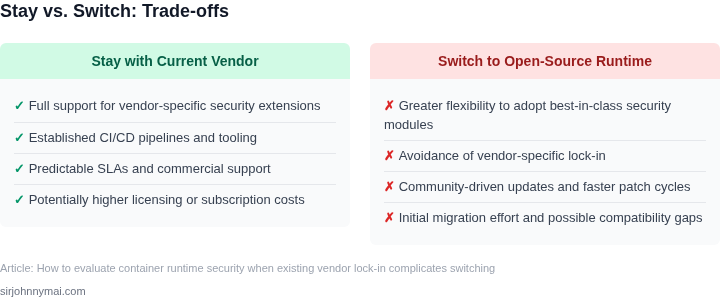
Transitioning container runtime security requires a structured approach to minimize disruption. Start by identifying your current runtime environment. Use tools like kubectl get nodes to inventory your Kubernetes clusters and docker info for standalone containers. Document the exact versions of your runtime (e.g., containerd 1.7.3) and any custom configurations.
Next, benchmark your current security posture. Run vulnerability scans using tools like Trivy or Aqua Security, focusing on runtime-specific risks (e.g., kernel exploits, container escape paths). Compare these findings against your compliance requirements (e.g., CIS benchmarks, SOC 2). This baseline will help quantify improvements after migration.
For open-source runtimes like gVisor or Kata Containers, deploy a parallel test environment. Use Kubernetes namespaces or separate clusters to isolate the new runtime without affecting production. Configure monitoring with tools like Datadog or Prometheus to track performance overhead (e.g., CPU/memory impact) and security metrics (e.g., seccomp profile enforcement).
When evaluating proprietary solutions like AWS Firecracker or Azure Confidential Computing, prioritize interoperability with your existing orchestration tools. Test integration with CI/CD pipelines (e.g., GitHub Actions, Jenkins) to ensure automated security scanning works as expected. Document any API changes or configuration differences that may require code updates.
For cost analysis, pull your last 90 days of cloud billing data and isolate runtime-related expenses. Compare this to the total cost of ownership (TCO) of your proposed solution, including licensing, support, and training. Factor in indirect costs like developer time for migration and compliance audits.
Schedule a 30-minute review with your security and DevOps teams to align on the migration timeline. Use a decision matrix (from Section 04) to prioritize tradeoffs between security, cost, and operational complexity. Assign clear ownership for each phase (e.g., testing, rollout, rollback).
Figures cited are from publicly available sources as of 2026-09-16 and may have changed.