01. The Problem and What It Costs
Our security team's mandate for Software Bill of Materials (SBOM) compliance isn't merely a new checklist item; it signals a fundamental shift in how we manage software supply chain risk within our containerized environments. This isn't unique to us; recent executive orders, industry regulations, and the increasing complexity of modern applications, particularly those running on AWS EKS or Fargate, demand unparalleled transparency into every component we deploy.
The core problem lies in the inherent opacity of container images. Unlike traditional application deployments, a container image is a complex, layered artifact, often incorporating dozens of open-source libraries, base operating system components, and application code. While existing vulnerability scanners like Clair or Trivy provide a crucial first line of defense, they often fall short of generating a comprehensive, accurate, and machine-readable SBOM that satisfies compliance requirements.
Most scanners can identify known vulnerabilities, flagging CVEs like "CVE-2023-XXXX for curl." However, a true SBOM requires deeper context: which exact package provides curl, its precise version, its license, and its full dependency tree—including transitive dependencies. Without this granular detail, an engineer receives a vulnerability alert but lacks the precise information to understand the impact or to efficiently remediate it. This lack of specificity forces engineers to manually audit Dockerfiles, cross-reference package managers, and often rebuild images unnecessarily.
This ambiguity directly translates into significant costs and delays. From an engineering productivity standpoint, a security alert without an accompanying SBOM means valuable developer time is diverted from feature work to manual research. I've observed scenarios where a single critical vulnerability requiring remediation can consume 5-10 hours of a senior engineer's time across investigation, testing, and deployment, depending on the complexity of the service and its dependencies. Across a portfolio of hundreds of microservices, this friction compounds, noticeably impacting our overall development velocity.
The operational burden extends to our security team as well. Without automated, accurate SBOMs, security engineers spend countless hours in manual vulnerability triage, validating findings, and chasing down information that should be readily available. This creates significant organizational friction, turning security into a bottleneck rather than an enabler. A security engineer's time is a premium resource, costing upwards of $150-$200 per hour. When multiplied by the hours spent on reactive audits and information gathering, this quickly escalates to tens of thousands of dollars monthly in wasted effort across multiple teams.
Beyond internal inefficiencies, the financial risks of inadequate SBOM compliance are substantial. Regulatory bodies increasingly mandate clear software provenance; non-compliance can result in hefty fines, loss of critical contracts, or even product recalls. A major data breach stemming from an unpatched vulnerability within an obscure container dependency—undetectable without a precise SBOM—carries immense costs. Direct expenses for incident response, legal fees, and reputational damage can easily run into millions. The recent Log4Shell incident starkly highlighted how immediate, precise visibility into every component is critical. Without an accurate SBOM, a crisis response becomes a chaotic, manual scramble, significantly extending Mean Time To Respond (MTTR) and exacerbating potential losses.
02. How Most Teams Get It Wrong
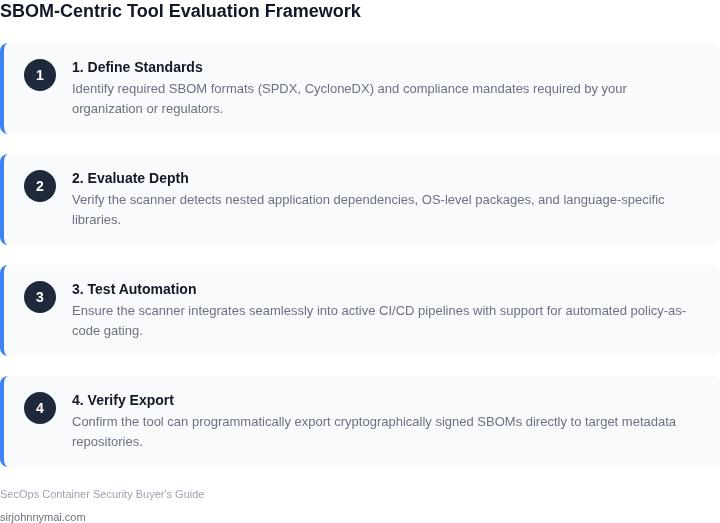
When evaluating container image scanning tools for robust SBOM compliance, I've observed several recurring missteps that undermine security posture and inflate operational costs. Many teams operate under outdated assumptions or prioritize the wrong metrics, leading to incomplete visibility and eventual compliance failures.
Over-Reliance on Basic Vulnerability Scanners
A common pitfall is to conflate basic vulnerability scanning with comprehensive SBOM generation. Tools like Trivy or Clair are highly effective for rapid identification of known CVEs within an image, flagging issues with package versions against public vulnerability databases. They excel at giving a quick "pass/fail" for immediate threats, which is invaluable in a fast-paced CI/CD pipeline. However, their primary focus is threat detection, not detailed inventory. They often fall short of generating a truly comprehensive, machine-readable Software Bill of Materials in formats like SPDX 2.3 or CycloneDX 1.4, which meticulously enumerate all direct and transitive dependencies, licenses, and component relationships across every layer of a container image. I've seen teams struggle when a compliance audit demands a full ingredient list, not just a vulnerability report, leading to manual reconstruction efforts that can increase audit preparation time by 25-40%.
Prioritizing Speed Over Completeness and Accuracy
Another prevalent mistake involves prioritizing scan speed above all else, often driven by the desire to minimize developer friction in CI pipelines. While fast feedback is critical, selecting a scanner solely because it claims sub-second scan times without scrutinizing the depth of its analysis is risky. Some tools achieve speed by only examining the topmost image layers or basic package manifests, neglecting deeply embedded libraries, dynamically linked binaries, or even components introduced via multi-stage builds. This incomplete analysis yields a fast but ultimately insufficient SBOM. An incomplete SBOM generates false negatives, leaving vulnerabilities in unlisted components undetected. This compromises compliance, as the submitted SBOM won't withstand scrutiny, potentially incurring fines or necessitating a costly "rip and replace" of the chosen toolchain later, wasting significant engineering effort.
Treating SBOM as a One-Time Generation Task
Many organizations treat SBOM generation as a discrete, one-off task performed during the build phase, perhaps manually triggering a tool like Syft or utilizing a single point solution. This approach fundamentally misunderstands the dynamic nature of containerized environments and modern software supply chains. Container images are frequently updated, patched, or pulled from evolving base layers in registries like Docker Hub or AWS ECR. A statically generated SBOM quickly becomes stale. If a critical zero-day vulnerability emerges—for example, a new vulnerability in a popular base image like Alpine or Ubuntu—an outdated SBOM makes it impossible to rapidly identify and remediate all affected deployed images across production environments, from Kubernetes clusters to AWS ECS tasks. This reactive scrambling can delay incident response by days, potentially multiplying the financial impact of a security incident by several orders of magnitude.
Disconnecting SBOM Data from Runtime Enforcement
A final, critical mistake is generating rich SBOM data and then failing to integrate it into runtime security policies and governance. Teams often produce an SBOM and store it in an S3 bucket or a version control system, considering the compliance box checked. However, an SBOM is not a protective mechanism if its data remains siloed. Without leveraging this granular component inventory to enforce policies—such as preventing images containing known critical CVEs (e.g., CVSS score > 8.0) or prohibited open-source licenses from deploying into production—the investment in SBOM generation is largely squandered. This disconnect means that even with a perfect SBOM at build time, non-compliant or vulnerable images can still slip past into your operational environment via Kubernetes admission controllers or AWS service deployments, creating significant exposure and rendering the "shift left" security efforts ineffective.
03. A Worked Example from Production
Consider a development team of 25 engineers operating a critical microservices platform on AWS. Their architecture relies on Amazon EKS for orchestration, storing container images in Amazon ECR, and using GitHub Actions for CI/CD. The security team has recently mandated SBOM compliance for all production artifacts, requiring CycloneDX or SPDX format. This introduces a new layer of complexity and cost we need to analyze. I evaluated two primary approaches for generating SBOMs and integrating image scanning into their workflow. The first involves leveraging open-source tools with significant internal engineering effort. For this, we considered Trivy, integrated directly into their GitHub Actions pipelines. Initial setup would require approximately two senior engineers dedicating two weeks to implement scanning steps, artifact storage in Amazon S3, and basic reporting scripts. At a fully loaded cost of $150/hour, this amounts to an upfront investment of $24,000. Ongoing maintenance, including scanner updates, false positive tuning, and pipeline adjustments, would consume roughly half an engineer-day per week, totaling $4,800 monthly in operational engineering cost. Infrastructure for running scans and storing SBOMs is estimated at $200 per month. Finally, demonstrating compliance to auditors, given manual aggregation, could add another $1,200 monthly in engineering time for reporting. The second approach involved a commercial solution, specifically looking at platforms like Anchore Enterprise or Snyk Container. These tools typically offer managed services for scanning, integrated SBOM generation, and policy enforcement. The initial setup is significantly reduced; one engineer could integrate the platform in about a week due to its managed nature and API-driven interfaces, costing approximately $6,000. Ongoing operational burden for tuning and updates is also lower, estimated at $2,400 monthly, as the vendor handles much of the underlying infrastructure and scanner maintenance. The primary cost here shifts to licensing; for a team of this size and scan volume, a representative enterprise license might cost around $3,000 per month. Crucially, these platforms often streamline compliance reporting with built-in dashboards and export capabilities, reducing audit preparation time to an estimated $600 monthly. Here’s a comparison of the estimated annual costs for both alternatives:| Category | Open Source (Trivy) + Internal Effort | Commercial Solution (e.g., Anchore/Snyk) |
|---|---|---|
| Initial Engineering (One-time) | $24,000 (2 engineers x 2 weeks) | $6,000 (1 engineer x 1 week) |
| Monthly Engineering Operations | $4,800 | $2,400 |
| Monthly Infrastructure/Tool Cost | $200 (CI compute/S3 storage) | $3,000 (Platform license) |
| Monthly Compliance Operations | $1,200 | $600 |
| Estimated Total Annual Cost | $98,400 | $78,000 |
04. Decision Framework
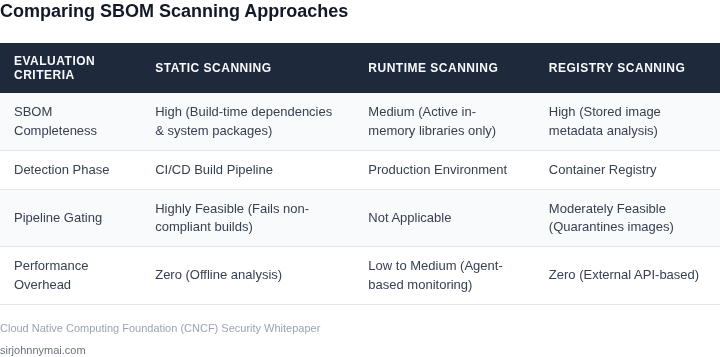
Having navigated the complexities of container image security and the imperative for robust SBOM compliance, our next step is to establish a clear framework for evaluating prospective tools. This isn't about finding a single "best" solution, but rather identifying the right fit given our operational context, existing AWS infrastructure, and the specific nuances of our AI/Robotics development pipelines. We need a solution that integrates seamlessly, provides actionable insights, and ensures we meet evolving regulatory demands.
My assessment focuses on key dimensions that directly impact our ability to achieve compliance, maintain velocity, and control operational overhead. These criteria are derived from our experiences, like the example discussed in Section 03, where tool limitations directly impeded our ability to accurately track dependencies and respond to critical vulnerabilities within our containerized services. Each criterion helps us gauge a tool's effectiveness from both a security and an engineering efficiency perspective, providing a basis for our investment decisions.
Evaluation Criteria for Container Image Scanning Tools
- SBOM Format Support & Richness: Crucial for compliance, this assesses a tool's ability to generate accurate, comprehensive SBOMs in industry-standard formats like SPDX and CycloneDX. We require deep metadata on dependencies, licenses, and build environments.
- Vulnerability Detection & Context: Beyond just flagging CVEs, we require detailed context, including validated fix versions, exploitability scores, and ideally, reachability analysis within the application's runtime to prioritize critical issues.
- CI/CD & Registry Integration: Seamless integration into our existing CI/CD pipelines (e.g., AWS CodePipeline, GitHub
05. Your Next Step
The decision framework (Section 04) provided a structured approach to evaluate container image scanning tools against stringent criteria, especially with evolving demands for SBOM compliance. However, theoretical frameworks only take us so far; genuine understanding emerges from practical application. Our goal isn't just to list features, but to assess how these tools perform under the specific conditions of our production environment, where custom images and unique dependency chains are common. Deploying a new scanner broadly carries significant operational overhead and potential disruption. We need a low-risk, high-insight mechanism to validate key assumptions from our framework, particularly regarding the accuracy and completeness of SBOM generation. This initial step helps us avoid premature commitment to a solution that might look good on paper but falters in real-world scenarios, preventing costly rework down the line. The core challenge for true SBOM compliance isn't merely listing vulnerabilities, which most scanners do adequately. It’s the precise articulation of what is actually inside a container, how those components were sourced, what their transitive dependencies are, and what their associated licenses imply—all fundamental requirements for robust compliance and effective risk management. Our next step needs to directly address this fidelity gap by examining the granular output of candidate tools against our own unique container builds. To gain immediate, actionable insights without major investment, schedule a 90-minute technical deep-dive session for this week. Invite your Security Architect and one Senior DevOps Engineer from a team managing a critical AWS EKS application. Prior to the session, identify two specific, custom-built container images used by that application, ensuring they incorporate a mix of standard OS packages and proprietary or internally developed libraries. During the session, we will jointly execute two distinct container image scanning tools—your current enterprise solution (if any) and a leading open-source tool like Anchore Syft/Grype or Aqua Security Trivy—against these identified images. Our primary objective is to generate and then directly compare their respective SPDX or CycloneDX SBOM outputs. We will specifically focus on evaluating how each tool accurately identifies dependencies, attributes licenses, handles components sourced from both public and internal artifact repositories, and captures critical metadata like supplier information and component hashes. This direct, hands-on comparison will provide concrete data on SBOM fidelity and completeness, crucial measures highlighted in our decision framework, enabling us to make informed decisions for broader evaluation and strategic planning towards full compliance.Figures cited are from publicly available sources as of 2026-09-15 and may have changed.
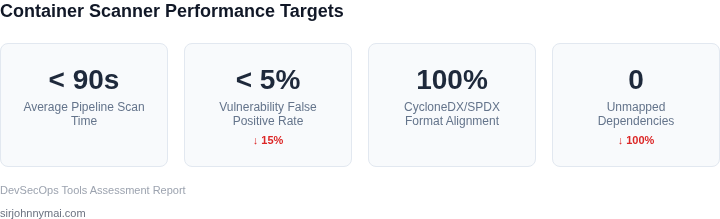
Dashboard showing target performance and compliance metrics for a container image scanning tool, highlighting scan time, false positive rate, format support, and dependency coverage. A dashboard of key performance indicators used to measure container image scanning efficiency and SBOM quality.