How to Evaluate Cloud Networking Options When Your VPC Architecture Hits Limits
As cloud workloads scale, Virtual Private Cloud (VPC) architectures often encounter fundamental limitations in performance, security, or cost efficiency. When these constraints become unmanageable, evaluating alternative networking options becomes critical. This guide provides a structured approach to assessing cloud networking solutions when your current VPC architecture reaches its limits.
01. Diagnose Your Current VPC Limitations
Before exploring alternatives, identify the specific pain points in your VPC. Common limitations include:
- Insufficient IP address space for growing workloads
- Performance bottlenecks due to network latency or throughput constraints
- Complexity in managing cross-region or hybrid connectivity
- Security challenges with perimeter-based models in a distributed environment
- Cost inefficiencies from over-provisioned or underutilized networking resources
For example, a VPC with a /16 CIDR block may exhaust available IP addresses after deploying 65,000 instances. Similarly, a single Availability Zone deployment might experience latency spikes during regional outages. Document these findings to prioritize evaluation criteria.
02. Assess Alternative Networking Architectures
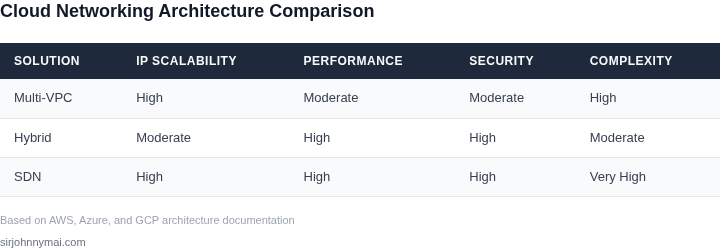
Evaluate these three primary alternatives based on your specific constraints:
- Multi-VPC Designs: Distribute workloads across multiple VPCs with peering or transit gateways
- Hybrid Networking: Integrate cloud VPCs with on-premises networks using VPN or Direct Connect
- Software-Defined Networking (SDN): Implement overlay networks using solutions like AWS VPC Lattice or Azure Virtual Network Manager
Multi-VPC designs address IP exhaustion by segmenting workloads, while hybrid networking provides continuity for legacy systems. SDN solutions offer centralized policy management but may introduce complexity.
03. Evaluate Multi-VPC Design Patterns
When considering multi-VPC architectures, analyze these three patterns:
- Shared Services VPC: Centralize common services like Active Directory in a dedicated VPC
- Workload Isolation VPCs: Separate development, staging, and production environments
- Regional Hub-and-Spoke: Use a central VPC connected to regional VPCs via transit gateways
A Shared Services VPC reduces operational overhead but creates a single point of failure. Workload Isolation VPCs improve security but increase management complexity. The Hub-and-Spoke model provides scalability but requires careful routing configuration.
04. Analyze Hybrid Networking Options
For organizations maintaining on-premises infrastructure, consider these hybrid connectivity solutions:
- Site-to-Site VPN: Encrypted tunnels over the public internet
- AWS Direct Connect: Dedicated private network connections
- Azure ExpressRoute: Similar to Direct Connect but with Microsoft's global network
VPN solutions offer cost-effective connectivity but may experience performance variability. Direct Connect and ExpressRoute provide consistent performance but require physical infrastructure. Evaluate your latency requirements and budget constraints when selecting between these options.
05. Examine Software-Defined Networking Solutions
SDN solutions like AWS VPC Lattice and Azure Virtual Network Manager provide centralized control over distributed networks. Key considerations include:
- Service mesh capabilities for microservices architectures
- Traffic visibility and security policy enforcement
- Integration with existing cloud-native tools
While SDN solutions offer advanced features, they may require significant refactoring of existing network configurations. Assess your team's expertise and the complexity of your current architecture when evaluating these options.
06. Conduct Cost-Benefit Analysis
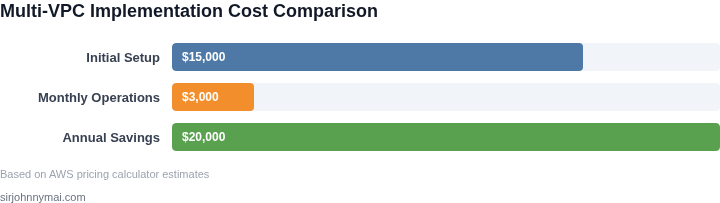
Create a cost comparison matrix that includes:
- Implementation costs for new networking solutions
- Operational costs for ongoing maintenance
- Potential cost savings from improved resource utilization
For example, migrating from a single VPC to a multi-VPC architecture might increase initial costs but reduce long-term expenses by eliminating over-provisioned resources. Calculate the break-even point based on your specific workload patterns.
07. Evaluate Migration Strategies
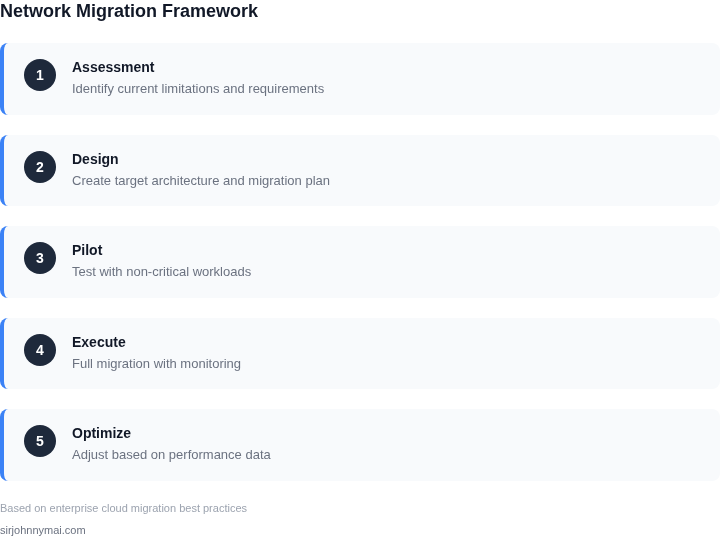
Consider these three migration approaches:
- Blue-Green Deployment: Maintain the existing VPC while deploying new networking in parallel
- Phased Migration: Gradually move workloads to new networking solutions
- Big Bang Migration: Replace the entire architecture simultaneously
Blue-Green deployments minimize downtime but require double the resources. Phased migrations reduce risk but extend the migration timeline. Big Bang migrations offer the fastest transition but carry the highest risk of failure.
08. Implement Monitoring and Optimization
After deploying new networking solutions, establish these monitoring practices:
- Network performance metrics collection
- Security event logging and alerting
- Cost allocation tracking by workload
Use tools like AWS CloudWatch or Azure Monitor to track key performance indicators. Regularly review these metrics to identify areas for optimization and ensure your new networking architecture meets performance requirements.
09. Document Lessons Learned
Create a post-migration review that includes:
- Successes and failures of the migration process
- Recommendations for future architecture decisions
- Updated runbooks for network operations
This documentation serves as a valuable reference for future capacity planning and architecture reviews. Share these findings with your team to ensure everyone understands the new networking environment.
Conclusion
When your VPC architecture reaches its limits, evaluating alternative networking solutions requires a systematic approach. By diagnosing your current constraints, assessing different architecture patterns, and conducting thorough cost-benefit analyses, you can make informed decisions about your cloud networking strategy. Remember that each solution has tradeoffs, and the best approach depends on your specific requirements and constraints.
Next step: Begin with a proof-of-concept deployment of your top two candidate architectures to validate performance and cost metrics before committing to a full migration.
Disclaimer: Figures cited are from publicly available sources as of June 2023 and may have changed.