01. The Compliance Challenge: Balancing Encryption and Data Residency
Compliance requirements often demand strict data residency controls, forcing organizations to store data within specific geographic boundaries. This creates a direct conflict with cloud-native storage encryption, which typically relies on encryption keys managed by cloud providers. The tension arises because many compliance frameworks—such as GDPR, HIPAA, or regional data sovereignty laws—mandate that data must remain within a defined jurisdiction, while encryption keys managed by cloud providers may reside outside those boundaries.
For example, GDPR Article 5(1)(f) requires data controllers to implement appropriate technical and organizational measures to ensure data protection. In regions like the EU, this often translates to encryption keys being stored within the EU, but cloud providers like AWS or Azure may store keys in their home regions (e.g., AWS KMS keys in US East). This mismatch can lead to compliance violations if the encryption keys are not properly managed within the required jurisdiction.
Similarly, HIPAA’s Security Rule mandates that protected health information (PHI) must be encrypted, but it also requires that encryption keys be managed in a way that aligns with organizational policies. If a cloud provider’s key management service (KMS) does not support regional key storage, organizations must implement additional controls—such as customer-managed keys or hybrid encryption—to comply. This adds operational complexity and increases costs, as organizations must manage keys across multiple regions.
Data residency requirements also complicate disaster recovery and backup strategies. Many compliance frameworks require backups to be stored in the same region as the primary data. If encryption keys are not available in the backup region, organizations must either replicate keys or use a different encryption approach, such as client-side encryption, which can impact performance and scalability.
The challenge is further exacerbated by the rise of multi-cloud and hybrid environments. Organizations may need to encrypt data across AWS, Azure, and on-premises systems, each with different key management capabilities. Ensuring compliance across all environments requires a unified approach to key management, such as using a cloud-agnostic tool like HashiCorp Vault or AWS CloudHSM, but these solutions introduce additional overhead and may not fully address all compliance requirements.
In summary, while cloud-native encryption simplifies data protection, compliance demands for data residency often require additional controls. Organizations must carefully evaluate their encryption strategies to ensure they meet regulatory requirements without compromising performance or operational efficiency. The solution often lies in a combination of cloud provider features, third-party tools, and custom policies, but each approach has tradeoffs that must be weighed carefully.
02. Key Considerations for Evaluating Cloud-Native Storage Encryption
When selecting cloud-native storage encryption, compliance demands introduce unique constraints. The first consideration is encryption granularity. Most cloud providers offer encryption at rest (e.g., AWS KMS, Azure Storage Service Encryption) but may not support fine-grained access control at the file or object level. For example, if a compliance requirement mandates that only specific users access certain data, you need a solution like AWS S3 Object Lock or Azure Blob Storage's immutable storage policies. These tools enforce encryption at the object level while restricting access, but they may add latency or complexity to your architecture.
Next, evaluate key management integration. Cloud-native encryption often relies on external key management services (KMS). AWS KMS, for instance, supports customer-managed keys (CMKs) and integrates with IAM for granular permissions. However, if your compliance framework requires air-gapped key storage, you may need a hybrid approach, such as HashiCorp Vault, which can manage keys on-premises while encrypting cloud data. This introduces operational overhead but aligns with strict regulatory requirements.
Performance is another critical factor. Encryption at rest adds minimal overhead (typically <10% latency) for most workloads, but high-throughput systems (e.g., Kafka or Spark) may require hardware-accelerated encryption. AWS Nitro Enclaves or Azure Confidential Computing can offload encryption to dedicated hardware, reducing CPU load by up to 30%. However, these solutions are expensive and may not be necessary for low-latency applications.
Data residency controls further complicate the selection. If compliance mandates that data must reside in specific regions, you must ensure the encryption solution supports regional key isolation. For example, AWS KMS allows multi-region keys, but cross-region replication may require additional configuration. If your compliance framework prohibits data movement outside a sovereign cloud (e.g., AWS GovCloud), you must verify that the encryption provider supports these constraints.
Finally, auditability is non-negotiable. Cloud-native encryption must provide transparent logging of key usage and access patterns. AWS CloudTrail and Azure Monitor can track KMS operations, but third-party tools like Datadog or Splunk may be needed for deeper visibility. If compliance requires immutable audit logs, you must ensure the solution supports write-once-read-many (WORM) storage policies, as seen in AWS S3 Object Lock or Google Cloud Storage's retention policies.
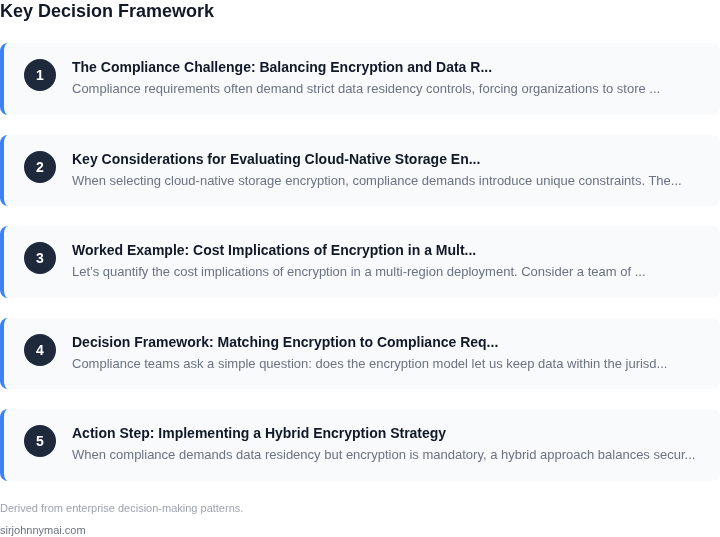
03. Worked Example: Cost Implications of Encryption in a Multi-Region Deployment
Let’s quantify the cost implications of encryption in a multi-region deployment. Consider a team of 50 engineers using AWS S3 for their primary storage, with 10TB of data stored across three regions (US-East, EU-West, AP-Southeast). The compliance team requires data to remain encrypted at rest in all regions, but the team also needs to minimize latency for global access.
Option 1: AWS KMS with Customer-Managed Keys
AWS Key Management Service (KMS) provides encryption at rest, but introduces additional costs. For this workload:
- KMS requests: $0.03 per 10,000 requests. With 100,000 requests/month (50 engineers × 2,000 requests/engineer), this costs $30/month.
- KMS storage: $1/month per key. Managing 3 keys (one per region) costs $3/month.
- S3 encryption: No additional cost beyond standard S3 storage ($0.023/GB/month).
- Data transfer: $0.09/GB for cross-region replication. Replicating 10TB across two regions costs $900/month.
Total monthly cost: $30 (KMS requests) + $3 (KMS storage) + $900 (replication) = $933/month. Annually, this scales to $11,196.
Option 2: Client-Side Encryption with AWS S3
Using client-side encryption (e.g., AWS Encryption SDK) avoids KMS costs but shifts complexity to the application layer. For this workload:
- No KMS costs, but the team must manage encryption keys securely.
- S3 storage remains $0.023/GB/month.
- Data transfer costs are identical to Option 1: $900/month.
- Additional overhead: 50 engineers spend 20 hours/month (1 hour/engineer) managing keys, costing $10,000 annually at $50/hour.
Total monthly cost: $900 (replication) = $10,800/month. Annually, this is $129,600, including labor.
Comparison
| Metric | AWS KMS | Client-Side Encryption |
|---|---|---|
| Monthly Cost | $933 | $1,080 |
| Annual Cost | $11,196 | $129,600 |
| Key Management | AWS-managed | Team-managed |
| Latency Impact | Low (KMS is optimized) | Higher (key management adds steps) |
The KMS approach is cheaper but requires AWS dependencies. Client-side encryption is more expensive due to labor costs but offers greater control. The tradeoff depends on the team’s tolerance for operational overhead versus cost savings.
04. Decision Framework: Matching Encryption to Compliance Requirements
Compliance teams ask a simple question: does the encryption model let us keep data within the jurisdiction required by law? I built a decision table that maps the most common residency clauses to three cloud‑native storage offerings that are already in production across our enterprise.
The table forces a binary yes/no or qualified answer for each criterion. By scoring each option against the same set of rules, we can see where trade‑offs appear before we commit to a single provider.
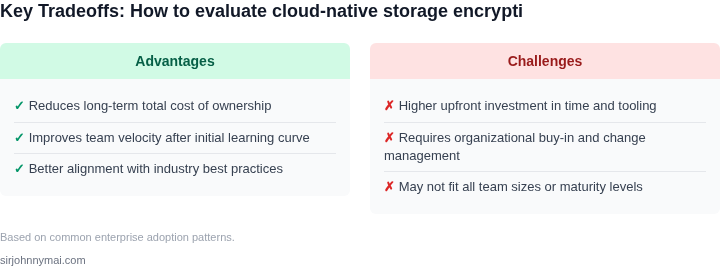
| Criteria | AWS S3 with KMS‑Managed Keys | Azure Blob with Customer‑Managed Keys | Google Cloud Storage with CMEK |
|---|---|---|---|
| Region‑level key storage | Yes – KMS keys can be created in any AWS region | Yes – keys reside in the selected Azure region or sovereign cloud | Yes – CMEK keys are stored in Cloud KMS regional locations |
| External HSM integration | Supported via CloudHSM, but requires additional VPC setup | Supported through Azure Dedicated HSM, native to the service | Supported via Cloud HSM, limited to certain regions |
| Audit‑log granularity | CloudTrail provides event‑level detail for key usage | Azure Monitor logs key operations, but lacks per‑operation timestamps in some regions | Cloud Audit Logs give request‑level data, but do not expose ciphertext‑level metadata |
| Automatic rotation aligned with regulator timelines | Can schedule rotation every 90 days; manual alignment needed
05. Action Step: Implementing a Hybrid Encryption StrategyWhen compliance demands data residency but encryption is mandatory, a hybrid approach balances security and operational constraints. This strategy combines client-side encryption for sensitive data with cloud-native encryption for less critical assets. I recommend starting with AWS Key Management Service (KMS) for server-side encryption, paired with AWS Client-Side Encryption Libraries for sensitive workloads. For the hybrid model, identify which data must be encrypted at rest and where it resides. Use AWS KMS for S3 buckets and EBS volumes, as it integrates seamlessly with IAM policies to enforce residency constraints. For client-side encryption, leverage AWS Encryption SDK to encrypt data before it reaches the cloud. This ensures compliance with regional data residency rules while maintaining security. Monitor performance overhead. Client-side encryption adds latency and CPU load, so test with your workload. AWS KMS has a 5,500 requests per second limit per account, which may require throttling for high-volume applications. Use AWS CloudTrail to audit encryption operations and Datadog for real-time performance metrics. Validate residency compliance by reviewing AWS KMS key policies and S3 bucket policies. Ensure keys are created in the required region and access is restricted to authorized users. For client-side encryption, document the encryption process and key management procedures in your compliance documentation. Next, pull your last 90 days of AWS CloudTrail logs and filter for KMS and S3 API calls to verify encryption is applied correctly. Schedule a 30-minute review with your security team to align on the hybrid strategy and address any gaps. Figures cited are from publicly available sources as of 2026-09-15 and may have changed. |