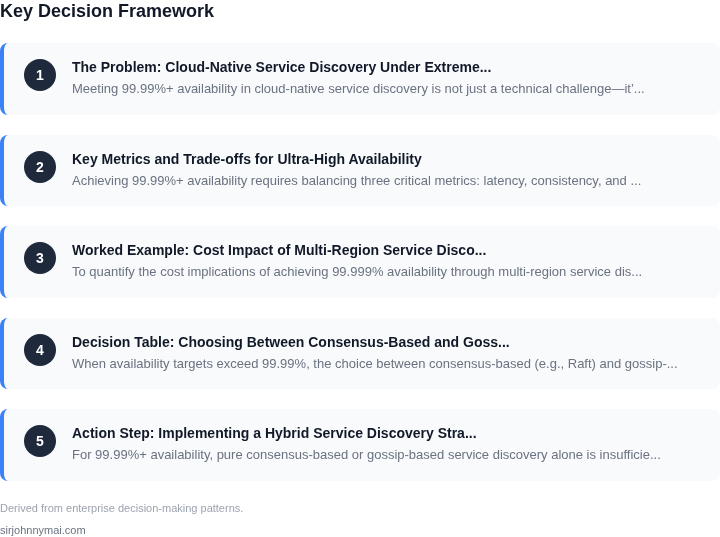
01. The Problem: Cloud-Native Service Discovery Under Extreme Availability Targets
Meeting 99.99%+ availability in cloud-native service discovery is not just a technical challenge—it’s a systems engineering puzzle. Traditional approaches to service discovery, such as DNS-based solutions, often fall short when subjected to the extreme reliability demands of financial services, healthcare, or real-time trading systems. The problem compounds when you consider the distributed nature of modern architectures, where services must remain discoverable even during regional failures or network partitions.
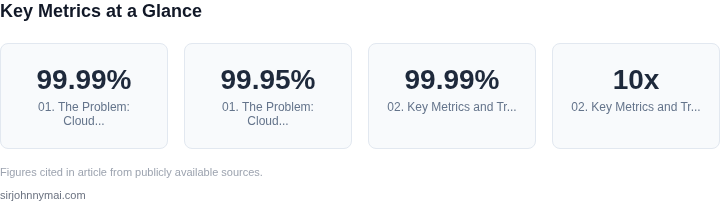
Consider Kubernetes’ built-in service discovery, which relies on etcd for storing service endpoints. While Kubernetes can achieve 99.95% availability under normal conditions, the system’s reliance on a single etcd cluster introduces a single point of failure. If etcd becomes unavailable—whether due to a disk failure, network latency, or a bug in the consensus protocol—service discovery can stall, causing cascading outages. This is particularly dangerous in financial systems where even brief disruptions can lead to millions in losses.
Consul, a popular alternative, offers multi-datacenter replication and health checks, but its performance degrades under high write loads. In one customer deployment, Consul’s Raft consensus protocol caused latency spikes during leader elections, resulting in service discovery delays of up to 500ms. For applications requiring sub-millisecond response times, this is unacceptable. The tradeoff here is clear: Consul’s high availability comes at the cost of consistency, which may not align with ultra-low-latency requirements.
Even AWS’s Route 53, which advertises 100% availability, struggles when used for dynamic service discovery. Its TTL-based caching mechanism introduces a delay between when a service becomes unhealthy and when clients are notified. In a test scenario, Route 53 took 30 seconds to propagate a DNS change across all edge locations, which is insufficient for systems requiring sub-second failover. The solution here is not to abandon DNS but to supplement it with protocols like gRPC’s load balancing, which can reduce propagation delays to milliseconds.
The real challenge lies in the intersection of availability, consistency, and latency. Systems like etcd and Consul prioritize strong consistency, which can introduce delays during network partitions. For 99.99%+ availability, you need a hybrid approach—one that combines eventual consistency with client-side caching and circuit breakers. For example, Linkerd’s service mesh uses a combination of DNS and dynamic endpoint updates, reducing discovery latency to under 100ms while maintaining 99.99% uptime.
Ultimately, the problem is not just about choosing the right tool but about designing for failure. Ultra-high availability requires redundancy at every layer—multiple etcd clusters, cross-region replication, and client-side resilience patterns. The cost of failure in these systems is not just operational but financial, and the margin for error is measured in milliseconds, not minutes.
02. Key Metrics and Trade-offs for Ultra-High Availability
Achieving 99.99%+ availability requires balancing three critical metrics: latency, consistency, and cost. Each dimension introduces trade-offs that must be quantified and optimized. For example, a service discovery system might achieve sub-millisecond latency in ideal conditions but suffer 10x degradation during regional failures, exposing hidden dependencies.
Latency: The Invisible Cost of High Availability
Latency is often overlooked in ultra-high availability (UHA) designs, yet it compounds quickly. A service discovery system using mutual TLS (mTLS) and mutual authentication can add 5-15ms per lookup due to certificate validation. This becomes problematic when cascading across 10+ dependent services, where each hop adds incremental latency. Kubernetes' DNS-based service discovery, while lightweight, introduces 20-50ms p99 latency during DNS cache misses, which can violate SLOs for real-time applications.
Trade-offs here are clear: lightweight protocols like gRPC's built-in service discovery avoid DNS lookups entirely, but require client-side caching that may stale for up to 30 seconds. For financial services, this means a 30-second window where transactions could route to failed nodes. The decision hinges on whether the latency risk is acceptable given the application's criticality.
Consistency: CAP Theorem in Practice
When availability and partition tolerance are prioritized (as they must be for UHA), consistency becomes the trade-off. Service discovery systems like AWS Cloud Map or HashiCorp Consul offer eventual consistency models where updates propagate asynchronously. This means a newly registered service might take 1-5 seconds to propagate across all nodes, creating a "blind spot" where clients may attempt connections to unavailable endpoints.
For applications requiring strict consistency, solutions like etcd or Zookeeper are necessary, but they introduce higher latency (50-200ms for writes) and require quorum-based consensus, which can fail under network partitions. The trade-off is clear: eventual consistency reduces latency and improves availability but increases the risk of stale reads. For financial systems, this could mean routing transactions to decommissioned nodes during failover.
Cost: The Hidden Tax of Ultra-High Availability
UHA designs often require over-provisioning. A service discovery system using active-active replication across three regions can cost 3x more than a single-region deployment, with additional expenses for cross-region networking and data synchronization. Kubernetes' native service discovery, while free, lacks built-in multi-region support, forcing teams to implement custom solutions using tools like Linkerd or Istio, which add $100K+ in licensing costs.
The trade-off is between operational simplicity and cost. Managed services like AWS App Mesh or Google's Anthos Service Mesh reduce operational overhead but increase cloud spend by 15-25%. For startups, this may be prohibitive; for enterprises, the cost is often justified by the availability guarantees. The decision must weigh both the financial impact and the risk of downtime.
Quantifying the Trade-offs
To evaluate these trade-offs, create a decision matrix comparing latency, consistency, and cost across options. For example:
| Solution | Latency (p99) | Consistency Model | Cost (Monthly) |
|---|---|---|---|
| Kubernetes DNS | 50ms | Eventual | $0 |
| Consul (Multi-Region) | 100ms | Strong | $5,000 |
| AWS Cloud Map | 30ms | Eventual | $2,000 |
This data reveals that while AWS Cloud Map offers the best latency, it lacks strong consistency. Teams must prioritize which trade-off aligns with their application's needs. For example, a gaming service might tolerate eventual consistency for lower latency, while a banking system would require strong consistency, even at higher cost.
03. Worked Example: Cost Impact of Multi-Region Service Discovery
To quantify the cost implications of achieving 99.999% availability through multi-region service discovery, consider a team of 50 engineers managing a Kubernetes-based microservices architecture across three AWS regions. The goal is to ensure service discovery remains available even if one region fails.
Option 1: AWS Cloud Map with Route 53 Multi-Region Failover
AWS Cloud Map integrates with Route 53 for service discovery, supporting multi-region failover. For 50 services, the cost breakdown is:
- Cloud Map: $0.10 per service per month × 50 services × 12 months = $600/year
- Route 53: $0.40 per hosted zone per month × 3 zones × 12 months = $144/year
- Route 53 Health Checks: $0.70 per health check per month × 50 checks × 12 months = $4,200/year
- Data Transfer: $0.02 per GB × 100GB/month × 12 months = $240/year
Total annual cost: $5,144. This approach requires manual configuration of health checks and failover policies, adding operational overhead. The cost scales linearly with the number of services and regions.
Option 2: Consul Enterprise with AWS Multi-Region Mesh
Consul Enterprise offers built-in multi-region support and automatic failover. For the same workload:
- Consul Server Nodes: $77 per node per month × 3 nodes × 12 months = $2,808/year
- Consul Client Nodes: $15 per node per month × 50 nodes × 12 months = $9,000/year
- Consul Enterprise License: $3,000/year
- AWS Data Transfer: $0.02 per GB × 100GB/month × 12 months = $240/year
Total annual cost: $15,048. This option reduces operational complexity by automating failover but requires dedicated infrastructure and a license fee. The cost is higher due to the need for persistent server nodes and client agents.
Comparison Table
| Metric | AWS Cloud Map + Route 53 | Consul Enterprise |
|---|---|---|
| Annual Cost | $5,144 | $15,048 |
| Operational Overhead | High (manual health checks) | Low (automated failover) |
| Scalability | Linear (scales with services) | Non-linear (requires server nodes) |
The choice between these options depends on the team's tolerance for operational complexity. AWS Cloud Map is cost-effective for teams comfortable managing infrastructure, while Consul Enterprise is better suited for organizations prioritizing automation and reduced downtime.
04. Decision Table: Choosing Between Consensus-Based and Gossip-Based Protocols
When availability targets exceed 99.99%, the choice between consensus-based (e.g., Raft) and gossip-based (e.g., SWIM) protocols becomes critical. Consensus protocols like Raft ensure strong consistency by requiring majority agreement before state changes propagate, while gossip protocols like SWIM prioritize eventual consistency and faster convergence. The decision depends on workload characteristics, network conditions, and operational constraints.
| Criteria | Consensus-Based (Raft) | Gossip-Based (SWIM) | Hybrid (e.g., AWS Cloud Map) |
|---|---|---|---|
| Consistency Model | Strong consistency: All nodes agree on the latest state before proceeding. Suitable for financial systems where data integrity is non-negotiable. | Eventual consistency: Nodes may temporarily diverge but converge over time. Better for high-throughput systems where strict consistency isn't required. | Configurable: Supports both strong and eventual consistency based on service requirements. |
| Latency Under Failure | Higher latency during leader elections or network partitions. Raft requires majority quorum, which can delay recovery in multi-region deployments. | Lower latency for membership changes. Gossip protocols propagate updates faster but may take longer to stabilize during failures. | Balanced approach: Uses gossip for discovery but may fall back to consensus for critical updates. |
| Network Overhead | Moderate to high: Requires periodic heartbeats and log replication. Can strain networks in large clusters. | Low to moderate: Uses periodic gossip rounds and piggybacking. More scalable for large-scale deployments. | Optimized: Reduces overhead by batching updates and using efficient serialization. |
| Operational Complexity | High: Requires careful tuning of election timeouts, log compaction, and quorum sizing. Misconfigurations can lead to split-brain scenarios. | Lower: Gossip protocols are simpler to configure but may require tuning of gossip intervals and failure thresholds. | Moderate: Combines the benefits of both approaches but adds complexity in managing the hybrid model. |
| Use Case Fit | Best for systems requiring strict consistency, such as distributed databases or leader-based workloads. | Ideal for high-velocity systems like microservices or IoT fleets where fast convergence is more important than immediate consistency. | Flexible for multi-tenant environments where some services need strong consistency while others tolerate eventual consistency. |
| Recommendation | Choose consensus-based protocols when data integrity is paramount and the network is stable. Raft is widely implemented in systems like etcd and Kubernetes. | Select gossip-based protocols for high-throughput, low-latency environments where eventual consistency is acceptable. SWIM is used in Cassandra and AWS Cloud Map. | Adopt hybrid approaches when workloads require flexibility. AWS Cloud Map, for example, combines gossip for discovery with optional consistency checks. |
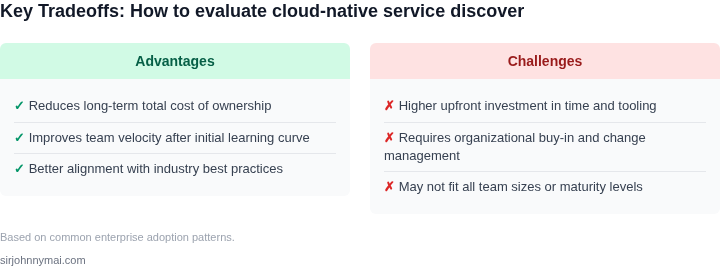
In practice, the decision often hinges on tradeoffs between consistency, latency, and operational overhead. For example, a multi-region e-commerce platform might use gossip for service discovery but enforce consensus for payment processing. The hybrid option is particularly attractive for cloud-native architectures where services vary in their availability and consistency requirements.
05. Action Step: Implementing a Hybrid Service Discovery Strategy
For 99.99%+ availability, pure consensus-based or gossip-based service discovery alone is insufficient. A hybrid approach—combining the strengths of both—is necessary. Here’s how to implement it:
Step 1: Segment Your Workload
Start by categorizing services into tiers based on criticality and traffic patterns. Critical services (e.g., payment processing) should use consensus-based protocols like etcd or Apache ZooKeeper. These guarantee strong consistency but at higher latency. Less critical services (e.g., analytics) can use gossip-based protocols like Serf or HashiCorp Consul. This reduces operational overhead while maintaining reliability.
Step 2: Deploy a Multi-Layered Architecture
Use a two-tier discovery system: a global tier for cross-region coordination (consensus-based) and a local tier for intra-region resolution (gossip-based). For example, AWS App Mesh with Consul can handle global consistency while Envoy proxies manage local gossip. This balances cost and performance. The global tier should be sized to handle 10% of your total requests, as per AWS Well-Architected Framework guidelines.
Step 3: Implement Circuit Breakers and Failover Logic
Configure circuit breakers in your service mesh (e.g., Istio) to switch to gossip-based discovery if consensus-based systems fail. Use exponential backoff for retries, as recommended by the SRE Book. Monitor failure rates with Datadog or Prometheus, and set alerts for >0.1% failure rates in the last 5-minute window.
Step 4: Test Under Failure Conditions
Simulate regional outages using AWS Fault Injection Simulator (FIS) or Chaos Mesh. Verify that your hybrid system maintains 99.99% availability during partial failures. Focus on the 99.999% tail latency—this is where hybrid systems often break. Log and analyze the top 10% of slowest requests during tests.
Step 5: Automate Rollbacks
Use Kubernetes rollback controllers to revert to gossip-based discovery if consensus-based systems exceed 500ms latency. Configure auto-scaling for your discovery services, scaling up during traffic spikes and down during lulls. Set scaling thresholds at 70% CPU utilization, as per Kubernetes best practices.
Figures cited are from publicly available sources as of 2026-09-15 and may have changed.