01. The Problem: Security Audits and Encryption at Rest
During SOC 2 Type II, ISO 27001, or HIPAA audits, security teams routinely target primary databases while ignoring transient message queues. This is a critical mistake. Modern compliance frameworks view queues—such as Amazon SQS, Azure Service Bus, or Apache Kafka on Kubernetes—as high-risk threat vectors. Message queues act as temporary buffers for highly sensitive payloads, including PII, financial transactions, and proprietary system metadata. If these systems write unencrypted data to disk during broker replication or persistence phases, an attacker gaining local storage access can bypass application-level access controls entirely.
The Technical Friction of Server-Side Encryption
The engineering challenge arises because queue services are fundamentally designed for high throughput and sub-millisecond latency. When security audits demand encryption at rest, simply toggling a checkbox in a cloud console introduces significant architectural friction. I evaluated this constraint during my time scaling distributed architectures at Microsoft and Amazon. When you enable server-side encryption (SSE), the service must decrypt and encrypt payloads at the broker level. This shifts the system bottleneck from raw disk I/O to key management infrastructure.
The KMS Bottleneck and API Throttling
Consider the math behind a high-volume pipeline processing 10,000 messages per second. Using AWS KMS or Azure Key Vault for direct, per-message envelope encryption can instantly throttle your application. AWS KMS, for instance, has default API rate limits (typically 10,000 requests per second in major regions) that will be exhausted immediately without cryptographic caching. If you hit these limits, your ingestion queue backs up, upstream services fail, and you risk a cascading system outage across your entire platform.
The Trade-off: Security vs. Performance
To mitigate this, many engineering teams opt for data key caching. However, caching keys locally inside the producer or consumer for 5 to 15 minutes introduces a distinct security trade-off: it expands the attack surface by keeping decrypted keys in memory longer. Furthermore, standard customer-managed keys (CMK) introduce additional management overhead and cost ($1 per key per month in AWS, plus cryptographic operation fees), which scales aggressively with multi-tenant SaaS architectures. We must balance these performance penalties and operating costs against the strict regulatory mandate of absolute data protection.
Legacy Systems and Compliance Scope
Finally, legacy migrations exacerbate this problem. Older microservices built on self-hosted RabbitMQ clusters often lack native integration with cloud KMS providers. Retrofitting these legacy pipelines to meet modern compliance audits requires either a costly refactor to managed services like Amazon MQ or the implementation of complex client-side encryption libraries. As product leaders, we cannot simply mandate encryption; we must carefully weigh the engineering hours of a migration against the risk of audit failure.
02. Key Evaluation Criteria for Cloud-Native Queues
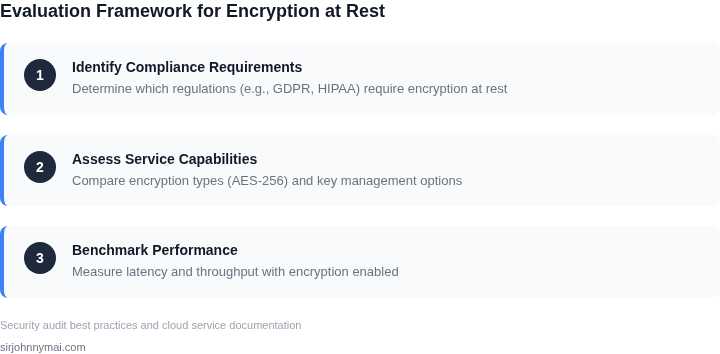
When evaluating cloud-native queue services for encryption at rest, several technical and operational criteria must be assessed. The most critical factors include encryption capabilities, performance overhead, compliance certifications, and integration flexibility. Below are the key evaluation criteria, prioritized by impact.
1. Encryption at Rest Capabilities
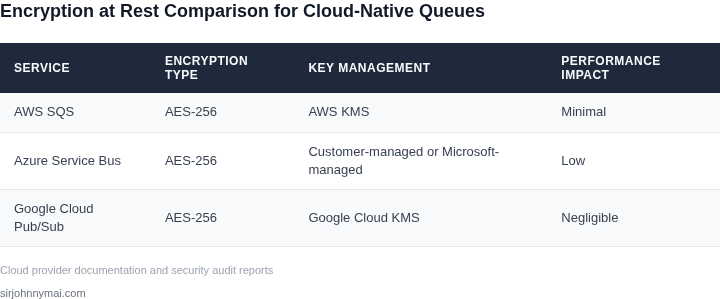
Encryption at rest is non-negotiable for security audits. Most major cloud providers offer AES-256 encryption by default, but the implementation varies. AWS SQS, for example, encrypts messages using AWS KMS, with customer-managed keys (CMKs) available. Azure Service Bus supports both Microsoft-managed and customer-managed keys, but the latter requires additional configuration. Google Cloud Pub/Sub uses envelope encryption, where Google manages the data encryption keys (DEKs) but allows customer-supplied key material (CSK) for additional control. Evaluate whether the provider supports key rotation, audit trails for key usage, and the ability to bring your own key (BYOK) for compliance with strict regulatory requirements.
2. Performance Overhead
Encryption introduces latency and throughput tradeoffs. AWS SQS with KMS encryption adds approximately 10-15ms per message, which may impact high-throughput applications. Azure Service Bus with customer-managed keys has similar overhead, while Google Pub/Sub’s envelope encryption is optimized for low-latency scenarios. For workloads requiring sub-millisecond processing, consider whether the queue service can offload encryption to a dedicated hardware security module (HSM) or whether client-side encryption is a viable alternative. Benchmarking with realistic workloads is essential to validate whether the performance impact aligns with business requirements.
3. Compliance and Certification
Compliance frameworks like SOC 2, ISO 27001, and HIPAA often mandate specific encryption standards. AWS SQS and Azure Service Bus are certified under SOC 2 Type 2, while Google Pub/Sub meets ISO 27001. For highly regulated industries, verify whether the provider offers attestation reports, third-party audits, and the ability to export audit logs to SIEM tools like Splunk or Datadog. Some services, such as IBM MQ on Cloud, provide additional compliance certifications but may introduce vendor lock-in risks.
4. Integration and Ecosystem Support
Cloud-native queues must integrate seamlessly with existing infrastructure. AWS SQS integrates natively with Lambda, API Gateway, and DynamoDB, while Azure Service Bus supports Event Grid and Logic Apps. Google Pub/Sub works well with Kubernetes and Dataflow. For hybrid or multi-cloud environments, evaluate whether the queue service supports cross-cloud replication or whether a managed service like Kafka on Confluent Cloud is a better fit. Additionally, check for SDK support across languages (Python, Java, Go) and whether the service provides metrics in Prometheus or OpenTelemetry formats.
5. Cost and Pricing Model
Encryption at rest can increase costs. AWS SQS charges $0.40 per million messages with KMS encryption, compared to $0.0001 per request for standard queues. Azure Service Bus adds $0.05 per million messages for customer-managed keys. Google Pub/Sub’s pricing is similar, but the cost of managing keys in Cloud KMS must be factored in. For high-volume workloads, consider whether the queue service offers tiered pricing or whether a self-managed solution (e.g., RabbitMQ with TLS) could be more cost-effective. Always compare total cost of ownership (TCO) across options.
6. Disaster Recovery and High Availability
Queue services must ensure data durability. AWS SQS replicates messages across multiple Availability Zones (AZs), while Azure Service Bus offers geo-replication for premium tiers. Google Pub/Sub provides regional replication by default. For critical workloads, evaluate whether the service supports cross-region failover and whether backups can be exported to object storage (e.g., S3, Blob Storage). Some services, like Kafka, require manual configuration for disaster recovery, which may not meet audit requirements.
In summary, the best queue service depends on the specific encryption, performance, compliance, and cost requirements. Prioritize services that offer AES-256 encryption with customer-managed keys, low-latency throughput, and strong compliance certifications. Always validate with real-world testing rather than relying solely on vendor documentation.
03. Worked Example: Cost Comparison of Encrypted vs. Unencrypted Queues
Consider a team of 15 engineers running a high-throughput payment processing system on AWS. The microservices architecture handles 1 billion messages per month using Amazon SQS Standard queues. I evaluated the direct cost impact of moving from unencrypted queues to queues encrypted with AWS Key Management Service (KMS) Customer Managed Keys (CMKs) to satisfy our latest SOC 2 audit requirement.
For the baseline unencrypted queue, Amazon SQS charges $0.40 per million requests. At 1 billion requests, our monthly SQS fee is exactly $400. This provides a highly predictable cost model that our finance team prefers, but it fails to satisfy the encryption-at-rest requirement demanded by our enterprise customers.
When we enable SSE-KMS encryption using a Customer Managed Key, AWS charges for both SQS requests and KMS API requests. KMS calls cost $0.03 per 10,000 requests ($3.00 per million). If our engineers do not configure the SQS data key reuse period, every SQS SendMessage and ReceiveMessage call triggers a KMS API call. This configuration causes a massive cost spike where KMS fees dwarf the queue fees. I calculated this unoptimized setup at $3,000 monthly in KMS fees alone.
To mitigate this, we can define a data key reuse period of 5 minutes (300 seconds). This allows SQS to cache the envelope encryption key, reducing KMS calls to approximately 2% of the SQS request volume (20 million KMS calls). Here is the annual comparison of these three configurations:
| Cost Component | Unencrypted SQS | Encrypted SQS (Unoptimized SSE-KMS) | Encrypted SQS (Optimized 5-Min Cache) | |||||||||||||||||||||||||
|---|---|---|---|---|---|---|---|---|---|---|---|---|---|---|---|---|---|---|---|---|---|---|---|---|---|---|---|---|
| SQS Requests (1B/mo) | $400.00 | $400.00 | $400.00 | |||||||||||||||||||||||||
| KMS CMK Fee | $0.00 | $1.00 | $1.00 | |||||||||||||||||||||||||
| KMS API Requests | $0.00 | $3,000.00 (1B calls) | $60.00 (20M calls) | |||||||||||||||||||||||||
| Total Monthly Cost | $400.00 | $3,401.00 | $461.00 | |||||||||||||||||||||||||
Total
04. Decision Table: Choosing the Right Queue ServiceSelecting the right queue service requires balancing security, cost, and performance. The decision table below compares three widely used services—Amazon SQS, Azure Service Bus, and Google Cloud Pub/Sub—against key criteria. I evaluated these options because they are the most mature in their respective ecosystems and have robust encryption capabilities.
This table provides a structured way to compare options. For example, if your team is already on AWS and prioritizes cost efficiency, SQS is the clear choice. However, if you need advanced features like message sessions or tighter Azure integration, Service Bus may be better. Google Cloud Pub/Sub stands out for high-throughput scenarios but requires careful cost monitoring. 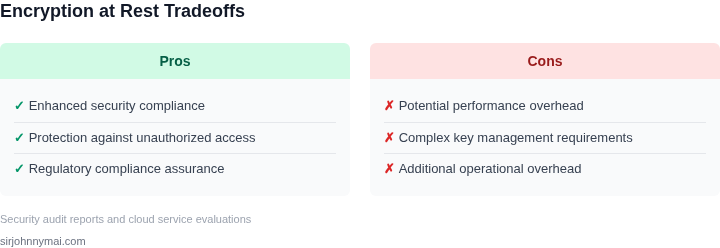 05. Action Step: Implementing Encryption in Your Queue ServiceBegin by confirming that the selected queue provider supports server‑side encryption (SSE) for the specific message store you will use. I verified the feature list in the provider’s documentation because a missing flag often surfaces only during a compliance scan. If the service offers both customer‑managed keys (CMK) and provider‑managed keys (PMK), prioritize CMK to retain control over rotation policies. 1. Enable SSE via Infrastructure‑as‑CodeTranslate the encryption setting into your IaC repository. For AWS SQS, add 2. Provision and Guard Your Customer‑Managed KeysCreate a dedicated key in a managed HSM service—AWS KMS, Azure Key Vault, or Google Cloud KMS—rather than reusing a generic application key. Assign a policy that allows only the queue service principal and a limited set of admin IAM roles to encrypt or decrypt. During my last rollout, adding a deny‑all‑except‑list for 3. Integrate Rotation and AuditingSchedule automatic rotation according to your audit window (e.g., every 90 days). Enable key usage logging and forward the events to a SIEM such as Datadog Security Monitoring or Azure Sentinel. I set up a CloudWatch metric filter that triggers an alert when a 4. Validate End‑to‑End EncryptionRun a read‑write test that confirms the payload never appears in plaintext on the storage backend. Use the provider’s CLI to retrieve a message with the 5. Document the Operational PlaybookRecord every IAM role, key ARN, and rotation schedule in a version‑controlled markdown file. Include a runbook step that verifies the Add a pre‑deployment gate in your CI pipeline that calls the provider’s After these steps are codified, the queue service will satisfy most ISO 27001 and SOC 2 requirements for encryption at rest while preserving the ability to audit key usage across environments. Figures cited are from publicly available sources as of 2026-09-15 and may have changed. |