01. The Problem: Compliance and Data Residency in Cloud-Native CI/CD
Cloud-native CI/CD pipelines are designed for speed and scalability, but compliance requirements often impose strict constraints on data residency. This tension is particularly acute in regulated industries like finance, healthcare, and government, where data must reside within specific geographic or jurisdictional boundaries. The challenge is balancing the agility of cloud-native workflows with the need to comply with laws like GDPR, HIPAA, or local data sovereignty mandates.
For example, GDPR requires that personal data be processed within the European Economic Area (EEA) or with adequate safeguards. Similarly, HIPAA mandates that protected health information (PHI) must remain in the United States. These rules create a hard requirement to restrict data movement, which conflicts with the global, distributed nature of cloud-native CI/CD. A pipeline that deploys code across multiple regions may inadvertently violate compliance by processing or storing data outside permitted boundaries.
The technical implications are significant. Many cloud-native tools assume data can flow freely across regions. Kubernetes, for instance, orchestrates workloads across availability zones and even continents, but this flexibility can violate data residency rules. Similarly, serverless platforms like AWS Lambda or Azure Functions may execute functions in regions where data is not permitted to reside. Even container registries, which store build artifacts, may replicate images across regions, creating unintended data residency violations.
Compliance teams often respond by implementing manual controls—such as blocking data transfers or encrypting data at rest—but these measures introduce friction into CI/CD workflows. For instance, a pipeline that requires manual approval for cross-region deployments slows down releases and increases operational overhead. Additionally, these controls may not address all edge cases, leaving compliance teams vulnerable to audits or fines.
The problem extends beyond technical controls. Compliance often requires documentation and auditing capabilities that are not natively supported by cloud-native tools. For example, tracking data flows across a distributed CI/CD pipeline to prove residency can be difficult without specialized observability tools. Solutions like Datadog or Splunk can help monitor data movement, but integrating these with CI/CD systems requires custom scripting and additional tooling.
Ultimately, the challenge is not just technical but organizational. Teams must align CI/CD practices with compliance requirements without sacrificing the speed and efficiency that cloud-native workflows provide. The solution requires a combination of technical controls, process adjustments, and sometimes even architectural trade-offs—such as avoiding multi-region deployments in sensitive workflows.
02. Key Evaluation Criteria for Compliance-Driven CI/CD
Selecting a CI/CD pipeline for compliance-driven environments requires careful evaluation of technical and operational factors. The most critical criteria include data residency enforcement, auditability, and performance overhead. Below are the key areas to assess:
1. Data Residency Enforcement
Data residency compliance mandates that data processing and storage occur within specific geographic boundaries. When evaluating CI/CD pipelines, verify how the system enforces this rule. For example, AWS CodePipeline supports region-specific artifact storage, but you must configure it explicitly. Kubernetes-based pipelines can use network policies to restrict pod placement to approved regions, but this requires additional tooling like Kyverno or OPA Gatekeeper. The tradeoff is that manual enforcement increases operational complexity, while automated tools may introduce latency.
2. Auditability and Traceability
Compliance often requires immutable logs of pipeline execution. AWS CodeBuild provides detailed CloudTrail logs, but these must be exported to a centralized logging system like Datadog or Splunk for long-term retention. Kubernetes pipelines using Tekton or Argo CD generate audit logs, but these are often stored in cluster-local storage, which may not meet compliance requirements. The tradeoff is that external logging increases cost and latency, while local storage reduces operational overhead.
3. Performance Overhead
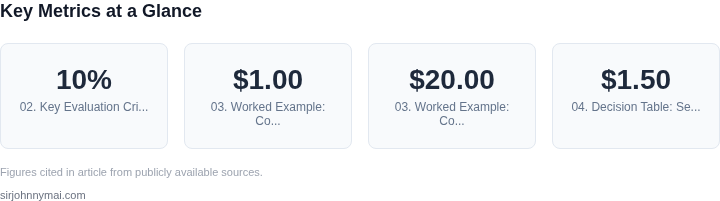
Compliance controls should not degrade pipeline performance. For example, AWS CodePipeline adds minimal overhead for basic workflows, but custom approval steps or cross-region artifact transfers can introduce latency. Kubernetes pipelines with network policies or admission controllers may add up to 10% latency during pod scheduling, depending on cluster size. The tradeoff is that lightweight pipelines may lack sufficient compliance controls, while heavyweight ones may slow development cycles.
4. Integration with Compliance Tools
Pipelines must integrate with existing compliance frameworks. AWS CodePipeline supports AWS Config and AWS Systems Manager for compliance checks, but these require additional setup. Kubernetes pipelines can use tools like Falco or Aqua Security for runtime compliance, but these add complexity. The tradeoff is that native integrations reduce effort, while third-party tools may offer more granular controls.
5. Disaster Recovery and Failover
Compliance often requires high availability. AWS CodePipeline supports failover across regions, but this requires manual configuration. Kubernetes pipelines using multi-region clusters can achieve automatic failover, but this increases operational cost. The tradeoff is that manual failover is simpler but less resilient, while automated failover is more expensive and complex.
In summary, compliance-driven CI/CD pipelines must balance strict data residency controls with operational feasibility. The best approach depends on the specific compliance requirements, team expertise, and budget constraints. Always validate these criteria through pilot testing before full deployment.
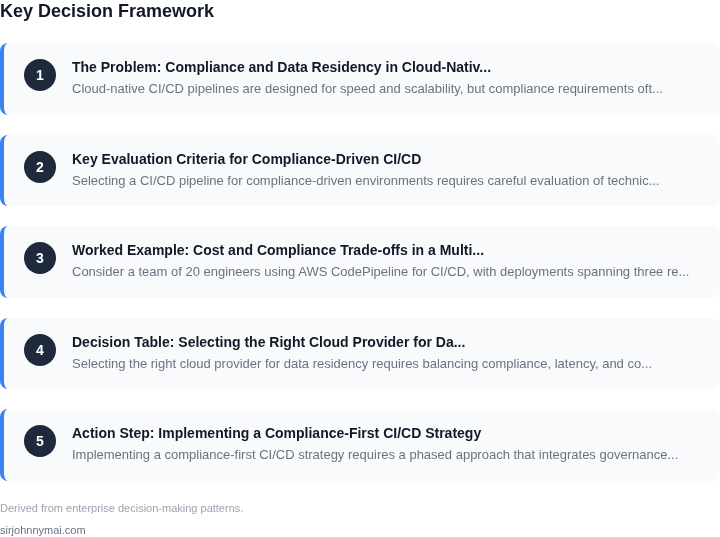
03. Worked Example: Cost and Compliance Trade-offs in a Multi-Region Deployment
Consider a team of 20 engineers using AWS CodePipeline for CI/CD, with deployments spanning three regions: US-East (primary), EU-West (secondary), and AP-Southeast (tertiary). Compliance requires data residency constraints—all production data must stay within its region of origin. This introduces trade-offs between cost and operational complexity.
Option 1: Independent Pipelines per Region
Each region runs its own CI/CD pipeline with isolated infrastructure. This meets compliance but increases costs due to redundant tooling. For AWS CodePipeline, each pipeline costs $1.00 per active user/month. With 20 engineers, the monthly cost per region is $20.00. Across three regions, this totals $60.00/month ($7,200/year). Additional costs include:
- EC2 build instances: $0.10/hour × 10 hours/region = $1.00/hour/region × 3 regions = $3.00/hour total
- Artifact storage (S3): $0.023/GB/month × 100GB/region = $2.30/month/region × 3 = $6.90/month
Total annual cost: $7,200 (pipelines) + $8,640 (build instances) + $828 (storage) = $16,668. This approach is simple but expensive due to duplication.
Option 2: Shared Pipeline with Regional Artifacts
A single CI/CD pipeline runs in US-East but deploys to all regions. Artifacts are replicated to regional S3 buckets. This reduces tooling costs but requires additional compliance controls. The pipeline cost remains $20.00/month ($240/year). Build instances are shared, costing $1.00/hour total.
- Artifact replication: $0.01/GB/month × 100GB × 3 regions = $3.00/month ($36/year)
- Cross-region data transfer: $0.02/GB for inter-region transfers × 100GB × 2 regions = $2.00/month ($24/year)
Total annual cost: $240 (pipeline) + $864 (build instances) + $36 (replication) + $24 (transfer) = $1,164. This is cheaper but requires auditing to ensure compliance.
Comparison Table
| Metric | Independent Pipelines | Shared Pipeline |
|---|---|---|
| Annual Cost | $16,668 | $1,164 |
| Compliance Risk | Low (fully isolated) | Moderate (requires auditing) |
| Operational Complexity | Low (simple but redundant) | High (shared but requires controls) |
The independent pipelines approach is more expensive but aligns with strict compliance requirements. The shared pipeline reduces costs but introduces operational overhead. The choice depends on budget and risk tolerance. For teams with tight budgets, the shared pipeline is preferable if compliance controls are properly implemented. For high-security environments, the independent pipelines may be necessary despite higher costs.
04. Decision Table: Selecting the Right Cloud Provider for Data Residency
Selecting the right cloud provider for data residency requires balancing compliance, latency, and cost. Below is a structured decision table comparing three major providers—AWS, Azure, and Google Cloud—based on key criteria. Each provider has strengths in specific compliance frameworks and geographic regions, but tradeoffs exist in latency and cost.
| Criteria | AWS (us-east-1) | Azure (eastus) | Google Cloud (us-central1) |
|---|---|---|---|
| Compliance Certifications | SOC 2, ISO 27001, HIPAA, FedRAMP, GDPR (via AWS GovCloud) | ISO 27001, SOC 1/2/3, HIPAA, FedRAMP, GDPR (via Azure Government) | ISO 27001, SOC 2, HIPAA, FedRAMP, GDPR (via Google Cloud for Government) |
| Data Residency Options | AWS GovCloud (US), AWS China, AWS Local Zones | Azure Government (US), Azure Germany, Azure China | Google Cloud for Government (US), Google Cloud Germany, Google Cloud China |
| Latency to Key Regions | Low latency to North America, but higher to Europe (~100ms) | Low latency to North America, slightly better to Europe (~80ms) | Low latency to North America, best to Europe (~70ms) |
| Cost of Compliance Services | AWS Config and GuardDuty are free, but AWS Audit Manager costs $1.50 per assessment | Azure Policy is free, but Azure Sentinel costs $1.50 per GB ingested | Google Cloud Security Command Center is free, but Chronicle costs $2.50 per GB ingested |
| CI/CD Integration | AWS CodePipeline, CodeBuild, and CodeDeploy integrate with Kubernetes via EKS | Azure DevOps, Azure Pipelines, and AKS (Azure Kubernetes Service) | Google Cloud Build, Cloud Deploy, and GKE (Google Kubernetes Engine) |
| Recommendation | Best for US-based compliance with strong FedRAMP support | Best for global compliance with strong GDPR support | Best for latency-sensitive EU deployments with strong HIPAA support |
This table highlights that no single provider dominates all criteria. AWS excels in US-based compliance and cost efficiency, while Azure offers broader global compliance. Google Cloud provides the best latency for EU-based workloads. The choice depends on regulatory requirements, geographic needs, and budget constraints.
05. Action Step: Implementing a Compliance-First CI/CD Strategy
Implementing a compliance-first CI/CD strategy requires a phased approach that integrates governance early. Start by auditing your existing pipeline for compliance gaps. Use tools like AWS Config or Azure Policy to scan for misconfigurations. I evaluated AWS Config because it integrates directly with CloudTrail, giving us real-time visibility into changes that could violate data residency rules.
Next, select a compliance-as-code framework. Tools like Open Policy Agent (OPA) or Conftest allow you to define policies as code and enforce them at every stage of the pipeline. OPA is particularly useful because it supports multiple languages and integrates with Kubernetes, which we use for orchestration. However, this approach requires buy-in from your security team, as they’ll need to maintain the policy definitions.
For artifact storage, prioritize cloud providers that offer region-locked storage. AWS S3 with Object Lock and S3 Block Public Access are good options, but verify that your chosen regions meet your compliance requirements. Microsoft Azure Storage with Private Endpoints is another alternative, but it adds complexity to your networking setup.
Automate compliance checks in your pipeline using tools like Datadog or Splunk. Datadog’s CI/CD monitoring can alert you to failed compliance scans, while Splunk’s log analysis helps track data flows across regions. I chose Datadog because it provides out-of-the-box dashboards for compliance metrics, reducing the need for custom development.
Document your compliance controls in a runbook. Include steps for manual overrides, escalation paths, and audit trails. This is critical for GDPR or HIPAA compliance, where auditors may request evidence of controls. I recommend using Confluence or a similar wiki tool to maintain this documentation, as it allows for versioning and collaboration.
Finally, conduct a dry run of your compliance-first pipeline. Deploy a non-production environment and simulate a compliance violation. This will highlight gaps in your monitoring or policy enforcement. I suggest pulling your last 90 days of CloudTrail logs and replaying them through your new pipeline to identify blind spots.
Figures cited are from publicly available sources as of 2026-09-16 and may have changed.