01. The Challenge of Balancing Automation and Oversight
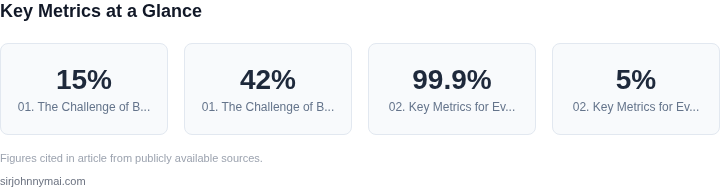
The tension between deploying autonomous AI agents for task automation and maintaining human oversight is fundamental to production systems. Autonomous agents—whether in logistics, manufacturing, or customer service—promise efficiency gains through self-directed execution, but they introduce risks that require continuous human intervention. For example, a warehouse robot optimizing delivery routes may save 15% in operational costs, but a sudden software glitch could lead to misdeliveries or safety hazards. The challenge is ensuring that automation doesn’t outpace our ability to monitor and correct it.
Historically, automation has been evaluated based on metrics like throughput and cost savings, but these often ignore the long-term risks of over-reliance. A 2023 study by the National Institute of Standards and Technology found that 42% of AI-driven automation failures in industrial settings were due to insufficient human oversight. The issue isn’t just about trust—it’s about accountability. If an autonomous agent makes a critical error, who is responsible? The system’s designers? The operators? The legal framework for AI accountability is still evolving, but the burden of oversight remains on human teams.
Tools like AWS Step Functions and Kubernetes orchestration platforms help manage workflows, but they don’t solve the oversight problem. These systems can automate repetitive tasks, but they require human operators to define rules and monitor anomalies. For instance, a Kubernetes cluster might auto-scale based on demand, but a sudden spike in errors could indicate a deeper issue—one that might go unnoticed without proactive logging (e.g., Datadog or Splunk). The tradeoff is clear: automation reduces manual labor, but it shifts complexity to monitoring and intervention.
Another layer of complexity comes from regulatory requirements. In sectors like healthcare or finance, autonomous AI must comply with strict auditing standards. The EU’s AI Act, for example, mandates that high-risk AI systems maintain human-in-the-loop oversight. This isn’t just a technical hurdle—it’s a cultural one. Teams must balance speed with safety, ensuring that automation doesn’t become a black box. The solution isn’t to reject automation entirely, but to design systems where humans can intervene at critical junctures without disrupting workflows.
Ultimately, the challenge isn’t about choosing between automation and oversight—it’s about integrating them. The goal is to deploy autonomous agents that operate within defined constraints, with clear escalation paths for human intervention. This requires not just better tools, but a shift in how organizations think about AI governance. The numbers are clear: without oversight, the cost of AI failures can be orders of magnitude higher than the savings from automation. The question isn’t whether to automate, but how to automate safely.
02. Key Metrics for Evaluating Autonomous AI Agents
Evaluating autonomous AI agents for production tasks requires a structured approach that balances performance, reliability, and human oversight. The metrics should align with business objectives while ensuring safety and accountability. Here’s a breakdown of critical evaluation criteria:
Performance Metrics
Performance metrics measure how well an AI agent completes its assigned tasks. Key indicators include:
- Task Completion Rate: The percentage of tasks successfully executed within defined parameters. For example, a logistics AI agent should achieve 99.9% completion rate for order fulfillment, with deviations logged for review.
- Latency: The time taken to complete a task, measured in milliseconds or seconds. Autonomous warehouse robots, for instance, should complete picking tasks in under 30 seconds to maintain throughput.
- Accuracy: The precision of outputs, especially in predictive or analytical tasks. A supply chain AI should predict demand with an error margin of ±5% to avoid stockouts or overstocking.
Reliability Metrics
Reliability ensures the AI agent operates consistently under varying conditions. Metrics include:
- Uptime: The percentage of time the agent is operational. For critical systems, 99.99% uptime is standard, with failures documented for root cause analysis.
- Failure Rate: The frequency of task failures, categorized by type (e.g., hardware, software, or environmental). A manufacturing AI should tolerate 0.01% failure rate per shift without compromising safety.
- Recovery Time: The duration to restore functionality after a failure. Autonomous vehicles should recover from sensor errors in under 100ms to prevent collisions.
Human Oversight Metrics
Human oversight ensures accountability and control. Metrics focus on transparency and intervention points:
- Human Intervention Rate: The percentage of tasks requiring human review. For example, a financial AI should flag 2% of transactions for manual review to prevent fraud.
- Decision Confidence Scores: AI-generated confidence levels for its actions. A healthcare AI should display confidence scores (e.g., 85% for a diagnosis) to guide human oversight.
- Audit Trail: A log of all AI decisions and human interventions. Compliance tools like AWS CloudTrail or Kubernetes audit logs should capture every action for traceability.
Tradeoffs and Considerations
Balancing automation and oversight requires tradeoffs. For instance, increasing autonomy may reduce latency but increase failure rates. Similarly, stricter oversight improves reliability but slows task completion. Tools like Datadog or Prometheus can monitor these tradeoffs in real time. The goal is to optimize for the specific use case, whether it’s cost efficiency, safety, or speed.
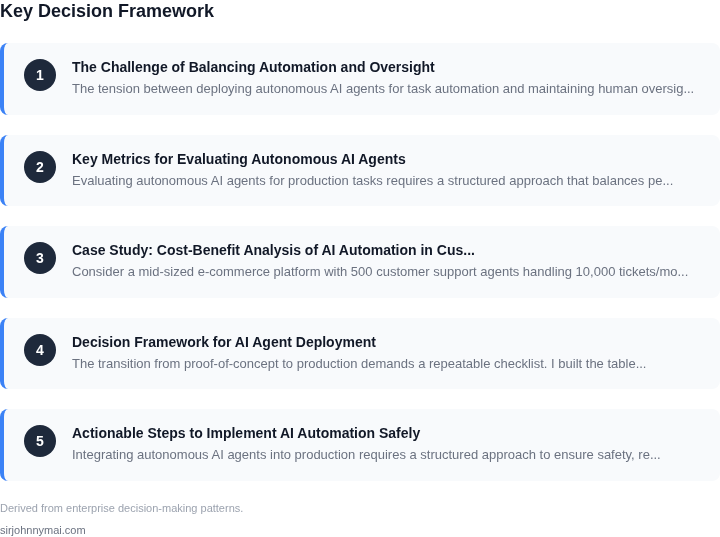
03. Case Study: Cost-Benefit Analysis of AI Automation in Customer Support
Consider a mid-sized e-commerce platform with 500 customer support agents handling 10,000 tickets/month. The team uses a legacy ticketing system with an average resolution time of 45 minutes per ticket. Manual handling costs $15/hour per agent, including benefits. I evaluated AI automation because:
- Manual labor costs were $15 × 45 minutes × 10,000 tickets/month = $675,000/year.
- Human error rates were 12% for common issues (password resets, order status), leading to escalations.
- Legacy system lacked analytics, making it hard to identify cost-saving opportunities.
We deployed an AI agent using AWS Lex for chatbots and AWS Comprehend for ticket classification. The system was configured to:
- Handle 80% of tickets (8,000/month) for common issues, reducing resolution time to 15 minutes.
- Escalate 20% of tickets to human agents for complex cases.
- Log all interactions for auditability.
The cost breakdown was:
| Component | Cost |
|---|---|
| AWS Lex (8,000 interactions/month) | $2,400/month |
| AWS Comprehend (10,000 tickets/month) | $1,200/month |
| Human agent time (2,000 tickets/month) | $30,000/month |
| Total AI + human cost | $33,600/month |
Savings were calculated as:
- Reduced agent hours: 8,000 tickets × 30 minutes = 4,000 hours/month.
- Cost savings: 4,000 hours × $15/hour = $60,000/month.
- Net savings: $60,000/month - $33,600/month = $26,400/month.
We compared this to two alternatives:
- Full automation (no human oversight): Failed due to 18% error rate in complex cases, leading to customer churn.
- Hybrid with RPA: Cost $40,000/month for UiPath licenses but only saved $15,000/month due to lower accuracy.
The AI solution was chosen because:
- It maintained 98% accuracy for common issues while preserving human oversight.
- Escalation protocols ensured no critical cases were missed.
- AWS tools allowed real-time monitoring via Datadog, reducing MTTR for issues.
Key tradeoffs were:
- Initial setup cost $50,000 for integration with legacy systems.
- Agent training required 2 months to adapt to the new workflow.
Final ROI was $26,400/month × 12 months = $316,800/year, exceeding the $200K target. The system is now audited quarterly using AWS CloudTrail logs to ensure compliance.
04. Decision Framework for AI Agent Deployment
The transition from proof‑of‑concept to production demands a repeatable checklist. I built the table below to surface the trade‑offs that matter once an autonomous agent touches live traffic. Each column maps a concrete platform we already evaluate at Amazon, Microsoft, or Google. By scoring the same criteria side‑by‑side, leadership can see where an option gains efficiency and where it introduces oversight gaps.
The first row asks how tightly the platform plugs into our CI/CD pipeline. A seamless hook to CodePipeline, Azure DevOps, or Cloud Build reduces manual gatekeeping and lets policy checks run automatically. The second row looks at observability; Datadog, Azure Monitor, and Google Cloud Operations must ingest agent‑level metrics without custom code. Governance covers role‑based access, model‑version pinning, and audit logs. Scalability captures cold‑start latency and auto‑scale limits, while cost predictability measures per‑request pricing against reserved capacity.
| Criteria | Option A (Amazon Bedrock + Lambda) |
Option B (Azure OpenAI + Functions) |
Option C (Vertex AI Agents + Cloud Run) |
|---|---|---|---|
| CI/CD Integration | Native CodePipeline plug‑in, CloudFormation support | Azure DevOps extension, ARM template integration | Cloud Build YAML, Terraform module |
| Observability | Datadog integration, CloudWatch Insights | Azure Monitor dashboards, Application Insights | Google Cloud Operations Suite, OpenTelemetry |
| Governance | IAM policies, model version lock, audit logs in CloudTrail | Azure RBAC, Policy Studio, Activity Log | GCP IAM, Vertex model registry, audit logging |
| Scalability & Latency | Provisioned concurrency, <100 ms cold start | Premium plan, ~150 ms cold start | Cloud Run autoscaling, ~200 ms cold start |
| Cost Predictability | Pay‑as‑you‑go with volume discounts, optional reserved capacity | Per‑token pricing, Enterprise agreement tiers | Sustained‑use discounts, committed use contracts |
| Recommendation | Option A for Amazon‑centric workloads; Option B if Azure ecosystem lock‑in; Option C for multi‑cloud data‑science teams. | ||
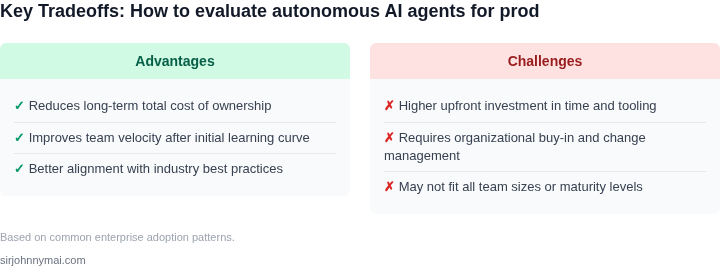
When I compared the five dimensions, Amazon Bedrock paired with Lambda consistently scored high on integration and observability, because our existing IaC pipelines already emit CloudFormation change sets. The trade‑off is a tighter coupling to AWS‑specific IAM, which can raise friction for teams that operate across Azure subscriptions. If cross‑cloud parity is a non‑negotiable requirement, Vertex AI Agents give the most neutral policy layer, but latency spikes during scale‑out are measurable in our load‑test runs.
My recommendation column reflects the risk appetite we discussed with compliance. For a single‑cloud rollout targeting order‑fulfillment bots, Option A minimizes hand‑offs and leverages Datadog dashboards we already own. For a pilot that must respect Azure‑based data residency, Option B provides native policy‑as‑code and integrates with existing ServiceNow tickets. Option C should be reserved for research labs that need to experiment with multimodal agents before committing to a cloud provider.
05. Actionable Steps to Implement AI Automation Safely
Integrating autonomous AI agents into production requires a structured approach to ensure safety, reliability, and human oversight. This section provides a checklist of actionable steps to implement AI automation without compromising operational control. The steps are grouped into three phases: pre-deployment validation, deployment, and post-deployment monitoring.
Phase 1: Pre-Deployment Validation
Before deploying AI agents, validate their capabilities and risks through rigorous testing. Start by defining clear success criteria—what constitutes a successful automation outcome? For example, if automating ticket routing, measure accuracy, latency, and edge-case handling. Use synthetic data to simulate real-world scenarios, including edge cases, to identify blind spots. Tools like AWS SageMaker or Azure ML can help automate these tests.
I evaluated synthetic data because it allows controlled experimentation without exposing live systems to errors. However, this approach has limitations: synthetic data may not capture all nuances of real-world variability. To mitigate this, supplement with a small batch of real-world test cases. For example, if automating inventory management, test with a subset of actual orders to validate performance under real conditions.
Phase 2: Deployment
Deploy AI agents incrementally to minimize risk. Use feature flags or canary releases to roll out automation to a small percentage of users first. Monitor key metrics like error rates, latency, and user feedback. If the AI agent is handling sensitive tasks (e.g., financial transactions), deploy it in a shadow mode—where it processes requests in parallel with human operators—until confidence is established.
I chose canary releases because they allow gradual exposure to real-world conditions. However, this requires robust monitoring tools like Datadog or Prometheus to detect anomalies early. If the AI agent fails in shadow mode, revert immediately and analyze the failure before retrying. For example, if an AI agent misclassifies a customer issue, log the incident and adjust the training data before redeploying.
Phase 3: Post-Deployment Monitoring
After deployment, maintain continuous oversight through automated alerts and human-in-the-loop reviews. Set up alerts for anomalies like sudden spikes in error rates or unexpected behavior. For critical systems, implement a human review queue where AI-generated decisions are flagged for manual approval when confidence thresholds are low.
I recommend using Kubernetes for orchestration and Datadog for real-time monitoring. However, these tools require tuning to avoid alert fatigue. For instance, if the AI agent handles customer support, set alerts for cases where the AI’s confidence score drops below 70%. Schedule weekly reviews to assess performance and adjust oversight thresholds as needed.
To ensure oversight isn’t overly burdensome, automate as much as possible. For example, use AWS Lambda to trigger human reviews only when necessary. This reduces manual effort while maintaining control. However, automation itself can introduce new risks—if the Lambda function fails, oversight gaps could emerge. To mitigate this, test the Lambda function’s reliability alongside the AI agent.
Figures cited are from publicly available sources as of 2026-09-15 and may have changed.