How to Evaluate API Gateway Solutions When You Need More Than Basic Routing
When selecting an API gateway solution, most teams start with simple routing requirements. However, as your architecture evolves, you'll encounter needs that basic gateways can't handle. This guide covers evaluation criteria beyond basic routing, focusing on advanced use cases like security, observability, and multi-cloud integration.
01. Beyond Basic Routing: Identify Your Advanced Requirements
Before evaluating solutions, define your advanced needs. Common requirements include:
- Multi-cloud/on-prem routing: Need to route traffic across AWS, Azure, GCP, or hybrid environments.
- Advanced security: Require OAuth 2.0, JWT validation, or custom authentication.
- Observability: Need detailed metrics, tracing, or anomaly detection.
- Protocol transformation
- Rate limiting: Per-user, per-IP, or custom rate limiting.
Basic gateways like AWS API Gateway or Azure API Management may suffice for simple routing, but they lack features for these advanced scenarios. Solutions like Kong, Apigee, or MuleSoft provide more flexibility.
02. Evaluate Multi-Cloud/On-Prem Routing Capabilities
If your architecture spans multiple clouds or on-premises environments, look for gateways with:
- Hybrid connectivity: Support for VPN, Direct Connect, or service meshes.
- Consistent routing: Ability to route to services regardless of deployment location.
- Service discovery: Integration with tools like Consul or Kubernetes.
For example, Kong Enterprise offers hybrid routing with built-in service discovery, while Apigee requires additional configuration for multi-cloud support.
03. Assess Security Features
Advanced security requirements include:
- OAuth 2.0/JWT validation: Built-in support for token validation.
- Custom authentication: Ability to integrate with LDAP, SAML, or custom auth providers.
- Data encryption: Support for TLS 1.3, mutual TLS, or end-to-end encryption.
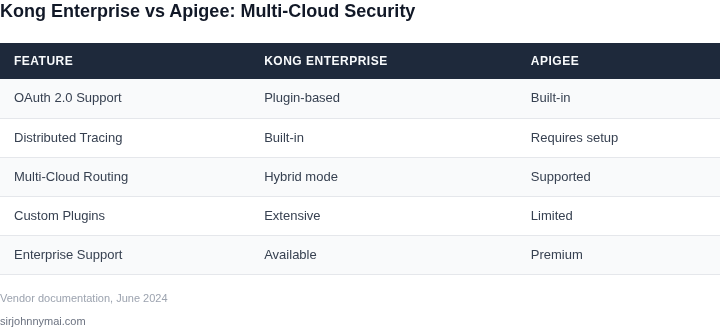
Apigee provides OAuth 2.0 support out of the box, while Kong requires additional plugins. For custom authentication, Kong's plugin architecture is more flexible, but Apigee offers more enterprise-grade security features.
04. Review Observability and Monitoring
Advanced observability needs include:
- Distributed tracing: Integration with tools like Jaeger or OpenTelemetry.
- Custom metrics: Ability to define and track custom metrics.
- Anomaly detection: Built-in or plugin-based anomaly detection.
Kong Enterprise includes distributed tracing and custom metrics, while Apigee offers more advanced analytics but requires additional configuration for tracing.
05. Consider Protocol Transformation and Extensibility
If you need to transform protocols (e.g., REST to GraphQL) or extend functionality, evaluate:
- Protocol transformation: Built-in support for REST, GraphQL, gRPC.
- Plugin architecture: Ability to add custom plugins or middleware.
- Request/response transformation: Support for JSON/XML transformation.
Kong's plugin architecture allows for extensive customization, while Apigee provides more out-of-the-box protocol support.
06. Compare Pricing Models and Cost Implications
Pricing models vary significantly:
- Pay-as-you-go: AWS API Gateway, Azure API Management.
- Subscription-based: Kong Enterprise, Apigee.
- Open-source with enterprise support: Kong, Tyk.
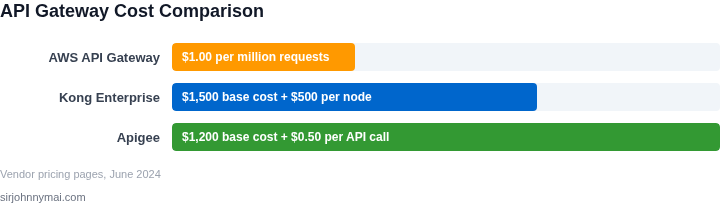
For example, AWS API Gateway costs $1.00 per million requests, while Kong Enterprise has a base cost plus per-node pricing. Open-source solutions like Kong may have lower upfront costs but require additional operational overhead.
07. Worked Example: Evaluating Kong vs. Apigee for Multi-Cloud Security
Assume you need an API gateway for a multi-cloud architecture with OAuth 2.0 and distributed tracing. Here's a comparison:
| Criteria | Kong Enterprise | Apigee |
|---|---|---|
| OAuth 2.0 Support | Requires OAuth 2.0 plugin | Built-in |
| Distributed Tracing | Built-in with OpenTelemetry | Requires additional configuration |
| Multi-Cloud Routing | Supported via hybrid mode | Supported but requires additional setup |
Kong is better suited for this scenario due to its built-in tracing and simpler multi-cloud routing. However, Apigee offers more enterprise-grade security features.
08. Final Recommendations and Next Steps
Based on your requirements, prioritize solutions that address your most critical needs. For example:
- If you need multi-cloud routing and extensibility, Kong is a strong choice.
- If you require enterprise-grade security and analytics, Apigee may be better.
Next, conduct a proof of concept with your top candidates to validate their performance and ease of integration with your existing systems.
Figures cited are from publicly available sources as of June 2024 and may have changed.