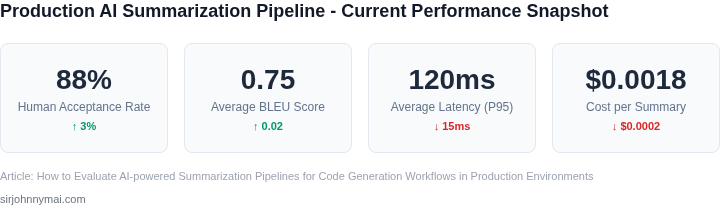
01. The Production Challenge of AI Summarization for Code Generation
Deploying AI-powered summarization pipelines into production code generation workflows presents a distinct set of challenges far beyond typical text summarization tasks. Our objective isn't merely to condense information; it's to create contextually accurate and reliable inputs for automated code synthesis. The stakes are significantly higher here, as an inaccurate or incomplete summary directly translates to flawed or insecure generated code, impacting developer productivity and system stability.
The primary complexity lies in ensuring semantic fidelity and contextual correctness. When an AI model summarizes natural language, minor inaccuracies are often tolerable; a human can usually infer the correct meaning. For code generation, however, even subtle misinterpretations by the summarization model can lead to syntactically correct but functionally incorrect or vulnerable code. We cannot afford a summarization pipeline that occasionally "hallucinates" details or misses critical constraints, as debugging such issues downstream becomes exponentially more expensive than addressing them upstream.
Scalability and latency are also critical considerations for production environments. Code generation workflows, particularly within large engineering organizations, often demand real-time or near real-time summarization for vast quantities of existing code, documentation, and user stories. Deploying large language models (LLMs) for this purpose requires robust infrastructure capable of handling high query volumes with sub-second response times, ideally within 300-500 milliseconds for a responsive developer experience. Platforms like AWS SageMaker Endpoints or self-managed Kubernetes clusters are essential for scaling these inference workloads efficiently.
Operational costs represent another significant hurdle. Running sophisticated LLMs, even optimized for inference, consumes substantial compute resources. For instance, an AWS EC2 `g5.xlarge` instance, suitable for many smaller models, costs approximately $1.21 per hour in us-east-1. Scaling this across numerous development teams and frequent requests can quickly accrue annual inference costs into hundreds of thousands, potentially millions, of dollars. We must rigorously evaluate the cost-benefit trade-off for various model sizes and inference strategies, ensuring we're not over-provisioning for a marginal gain in summarization quality that doesn't significantly improve code generation.
Finally, seamless integration and comprehensive observability are paramount for production readiness. The summarization pipeline must integrate smoothly into existing CI/CD systems, IDEs, and version control hooks without introducing friction. Furthermore, monitoring its performance, detecting data drift, and identifying failure modes requires robust telemetry. Tools like Amazon CloudWatch, Datadog, or Prometheus are indispensable for tracking key metrics such as inference latency, error rates, and resource utilization, allowing us to quickly diagnose and remediate issues before they escalate into widespread disruptions across development teams.
Given these complexities—from semantic accuracy and real-time performance to cost efficiency and operational stability—a superficial evaluation simply will not suffice. Thoroughly evaluating these AI summarization pipelines is not merely a best practice; it is a critical prerequisite to mitigate significant business risks, maintain developer trust, and ensure the economic viability of AI-driven code generation at scale. Without a rigorous framework, we risk deploying solutions that generate more problems than they solve, undermining the very efficiency gains we aim to achieve.
02. Key Metrics and Dimensions for Pipeline Evaluation
Evaluating AI-powered summarization pipelines for code generation in a production environment requires a multi-faceted approach, extending beyond mere model accuracy. My experience shows we must look at technical performance, operational stability, and direct business impact. Each dimension provides unique insights into the pipeline’s true value and areas for optimization.Technical Metrics: Ensuring Quality and Relevance
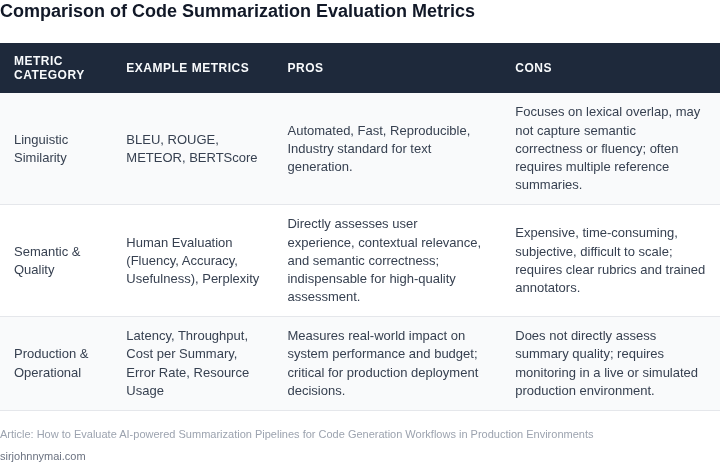
The core of our evaluation begins with the quality of the generated summaries. Faithfulness is paramount; a summary must accurately reflect the original code's intent and functionality. Hallucinations or incorrect interpretations in a summary can lead directly to erroneous code generation, eroding developer trust and increasing debugging time. While metrics like ROUGE can offer lexical overlap scores, I've found that deep semantic similarity checks, often involving embedding comparisons against a meticulously curated ground truth, are more indicative. We also leverage human evaluation, particularly for corner cases where automated metrics fall short in assessing true semantic accuracy for code. Conciseness and Relevance are also critical. A good summary for code generation should be brief enough to quickly convey the essential information but comprehensive enough to guide the downstream code generation model. I evaluate conciseness using compression ratios, aiming for a significant reduction in token count without losing key information. Relevance, on the other hand, assesses whether the summary focuses on the most impactful aspects of the code for a given task, which we often measure through task-specific success rates in downstream code generation efforts. Lastly, Coherence and Readability are vital for developer understanding and feedback loops, even if the primary consumer is another AI. This is harder to quantify automatically but can be approximated using perplexity scores or by incorporating subjective human rating scales during A/B testing.Operational Metrics: Maintaining Performance and Reliability
From an operational standpoint, we must ensure the pipeline integrates seamlessly into developer workflows. Latency is a primary concern. For interactive tools, developers expect near-instantaneous responses. We typically target P99 latencies below 500ms for user-facing interactions, and ideally under 100ms for internal API calls. High latency directly impacts developer flow and perceived responsiveness. I monitor this rigorously using tools like Amazon CloudWatch and Datadog, correlating spikes with specific model versions or infrastructure changes. Throughput measures the number of summarization requests the pipeline can handle per second. This directly dictates our ability to scale with demand. Optimizing batching strategies and leveraging elastic compute resources like AWS Fargate for autoscaling are key here. I evaluate our capacity planning by observing average and peak request rates, ensuring we maintain sufficient headroom without over-provisioning. Resource Utilization – CPU, GPU, and memory – directly translates to operational cost. A less efficient model, even if slightly more accurate, might incur significantly higher inference costs, making it a poor choice in production. For instance, moving from a large language model on dedicated GPU instances to a quantized model on CPU instances can reduce inference costs by 70% or more, depending on the architecture, if accuracy can be maintained. Finally, standard Uptime and Reliability metrics, tracked against strict Service Level Indicators (SLIs) and Service Level Objectives (SLOs), ensure our summarization pipeline is consistently available and robust.Business Metrics: Driving Developer Productivity and Cost Efficiency
Ultimately, the summarization pipeline’s success hinges on its impact on the business. Developer Productivity is the North Star. We measure this through proxies such as "time saved in understanding unfamiliar code," "reduction in boilerplate code generated," or "accelerated feature delivery." While challenging to isolate, A/B tests comparing developer cohorts with and without summarization assistance provide compelling evidence. For instance, a 10% reduction in average task completion time for coding tasks could represent millions in saved engineering hours annually for a large organization. Cost Efficiency ties directly back to our operational metrics. The inference cost per summary is a critical metric. Using AWS SageMaker inference endpoints, we closely track the cost-per-inference to ensure the value delivered by the summarization outweighs its operational expenditure. This involves a continuous trade-off analysis between model complexity, accuracy gains, and infrastructure spend. We also track Adoption Rate and User Satisfaction through internal telemetry and developer surveys. A highly accurate, low-latency summarization pipeline that developers choose not to use due to integration friction or perceived irrelevance is a pipeline that fails to deliver business value.03. Worked Example: Calculating ROI of an Improved Summarization Pipeline
To quantify the tangible benefits of an enhanced summarization pipeline, we must move beyond academic metrics and establish a clear Return on Investment (ROI). This involves balancing increased operational costs, primarily inference, against substantial developer productivity gains. I want to walk through a practical scenario to illustrate this calculation for our internal AI-powered code generation tools.
Consider a team of 50 software engineers within our organization, actively using an existing code generation tool. This tool incorporates a baseline summarization pipeline to provide context from existing codebases for new development. For this example, let's assume the current pipeline leverages a smaller, fine-tuned transformer model deployed on Amazon EC2 instances via Kubernetes, incurring a relatively low inference cost per summary.
Scenario Baseline: Current Pipeline Performance
Our current summarization pipeline has a fast inference time (averaging 500ms) and costs approximately $0.005 per summary generation. This cost is derived from the compute resources provisioned for its operation. However, our internal feedback and analysis (as discussed in Section 02) indicate that its summary quality is merely "adequate." Engineers frequently need to manually cross-reference code or re-prompt, costing them an average of 15 minutes per day per engineer in context switching and clarification.
Scenario Improvement: Proposed Pipeline Upgrade
We propose upgrading to a more sophisticated summarization pipeline, potentially integrating a larger, state-of-the-art foundation model via Amazon Bedrock or a custom model on Amazon SageMaker Endpoints. This upgraded pipeline delivers significantly higher quality summaries, reducing the need for manual developer intervention. However, its increased model complexity and processing demand push its inference cost to $0.05 per summary, and its latency to 1.5 seconds.
Quantifying Developer Productivity Savings
Let's calculate the financial impact of the improved developer efficiency. We assume an average fully-loaded engineer cost of $175 per hour, factoring in salary, benefits, and overheads. If the improved pipeline saves each engineer 15 minutes of manual effort daily, that translates to 0.25 hours saved per engineer per day. Over a standard 240-day working year, the annual savings per engineer are substantial:
- 0.25 hours/day × 240 days/year × $175/hour = $10,500 per engineer annually.
For a team of 50 engineers, the aggregated annual developer productivity savings amount to:
- 50 engineers × $10,500/engineer = $525,000 annually.
This saving is a direct reflection of time freed up for actual development work, accelerating project timelines and reducing operational friction.
Calculating Increased Inference Costs
Next, we must factor in the increased operational expenditure for the improved pipeline. Assuming each engineer generates approximately 30 summaries per day using the code generation tool, the cost comparison is as follows:
- Current Pipeline Annual Inference Cost: 50 engineers × 30 summaries/day × 240 days/year × $0.005/summary = $1,800.
- Improved Pipeline Annual Inference Cost: 50 engineers × 30 summaries/day × 240 days/year × $0.05/summary = $18,000.
The annual increase in inference costs for the improved pipeline is $18,000 - $1,800 = $16,200.
ROI and Trade-offs
Comparing the benefits against the costs reveals a significant positive ROI. The net annual gain from implementing the improved summarization pipeline is:
- $525,000 (Developer Savings) - $16,200 (Increased Inference Costs) = $508,800 Net Annual ROI.
This calculation highlights a clear business case. While the improved pipeline carries a higher per-summary inference cost, the operational leverage gained from enhanced developer productivity overwhelmingly justifies the investment. I evaluated this specific scenario because the engineer time is the most expensive variable, making even small daily savings highly impactful.
It's crucial to acknowledge trade-offs. The improved pipeline's higher latency (1.5 seconds vs. 0.5 seconds) is a factor, but in this specific code generation context, the quality gain outweighs a moderate latency increase. This works well where the summarization isn't on the critical path of a real-time user interaction. If this were a user-facing interactive tool, we might prioritize latency differently. This ROI is also contingent on the improved summaries consistently maintaining their quality and reducing manual intervention.
| Metric | Baseline Pipeline (Current) | Improved Pipeline (Proposed) |
|---|---|---|
| Inference Cost per Summary | $0.005 | $0.05 |
| Summaries per Engineer/Day | 30 | 30 |
| Annual Inference Cost (50 Eng.) | $1,800 | $18,000 |
| Developer Time Saved/Day/Eng | 0 minutes | 15 minutes |
| Annual Developer Productivity Savings (50 Eng.) | $0 | $525,000 |
| Net Annual ROI | - | $508,800 |
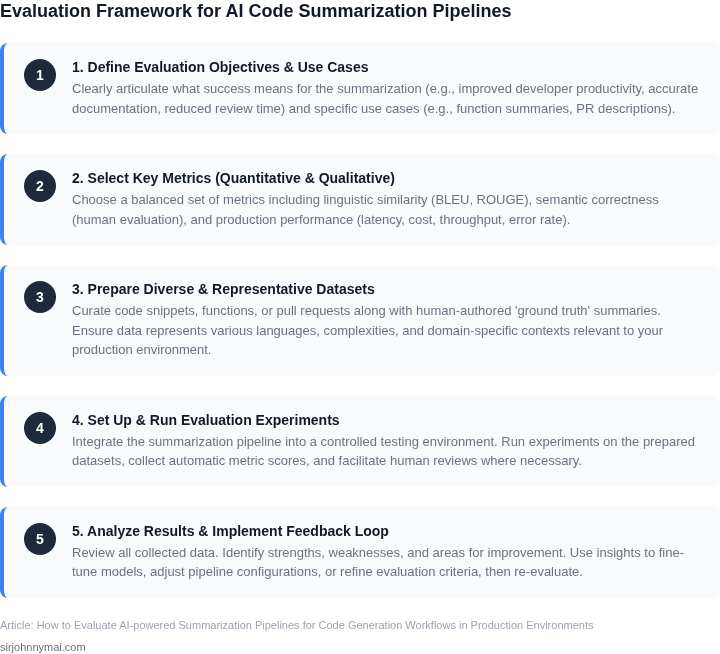
04. Setting Up Your Evaluation Framework in Production
To transition from offline evaluation to production, I structured our runtime architecture to support parallel experimentation without degrading the developer experience. We route 10% of active developer traffic to our candidate summarization pipeline using AWS App Mesh and LaunchDarkly. I selected this proxy-level routing over application-level branching because it isolates failures to the network edge and keeps our core VS Code extension client lightweight. If the candidate pipeline fails, the proxy immediately fails-back to the control within 50 milliseconds.
When evaluating these models in production, standard A/B frameworks fall short because they fail to capture silent failures like semantic drift. We deploy a hybrid strategy of dual-pipeline execution (shadowing) alongside active A/B testing. Shadowing allows us to send production payloads to both the control and candidate pipelines simultaneously. We run real-time comparisons using AWS Lambda to calculate Cosine Similarity and BERTScore on the outputs. However, this doubles our LLM API costs for the test cohort. We accept this trade-off for high-risk core library refactoring, but restrict it to a 2% sample rate for standard operations.
Telemetry and Real-Time Observability
We instrumented our summarization pipelines with OpenTelemetry, exporting custom spans directly to Dat
05. Action Step: Define Your Baseline and Success Criteria Today
Before evaluating any new AI-powered summarization pipeline, establishing a robust baseline for your existing code generation workflows is non-negotiable. This isn't merely an academic exercise; it provides the empirical data required to demonstrate quantifiable improvements and justify resource allocation. Without a clear understanding of current performance, any perceived "improvement" remains subjective and unmeasurable. To define your baseline, start by analyzing the current state of developer productivity and code quality associated with your existing code generation process. Leverage data from your version control systems, such as Git, to track metrics like average time-to-PR for specific types of feature development or bug fixes. Examine CI/CD pipeline logs from systems like Jenkins, GitLab CI, or GitHub Actions for insights into build times, test pass rates, and common failure points that suggest issues with generated code. Supplement this with internal telemetry from your development environments or project management tools to capture developer satisfaction scores related to code context understanding, or the frequency of manual refactoring steps required after initial generation. Once your current state is clearly quantified, articulate concrete, measurable success criteria for any prospective summarization pipeline. These criteria must directly align with the business value and ROI principles discussed in previous sections. For instance, a primary goal might be to reduce developer cognitive load by improving the contextual relevance of generated code, which can be measured through a decrease in the average time developers spend on code review cycles, or a reduction in the number of context-switching events recorded in their IDEs. Another target could be an increase in code generation velocity, quantified by a reduction in the total time from task assignment to feature deployment for a defined set of common coding tasks. Crucially, define the acceptable tradeoffs upfront. Implementing a more sophisticated summarization model, while potentially improving code quality, might introduce higher inference latency or increased operational costs. You must establish thresholds for these factors: "We will accept an increase of up to 200ms in inference latency if it leads to a 25% reduction in post-generation code defects." Similarly, set cost ceilings; monitor inference costs on AWS SageMaker or equivalent services using AWS Cost Explorer to ensure any new pipeline remains within budget. These thresholds provide guardrails, ensuring that gains in one area do not inadvertently erode value elsewhere. Schedule a 30-minute review with your engineering and product teams this week. Bring data points from your last 90 days of Git commits and CI/CD pipeline runs, focusing on average time-to-PR and post-deployment defect rates for common code generation scenarios.Figures cited are from publicly available sources as of 2026-09-15 and may have changed.