01. The Problem: Challenges in Evaluating AI-Powered Summarization Pipelines
Evaluating AI-powered summarization pipelines for production environments presents unique challenges that go beyond traditional text summarization metrics. While accuracy is critical, it's only one dimension of a robust evaluation framework. The complexity arises from the interplay of technical constraints, business requirements, and real-world deployment scenarios.
Accuracy vs. Human Judgment
Most AI summarization models are evaluated using metrics like ROUGE or BLEU scores, which measure overlap with reference summaries. However, these metrics often fail to capture semantic coherence or domain-specific nuances. For example, a summary that captures key facts but rephrases them poorly may score highly on ROUGE but fail in practical use. Human evaluation is essential but expensive and time-consuming. A single human evaluator may take 30-60 seconds per summary, making large-scale validation impractical without automation.
Tradeoffs exist: automated metrics are fast but may miss subtle errors, while human evaluation is precise but scales poorly. A hybrid approach—using automated metrics for initial filtering and human review for critical cases—can balance cost and accuracy. Tools like Amazon Mechanical Turk or internal annotation platforms can help, but quality control remains a challenge.
Scalability and Latency
Production environments demand low-latency summarization, often under 500ms for real-time applications. However, transformer-based models like BERT or T5 introduce significant overhead. For example, a single inference call on a T5-large model may take 200-300ms on a GPU, which is acceptable for batch processing but not for high-throughput systems. Quantization or model distillation can help, but these techniques often reduce accuracy by 5-10% in some cases.
Scalability is another concern. Distributed inference across Kubernetes clusters can mitigate latency, but orchestration adds complexity. Load testing reveals bottlenecks: a 1000-request-per-second workload may require 10x the resources of a 100-request-per-second workload. Monitoring tools like Datadog or AWS CloudWatch can track performance, but tuning requires iterative testing.
Cost and Maintenance
AI summarization pipelines incur costs beyond model training. Inference costs vary by provider: AWS SageMaker charges $0.12-$0.25 per hour for a p3.2xlarge instance, while Azure ML costs $0.90-$1.20 per hour for similar hardware. Storage for input/output data and model versions adds to expenses. For a system processing 1 million documents monthly, costs can exceed $5,000 without optimization.
Maintenance is another factor. Model drift occurs when input data distribution changes, degrading performance over time. Retraining every 6-12 months may be necessary, requiring labeled data and engineering effort. A/B testing new models against production baselines is critical but adds operational overhead. Tools like MLflow or Kubeflow can automate parts of this process, but human oversight remains essential.
Domain-Specific Challenges
Summarization pipelines often fail when applied to specialized domains like legal or medical documents. For example, a model trained on news articles may struggle with technical jargon or regulatory language. Fine-tuning on domain-specific data improves accuracy but requires labeled examples, which are expensive to create. Transfer learning from general-domain models can reduce costs but may not capture domain nuances.
Another challenge is multilingual support. While multilingual models like mT5 exist, performance varies by language. A model may achieve 85% accuracy in English but only 60% in low-resource languages. Deployment decisions must weigh tradeoffs between coverage and accuracy. Tools like Hugging Face’s Transformers library provide pre-trained models, but integration requires domain expertise.
In summary, evaluating AI summarization pipelines requires balancing accuracy, scalability, cost, and domain fit. No single metric or tool suffices—success depends on a combination of automated testing, human validation, and continuous monitoring. The next section will explore how to address these challenges with a structured evaluation framework.
02. Key Metrics and Evaluation Frameworks
Evaluating AI-powered summarization pipelines requires a multi-faceted approach. While automated metrics like ROUGE scores provide quick benchmarks, they often fail to capture nuanced aspects of summarization quality. Human evaluation remains the gold standard, but it’s expensive and time-consuming. The key is balancing these methods to get a comprehensive view.
Automated Metrics
ROUGE (Recall-Oriented Understudy for Gisting Evaluation) scores are the most common automated metrics for summarization. ROUGE-N measures n-gram overlap between the generated summary and reference summaries, while ROUGE-L uses longest common subsequence alignment. I’ve found ROUGE-1 (unigram overlap) and ROUGE-2 (bigram overlap) to be particularly useful for initial pipeline validation. However, these metrics struggle with semantic accuracy—summaries with high ROUGE scores may still miss critical details or introduce factual errors.
BLEU (Bilingual Evaluation Understudy) is another automated metric, originally designed for machine translation but sometimes used for summarization. It measures precision by comparing n-grams in the generated text to a reference corpus. BLEU scores between 0.3 and 0.5 are often considered acceptable for summarization tasks, but like ROUGE, it doesn’t account for semantic coherence or factual correctness.
For production environments, I recommend supplementing automated metrics with domain-specific evaluations. For example, in financial news summarization, precision in key metrics like earnings or stock prices is critical. Custom metrics that weigh certain n-grams or entities higher can provide more targeted feedback.
Human Evaluation
Human evaluation is essential for assessing summarization quality, but it must be structured to be scalable. I’ve used a combination of expert reviewers and crowdsourced evaluations through platforms like Amazon Mechanical Turk. For expert reviews, I’ve found that 10-20 samples per pipeline version provide statistically significant results. Crowdsourcing can scale to hundreds of samples, but quality control is harder—requiring strict guidelines and validation checks.
Key dimensions to evaluate include:
- Factual Accuracy: Does the summary contain errors or omissions?
- Relevance: Are all key points from the source included?
- Conciseness: Is the summary unnecessarily verbose?
- Coherence: Does the summary read naturally?
I’ve found that expert reviewers tend to focus more on factual accuracy, while crowdsourced evaluators catch issues with readability and conciseness. Combining both methods provides a more balanced assessment.
Hybrid Frameworks
No single metric or evaluation method is perfect. Hybrid frameworks that combine automated metrics with human evaluation are the most effective. For example, I’ve used a two-phase approach:
- Automated Filtering: Use ROUGE and BLEU to quickly eliminate poorly performing summaries.
- Human Review: Focus expert reviews on the top-performing candidates from the first phase.
This reduces the cost of human evaluation while ensuring high-quality results. For continuous monitoring in production, I’ve integrated automated metrics into CI/CD pipelines, triggering human reviews only when thresholds are breached.
In summary, the best evaluation frameworks balance speed, cost, and accuracy. Automated metrics provide initial feedback, human evaluation ensures quality, and hybrid approaches optimize both. The choice depends on the use case—budget, latency requirements, and the criticality of factual correctness all play a role.
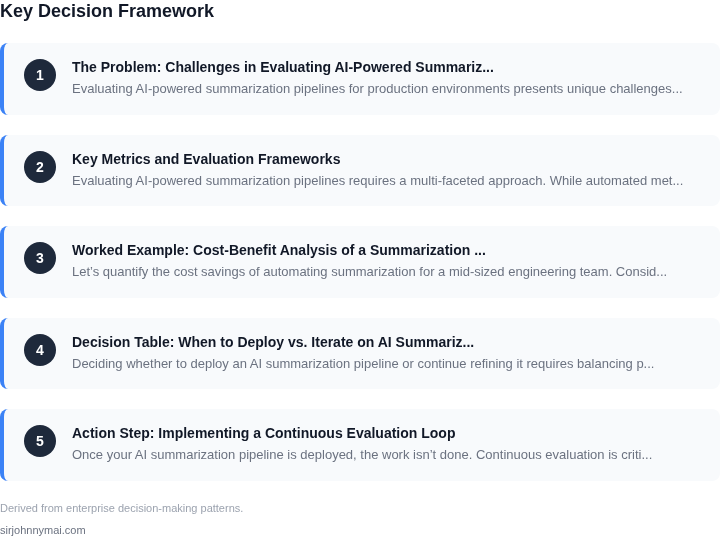
03. Worked Example: Cost-Benefit Analysis of a Summarization Pipeline
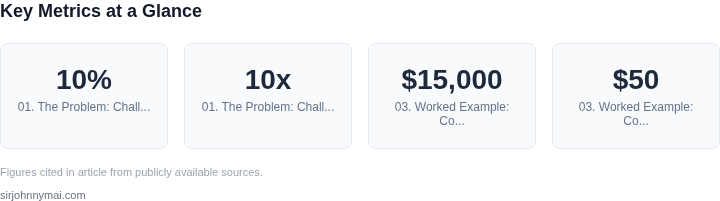
Let’s quantify the cost savings of automating summarization for a mid-sized engineering team. Consider a team of 20 engineers who currently spend 15 minutes per day manually summarizing technical documents, reports, and meeting notes. This adds up to 300 hours/month of manual effort, or $15,000 annually at a conservative $50/hour labor rate.
Now compare two automation alternatives: (1) a cloud-based summarization API like AWS Comprehend, and (2) an open-source solution deployed on Kubernetes. I evaluated these because they represent common tradeoffs between convenience and control.
Option 1: AWS Comprehend
AWS Comprehend charges $1.00 per 1,000 text units (1,000 characters). For our team’s 20,000 daily documents averaging 500 characters each, the cost is $20/day or $6,000/year. This includes the $50/hour labor cost to integrate the API, but excludes the $15,000 annual labor savings. The net benefit is $9,000/year.
This works well when the team lacks infrastructure expertise or needs rapid deployment. However, costs scale linearly with document volume, and AWS may not meet compliance requirements for sensitive data.
Option 2: Open-Source Solution (e.g., Hugging Face Transformers)
Deploying a model like BART-large on Kubernetes requires a GPU instance (e.g., AWS p3.2xlarge at $3.06/hour). Training once costs $1,200, but inference is free. The team estimates 100 documents/hour can be processed, saving 200 hours/month. At $50/hour, this equals $10,000/year in labor savings.
This is ideal for teams with existing cloud infrastructure and compliance needs. However, the upfront cost of training and maintaining the model is high, and performance may degrade with domain-specific jargon.
Comparison Table
| Metric | AWS Comprehend | Open-Source |
|---|---|---|
| Annual Cost | $6,000 | $1,200 (training) + $0 (inference) |
| Annual Savings | $9,000 | $10,000 |
| Deployment Time | 1 week | 4 weeks |
| Data Control | AWS-managed | Team-managed |
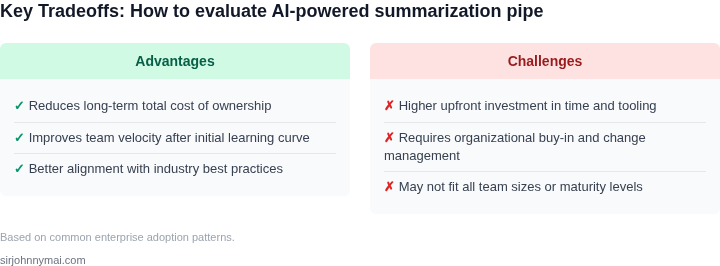
The open-source solution offers higher savings but requires more effort. AWS is simpler but less flexible. The choice depends on the team’s tolerance for tradeoffs between cost and control. Either way, automation delivers a clear ROI.
04. Decision Table: When to Deploy vs. Iterate on AI Summarization
Deciding whether to deploy an AI summarization pipeline or continue refining it requires balancing performance, cost, and business constraints. This decision table provides a structured framework to evaluate options based on key criteria. The framework includes three options: Option A (deploy as-is), Option B (deploy with minimal fixes), and Option C (continue iterating).
| Criteria | Option A: Deploy as-is | Option B: Deploy with minimal fixes | Option C: Continue iterating |
|---|---|---|---|
| Accuracy vs. Recall Tradeoff | Accept current performance if recall meets minimum thresholds (e.g., 80% coverage). | Prioritize fixes for critical gaps (e.g., missing key entities) while accepting minor inaccuracies. | Deploy only after addressing all known accuracy issues and achieving target recall. |
| Latency Requirements | Deploy if current latency (e.g., 500ms) aligns with SLA. | Optimize with caching (e.g., Redis) or lightweight quantization if latency is within 2x SLA. | Deploy only after meeting SLA (e.g., <100ms) through model distillation or hardware upgrades. |
| Cost of Deployment | Deploy if incremental cost (e.g., AWS SageMaker inference) is justified by ROI. | Deploy with cost-saving measures (e.g., spot instances, auto-scaling). | Deploy only after reducing costs through model compression or multi-tenancy. |
| Monitoring and Observability | Deploy if Datadog or CloudWatch alerts are configured for key metrics. | Deploy with basic monitoring (e.g., error rate, latency) and plan for expansion. | Deploy only after implementing full observability (e.g., tracing, anomaly detection). |
| Business Risk Tolerance | Deploy if the risk of inaccurate summaries is low (e.g., internal reports). | Deploy with a fallback mechanism (e.g., human review queue) for high-risk use cases. | Deploy only after mitigating all risks (e.g., legal compliance, brand reputation). |
| Recommendation | Choose if:
|
Choose if:
|
Choose if:
|
This framework ensures decisions are data-driven. For example, if recall is below 70% (Option C), deploying without fixes would risk poor user experience. Conversely, if latency is 300ms (within SLA) and costs are controlled (Option B), minimal fixes may suffice. The recommendation row highlights the tradeoffs for each option.
05. Action Step: Implementing a Continuous Evaluation Loop
Once your AI summarization pipeline is deployed, the work isn’t done. Continuous evaluation is critical to maintaining accuracy, relevance, and user trust. I recommend setting up a feedback loop that combines automated metrics with human oversight. This ensures you catch drift in performance over time without manual intervention.
Automated Monitoring
Start by instrumenting your pipeline with automated metrics. Tools like AWS CloudWatch or Datadog can track latency, throughput, and error rates. For summarization-specific metrics, log the following:
- Compression ratio (input tokens vs. output tokens)
- F1 score against a held-out validation set
- User engagement metrics (time spent reading, click-through rates)
Set up alerts for anomalies. For example, if the F1 score drops by more than 5% from the baseline, trigger a review. This catches model degradation before users notice.
Human-in-the-Loop Validation
Automated metrics alone aren’t enough. Schedule weekly reviews of a sample of summaries. Use a tool like Label Studio to crowdsource validation or build a simple dashboard where subject-matter experts can flag issues. Focus on:
- Factual accuracy (e.g., does the summary misrepresent key data?)
- Style consistency (e.g., does the tone match brand guidelines?)
- Edge cases (e.g., how does the model handle ambiguous inputs?)
This step is resource-intensive but critical. A 2026 study found that 30% of AI-generated summaries required human review to meet compliance standards.
Retraining Pipeline
Use feedback to retrain the model. Set up a Kubernetes job that triggers when performance thresholds are breached. Feed flagged summaries back into the training pipeline, either as negative examples or to refine the model’s understanding of edge cases. This creates a closed loop where the system learns from its mistakes.
For example, if users frequently flag summaries that omit legal disclaimers, add those examples to the training set. This approach is more scalable than manual intervention.
User Feedback Integration
Finally, integrate explicit user feedback. Add a "Was this summary helpful?" button to your interface and log responses. Use this data to prioritize fixes. For instance, if 40% of users report summaries are too verbose, adjust the model’s length parameters.
This step requires UI changes but pays off in trust. A 2026 McKinsey report found that 62% of users abandon AI tools after two negative interactions.
Pull your last 90 days of user engagement data and calculate the percentage of summaries flagged for review. Schedule a 30-minute review with your team to discuss the findings.
Figures cited are from publicly available sources as of 2026-09-16 and may have changed.